
Volumes 20 to 29
29 Harv. C.R.-C.L. L. Rev., No. 2 (Summer 1994) Symposium: Stonewall at 25 INTRODUCTION: STONEWALL AT 25 The Editors Articles […]

29 Harv. C.R.-C.L. L. Rev., No. 2 (Summer 1994) Symposium: Stonewall at 25 INTRODUCTION: STONEWALL AT 25 The Editors Articles […]
19 Harv. C.R.-C.L. L. Rev., No. 2 (Summer 1984) A Tribute to Clarence Clyde Ferguson, Jr. A TRIBUTE TO THE
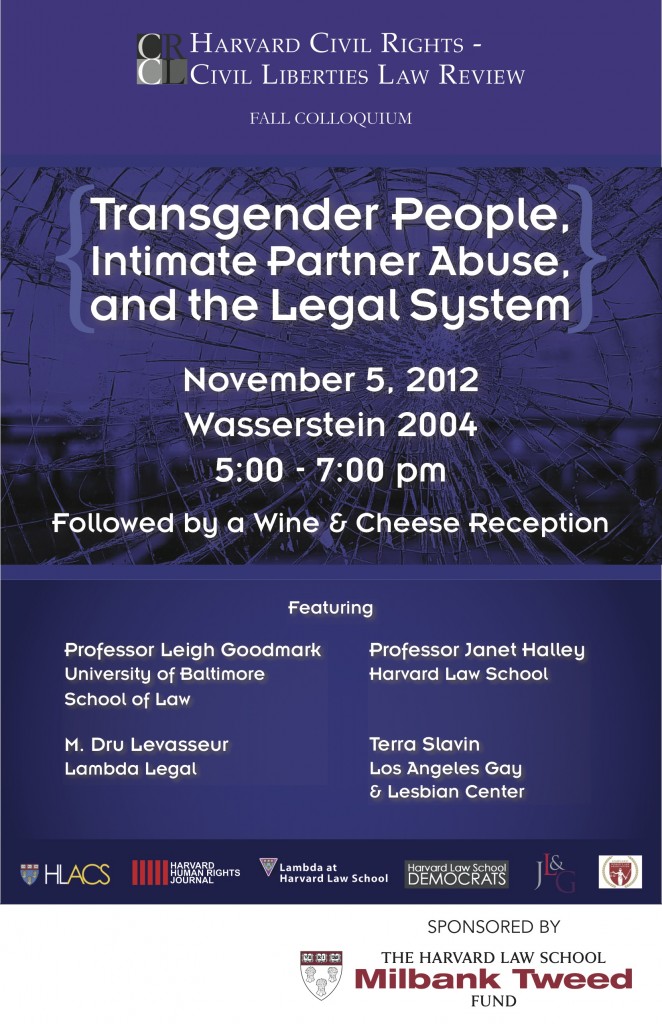
Introduction On November 5, 2012, CR-CL hosted its Fall Colloquium, “Transgender People, Intimate Partner Abuse, and the Legal System.” The

In the wake of Gonzaga Univ. v. Doe, in which the Supreme Court entrenched a tight-fisted test for whether Congress has guaranteed a statutory right to individuals, the lower courts have felt out the bounds of a new doctrine piecemeal. Recently, in Shakhnes v. Berlin, the Second Circuit held that at least in some cases where Congress confers a right with bounds set by flexible standards – as opposed to hard and fast rules – and a regulation subsequently “defines or fleshes out that right” by imposing a rigid rule, the statute provides the “source” of a right but the regulation ultimately defines the limits of what is enforceable under § 1983. The court ignored persuasive reasoning that would have provided a conceptually sounder basis for deciding the narrow issue at bar, but in so doing mitigated the unduly harsh consequences of the narrower conception of rights that would follow from such reasoning in the wake of Gonzaga.

Introduction In his article forthcoming in Volume 47:1 of the Harvard Civil Rights-Civil Liberties Law Review, “The Right to Comprehensive
Introduction San Francisco City Attorney Kathleen Morris calls for overturning a century of precedent in local government law. On Tuesday
Introduction On Monday, March 26, 2012, the Harvard Civil Rights-Civil Liberties Law Review, in conjunction with the Juvenile Law Center
Mark Tushnet Professor Tushnet, who graduated from Harvard College and Yale Law School and served as a law clerk to

Noah and Matt are joined in the studio this week by HarvardCRCL.org Technology and Privacy blogger Andrew Mamo. Matt fills us in on the recent Supreme Court decision in Florence v. Board of Freeholders and the potential impact of a blanket rule allowing strip searches for jail intake even for minor offenses. Andrew discusses the recent concern over Google’s unified privacy policy, the Consumer Online Privacy Bill of Rights, and efforts in Europe to establish a right to be forgotten.
On Thursday, April 5, 2012, from 5-7PM in Wasserstein 1015 at Harvard Law School, CR-CL will present a colloquium, “The State of Progressive Constitutional Theory: The Paradox of Constitutional Democracy and the Project of Political Justification.” The colloquium honors the forthcoming article by Nimer Sultany exploring the perils and paradoxes inherent in the search for a progressive theory of the United States Constitution. Speakers will include Dean Martha Minow and Professors Karl Klare, Frank Michelman, and Duncan Kennedy.
Article drafts and video of CR-CL’s recent colloquium. On Monday, March 26, 2012, the Harvard Civil Rights-Civil Liberties Law Review, in conjunction with the Juvenile Law Center and the Milbank Foundation, presented a colloquium: Roper, Graham, and J.D.B.: Redefining Juveniles’ Constitutional Rights. Guests at the event included Martin Guggenheim of NYU Law School, Marsha Levick and Robert Schwartz of the Juvenile Law Center, Michael Dale, of the Nova Southeastern Law Center, and the Hon. Jay Blitzman, chief judge of the Middlesex County Juvenile Court.