Labor and Employment

Amicus, Education & Youth, Labor and Employment

Teacher Professionalization Is Good For Students And Teachers

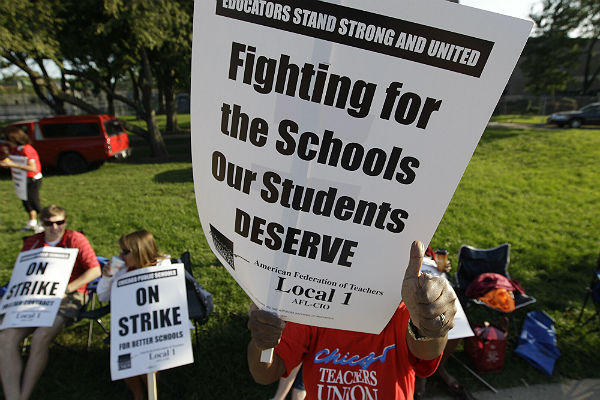
If teachers are paid well, which in Chicago they are, then they should expect to perform their work the same way other professionals, e.g., lawyer, doctors, engineers, financial professionals, perform theirs. Teachers should expect to be hired to perform to a certain expectation of success, to be compared to the success of their peers at achieving those expectations, and to be fired if they consistently fail to meet them. The ultimate result would be the achievement of the one thing that all sides in this fight seem to agree that they are working, the best possible education for Chicago’s public school students.

Amicus, Courts & Judicial Interpretation, Freedom of Expression, Labor and Employment, Reproductive Rights, Sex Equality

Obamacare Injunction Dodges Question of Corporate Religious Freedom

Hercules Industries, a Denver company that provides heating and air conditioning equipment recently won a preliminary injunction against the imposition of the preventive care requirement adopted pursuant to the Affordable Care Act. Predictably, conservatives lauded the decision as a victory for religious freedom, because, at least for the moment, this family-owned business that employs around 300 people has the religious freedom to tell their employees they’re on their own to pay for reproductive health services. Don’t expect it to last.

Amicus, Education & Youth, Labor and Employment

Does Publishing Teacher Rankings Implicate Privacy Concerns?

It is reasonably foreseeable that parents will try to use this information to pressure their children’s schools into firing certain teachers or to assign their children to particular classrooms – actions which will not serve the broader purpose of improving instruction….The level of detail with which the data has been released can only serve to publicly humiliate teachers and is only reasonably necessary for school administrators’ use, not the general public.

Amicus, Courts & Judicial Interpretation, Education & Youth, Freedom of Expression, Labor and Employment

Employment Discrimation and Who is a "Minister"?

In a unanimous decision, the Supreme Court held on Wednesday that a “ministerial exception” barred a parochial school teacher from pursuing an employment discrimination claim against the church that runs the school. This opinion dramatically limits the scope of protection provided to religious employees under the “primary duties” test, the standard previously used by several federal circuits. Although lower courts can continue to carve out areas in which exceptional circumstances may compel the conclusion that the ministerial exception need not apply, “ministers” now receive no protection under civil rights or other discrimination statutes.

Amicus, Labor and Employment

Fired for Working During a Break?

A former Target employee has brought a claim against Target in federal court based upon the Fair Labor Standards Act. The plaintiff’s complaint states that he had complained to Target’s Human Resources Department about having to work during what were supposed to be 30-minute unpaid meal breaks, that Target responded by saying they could not pay him for this work because they “couldn’t pay overtime,” and that Target ultimately terminated him in retaliation for raising these concerns. This complaint may add controversy to Target’s very public fight to prevent unionization that has developed over the past year.

Amicus, Education & Youth, Freedom of Expression, Labor and Employment

Employment Discrimination Law in Parochial Schools

“[T]his is tough and I’m stuck on this.” Justice Breyer expressed the prevailing theme of the oral arguments before the Supreme Court in Hosanna-Tabor v. EEOC. The oral arguments demonstrated that the justices are having a difficult time delineating the boundaries of the ministerial exception. Professor Laycock sketches out a broad ministerial exception that would prevent judges from interpreting religious doctrines where a church’s interpretation could reasonably vary […]

Amicus, Courts & Judicial Interpretation, Labor and Employment

Can You Complain About Work Over Facebook?

An Administrative Law Judge for the National Labor Relations Board (NLRB) recently decided the “first case involving Facebook to have resulted in an ALJ decision.” Judge Arthur Amchan stated that “the only substantive issue in this case . . . is whether by their postings on Facebook, the five employees engaged in activity protected by the [National Labor Relations] Act (NLRA).” Judge Amchan stated that “discussing” employment conditions is protected “regardless of whether there is evidence that such discussions are engaged in with the object of initiating or inducing group action.” Should NLRA protection turn on whether the Facebook post receives a “Like” or a few one-line lighthearted responses by friends who happen to be co-workers?

Scroll to Top