

Christina Hioureas*
This piece is intended to serve as a reflection, based on experience before international courts and tribunals, on how small nations can use international law to secure their interests. I posit that from the South China Sea to the Indian Ocean, principled legal strategy, anchored in the law, can rebalance global asymmetries of power.1
The article sets out three propositions. First, I argue that international law is a strategic power multiplier for small nations. Second, I illustrate that proposition through three case studies in which my colleagues and I have had the privilege to serve, namely, the Philippines’ arbitration concerning the South China Sea, Mauritius’ multi-forum approach to vindicate its sovereignty over the Chagos Archipelago, and the recent climate change advisory opinion proceedings involving some of the most vulnerable States. Finally, I outline a practical toolkit for small States, including avenues which may be relevant to situations of foreign invasion and occupation, airspace constraints, and economic coercion.
It is important to bear in mind one key premise that underlies these propositions: for small nations, process choices are power choices. Selecting the right forum, calibrating claims to the right instrument, and building an evidentiary record that decision-makers can trust often matter as much as the merits themselves. That is the thread that connects the Philippines in the South China Sea, Mauritius in the Chagos Archipelago, and vulnerable States in connection with climate change—and it is the thread that can guide other States as well. The aim of this piece is to show what can be achieved when States use international law as a deliberate instrument of policy—patiently, skillfully, and with resolve.
I. International Law is a Tool for Small Nations
There is a persistent myth in geopolitics that “might makes right.” International law exists to prove the opposite: that law, careful strategy, and sound process can prevail where raw power would otherwise overwhelm. For small nations, international law functions as an equalizer in three essential ways.
First, international law stabilizes expectations by clearly allocating rights and obligations—over territory, maritime zones, airspace, communications, and the environment—and by conferring standing to invoke those rights before neutral tribunals. Well-chosen fora and well-framed claims can unlock the leverage inherent in these entitlements.
Second, international dispute resolution converts facts into evidence and assertions into authoritative findings. When a court determines, for example, that a claim to “historic rights” has no place outside a treaty’s limits, or that a State’s construction activities violate environmental duties, the debate shifts from rhetoric to adjudicated reality. Those decisions carry consequences—under the law, reputationally in the international community, and for businesses contemplating whether to invest in that State. The failure of a State to comply with a judgment has consequences.
Third, international law forges coalitions. Advisory proceedings and multilateral processes, such as interventions before international courts, invite broader participation and help align the interests of States. The process of legal engagement—through pleadings and hearings—can build support and reshape the diplomatic terrain.
II. Case Studies that Illustrate International Law as a Tool for Small Nations
These dynamics are not theoretical. They are visible—vividly so—in the Philippines’ Annex VII arbitration under the United Nations Convention on the Law of the Sea (UNCLOS) in connection with the South China Sea, in Mauritius’ pathbreaking legal campaign to end the United Kingdom’s (UK) unlawful excision of the Chagos Archipelago, and even in the recent climate change advisory opinion proceedings before the International Tribunal for the Law of the Sea (ITLOS) and the International Court of Justice (ICJ). I will describe the advocacy choices that those States made: what they asked courts and tribunals to decide, what they deliberately left out, and how they sequenced proceedings to accumulate the desired legal effect.
A. The South China Sea Arbitration
The South China Sea is a body of water of almost unparalleled geopolitical importance. It has historically been a vital corridor for international trade, connecting the markets of China and India. Today, nearly one-third of global trade passes through the South China Sea.
It is a semi-enclosed body of water, bounded by China to the north; Malaysia, Brunei, Indonesia, to the south; the Philippines to the east, and Vietnam to the west. (See map below) These countries claim various parts of the South China Sea, often in overlapping areas, which have been the subject of negotiations. The United States has, in recent years, asserted its own regional dominance through freedom of navigation operations, reinforcing its position that these are international waters. All of this takes place over a backdrop of what is believed to be significant oil and gas reserves waiting to be exploited under the sea floor—not to mention the military importance of the region.
When the Philippines initiated this arbitration, it faced daunting realities. China’s expansive claims were framed by what many readers may know as the “nine-dash line.”2
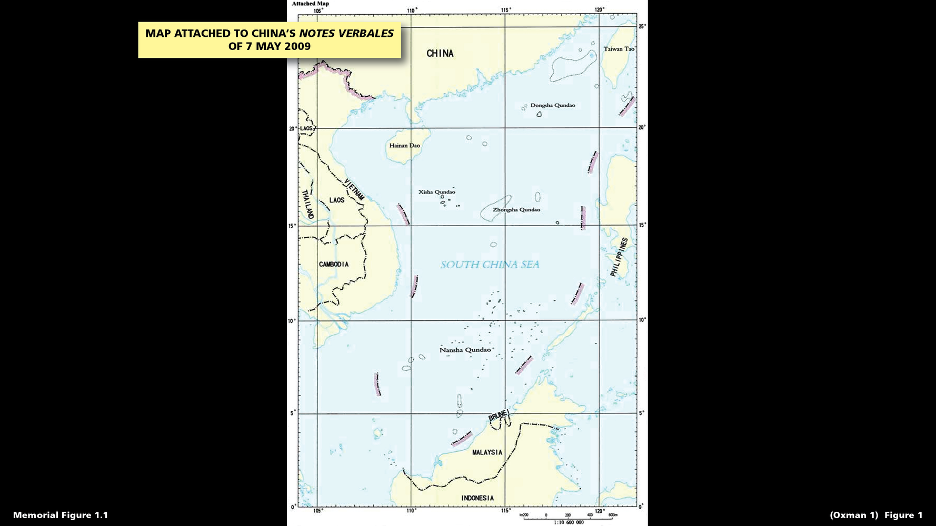
China also exerted persistent interference with Philippine fishing and resource activities, and engaged in large-scale artificial island-building that devastated the coral ecosystems and advanced its military footprint.
Diplomacy had stalled, and force was neither viable nor lawful. The question was whether international law could deliver results. In this dilemma, the Philippines turned to UNCLOS for two clear reasons:
First, Part XV of the Convention creates compulsory settlement procedures for any dispute concerning the interpretation and application of its provisions, with Annex VII arbitration as the default. Notably, under UNCLOS, the “absence of a party or failure of a party to defend its case shall not constitute a bar to the proceedings” (Annex VII, Article 9). A tribunal having jurisdiction under the Convention may thus proceed even if a respondent declines to appear. This was particularly important given that China had consistently rejected any attempt by the Philippines to refer the dispute to adjudication. Indeed, China chose not to formally participate in the proceedings.
Second, it must be noted that UNCLOS does not govern the question of sovereignty over maritime features. China had made a declaration under Article 298 of UNCLOS excluding disputes on delimitation, among other issues, from compulsory dispute settlement. The Philippines therefore needed to craft its submissions to fit within UNCLOS’ jurisdictional envelope: no claims to territorial sovereignty and no maritime delimitation.
Instead, the Philippines’ pleadings focused on three strands: the status of features (as islands, rocks, or low-tide elevations), the maritime entitlements those features could lawfully generate, and breaches of environmental obligations. That framing enabled the arbitral tribunal to proceed notwithstanding China’s non-participation.
By inviting the tribunal to interpret and apply the Convention’s text—on the status of maritime features, the limits of those features’ entitlements, and the duty to protect the marine environment—the Philippines navigated jurisdictional obstacles and transformed the dispute from geopolitical to legal.
The outcome of that case shows how international law can create political leverage. The arbitral tribunal held that China’s claims to “historic rights” or other sweeping assertions of jurisdiction within the so-called “nine-dashed line” could not stand. UNCLOS is comprehensive: once a State joins, its rights and obligations are found in the treaty’s text—not in indeterminate historic claims.
Applying the regime of islands, the tribunal concluded that none of the features at issue could generate an exclusive economic zone (EEZ) or continental shelf beyond a territorial sea. In doing so, it looked to the capacity of features in their natural state, not to enhancements engineered to inflate entitlements. Critically for the Philippines, this ruling confirmed where there was no lawful overlap with its own EEZ and continental shelf, even if China were to have been correct that it had sovereignty claims to those features.
Finally, the tribunal gave concrete content to environmental obligations. It read the Convention’s provisions as imposing duties of due diligence, environmental impact assessment, and prevention of harm, and it found the large-scale dredging and island construction to be in violation of UNCLOS.
These holdings supplied the Philippines with authoritative determinations about its rights, reinforced expectations for State conduct in the region, and catalyzed broader international support. They also demonstrated that non-participation by a powerful State does not absolve it from the law. For small nations, the lesson is clear: a legally sound case can clarify rights—even in the shadow of great power politics.
To capture this point. Counsel for the Philippines placed a simple map on the screen:3
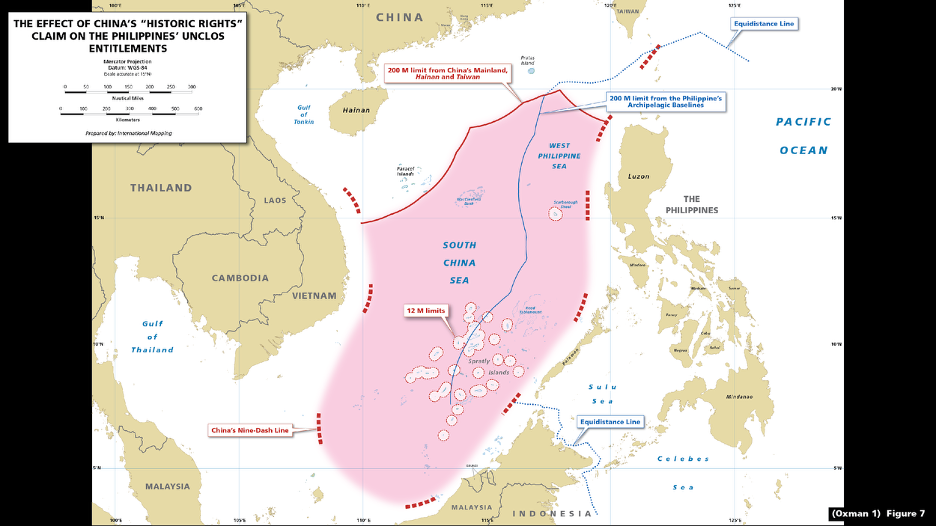
The map shows Philippines’ coastline, a 200-nautical-mile arc marking its EEZ, and, overlaid, the locations of the features claimed by China which the tribunal later classified as rocks or low-tide elevations, thus incapable of generating maritime entitlements beyond a territorial sea. The visual did what pages of argument could not: it showed there were extremely limited overlaps between the maritime zones, if any, generated by the features China claimed and the Philippines’ EEZ. Outside those overlapping maritime areas, China’s interferences with the Philippines’ rights in its EEZ were plainly unlawful. Evidence, put to work in the right forum, did the heavy lifting.
B. Mauritius’ campaign to end the United Kingdom’s unlawful excision of the Chagos Archipelago
Turning to the second case study: the UK and Mauritius’s longstanding sovereignty dispute over the Chagos Archipelago. In 1965, as Mauritius was moving toward independence from the UK, Britain detached the Chagos Archipelago from Mauritius to form the so-called “British Indian Ocean Territory” (BIOT). The UK then expelled the Chagossian population between 1967 and 1973 to make way for a joint UK-US military base on Diego Garcia, the largest island in the archipelago. Mauritius has consistently claimed that the excision was illegal and that the Chagos Archipelago is part of its territory. The UK maintained control, arguing that the detachment was lawful and necessary for defense purposes.
Mauritius’ long struggle to vindicate its sovereignty over the Chagos shows that a small nation, armed with the law and strategic patience, can marshal international law to profound effect. By sequencing proceedings across carefully chosen fora—each selected for its competence and leverage—Mauritius transformed a complex, politically charged dispute into a series of reinforcing legal determinations, culminating in the UK’s agreement to return Chagos to Mauritius just last year.
Mauritius first initiated an arbitration under UNCLOS in 2010, challenging a maritime protected area unilaterally proclaimed by the United Kingdom around the Chagos Archipelago. That tribunal found that the marine protected area was unlawful on multiple grounds, including lack of due regard to Mauritius’ rights and bad faith in the proclamation process. While the tribunal could not address sovereignty—an issue beyond the Convention’s scope—the award nonetheless exposed legal fault lines in the UK’s posture and set the stage for the next move.
Mauritius then led a resolution in the United Nations (UN) General Assembly in 2017 requesting an advisory opinion from the ICJ on the Chagos Archipelago. Mauritius did not frame the question as one of territorial title, but of decolonization. The questions put to the Court were whether the decolonization process was lawfully completed when the UK excised the Chagos from Mauritius in 1965 and, if so, what the legal consequences flowing from that were.
In its historic 2019 opinion, the Court concluded that decolonization had not been lawfully completed, that the UK was obligated to return the archipelago forthwith, and that third States were prohibited from aiding and abetting the UK in its unlawful conduct.4
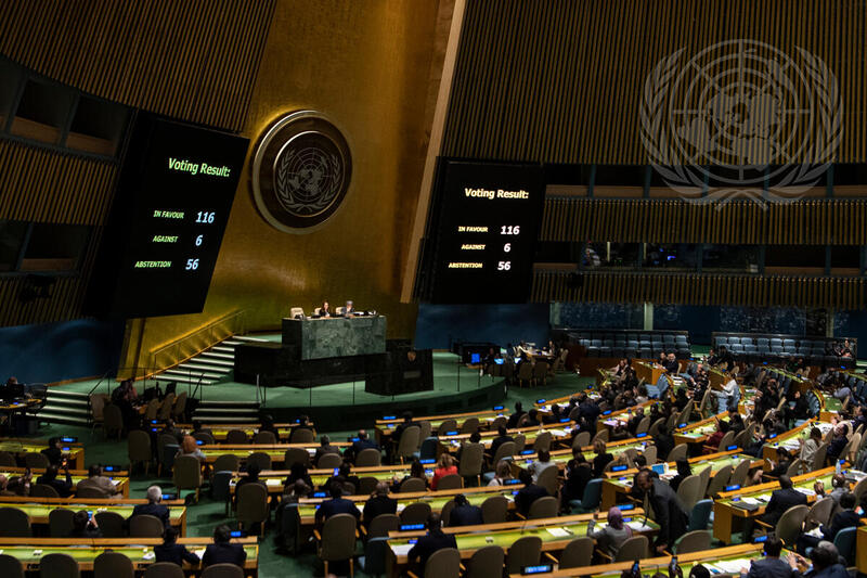
Taking the opinion, Mauritius spearheaded an initiative of the UN General Assembly to implement the opinion in the form of a resolution calling for compliance. In so doing, Mauritius converted legal principle into political momentum. The resolution amplified its voice and broadened support. While advisory opinions are not legally binding, they carry significant authority, even more so when implemented in the form of a resolution. They invite global participation; they clarify legal principles; and they catalyze follow-on action. For Mauritius, it was a powerful cumulative step.
Mauritius subsequently proceeded to ITLOS to delimit its maritime boundaries with the Maldives.5
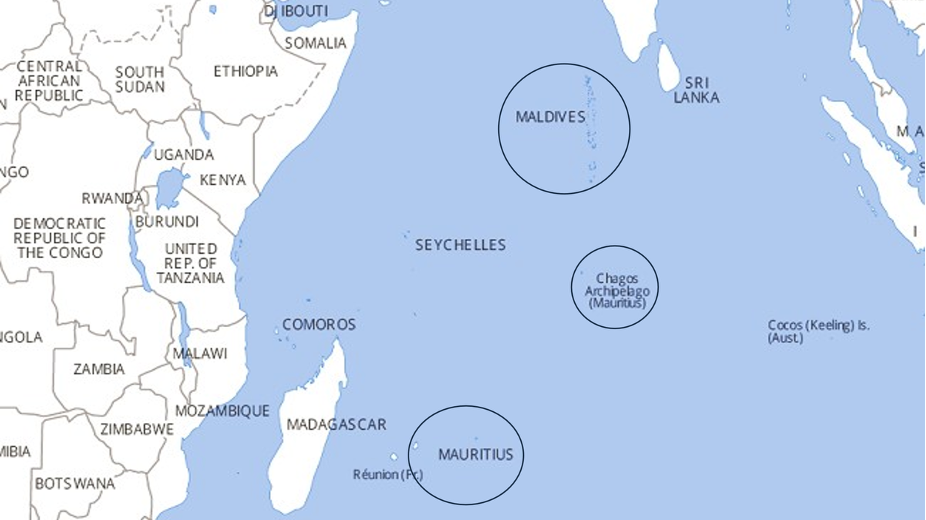
As the map illustrates, the distance between Mauritius and the Maldives means that there could be no overlapping maritime entitlements without the Chagos Archipelago. The strategy was to use this maritime delimitation proceeding to confirm before another tribunal that Mauritius had sovereignty over the archipelago. In other words, the aim was to persuade the Tribunal to recognize that Mauritius has sovereignty over Chagos to conduct maritime delimitation with the Maldives.
Of course, ITLOS does not have jurisdiction to determine if Mauritius has sovereignty over the Chagos. But the ICJ had opined on this very issue in its advisory opinion. The question was thus whether the advisory opinion, which is not legally binding, could be taken into account by another court in determining a bilateral dispute.
ITLOS concluded that it could. It held that, “judicial determinations made in advisory opinions carry no less weight and authority than those in judgments because they are made with the same rigour and scrutiny by the ‘principal judicial organ of the United Nations with competence in matters of international law.” ITLOS treated the ICJ’s conclusions as authoritative background and moved forward on the premise that the Chagos Archipelago is part of Mauritius.
The architecture of Mauritius’ strategy is instructive. It selected fora that matched the legal questions to be answered—law of the sea issues before an UNCLOS arbitral tribunal; decolonization and State responsibility before the ICJ; and maritime delimitation before ITLOS. Each step built upon the last, gradually consolidating a coherent legal narrative that other international bodies could not ignore.
Mauritius further implemented the opinion in the form of various “soft” enforcement actions. This included contacting Google and Apple Maps and having them remove the reference to BIOT, in light of the advisory opinion and General Assembly Resolution. It contacted the international postal union, as “BIOT” stamps were invalid. It informed the UN Treaty Services that any treaties that the UK had signed or ratified to extend to the so-called “BIOT” were no longer applicable to the Chagos. It built a coalition of like-minded States on various issues of political importance.
What Mauritius was able to achieve was a measured victory for international law. After more than half a century of dispute, in October 2024, the UK and Mauritius announced a political understanding: Mauritian sovereignty over the Chagos would be recognized and implemented, while Diego Garcia would remain available for US-UK defense needs under a long-term lease. On 22 May 2025, the UK signed a treaty to transfer sovereignty to Mauritius, while securing an initial 99-year lease of Diego Garcia for a total of approximately £3.4 billion to ensure the base’s long-term operation.6 This agreement was welcomed by the United States.
This sequence illustrates how Mauritius’s use of international law reset the negotiating baseline: the negotiations were no longer over whether sovereignty would return, but on what terms the islands would be returned.
C. The ITLOS and ICJ Climate Change Advisory Opinion Proceedings
The final case study considers how advisory opinions were employed by small-island and developing States to move the debate on climate change. Working through coalitions, these States asked international courts and tribunals to clarify States’ obligations on climate change under international law.
They began with ITLOS, requesting an advisory opinion on whether States have obligations under UNCLOS to protect and preserve the marine environment from climate change impacts. This was a deliberate first step for two reasons. First, anthropogenic greenhouse gas emissions have grave effects on the ocean—warming, acidification, deoxygenation, sea‑level rise, and biodiversity loss—placing the marine environment at the center of climate harm. Second, UNCLOS contains a relatively concrete set of rules on the duty to protect and preserve the marine environment. By situating the request within this mature treaty framework, small-island States narrowed the legal issues to questions that fell squarely within ITLOS’ expertise. This focus increased the likelihood of receiving a favorable finding: it engaged a specialist tribunal, applied well‑established due diligence and precautionary standards to a defined subject matter, and linked climate harms to obligations already accepted by virtually all UNCLOS parties.
Building on that sectoral base, vulnerable States—led diplomatically by Vanuatu— supported an advisory process at the ICJ to place climate change duties within the broader framework of international law.7
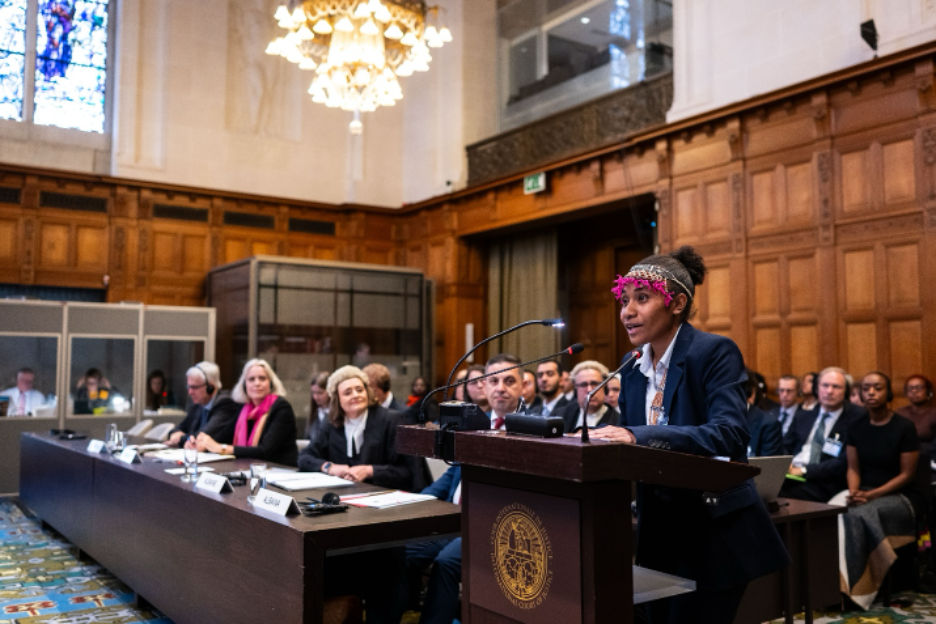
The order mattered. The ICJ advisory opinion built on the ITLOS advisory opinion: it addressed obligations under multiple bodies of international law (including international environmental law and international human rights law), and clarified how State responsibility and remedial obligations operate in the context of transboundary harm. The result were two historic opinions on the obligations of States to address the climate crisis and the legal consequences of a failure to do so.
This multi‑forum strategy was deliberate. The involved States strategized to allocate questions to the institutions best suited to address them. In so doing, they built mutually reinforcing authority. The result is a coherent body of authoritative guidance that vulnerable States can invoke to shape State conduct, steer public and private finance, inform domestic courts and regulators, and convert appeals for survival into the language of legal obligation rather than political discretion.
III. Small-Nation Toolkit: How to Use Law as Leverage
From these experiences and others, a practical toolkit emerges. The key is to view these tools not in isolation, but as parts of an integrated strategy. The right sequence, the right forum, the right claim, the right evidentiary record, and the right complimentary political and enforcement actions—are strategic choices. The cases discussed show that when a State is disciplined about those choices, even entrenched disputes can shift.
Small nations can prevail in international dispute resolution through method and discipline. Successful strategies share five distinctive features.
First, they are anchored in jurisdiction. A case that begins by identifying the correct forum and framing the dispute squarely within the right instrument is already halfway won. In the Philippines’ arbitration, the decision to confine the case to the interpretation and application of UNCLOS—and to keep sovereignty and delimitation off the table—was the difference between a jurisdictional dead end and a victory on the merits.
Second, they are evidence-led. Small nations succeed by converting lived realities into forensic proof—satellite imagery, environmental impact data, aviation notices, declassified cables, and statements by responsible officials. The best strategy is to present meticulous, corroborated evidence that leaves little room for ambiguity.
Third, they are coordinated across the government. Diplomats, technical agencies, and independent experts must be coordinated to ensure that legal submissions are supported by consistent State practice, coherent policy statements, and well-prepared witnesses. This supports credibility before adjudicators.
Fourth, they integrate litigation with diplomacy. Every filing has a diplomatic horizon; every hearing is a moment of public diplomacy. Coalitions matter: the Philippines’ award resonated because other States understood its implications for the law of the sea. Mauritius’ advisory opinion gained force because of its coalition with African States, non-alignment States and because the General Assembly carried it forward. Vulnerable States moved the discussion on climate change to action because they built a coalition and martialed the media and public support.
Fifth, they plan for implementation. Provisional measures, follow-on cases, and political and commercial implementation—that is how judgments and opinions make an impact. Implementation is not an afterthought; it is an integral part of the strategy from the outset.
Against that background, the role of international law has a particular resonance: it offers a way to turn structural disadvantages into advantages. When a small nation uses the law to obtain a favorable opinion or judgment, it does not protect its interests alone, it advances the international rule of law for all.
That is why it is no exaggeration to say that small nations are often the custodians of the international legal order. Because they must rely on it, they are the ones most likely to strengthen it. Because they cannot take it for granted, they are the ones most likely to innovate within it.
The rule of law is not a luxury. For small nations, it is the path to security, dignity, and prosperity. The case studies provided prove that when small nations choose that path with care, clarity and courage, the international community—and the law itself—move with them.
*Christina Hioureas is a partner and Global Co-Chair of Foley Hoag’s International Litigation & Arbitration Department, and Chair of the firm’s United Nations Practice Group. She is also a Visiting Professor of Law at both the University of California Los Angeles (UCLA) School of Law and the USC Gould School of Law, where she teaches courses on the interplay between international arbitration, inter-State proceedings, the UN, environmental law, and human rights. This piece is published in her personal capacity; the views expressed do not necessarily reflect those of any institution with which she is or has been affiliated.
- A version of this piece was originally delivered as a keynote address on “Small Nations and the Role of International Law” to the Cyprus Bar Association in Nicosia, Cyprus on 18 November 2025. It has been adapted for publication. ↩︎
- Image Presented during Oral Hearing before the Arbitral Tribunal. https://www.itlos.org/en/main/cases/default-title-1/. ↩︎
- Image Presented during Oral Hearing before the Arbitral Tribunal. https://www.itlos.org/en/main/cases/default-title-1/. ↩︎
- Image of the UN General Assembly Resolution vote discussed below. https://media.un.org/photo/en/asset/oun7/oun739095. ↩︎
- Image Presented during Oral Hearing before ITLOS. ↩︎
- https://assets.publishing.service.gov.uk/media/682f25afc054883884bff42a/CS_Mauritius_1.2025_Agreement_Chagos_Diego_Garcia.pdf ↩︎
- Image from the ICJ advisory opinion proceeding. https://www.icj-cij.org/multimedia-cases. ↩︎