


Student Features

Student Features

Kenya vs. The ICC Prosecutor

On August 30, 2011, the Appeals Chamber of the International Criminal Court (ICC), by a majority, rejected Kenya’s admissibility challenges under Article 19(2)(b) of the ICC Statute[1] in cases involving several Kenyans who allegedly perpetrated crimes against humanity during the December 2007 post-election violence.[2] The ICC’s denial of Kenya’s admissibility challenge is significant because this is the first time since the Rome Statute entered into force on July 1, 2002 that a State Party has challenged the Court’s assertion of jurisdiction over its nationals on the basis that the State Party itself is investigating the incidents at issue. Accordingly, Kenya has argued it should therefore be given time and space to do its own investigation before interference from the Hague-based court. This important judgment therefore merits some attention, which this case note aims to help provide.


[1] See Rome Statute of the International Criminal Court art. 19(2)(b), July 17, 1998, U.N. Doc. A/CONF.183/9 [hereinafter Rome Statute].

[2] Prosecutor v. Ruto, Kosgey & Sang, Case No. ICC-01/09-01/11 OA, Judgment on the Appeal of the Republic of Kenya Against the Decision of Pre-Trial Chamber II of 30 May 2011 Entitled “Decision on the Application by the Government of Kenya Challenging the Admissibility of the Case Pursuant to Article 19(2)(b) of the Statute” (Aug. 30, 2011), http://www.icc-cpi.int/iccdocs/doc/doc1223134.pdf [hereinafter Appeals Chamber Judgment]; see also Prosecutor v. Ruto, Kosgey & Sang, Case No. ICC-01/09-01/11 OA, Judgment on the Appeal of the Republic of Kenya Against the Decision of Pre-Trial Chamber II of 30 May 2011 Entitled “Decision on the Application by the Government of Kenya Challenging the Admissibility of the Case Pursuant to Article 19(2)(b) of the Statute,” Dissenting Opinion of Judge Anita Ušacka (Sept. 20, 2011), http://www.icc-cpi.int/iccdocs/doc/doc1234872.pdf [hereinafter Dissenting Opinion].

Student Features

Beyond a Seat in the United Nations

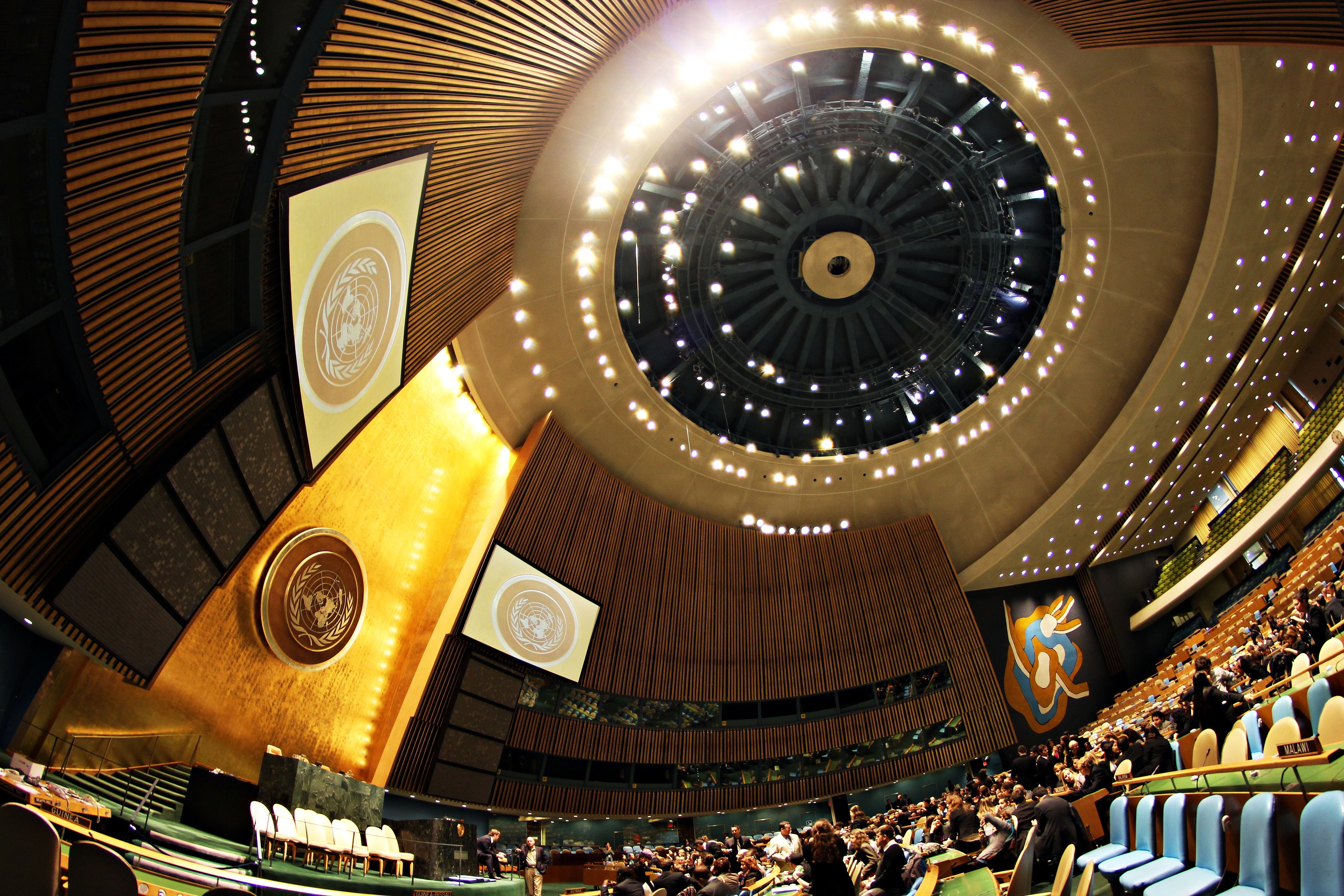
Looking from the speaker’s podium, Palestine’s seat in the United Nations (U.N.) General Assembly Hall is at the very left corner in the last row for delegations. The wooden desk and ocher-blue chairs are like any other of the interior from the 1950s, including the grey plastic headphones. Only one element is missing: the green, red, and yellow voting buttons, which are replaced with a silver metal plate. Other permanent observers, such as international and non-governmental organizations, are seated in the dark, close to the exit sign. Palestine sits alongside the Holy See and the Vatican, in the same line as Turkey in this sixty-sixth General Assembly session. Although Palestine has a place in the world organization, which was founded “to practice tolerance and live together in peace with one another as good neighbours,” it is still not a full member of the United Nations.[1]

On September 23, 2011, Palestine’s President Mahmoud Abbas went up to the podium in the morning session during the third day of the General Assembly’s General Debate.[2] He announced:

“I would like to inform you that, before delivering this statement, I, in my capacity as President of the State of Palestine and Chairman of the Executive Committee of the Palestine Liberation Organization, submitted to H.E. Mr. Ban Ki-moon, Secretary-General of the United Nations, an application for the admission of Palestine on the basis of the 4 June 1967 borders, with Al-Quds Al-Sharif as its capital, as a full member of the United Nations.[3]

Shortly after, Israel’s Prime Minister, Benjamin Netanyahu, stepped in front of the microphone to address the Assembly, and answered: “President Abbas just said on this podium that the Palestinians are armed only with their hopes and dreams . . . . The Palestinians should first make peace with Israel and then get their state.”[4]


[1] U.N. Charter pmbl.

[2] President Mahmoud Abbas’s remarks were given right after the President of Armenia, Serzh Sargsyan, and before the Prime Minister of Japan, Yoshihiko Noda, gave their opening remarks. South Sudan, the newest U.N. member, had just spoken. General Debate: 66th Session, General Assembly of the United Nations (Sept. 23, 2011), http://gadebate.un.org/homepage/2011-09-23.

[3] H.E. Mr. Mahmoud Abbas, President of the State of Palestine, Chairman of the Executive Committee of the Palestine Liberation Organization, President of the Palestinian National Authority, Statement Before the United Nations General Assembly Sixty-Sixth Session General Debate (Sept. 23, 2011), available at http://gadebate.un.org/66/palestine; see also Application of the State of Palestine for Admission to Membership of the United Nations, U.N. Doc. A/66/371–S/2011/592 (Sept. 23, 2011).

[4] H.E. Mr. Benjamin Netanyahu, Prime Minister of the State of Israel, Statement Before the United Nations General Assembly Sixty-Sixth Session General Debate (Sept. 23, 2011), available at http://gadebate.un.org/sites/default/files/gastatements/66/IL_en.pdf [hereinafter Statement by Netanyahu]. He continued:

“President Abbas just said on this podium that the Palestinians are armed only with their hopes and dreams. Yeah, hopes, dreams and 10,000 missiles and Grad rockets supplied by Iran, not to mention the river of lethal weapons now flowing into Gaza from the Sinai, from Libya, and from elsewhere. . . . The Palestinians should first make peace with Israel and then get their state. But I also want to tell you this. After such a peace agreement is signed, Israel will not be the last country to welcome a Palestinian state as a new member of the United Nations. We will be the first.”


Article Responses

Chief Justices Marshall and Roberts and the Non-Self-Execution of Treaties

David Sloss’s article, Executing Foster v. Neilson, is an important contribution to the literature on the judicial enforcement of treaties.[1] I agree with much of it, as I agree with much of Professor Sloss’ other writing on treaties.[2] In particular, I agree that the two-step approach to treaty enforcement that he proposes is generally the right approach, and I agree that the “intent-based” approach to the self-execution issue that he criticizes is highly problematic.[3] But Professor Sloss and I disagree about the source of this problematic approach. I have traced this approach to Chief Justice Marshall’s opinion in Foster v. Neilson.[4] Professor Sloss traces it to courts and scholars (including me) who, in his view, have misread Foster.[5] I shall address our differences on this point below. First, however, I shall explain my general agreement with the two-step approach to treaty enforcement that Professor Sloss defends.

The much-controverted question of treaty self-execution is widely understood to concern whether a treaty may be enforced directly by the courts or must instead await legislative implementation.[6] Professor Sloss proposes a two-step analysis for addressing this question. The first step is to determine what the treaty obligates the United States to do.[7] This is a question of treaty interpretation, to be answered through the application of the international law of treaty interpretation. The second step is to identify which domestic officials have the power and duty to enforce the obligation.[8] This, Professor Sloss argues, is entirely a matter of U.S. domestic law, not a matter of treaty interpretation.[9] Courts and commentators have fallen into error, and produced much confusion, by treating the second question as one of treaty interpretation, seeking an answer in the text of the treaty or in the parties’ intent.[10] Professor Sloss notes that treaties seldom address the question of which domestic officials—legislative, executive, or judicial—are responsible for enforcing the treaty.[11] Instead, treaty parties almost always leave that question to the domestic law of the states-parties.

Professor Sloss is entirely correct to note that seeking the answer to this question in the treaty itself is highly problematic. Although there is nothing in international law that prevents states from addressing that question in the treaty itself, the fact is that states almost never do so.[12] Domestic officials take their cues from domestic law, and states have very different constitutional rules concerning the need for legislative implementation of treaties.[13] In the United Kingdom and most nations of the British Commonwealth, treaties are never enforceable in the courts until they have been implemented by legislation.[14] The constitutional law of other countries permits the direct judicial enforcement of some treaties but not of others.[15] In the United States, for example, treaties that require the criminalization of conduct or the appropriation of money must be legislatively implemented because the Constitution has been interpreted to require a statute for those purposes.[16] Because of the diversity of domestic constitutional rules on the question, states rarely, if ever, address the issue of domestic implementation in the treaties they conclude. Seeking an answer to the self-executing question in the treaty itself is thus, in Justice Breyer’s words, like “hunting [for] the snark.”[17]No matter how hard they look, the courts will almost never find an answer there.

 Read full article (PDF)


[1] David L. Sloss, Executing Foster v. Neilson: The Two-Step Approach to Analyzing Self-Executing Treaties, 53 Harv. Int’l L.J. 135 (2012).

[2] See, e.g., David L. Sloss, Self-Executing Treaties and Domestic Judicial Remedies, 98 Am. Soc’y Int’l L. Proc. 364 (2004); David L. Sloss, Non-Self-Executing Treaties: Exposing a Constitutional Fallacy, 36 U.C. Davis L. Rev. 1 (2002); David L. Sloss, The Domestication of International Human Rights: Non-Self-Executing Declarations and Human Rights Treaties, 24 Yale J. Int’l L. 129 (1999).

[3] Sloss, supra note 1, at 163.

[4] Carlos Manuel Vázquez, Treaties as Law of the Land: The Supremacy Clause and the Judicial Enforcement of Treaties, 122 Harv. L. Rev. 599, 607 (2008) [hereinafter Vázquez, Treaties as Law]; Carlos Manuel Vázquez, The Four Doctrines of Self-Executing Treaties, 89 Am. J. Int’l L. 695, 700–05 (1995) [hereinafter Vázquez, Four Doctrines]; Carlos M. Vázquez, Foster v. Neilson and United States v. Percheman: Judicial Enforcement of Treaties, in John E. Noyes et al., International Law Stories 151, 167–68 (2007) [hereinafter Vázquez, International Law Stories]; Foster v. Neilson, 27 U.S. (2 Pet.) 253 (1829).

[5] Sloss, supra note 1, at n.26 (citing Vázquez, Treaties as Law); Curtis A. Bradley, Self-Execution and Treaty Duality, 2008 Sup. Ct. Rev. 131; Ernest A. Young, Treaties as “Part of Our Law,” 88 Tex. L. Rev. 91 (2009).

[6] See Sloss, supra note 1, at 137.

[7] Id. at 143.

[8] Id.

[9] Id. at 137–40, 143, 162, 188.

[10] See generally id.; see, e.g., Medellín v. Texas, 552 U.S. 491, 504–05 (2008).

[11] Sloss, supra note 1, at 163.

[12] Vázquez, Treaties as Law, supra note 4, at 607.

[13] Id.

[14] Id. at 679; Duncan B. Blakeslee et al., National Treaty Law and Practice 733–34 (2005).

[15] Id. at 17–18.

[16] Restatement (Third) of the Foreign Relations Law of the United States § 111(4)(c) cmt.i, n.6 (1987).

[17] Medellín, 552 U.S. at 549 (Breyer, J., dissenting).

Student Commentaries

Saving an Ancient Community

I.        Introduction

The Christian community in Iraq has survived conquests by Arabs, Huns, and Turks over the two millennia since the birth of Christianity. However, the latest danger to Iraq’s Christians, who include Assyrians, Chaldeans, and Catholics, poses the largest threat that this community has faced yet. In post-Saddam Iraq, a lethal combination of a Western “other” Christian identity, Islamic extremism, and a depressed economy has taken an enormous toll on Christians in Iraq. Their communities all over the country have been devastated by violence against men, women, children, and community symbols like priests, bishops, and churches. Because they only numbered about 1.5 million before the fall of Saddam Hussein, these attempts to terrorize and scare away Christians threaten the very existence of Christianity in Iraq.

In response to violence inside Iraq, many Christians have fled the country or become internally displaced, fleeing to traditionally Christian areas in Northern Iraq. Though their situations outside Iraq as registered or unregistered refugees may be difficult, those who are a part of the Christian Iraqi diaspora are hesitant to return to their homeland due to the systematic violence and discrimination they have faced and may face again. Can international action or internal, government programs do anything to save Christianity in Iraq?

To answer this question, I will address a number of issues. First, I will explore the underlying causes of the historical violence against Christians, taking a deeper look at the construction of the Christian identity as the Western “other.” Second, I will consider the current situation facing Iraqi Christian refugees and internally displaced peoples. Finally, I will propose remedies that seek to encourage Christian Iraqis to either remain in or return to Iraq. These remedies include 1) deconstructing Christians’ “other” identity through constitutional changes and civil society initiatives, 2) creating a semi-autonomous “safe haven” for Christians inside Iraq, and 3) encouraging international economic assistance to revive devastated Christian communities. Though my suggestions are to promote a continuing Christian presence in Iraq, they are by no means a definitive solution. There is still time to save Christianity in Iraq, but it remains uncertain whether the community will ever fully recover from the devastation of the last ten years.

Read full article (PDF)

Article Responses

One Step Forward, Two Steps Back?

I.        Introduction

Kevin Heller’s essay A Sentenced-Based Theory of Complementarity marks a significant contribution to the growing scholarship on the International Criminal Court (ICC) and complementarity.[1] His proposed re-thinking of the complementarity regime is original and helpful in highlighting existing policy dilemmas of ICC practice. A “sentence-based” heuristic is appealing in its clarity and its objective to facilitate effective repression. Nevertheless, like Darryl Robinson,[2] I share some hesitation regarding the central claim of this theory. In my view, the argument that the ICC should focus “exclusively on sentencing” when determining whether “ordinary” crime prosecution is admissible is neither desirable nor manageable in all cases. I will focus on three aspects: The assumptions underlying the central claim, the desirability of a new methodology, and its manageability.

II.     Underlying Assumptions

Heller’s case for a deviation from existing approaches relies on four basic premises: (i) the claim that the ICC admissibility test[3] creates undue pressure to charge international crimes under an international label, (ii) the alleged disadvantages of domestic prosecution of international crimes, (iii) the advantages of a “sentencing” heuristic over threat-based compliance, and (iv) the assumption that “higher” sentences might create “better” justice.[4] All four key assumptions merit further critical reflection.


[1] See Kevin Jon Heller, A Sentence-Based Theory of Complementarity, 53 Harv. Int’l L.J. 85 (2012).

[2] See generally Darryl Robinson, Three Theories of Complementarity: Is it About the Charge, the Sentence, or the Process?, 53 Harv. Int’l L. J. Online 165 (2012).

[3] For a survey, see Jann K. Kleffner, Complementarity in the Rome Statute and National Criminal Jurisdictions (2008); 1 The International Criminal Court and Complementarity: From Theory to Practice (Carsten Stahn & Mohamed M. El Zeidy eds., 2011); Mohamed M. El Zeidy, The Principle of Complementarity in International Criminal Law (2008); Darryl Robinson, The Mysterious Mysteriousness of Complementarity, 21 Crim. L.F. 67 (2010).

[4] See Heller, supra note 1, at 87–88.

Article Responses

Three Theories of Complementarity

The principle of complementarity, which governs the International Criminal Court (ICC), will inevitably require some difficult determinations about whether a national proceeding warrants deference. One may discern in the literature three major theories about what the ICC should scrutinize when it assesses a national proceeding: the nature of the charges laid, the severity of the sentence imposed, or the quality of the process adopted. These three approaches are not necessarily mutually exclusive; they can be combined in different ways and with different emphases to create plausible schemas.

Kevin Jon Heller’s article, A Sentence-Based Theory of Complementarity, makes a valuable contribution to the discussion.[1] He advances an important and convincing critique of approaches that would focus on the domestic or international nature of the charges or on the relative gravity of the charges.[2] He proposes to replace such approaches with one focused on the sentence.[3] While Professor Heller may be successful in showing that a sentence-based approach is superior to a charge-based approach, I will argue that a sentence-based approach also raises some serious difficulties that have not been addressed. I will therefore suggest a third option, a process-based approach. I believe that a process-based approach is not only the best fit with the Rome Statute (the positive law); it is also the most elegant theory.[4] Under a process-based approach, the Court can refer to charges and sentences as indicia, insofar as they shed light on the genuineness of the process.

While I have reservations about the more radical proposal to adopt a new approach to complementarity that focuses exclusively or even primarily on sentence severity, I believe that A Sentence-Based Theory of Complementarity offers two important insights. The first demonstrates the very limited role that should be accorded to “charges.”[5] The second demonstrates the potentially important role that can, in some circumstances, be accorded to “sentences.”[6] I would absorb these insights into a process-based theory.

Heller also raises concerns about the “same conduct” test adopted by the ICC.[7] Similar concerns have been raised in other recent thoughtful scholarship,[8] so it is valuable to inspect the concerns here. While I agree that some flexibility is needed, I hope to show that the problem is actually much narrower than is often perceived in the literature. The Rome Statute already provides solutions to the scenario where a state wishes to prosecute a person for a different crime. These solutions include a consultation mechanism to prioritize cases as well as the “interests of justice” test. In my view, stretching the admissibility regime to cover such scenarios is not only unnecessary but would generate incoherencies. Thus, while I partly agree with the concerns raised by Heller and others, I will argue for a much narrower solution.

All references to “admissibility” in this comment concern the complementarity aspects of the Rome Statute—Article 17(1)(a)–(c))—and not the distinct issue of “gravity” (Article 17(1)(d)).

Read full article (PDF)


[1] Kevin Jon Heller, A Sentence-Based Theory of Complementarity, 53 Harv. Int’l L.J. 85 (2012).

[2] Id. at 88–107.

[3] Id. at 107–30.

[4] Rome Statute of the International Criminal Court, Jul. 17, 1998, UN Doc. A/CONF.183/9, 2187 U.N.T.S. 90 [hereinafter Rome Statute].

[5] See generally Heller, supra note 1.

[6] Id.

[7] Id. at 107–30.

[8] See infra note 53.

Scroll to Top