The Harvard Journal of Law and Public Policy has hosted several symposia and has proudly published remarks from the Federalist Society’s National Student Symposium for years. Below are selections of our most recent Symposia:

Selections from Recent Symposia
Dobbs and the Originalists by Stephen E. Sachs
Though often hailed as an originalist triumph, Dobbs v. Jackson Women’s Health Organization has also been condemned as an originalist betrayal. To some, it abandoned originalism’s principles in favor of a Glucksberg-esque history-and-tradition test, or even a “living traditionalism”; to others, its use of originalism was itself the betrayal, yoking modern law to an oppressive past. This essay argues that Dobbs is indeed an originalist opinion: if not distinctively originalist, then originalism-compliant …
Tradition, Originalism, and General Fundamental Law by Jud Campbell
Judges and scholars have puzzled over the place of tradition within an originalist approach to constitutional interpretation. Traditionalism is increasingly prominent in the Supreme Court’s rights jurisprudence, particularly as some originalist Justices express concerns over the longstanding tiers-of-scrutiny framework. But the relevance of tradition to originalism is far from obvious. …
Common Good Constitutionalism and Common Good Originalism: A Convergence? by Josh Hammer
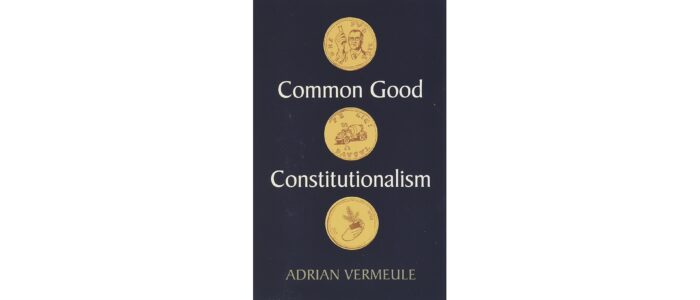
I initially conceived of common good originalism as a direct response to common good constitutionalism, and it remained that way until I began to further develop it as a viable and independent framework for constitutional interpretation. Vermeule responded to that initial 2020 essay of mine, praising it at the time as a “a laudable development, a movement half-way to the right approach.” Over three years later, I still do not object to the characterization of common good originalism as a “half-way” measure of sorts between the long-regnant originalism status quo … and common good constitutionalism.
Justice Alito: A Justice of Foxes and Hedgehogs by Hon. Amul Thapar
So, where does Justice Alito fall? Many would no doubt say that he’s a fox, and there is some truth to that. In many contexts, Justice Alito openly acknowledges the limits of rules and the practical value of standards. Those insights reflect his reminder that “judging is not an academic pursuit” but rather a “practical activity” with often life-altering consequences for the parties before us. But I think that’s only part of the story. When it comes to the separation of powers, I submit, Justice Alito typically resembles a hedgehog.
Reason and Fiat in the Jurisprudence of Justice Alito by Adrian Vermeule
My thesis will be that the best organizing antinomy around which to structure a discussion of Justice Alito’s jurisprudence is one advanced by the legal theorist Lon Fuller in a famous essay—or an essay that ought to be more famous than it is—titled “Reason and Fiat in Case Law.” I will suggest that a number of Justice Alito’s most striking opinions can be profitably understood as grappling with the problem of reconciling reason and fiat in our law …
Administrative Law in the States: An Introduction to the Symposium by Hon. Jeffrey S. Sutton
Five States—Colorado, Georgia, Kansas, Pennsylvania, Wisconsin—and five distinct approaches to administrative law … Perhaps there should be a round-robin tournament to pick the best one. Or perhaps Adam White, the symposium’s able organizer in chief, might judge the justices, declaring a winner after reading each justice’s submission and hearing them present their cases. Or perhaps I—federal judges have trouble resisting the temptation to pick winners—should decide who wins. But maybe winning is not the right way to think about it.
Per Curiam Symposia
Major Questions, Non-Delegation, and Chevron Deference
[T]he MQD also gets Congress wrong in its current form, insofar as it applies uniformly across-the-board. Congress is highly sophisticated when it delegates power, and the conditions under which it delegates power vary considerably . . . – Joseph Postell
In partnership with the Pacific Legal Foundation, this Symposium features Jonathan Adler, Louis Capozzi, Alison Somin, and more.
Constitutional Administration & Collective Bargaining
As Howard points out, 35% of public employees in America belong to unions – 25% in federal government, 30% in state government, and 40% in local government . . . – Peter H. Schuck
A symposium on Philip Howard’s book Not Accountable featuring works from Adam J. White, Donald Elliott, Julia D. Mahoney, and more.
Regulatory Budgeting
[T]o really force government to consider the cost to taxpayers for each new rule, a regulatory budget would have to be implemented. – Sen. Lankford
Featuring works from Sen. James Lankford, James Broughel, Laura Jones, and more.
Celebrating Justice Clarence Thomas
If any new justice could be forgiven for starting slowly, it was the Boss. Yet he took the Court by storm. – Hon. Gregory Katsas
Featuring works from Hon. Gregory G. Katsas, Hon. David R. Stras, Hon. James C. Ho, Hon. Neomi Rao, and more.
Recent National Student Symposia
Why Separate Powers, 2024 National Student Symposium
The Harvard Law School Federalist Society Chapter hosted the 43rd annual National Student Symposium on March 8–9, 2024. Symposium panels focused on fundamental questions about our nation’s constitutional structure and the allocation of power between the three branches of government, in keeping with the conference’s theme: Why Separate Powers? This Symposium was featured in Issue 1 of Volume 48.
Law and Democracy, 2023 National Student Symposium
The University of Texas School of Law Federalist Society Chapter hosted the 42nd National Student Symposium on March 3–4, 2023. The Symposium was organized around the theme “Law and Democracy” and tackled important issues surrounding originalism, federalism, and the democratic process. The Symposium hosted five panels on significant constitutional issues that generated serious discussion among students, scholars, and practitioners. This Symposium was featured in Issue 1 of Volume 47.
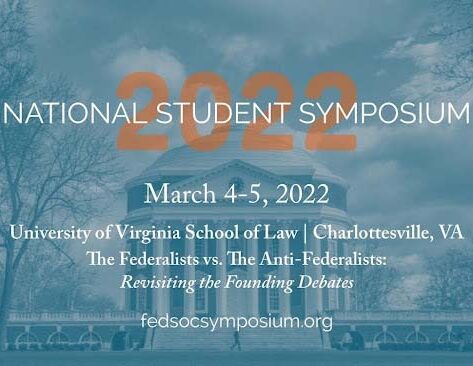
The Federalists vs. The Anti-Federalists: Revisiting the Founding Debates, 2022 National Student Symposium
The University of Virginia School of Law Federalist Society Chapter hosted the 41st annual National Student Symposium on March 4–5, 2022. The Symposium focused on the debates surrounding the ratification of the Constitution to help shed light on the document’s original meaning. Many who study the Founding focus only on The Federalist Papers. But the Anti-Federalists were the other half of the story. This symposium provided an opportunity to revisit the founding debates and discuss the arguments for and against our Constitution. This Symposium was featured in Issue 1 of Volume 46.
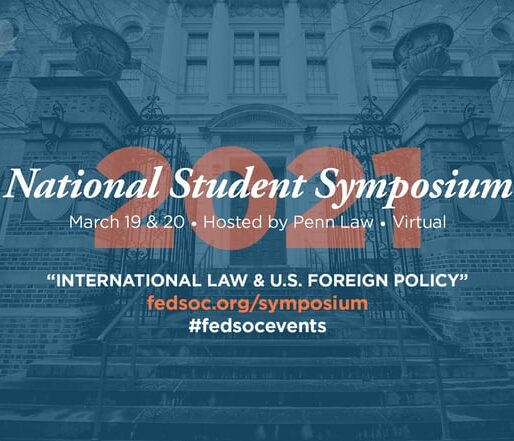
International Law & U.S. Foreign Policy, 2021 National Student Symposium
Penn Law’s Federalist Society Chapter hosted the 40th Annual National Student Symposium on March 19–20, 2021. The topic of the Symposium was “International Law & U.S. Foreign Policy.” The Symposium focused on issues such as constitutional interpretation, international governance, trade, and human rights. For the past 20 years the U.S. has found itself engaging in a variety of conflicts across the globe, confronting the rise of geopolitical rivals in both military and economic influence, and most recently combating the global impact of COVID-19. The newfound focus on U.S. foreign policy has introduced an array of complex and contentious legal and political issues. This Symposium was featured in Issue 1 of Volume 45.