
Author name: bakcan

Essays, Online Scholarship

Data Waste

By: Elettra Bietti & Roxana Vatanparast

This Post is the fifth in a new Frontiers series that critically explores the connection between international law and emerging technology, featuring the writing of scholars from a variety of disciplines affiliated with the Institute for Global Law and Policy (IGLP) at Harvard Law School.

[Click here for PDF]

There is no small irony in the fact that a company sharing a name with the largest tropical rainforest in the world is significantly contributing to environmental destruction. While Amazon has announced intentions to be carbon neutral by 2040, its platform operations contribute to significant carbon emissions.[1] Amazon also contributes to environmental harms in indirect ways through its provision of cloud-computing services to the oil and gas industry,[2] and its donations to political candidates denying climate change.[3]

Amazon’s practices are just one example of the environmental impacts of data-driven technologies. They also reflect a broader phenomenon related to data-intensive commercial practices today. Empirical findings have shown that digital technologies contribute to 4% of overall greenhouse gas emissions, a number expected to double by 2025.[4] Other estimates indicate that training a single artificial intelligence (“AI”) model emits carbon dioxide in amounts comparable to that of five cars over their lifetimes,[5] and that bitcoin mining consumes more electricity than the country of Switzerland.[6]

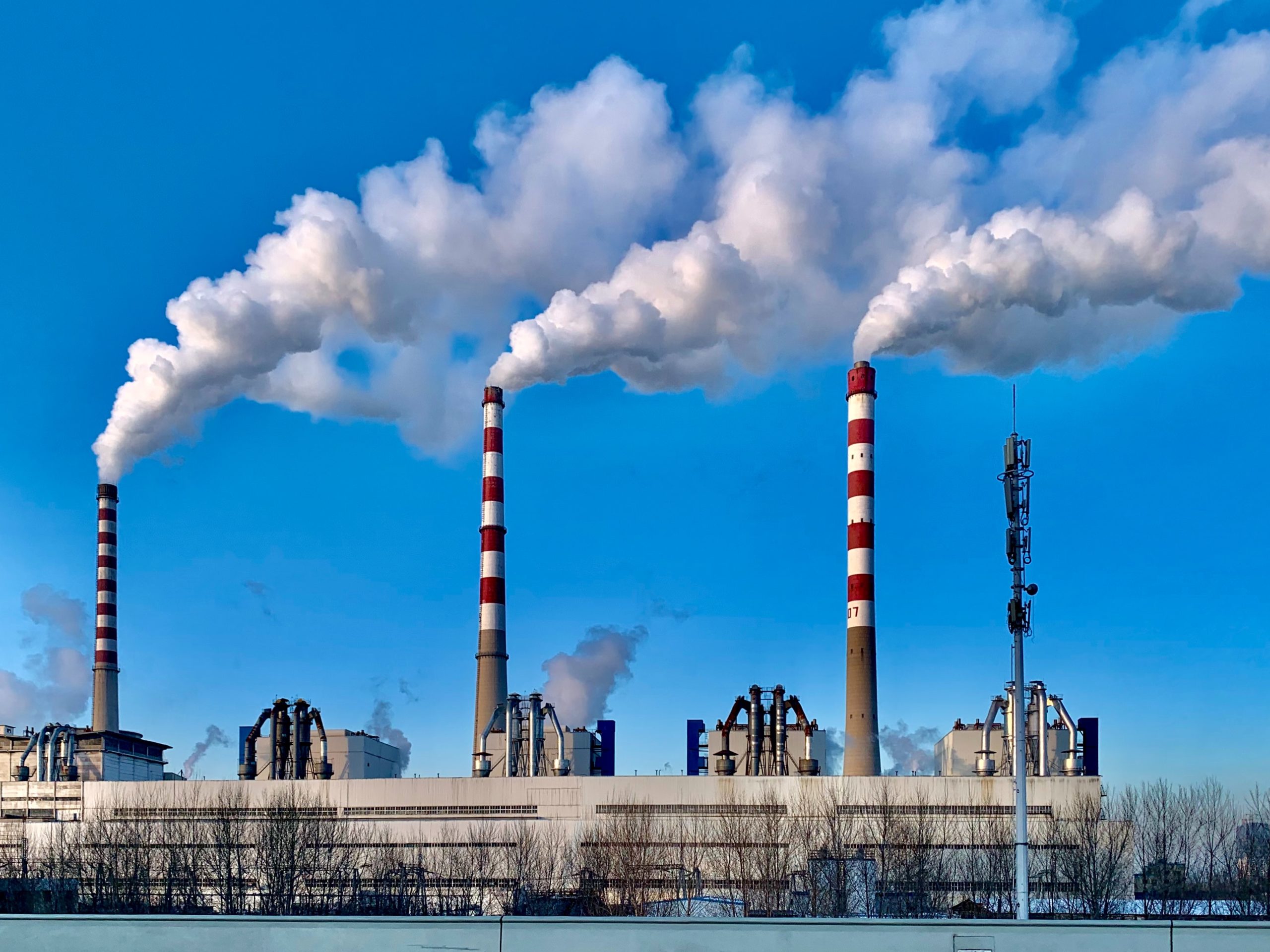
While much legal scholarship relating to data collection and processing has focused on individual privacy and autonomy, far less attention has been paid to the environmental impacts of data. In this contribution, we highlight a phenomenon we call “data waste,”[7] or the carbon emissions, natural resource extraction, production of waste, and other harmful environmental impacts directly or indirectly attributable to data-driven infrastructures. These include platform-based business models, the programming and use of AI systems, and blockchain-based technologies.

We first describe data-driven infrastructures as reflecting an ideology of permissionless innovation and as producing network effects that tend toward monopolization. We then explain how these factors have shaped data-driven infrastructures’ impact on the climate. Next, we discuss how law and legal institutions have facilitated these developments and call for a more systemic understanding of the factors contributing to data waste. We end with a call to frame the issue of data waste as a sociotechnical controversy that raises broader questions about the power dynamics that underlie data-driven infrastructures and the need to imagine alternatives.

Data-Driven Infrastructures

Data-driven infrastructures are here defined widely as technologies that are fueled by data and that generate data. Data in other words is both an input and an output of these technologies, in that it is both produced by such infrastructures, and what allows them to function. Examples of data-driven infrastructures include content sharing platforms such as Facebook, YouTube, Twitter, Google, and Amazon; AI systems that both rely on data for their training and functioning and also produce new data, relying on the idea that “bigger is better”;[8] and blockchain-based systems which rely on and produce information in the form of ledgers. Data-driven infrastructures also depend on material infrastructures for storing, transporting, and processing data, such as data centers and data servers, which depend on intensive energy[9] and water[10] usage. Data-driven infrastructures therefore exist at multiple infrastructural layers.[11]

Data-driven infrastructures possess two specific characteristics which set them apart from most other infrastructures. The first is that they are based on logics of “permissionless innovation” and “generativity.”[12] Permissionless innovation is the principle according to which a given infrastructure allows others to innovate on top of it without asking those who develop or control the infrastructure for permission to do so. Generativity is the capacity to build upon an existing system in ways unforeseen by the original designers.[13] The second characteristic of data-driven infrastructures is that they facilitate the monopolization of digital markets. These infrastructures enable and incentivize business models based on connecting increasing numbers of people, capturing their attention, and using their data for profit. Data-driven infrastructures give rise to network effects; their functionality improves with the greater number of people using them and the greater amount of data collected through them, driving ever-increasing data collection. The success of these business models thus depends on market power concentration, achieved by ousting competitors for valuable user data and attention, and making other businesses dependent on their essential infrastructure.[14] In what follows, we explore these two aspects in turn, showing how they have contributed to data waste.

“Permissionless” Data Waste

The way the Internet was initially developed, including its layered end-to-end networked structure, enabled innovation to take place at the user-interface level without interference from those who control the physical backbones of the internet, including cables and transmission channels.[15] This led to a vision of the Internet in its early stages as an open ecosystem for permissionless innovation—a site where new entrants were able to develop projects and initiatives that were thought to significantly challenge the status quo, through peer-to-peer networks and collaborative platforms. A similar principle applies to blockchain technologies which rely on an open distributed ledger managed by a peer-to-peer network of distributed nodes. Behind the appearance of a frictionless infrastructure, however, these and other permissionless technologies hide a darker side. They have enabled a culture of unreflective innovation which, if left unchecked, is too often blind to long-term systemic effects. A culture of “moving fast and breaking things,” as expressed in the famous Facebook slogan,[16] can lead to negative externalities—including the harms on society and the environment imposed by data waste—while responsibility for those harms remains diffuse.

Network Effects and Market Power

A second aspect of data-driven infrastructures is their network effects. Network effects are the positive effects that adding a new user of a good or service can have on the value of the good or service itself.[17] For instance, the more individuals use Facebook, the more attractive it becomes to join and spend time on the site. Similarly, the more searches are performed on Google Search, the more accurate their search algorithms become. Network effects go hand-in-hand with so called multi-sided markets. These are markets where two complementary services become easier to offer through the intermediation function of a platform. For example, Amazon makes it less costly for buyers to find sellers, and also cheaper for sellers to find buyers. Similarly, on Google Search, advertisers and websites are a source of content for users, and users the source of attention that websites and advertisers seek. Google stands to gain from the transactions between websites/advertisers and users because it obtains both users’ data and advertisers’ money.

Network effects in multi-sided data-driven markets can lead to monopolization, as corporations increasingly compete for the data and scarce attention of individuals from which they can generate revenues and profits. Such monopolization leads to an attention-based economy.[18] In the attention economy, platforms try to outcompete each other by offering users appealing content, capturing their attention, collecting their data, and locking them into the habit of using their platform instead of another. The more data that a company can collect, the more successful they will be at locking-in users and driving out competitors.[19]

The combination of permissionless innovation and network effects that concentrate market power is driving ever-increasing data processing and storage, content (and particularly video) streaming in real-time, and complex data analytics systems—all of which require intensive energy usage.[20] To compete and generate revenues, tech giants such as Google and Facebook fuel an aggressive culture of constant virtual connection for all—a culture largely powered through video content, as made salient by the success of platforms such as YouTube, Instagram, and Twitch—one that may also be advancing in the Global South through cheap mobile devices and phone contracts.[21] The constant connection inherent to these business models comes with a substantial increase in data collection and waste.

Big tech companies’ market power also has other environmentally detrimental effects. Consider Amazon. Amazon Web Services is the largest provider of web storage and cloud services worldwide, far ahead of its largest competitors: Google, Microsoft, and IBM. Not only does the internet largely run on Amazon servers, but Amazon also provides cloud-computing services to the oil and gas industry, helping them extract fossil fuels more efficiently.[22] Amazon also donates to political candidates that deny climate change, thereby shaping public discourse on the issue.[23] Amazon’s example shows how network effects and concentrated market power are tied to environmental harms, as well as the power to shape public debates on climate change through political donations. Thus, data-driven infrastructures, market power, and the political discourse around environmental issues cannot be disentangled from data waste.

The Role of Law

The early history of permissionless innovation is linked to the ideology of “lawlessness,” or the idea that innovation flourishes in the absence of regulatory constraints and that there exists an independent lawless space called cyberspace.[24] Indeed, in the United States, for instance, the dominant discourse in the tech industry is that self-regulation and self-governance promote innovation. This might be attributable to the assumption that law perpetually lags behind innovation, and therefore law should take a reactive role and defer to the authority of technologists in order not to hinder innovation.[25]

This idea, of course, reflects a limited view on the interaction between law, technology, and society. Cyberspace and data-driven infrastructures are and have always been far from lawless. Lawyers use private law mechanisms to code assets into capital.[26] Tech companies, as owners of data-driven infrastructures, use these mechanisms to create and protect the wealth they obtain through data markets.[27] At the same time, legal rights, privileges, and immunities have assured the reproducibility of economic and political power through information technologies.[28] Changes in U.S. antitrust doctrine, and the challenges brought by technology corporations that no longer fit within the “consumer welfare” antitrust model based on short-term price effects, have also contributed to the concentration of market power of companies like Amazon.[29] Moreover, in the United States, campaign finance laws protect corporate financing of political candidates based on freedom of speech principles,[30] giving tech companies opportunities to shape public discourse and policy. At a more fundamental level, law affects the relative bargaining power between technology corporations and users,[31] which facilitates tech corporations’ endless accumulation of data from users and determines how gains from the data economy are distributed. Finally, international environmental law’s role in managing global waste and the externalization of waste by market mechanisms shapes the global distributive effects of data waste.[32] To say that data-driven infrastructures are self-regulated or that data waste is a result of lawlessness would therefore overlook a wide variety of legal mechanisms and institutions that have contributed to the phenomenon, and the broader legal arrangements which form part of the social fabric which technology embeds and in which it is embedded.[33]

Data Waste as Sociotechnical Controversy

The issues surrounding data waste reflect a sociotechnical controversy. The problem is not just how to rein in the harmful environmental effects of data processing by creating more so-called “sustainable tech” or “green tech,” or by creating newer and better legal and policy frameworks around these particular environmental harms. Rather, as a sociotechnical controversy, it raises broader questions.

Calls for technical fixes, such as moving to greener technologies to address climate change, reflect the same visions of social progress that are embedded in the very technologies that are contributing to harm in the first place.[34] The vision that technology can fix social and political problems without the need for social and political engagement is deeply flawed. What is needed instead as a first step toward political engagement on these issues is a systemic understanding of how data-driven infrastructures, the social and legal constructs that contribute to their flourishing, and the people building and designing them are collectively shaping futures for humanity and ecology. Data waste, at its core, is a democratic and distributional problem. It requires engagement not only from experts and policymakers, but also democratic publics. This political engagement should also consider the ways in which different ownership, production, and distribution models might impact data waste.

Conclusion

While many questions remain to be explored in future research on data waste, this contribution serves as a call to consider not only the environmental harms resulting from data-driven infrastructures, but also broader questions about the forms of social life we would like to promote. The technological and economic powers associated with data-driven infrastructures are also political powers. The issues they raise will not be solved through technical fixes. We must ask whether we want technology companies, data-driven infrastructures, and the people behind them to have the power to shape the social and ecological conditions for our futures, and if not, who ought to be exercising such power, and what role law and public political engagement can play in shaping alternatives.

Elettra Bietti is a Doctoral Candidate at Harvard Law School, a Kennedy-Sinclair Scholar, and an Affiliate at the Berkman Klein Center for Internet and Society.

Roxana Vatanparast is a Visiting Researcher at the Institute for Global Law & Policy at Harvard Law School (IGLP) and a PhD Candidate at the University of Turin. 

[1] See Carbon Footprint, Amazon Sustainability—US (2019), https://sustainability.aboutamazon.com/carbon-footprint (last visited Oct. 6, 2019).

[2] See Brian Merchant, Amazon Is Aggressively Pursuing Big Oil as It Stalls Out on Clean Energy, Gizmodo, https://gizmodo.com/amazon-is-aggressively-pursuing-big-oil-as-it-stalls-ou-1833875828.

[3] See David McCabe & Karen Weise, Bezos and Zuckerberg Take Their Pitches to Washington, N.Y. Times, (Sept. 19, 2019), https://www.nytimes.com/2019/09/19/business/bezos-zuckerberg-washington.html.

[4] See Maxime Efoui-Hess, Climate Crisis: The Unsustainable Use of Online Video, Shift Project (2019).

[5] See Karen Hao, Training a Single AI Model Can Emit as Much Carbon as Five Cars in Their Lifetimes, MIT Tech. Rev., https://www.technologyreview.com/s/613630/training-a-single-ai-model-can-emit-as-much-carbon-as-five-cars-in-their-lifetimes/; Emma Strubell, Ananya Ganesh & Andrew McCallum, Energy and Policy Considerations for Deep Learning in NLP, Ann. Meeting Ass’n Computational Linguistics (2019).

[6] See James Vincent, Bitcoin Consumes More Energy Than Switzerland, According to New Estimate, The Verge (July 4, 2019), https://www.theverge.com/2019/7/4/20682109/bitcoin-energy-consumption-annual-calculation-cambridge-index-cbeci-country-comparison.

[7] On the wastefulness of the vast amounts of data generated on a daily basis, see Ron Bianchini, Are Data Centers the New Global Landfill?, Wired (Oct. 2012), https://www.wired.com/insights/2012/10/data-centers-new-global-landfill/.  Others have referred to the generation of data as a “digital pollutant,” a “a new kind of trash for the information age.”  Tyler Elliot Bettilyon, How Data Hoarding Is the New Threat to Privacy and Climate Change, Medium, (Aug. 1, 2019), https://onezero.medium.com/how-data-hoarding-is-the-new-threat-to-privacy-and-climate-change-1e5a21a49494.  Nanna Bonde Thylstrup frames “digital traces” as a question of waste, which create social and environmental problems that “follow gendered and colonial structures of violence.” Nanna Bonde Thylstrup, Data Out of Place: Toxic Traces and the Politics of Recycling, Big Data & Soc., July-Dec. 2019, at 1, 2. Similarly, interdisciplinary workshops and research projects have been organized around addressing issues of waste in the context of big data. See, e.g., Workshop Data Associations in Global Law & Policy II: Making Waste, Talking Trash, Digital Humanitarianism: L. & Pol’y Challenges (Dec. 14, 2018), http://datapolicy.law.unsw.edu.au/resources.

[8] “Bigger is better” in this context refers to the belief that AI models that use mass computation are more accurate, and thus “better.” Roel Dobbe and Meredith Whittaker, AI and Climate Change: How They’re Connected, and What We Can Do About It, Medium (Oct. 17, 2019), https://medium.com/@AINowInstitute/ai-and-climate-change-how-theyre-connected-and-what-we-can-do-about-it-6aa8d0f5b32c.

[9] See Sean Cubitt, Finite Media: Environmental Implications of Digital Technologies 16–21 (2017).

[10] See Mél Hogan, Data Flows and Water Woes: The Utah Data Center, Big Data & Soc., July-Dec. 2015, at 1.

[11] See Yochai Benkler, From Consumers to Users: Shifting the Deeper Structures of Regulation Toward Sustainable Commons and User Access, 52 Fed. Comm. L. J. 561 (2000).

[12] See generally Jonathan Zittrain, The Future of the Internet and How to Stop It (2008).

[13] See id.; see also Jonathan Zittrain, The Generative Internet, 119 Harv. L. Rev. 1974 (2006).

[14] See Lina M. Khan, Amazon’s Antitrust Paradox, 126 Yale L.J. 710 (2017).

[15] See Yochai Benkler, The Wealth of Networks: How Social Production Transforms Markets and Freedom 59 (2006).

[16] See, e.g., Hemant Taneja, The Era of “Move Fast and Break Things” Is Over, Harv. Bus. Rev. (Jan 22, 2019), https://hbr.org/2019/01/the-era-of-move-fast-and-break-things-is-over; Jonathan Taplin, Move Fast and Break Things: How Facebook, Google, and Amazon Cornered Culture and Undermined Democracy (2017).

[17] See generally Carl Shapiro & Hal R. Varian, Information Rules: A Strategic Guide to the Network Economy (1999).

[18] See, e.g., Tim Wu, The Attention Merchants: The Epic Scramble to Get Inside Our Heads (2016).

[19] It has been argued extensively, for example, that users’ consent in digital environments is illusory, because platforms and other digital actors own infrastructures and impose the terms of their relationship on users without users’ ability to opt-out and look elsewhere. See, e.g., Julie E. Cohen, Turning Privacy Inside Out, 20 Theoretical Inquiries L. (2019); Elettra Bietti, Consent as a Free Pass: Platform Power and the Limits of the Informational Turn, 40 Pace L. Rev. 310 (2020). Further, once infrastructure owners have data about individuals, they can leverage that data to nudge and behaviorally manipulate users to remain on their platform. See, e.g., Mireille Hildebrandt, Smart Technologies and the End(s) of Law: Novel Entanglements of Law and Technology (2015); Shoshana Zuboff, The Age of Surveillance Capitalism: The Fight for a Human Future at the New Frontier of Power (2019).

[20] See Cubitt, supra note 9.

[21] Buying a Smart Phone on the Cheap? Privacy Might Be the Price You Have To Pay, Privacy Int’l (Sept. 20, 2019), https://privacyinternational.org/long-read/3226/buying-smart-phone-cheap-privacy-might-be-price-you-have-pay.

[22] See Merchant, supra note 2.

[23] See McCabe and Weise, supra note 3.

[24] See John Perry Barlow, A Declaration of the Independence of Cyberspace (1996), https://www.eff.org/cyberspace-independence.

[25] This idea refers to the “law lag” narrative prevalent in dominant discourses on law’s relationship to science and technology, which fails to take into account their interactive relationship in ordering society. See Sheila Jasanoff, Making Order: Law and Science in Action, in The Handbook of Science and Technology Studies 761–786, (Edward J. Hackett et al. eds., 3rd ed. 2008).

[26] See generally Katharina Pistor, The Code of Capital: How the Law Creates Wealth and Inequality (2019).

[27] See generally id.; Julie E. Cohen, Between Truth and Power: The Legal Constructions of Informational Capitalism (2019).

[28] See Cohen, supra note 27.

[29] See Khan, supra note 14.

[30] See Citizens United v. Federal Election Commission, 558 U.S. 310 (2010).

[31] See Duncan Kennedy, The Stakes of Law, or Hale and Foucault!, 15 Legal Stud. F. 327 (1991).

[32] See Olivier Barsalou & Michael Hennessy Picard, International Environmental Law in an Era of Globalized Waste, 17 Chinese J. Int’l L. 887 (2018).

[33] See Jasanoff, supra note 25; States of Knowledge: The Co-production of Science and the Social Order, (Sheila Jasanoff ed., 2004).

[34] See States of Knowledge, supra note 33.

Essays, Online Scholarship

The Law’s New Language?

By: Megan Ma

This Post is the fourth in a new Frontiers series that critically explores the connection between international law and emerging technology, featuring the writing of scholars from a variety of disciplines affiliated with the Institute for Global Law and Policy (IGLP) at Harvard Law School.

[Click Here for PDF]

The relationship between law and language has always been one born of necessity. Language is often conceived as the vehicle in which legal norms could embed itself; the house but not the home. Consequently, language is important to the law, but only as a tool through which the law is realized. In confrontation with legal automation, technologies that harness algorithms to perform banal tasks translate “legalese” from common standards into code. Effectively, machines are interpreting the language of legal processes into its own understandable terms. This begs the question: how does the “code-ification” of legal language differ from existing legal practice? More importantly, does this change the inherent character of the law? This paper proceeds by first giving a technological background and continues by exploring how code may shape the law.

Technological Background

I begin first with a drawing of the technological landscape. In The Age of Surveillance Capitalism, Shoshana Zuboff describes the “mandate of the prediction imperative,”[1] a pursuit of certainty that regards complete and total information as ideal.  Machine intelligence becomes the restoration of “humankind to the Garden of Eden.”[2] The result: a utopia of certainty.

Equally, the model of “legal singularity” presents striking similarities.[3] Legal singularity associates the law as precise, predictable, and certain in its function.[4] Precision has often been described as an essential component of legal language. Nevertheless, new factual circumstances create room for interpretation. Consequently, legal indeterminacy is perceived as a threat, a tell that the law’s current state is one of incompleteness.[5]

The rise of artificial intelligence (“AI”) suggests that legal singularity could be achievable. Anthony Casey and Anthony Niblett argue that existing legal forms will become irrelevant as machines enable the development of a new type of law: the micro-directive. The micro-directive is perceivably a new linguistic form, offering “clear instruction to a citizen on how to comply with the law.”[6] In this futuristic construct, lawmakers would only be required to set general policy objectives. Machines would then examine its application in all possible contexts, creating a depository of legal rules that best achieve this objective. The legal rules generated would be converted into micro-directives that, subsequently, regulate how actors should comply with the law.

Imagining the legal order as a system of micro-directives, the law finds itself drawn to a linguistic structuralist framework, carrying forth the jurisprudential work of Hans Kelsen and the pure “science of law.”[7] Just as a norm expresses not what is, but what ought to be, the micro-directive draws attention to the semiotics of legal argument. Like Kelsen’s norms, the micro-directive rests on the principle of effectiveness. The legal order relies on the assumption of being efficacious, such that its citizens conduct themselves in pure conformity with it.[8] Seated within the technological authority of AI,[9] the micro-directive distorts the realities of legal reasoning by removing value judgments from the adjudication process. The presumption that machines are able to generate neutral sets of information, then translate such information into perfectly comprehensible instruction, is evidently misinformed. It stands on the premise that translation operates without interpretation. More importantly, it strategically excludes the actors involved in the translation; inadvertently, conferring the rule of law to code. The process of transforming a general standard to a micro-directive is, therefore, a process of subverting politics in its linguistic casing.

Language games are employed to fix meaning, remove connotation, and delineate value. The use of standards complements the language games played: having the appearance of removing subjectivity, opting for “mechanical solidarity,”[10] and capturing “reality unmediated by human intervention.”[11] Arguably, code satisfies the conditions of standards and with increased precision. Nevertheless, we return to the problem of translation. The law hinges on complicated sociopolitical relationships; metaphors that require latent understanding of temporal societal constructs.[12] Consequently, as articulated by legal scholarship,[13] AI could work complementary to, rather than substitutive of, legal systems.

How Code Could Shape the Law

So, how then could code shape the law? The most obvious example is speed regulation. Traffic lights “communicate the content of a law to drivers at little cost and with great effect.”[14] The traffic light is regarded as translating legal complexity to a simple command. The content of the law is produced by code, effectively reimagined as a comprehensive list of instructions communicated to the citizens. Just as green means go, and red means stop, these simple commands are passively understood as progress towards increased efficiency and utility in the law.[15] It extends beyond law as fact; establishing, instead, that code is an indisputable truth. The purpose of the micro-directive then is a purification of language, a shift away from discourse. The boundaries of law governed by language are removed. Words not only would lose their meaning; they would have no meaning. Code becomes the sole bearer of value and semiotic vessel in which the law embeds itself.

The underlying assumption is that law and its language exist in a state of universality and is logically reducible. Most fascinating, though, is the belief that description is distinct from interpretation; that in describing the law, the language is seen as quantitative and objectifiable. But, is descriptive formal language purely dissociative? Or, could we challenge the premise that linguistic form is in fact integral to the formation of legal knowledge?

Ferdinand de Saussure, the father of modern linguistics, viewed language as a system; an institution of the present, but also a product of the past.[16] Saussure spoke of linguistic evolution—or rather, changes in interpretation. Linguistic changes are signaled by the emergence of analogical forms.[17] Analogy replaces the “old, irregular formations by new ones of greater regularity.”[18] Though not itself a process of change, analogy is a product of it.

Ludwig Wittgenstein regarded language as a form of life,[19] and linguistic expression as constructive of its being. Conceivably, language could be no more than a list of orders and classifications. In abiding by the rules of association—or, to play the game—is to accept the inherent authority of its practice. Meaning is found in the performance of the word, and not in the understanding of it.  Geoffrey Samuel states that the “true meaning of a legal text is hidden within the language employed.”[20] That is, should language be employed in a new space, the meaning will naturally differ. Relative to AI, how could a technological artifact perform as a legal language?

Computable contracts are a helpful start. Harry Surden argues that contracts may be represented as computer data; that ordinary language is merely assumed as the dominant form of legal expression.[21] The “contract as data” approach, as he articulates, expresses contractual obligations as structured and precisely defined information that is “machine-readable.”[22] Contract terms are made “understandable” through a process of translation: from descriptive language to consonant computer instructions. Conditions of agreements are not explained but listed as structured data records. Equally, these records are given semantic content to substantiate meaning to its terms.[23] Surden contends that contracting parties are able to delineate intentions within the “strictures of computer constraints.”[24] Parties encode contract terms in a pre-defined fashion,[25] allowing a computer to reliably extract information for later processing. As a result, conformance testing in contracts could be rendered automatic. There remains, however, an existing gap. Despite the capacity to express contracts in an alternative computable form, there is no means for interpretation. Rather, the interpretation of contractual obligations is perceived as irrelevant. Surden concedes importantly that the use and purpose of data-oriented contracts is communication, and not interpretation nor understanding.

Nevertheless, what Surden reveals is an ancestry of code as a legal language. Surden’s discussion on the translatability of contracts, from descriptive language to structured data, is indicative of a broader history on the “code-ification” of law. Surden attempts to demonstrate that a seamless translation exists between law and code, and particularly, one that reduces transaction costs by eliminating uncertainty and communicating precisely. A deeper epistemological struggle surfaces: is the aim of the law merely to signpost?

Duncan Kennedy considered the import of structural linguistics in law. He conceived argument as systematically formulaic, “a product of the logic of operations.”[26] That is, legal argument can be broken into components and manipulated through operations. Operations diagnose and assume the circumstances, or relationships, in which the component is to be “deployed.”[27] The conundrum is whether the process of reducing legal argument to a system of operations sufficiently describes the function of the law. One thing is certain; as Kennedy writes, “language seems to be ‘speaking the subject,’ rather than the reverse.”[28]

The reimagination of legal language as code, or even law as an inventory of structured data records, tests the aforementioned conundrum. Interestingly, Jacques Derrida questioned natural language and the medium of writing as the accepted form of communication. Derrida considers how writing is perceived as the original form of technology; that “[t]he history of writing will conform to a law of mechanical economy.”[29] Independent of structure or meaning, writing was a means to conserve time and space by way of “convenient abbreviation.”[30] Is legal writing then not merely a method of notation? Would this suggest that the use of code advances the notion of convenience, communicating in a manner that further conserves time and space?

Pairing speech-act theory with the mathematical theory of information, Mireille Hildebrandt investigates the performativity of the law and legal judgments when applied to computing systems. In her analytical synthesis of these theories, she dwells on meaning. “Meaning,” she states, “…depends on the curious entanglement of self-reflection, rational discourse and emotional awareness that hinges on the opacity of our dynamic and large inaccessible unconscious. Data, code…do not attribute meaning.”[31]

Consequently, the inability of computing systems to process meaning raises challenges for legal practitioners and scholars. Hildebrandt suggests that the shift to computation would necessitate a shift from reason to statistics.[32] Learning to “speak the language” of statistics would become important in the reasoning of biases inherent in AI-driven legal technologies.[33] Hildebrandt addresses precisely the anxiety and evolutionary pressures imposed by the onset of AI in law. These tensions indicate a fundamentally linguistic shift that bears the epistemic flavors of both legal formalism and realism.

Reflecting back to Zuboff, the notion of formal indifference strikes a chord. Zuboff describes a “form of observation without witness,” interpreting the intangible as measurable.[34] A dichotomous process occurs where impenetrable complexity is met with simplicity: a “robotized veil of abstraction.”[35] Connecting then initial observations towards the “code-ification” of law, the migration from descriptive language allows the legal actor to be “removed from responsibility for the worldly consequences of his actions.”[36] Surden’s machine-readable contracts, as an alternative form of legal writing, is already challenging the use of descriptive language as the legal language.

The recent interdisciplinary paper, “Coin-Operated Capitalism,”[37] teases this premise by investigating the translation of contracts to code. While the study is focused on its failures to fully reflect contractual promises, the investigation further demonstrates that an analogical form of the legal language not only has emerged but is thriving. Its existence and presence are indicative of a desire for legal singularity and a turn towards the science of law. The legal language then is at the cusp of evolution; one where statistics and code would find its place.

Conclusion

Saussure conceived of linguistic evolution through analogy; specifically, the appearance of analogous forms as a signal of change. Code as a legal language would in theory resolve legal indeterminacy, producing incontestable truths as algorithms and code provide answers without questions. However, algorithmic governmentality runs the risk of increasing opacity by falsely interpreting abstraction as verity. Moreover, it exposes a technocratic shift that necessarily warrants further analysis of its potential implications. Nonetheless, its emergence is perhaps revealing of a larger battlefield, that the path of law is being shaped by its linguistic trajectory. Should linguistic signs leave epistemic traces, artificial legal intelligence becomes ripe for realizing the legal dream.

Megan Ma is a PhD candidate in Law at Sciences Po Law School, where her research focuses on the impact of artificial legal intelligence on the function of law.

[1] Shoshana Zuboff, The Age of Surveillance Capitalism: The Fight for a Human Future at the New Frontier of Power, 399 (2019).

[2] Id. at 401.

[3] Benjamin Alarie, The Path of the Law: Towards Legal Singularity, 66 U. Toronto L.J. 443, 445 (2016).

[4] See Michael Freeman, Lloyd’s Introduction to Jurisprudence (9th ed. 2014) (discussing stare decisis as the “life-blood of legal systems,” requiring precision in addition to stability and certainty).

[5] See Katharina Pistor and Chenggang Xu, Incomplete Law, 35 N.Y.U. J. Int’l L. & Pol. 931, 932 (2003).

[6] Anthony J. Casey and Anthony Niblett, The Death of Rules and Standards, 92 Ind. L.J. 1401 (2017).

[7] Hans Kelsen, Pure Theory of Law 1 (1967).

[8] See Hans Kelsen, What is Justice? 290 (1971).

[9] Algorithms are seen as providing a “convenient” source of authority, and humans thus trust tasks to be controlled by technology and delegate responsibility. See Hannah Fry, Hello World: Being Human in the Age of Algorithms 16 (2018).

[10] Sergio Sismondo, An Introduction to Science and Technology Studies 138 (2d ed. 2010).

[11] Sheila Jasanoff, Science and the Statistical Victim: Modernizing Knowledge in Breast Implant Litigation, 32 Soc. Stud. Sci. 37, 51 (2002).

[12] See Neil M. Richards and William D. Smart, How Should the Law Think About Robots?, in Ryan Calo et al., Robot Law 16–18 (2016).

[13] See, e.g., Frank Pasquale, A Rule of Persons, Not Machines: The Limits of Legal Automation, 87 Geo. Wash. L. Rev. 1, 6 (2019); see also Alarie, supra note 3.

[14] Casey and Niblett, supra note 6, at 1416; see also Sheila Jasanoff, The Ethics of Invention: Technology and the Human Future (2016).

[15] This includes, for example, the interpretation of micro-directives as improving on inefficient and costly legal rules. See Casey and Niblett, supra note 6, at 1410–12.

[16] See Ferdinand de Saussure, Course in General Linguistics 64–65 (Bloomsbury Revelations ed. 2013).

[17] An analogical form, as defined by Saussure, is a form made in the image of one or more other forms according to a fixed rule. See id. at 190, 201.

[18] Id. at 202.

[19] See Ludwig Wittgenstein, Philosophical Investigations 11 (2d ed. 1953).

[20] Geoffrey Samuel, Is Legal Reasoning Like Medical Reasoning?, 35 Legal Stud. 323, 334 (2015).

[21] See Harry Surden, Computable Contracts, 46 U.C. Davis L. Rev. 629, 632–33 (2012).

[22] Id. at 647.

[23] For example, inputs of key contract phrases such as “the parties hereby agree” are heuristic patterns that a computer is able to identify. See id. at 641, 644.

[24] Contracts expressed as “this contract giving the right, but not the obligation to purchase, shall no longer be valid after the 18th of January in the year 2015” would have the data-oriented approach: <Option_Expiration_Date:01/18/2015>. See id. at 647–49.

[25] Surden includes other examples of contract terms, such as price and quantity that are defined ahead of time (i.e. <Exercise_Price: $400>). See id.

[26] Duncan Kennedy, A Semiotics of Legal Argument, 3 Collected Courses of the Academy of European Law 309, 343 (1994).

[27] Kennedy describes relating argument-bites (components) to one another by operations to confront legal problems. See id. at 351.

[28] Id. at 350.

[29] Jacques Derrida, Limited Inc. 4 (1988).

[30] Id.

[31] Mireille Hildebrandt, Law as Computation in the Era of Artificial Intelligence: Speaking Law to the Power of Statistics, 68 U. Toronto L.J. 12, 26 (Supp. 1 2019).

[32] See id. at 28.

[33] Id. at 30.

[34] Zuboff, supra note 1, at 377.

[35] Zuboff describes a form of power derived from a way of knowing that dehumanizes qualitative means of evaluation and produces instead “equivalence without equality.” She sees “objectification [as] the moral milieu in which our lives unfold.” See id.

[36] Pierre Schlag, The Aesthetics of American Law, 115 Harv. L. Rev. 1047, 1060 (2002).

[37] Shaanan Cohney et al., Coin-Operated Capitalism, 119 Colum. L. Rev. 591 (2019).

Essays, Online Scholarship

The Infrastructures of the Global Data Economy: Undersea Cables and International Law

By: Roxana Vatanparast

This Post is the third in a new Frontiers series that critically explores the connection between international law and emerging technology, featuring the writing of scholars from a variety of disciplines affiliated with the Institute for Global Law and Policy (IGLP) at Harvard Law School.

[Click Here for PDF]

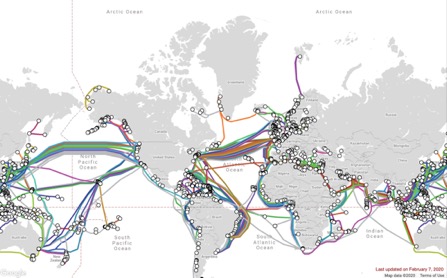
Ninety-nine percent of global data moves through undersea cables. Should their usage be interrupted for any reason, the entire global economy would be disrupted, as an estimated $10 trillion in financial transfers are dependent upon them.[1] Undersea cables, or as Surabhi Ranganathan terms them, the “out-of-sight arteries of globalization,”[2] are critical infrastructure for the digital economy and the movement of capital around the world. Undersea cables are what make global “flows” and exchanges of data as a commodity possible.[3] They have enabled the growth of the “global data economy,” or the economy that trades in personal information,[4] by providing the material basis for corporations to profit from data collection and processing.[5]

In connecting distant territories around the world, cables often implicate international law.  Yet much of the international legal literature on digital data in relation to territoriality asserts that it is something immaterial, intangible, unterritorial, or post-territorial.[6] While these conceptualizations illustrate some of the complexities that have arisen in trying to map digital data onto extant international legal frameworks, they might also have a blackboxing effect.[7] Imagining data as deterritorialized obscures its underlying histories and power dynamics, including the territorial politics, ecological extraction, labor, and forms of knowledge that went into constructing its underlying infrastructures.

Conceptualizing data as intangible or immaterial also renders it seemingly ubiquitous, evenly spread around the world, or nowhere in particular. This obscures the unevenness of where data comes from and where it travels, who has access to and exercises control over data, and who can use it for what purposes. Data is not collected, distributed, or accessible equally. The paths data travels often depend on algorithms, corporate decision-makers and engineers, regulatory environments, geographies of trade, development projects, and material hardware—none of which have even geographic configurations. The paths data travels are also subject to path dependencies created by initial overlays of cables for the telegraph that were motivated by imperial ambitions, as many undersea cables today follow similar paths. For example, as undersea cable networks are typically constructed within already existing routes,[8] many of which were developed for telegraphic cables as part of colonial projects, they tend to “reinforce existing global inequalities.”[9]

The global data economy, cloud computing, and wireless technologies are thus grounded in tangible cables,[10] the uneven geographies of which affect the speeds and costs at which data travels around the world, the availability of information and communications technologies (“ICTs”) in different parts of the world, and the sites where communications can be either intercepted for surveillance purposes or cut off entirely.[11] As the global data economy becomes an increasingly significant part of global economic activity, the uneven geographies of cables can have significant impacts on global economic distribution.

This short article will foreground the material infrastructure underlying the global data economy to highlight its entanglement with technological, legal, and social orders.[12] It will trace how cables helped shape political thought in the nineteenth century and were in turn shaped by imperial dynamics. Then it will discuss the material turn in international law and how it provides ways for reimagining international law’s effects on everyday life. Finally, it will discuss how cables have become sites where power and contestation play out, the relationship of international law to undersea cables, and how they have mutually shaped each other. It will end with some thoughts on denaturalizing the relationship between undersea cables, international law, and the global data economy.

Cables and Spatial Relations

For Marshall McLuhan, the medium is the message and “the ‘message’ of any medium or technology is the change of scale, pace, or pattern that it introduces into human affairs.”[13] In this view, the content of the communications and data that travel through the medium of a cable matters less than the possibilities or limitations offered by the medium. The medium of cables helped shape and restructure social relationships and conceptualizations of space, and thereby shaped conceptualizations and practices of governance.

In the nineteenth century, with the advent of the telegraph during the height of the British Empire’s power, it was thought that the new communications technology could “annihilate” space. Engineers and statesmen thought that cables linking imperial territories around the world could overcome the challenges of maintaining a global empire and a durable polity that lacked homogeneity.[14] As Duncan Bell argues, global telegraphic communications, which moved through undersea cables, altered imperial governance as well as ways of thinking about political association along racialized lines rather than territorial boundaries, allowing Victorians to imagine a “politically-integrated Angloworld [which] was inconceivable without a dense communication infrastructure to bind it together.”[15] Thus, more than the economic, political, and strategic possibilities offered by the advent of the submarine telegraphic cable, the altered perceptions of time and distance that undersea cables motivated transformed nineteenth-century political thought. In doing so, they enabled the imagination of unified political communities such as nations,[16] and governance along new spatiotemporal scales.

Materiality and International Law

While the social sciences have focused for some time on the significance of objects and materiality and their entanglement with political and social orders,[17] international legal scholarship has recently started to engage with this mode of analysis in more depth. For example, Jessie Hohmann and Daniel Joyce describe the possibilities offered by engaging with objects and materials rather than classic texts and normative frameworks: “[i]n revealing the deep entanglements of international law and the material things around us, we can begin to understand how international law structures and disciplines its subjects—and sets the contours for the possibilities and limits of our lives—through objects.”[18] International law’s authority is often founded on material objects.[19] Luis Eslava and Sundhya Pahuja also consider that the material world is what gives international law meaning and effect, and it is in and through the material world, mundane objects, and artifacts that international law unfolds.[20] Moreover, Benedict Kingsbury argues for “thinking infrastructurally” in international law to account for the ways in which infrastructures can have regulatory effects.[21] For him, infrastructure refers to “a set of relations, processes and imaginations” and brings together technical, social, and organizational elements in relation to law and governance.[22]

As Jessie Hohmann notes, the distinction between the passive object and the agentive subject is a weak one, and our abilities to categorize and distinguish between things as belonging to one or another of those categories are often hampered by those qualities of things which are always unknowable.[23] These categorizations are also resisted by the very politics of those artifacts.[24] As Bruno Latour has noted, the idea that objects or things can be actants with agency creates possibilities to overcome conceptual binaries and distinctions, as well as abandon the idea that the natural and the social worlds are separate.[25] It challenges the notion that there are “distinct ontological zones” which create distinctions between humans and non-human actants, for example.[26] In this way, Latour’s concepts have been particularly useful in helping international legal scholars rethink some of the common assumptions upon which international legal doctrines rest.[27] Nevertheless, this article proposes moving beyond a Latourian conception of objects as actants with agency on par with humans. It seeks to emphasize the exercises of power and forms of politics that the materiality of cables enable and their entanglement with technological, legal, and social orders.[28]

Cables as Sites of Power and Contestation

It is important to consider not only how material objects and infrastructures help shape international law and affirm its authority, but also how international law helps facilitate their construction, and how the interaction between law and materiality helps produce social orders.[29] Undersea cables became the site of political, economic, and legal contestation by a variety of actors, including states, individual developers, and corporations—struggles which continue today.[30] These contestations involved issues of ownership, control and access, sovereignty, and territorial claim-making.[31]

In the nineteenth century, for example, the high demand for gutta percha, a natural plastic used as insulating material for cables, changed economic, social, and ecological conditions for native people in Southeast Asia,[32] sparking territorial contestations that have shaped borders which still exist today.[33] Moreover, cables and access to telegraphic communications not only played a role in territorial conflicts between colonial powers, but also provided the impetus for territorial claim-making over island territories.

International legal regimes both facilitated and helped construct the development of undersea cable networks. Limitations on state claims of sovereignty in the high seas gave significant leeway for the laying of cables on the seabed, as authorized by the United Nations Convention on the Law of the Sea (“UNCLOS”) and customary international law. At the same time, state claims of sovereignty and partnerships with private corporations in early developments of telegraphic cable infrastructures paved the way for corporations to play a significant role in having control over undersea cables today. This was due to the fact that some states did not want supranational oversight or regulation by international organizations or foreign state-owned cables to come into their sovereign territorial space, including their territorial space in the sea. These dynamics show how international legal regimes and state claims of sovereignty helped shape the submarine cable networks we have in place in today, as well as how cables helped shape territorial borders, disputes, and politics.

Conclusion

Conceptualizing data as immaterial, intangible, or unterritorial obscures the social construction of infrastructures such as undersea cables that enable it to move around the world. By rendering visible these seemingly invisible infrastructures, we might not only have a better understanding of how they were socially and legally constructed, but also the multiple sites of power, politics, and contestation they enabled, historically and today. Moreover, considering the material infrastructures underlying data might allow us to highlight issues that might otherwise be overlooked. For example, we might better understand how international legal regimes like UNCLOS facilitated the development of infrastructures that enable the global data economy today and the roles these regimes play in shaping their past, present, and future configurations, or how cables have long challenged the divide between the public and the private.[34]

Invisibilities are problematic when they naturalize the phenomena that they conceal. The “territorial trap” in international law risks masking how contemporary global political economy functions outside the confines of territorial borders and how it distributes power and authority.[35] By rendering these dynamics invisible, international law also obscures its own role in facilitating and constructing that political economy.

To counteract these invisibilities and naturalizations, this article proposes foregrounding the material infrastructures that make the global data economy possible as a way of highlighting how they have helped shape, and were shaped by, international legal regimes, everyday people, and broader social and political orders. In doing so, we might also raise different questions about how the material and international legal infrastructures of the global data economy shape global economic distribution. Rather than simply bringing more countries into the global data economy through new cable landings and assuming that will automatically bring economic development and social progress, we ought to step back and question the structures that facilitate the distribution of the value generated from the global data economy to just a small number of corporations, states, and individuals.

Roxana Vatanparast is a Visiting Researcher at the Institute for Global Law & Policy (IGLP) at Harvard Law School and a PhD Candidate at the University of Turin.

[1] See Douglas R. Burnett & Lionel Carter, International Submarine Cables and Biodiversity of Areas Beyond National Jurisdiction: The Cloud Beneath the Sea 4 (2017).

[2] Surabhi Ranganathan, The Out-of-Sight Arteries of Globalization, Visualizing Climate and Loss, http://histecon.fas.harvard.edu/climate-loss/lawofthesea/arteries.html (last visited Feb. 7, 2020).

[3] On international legal and policy-making writing emphasizing the value of “flows” of data, see Fleur E. Johns, The Deluge, 1 London Rev. Int’l L. 9, 16 (2013).

[4] Id. at 10 (citing Nils Zurawski, Local Practice and Global Data: Loyalty Cards, Social Practices and Consumer Surveillance, 52 Soc. Q. 509, 513 (2011)).

[5] See Nicole Starosielski, Introduction, in Signal Traffic: Critical Studies of Media Infrastructures 1, 5–6 (Lisa Parks & Nicole Starosielski eds., 2015).

[6] See, e.g., Jennifer Daskal, The Un-Territoriality of Data, 125 Yale L.J. 326 (2015); Kristen E. Eichensehr, Data Extraterritoriality, 95 Tex. L. Rev. 145 (2017); William J. Drake, Territoriality and Intangibility: Transborder Data Flows and National Sovereignty, in Beyond National Sovereignty: International Communication in the 1990s 259 (Kaarle Noerdenstreng & Herbert I. Schiller eds., 1993); Paul De Hert & Johannes Thumfart, The Microsoft Ireland Case and the Cyberspace Sovereignty Trilemma. Post-Territorial Technologies and Companies Question Territorial State Sovereignty and Regulatory State Monopolies, 4 (Brussels Privacy Hub Working Paper No. 11, 2018).

[7] Blackboxing is a concept in social science that refers to the ways in which a technology’s invisibility or opaqueness can be attributed to its success. See, e.g., Bruno Latour, Pandora’s Hope: Essays on the Reality of Science Studies 304 (1999).

[8] Nicole Starosielski, The Undersea Network 20 (2015).

[9] Id. at 12.

[10] See Nicole Starosielski, Fixed Flow: Undersea Cables as Media Infrastructure, in Signal Traffic: Critical Studies of Media Infrastructures, supra note 5, at 53.

[11] See id. at 61–66.

[12] See States of Knowledge: The Co-production of Science and the Social Order (Sheila Jasanoff ed., 2004).

[13] Marshall McLuhan, Understanding Media: The Extensions of Man 7, 8 (1964).

[14] See Duncan S. A. Bell, Dissolving Distance: Technology, Space, and Empire in British Political Thought, 1770–1900, 77 J. Mod. Hist. 523, 532 (2005).

[15] Duncan Bell, Cyborg Imperium, c.1900, in Coding and Representation from the Nineteenth Century to the Present: Scrambled Messages (Anne Chapman & Natalie Chowe eds., forthcoming).

[16] On the nation as an “imagined political community,” see Benedict Anderson, Imagined Communities: Reflections on the Origin and Spread of Nationalism (rev. ed. 2016).

[17] See, e.g., Langdon Winner, Do Artifacts Have Politics?, 109 Daedalus 121 (1980); Bruno Latour, Where are the Missing Masses? The Sociology of a Few Mundane Artifacts, in Shaping Technology / Building Society: Studies in Sociotechnical Change 225 (Wiebe E. Bijker & John Law eds., 1992).

[18] International Law’s Objects, 2 (Jessie Hohmann & Daniel Joyce eds., 2019).

[19] See id. at 2.

[20] See Luis Eslava & Sundhya Pahuja, Beyond the (Post)Colonial: TWAIL and the Everyday Life of International Law, 45 J.L. & Pol. Afr. Asia & Latin Am. 195, 203 (2012).

[21] See Benedict Kingsbury, Infrastructure and InfraReg: On Rousing the International Law “Wizards of Is,” 8 Cambridge Int’l L.J. 171 (2019).

[22] Id. at 179.

[23] See Jessie Hohmann, The Lives of Objects, in International Law’s Objects, supra note 18, at 30, 31.

[24] See id. at 32.; Winner, supra note 17.

[25] See Bruno Latour, Reassembling the Social: An Introduction to Actor-Network-Theory (2005); Bruno Latour, We Have Never Been Modern (Catherine Porter tran., 1993).

[26] Latour, We Have Never Been Modern, supra note 25, at 10–11.

[27] See Kingsbury, supra note 21, at 174.

[28] See Jasanoff, supra note 12.

[29] See id.

[30] See, e.g., Jeremy Page, Kate O’Keeffe & Rob Taylor, America’s Undersea Battle With China for Control of the Global Internet Grid, Wall Street J. (Mar. 12, 2019), https://www.wsj.com/articles/u-s-takes-on-chinas-huawei-in-undersea-battle-over-the-global-internet-grid-11552407466.

[31] See Jill Hills, The Struggle for Control of Global Communication: The Formative Century 83 (2002).

[32] See John Tully, A Victorian Ecological Disaster: Imperialism, the Telegraph, and Gutta-Percha, 20 J. World Hist. 559–79 (2009).

[33] See Helen Godfrey, Submarine Telegraphy and the Hunt for Gutta Percha: Challenge and Opportunity in a Global Trade (2018).

[34] Cables are owned and operated by both private actors (some state-owned) and large conglomerates of public and private actors. See Stephen Humphreys, Data: The Given, in International Law’s Objects, supra note 18, at 199.

[35] See generally Nikolas M. Rajkovic, The Visual Conquest of International Law: Brute Boundaries, the Map, and the Legacy of Cartogenesis, 31 Leiden J. Int’l L. 267 (2018).

Online Scholarship, Perspectives

The International Health Regulations: The Past and the Present, But What Future?

By: Lauren Tonti

Containing a pandemic is a titanic task, requiring the cooperation of modern-day Titans. On March 11, 2020, the World Health Organization (“WHO”) declared a global pandemic of COVID-19, a respiratory disease spread by airborne pathogens from the coronavirus family. Infecting nearly 1,500,000 individuals across 184 countries as of April 9, 2020, and killing over 90,000 worldwide, COVID-19 has tested the tools of global health governance that are designed to protect populations. One such tool is the International Health Regulations (“IHR”). As a multinational agreement binding 196 Member States to monitor and report international health threats, the IHR seeks to coordinate a balanced public health response, while minimizing disruption to international travel and trade and upholding human rights. Mandating protocols to detect, assess, and report outbreaks, the IHR requires Member States to implement core capacities designed to equip national disease outbreak responses. Importantly, the IHR also gives the WHO’s Director-General the power to declare a public health emergency of international concern (“PHEIC”), which mobilizes coordinated international action. Indeed, states shoulder much of the responsibility to generate and report the public health metrics required to trigger any PHEIC notification. The IHR reflects an accumulation of the lessons that past pandemics have taught the global community. But as the world watches COVID-19 take its toll, the future of these regulations remains uncertain.

The IHR: An Instrument Informed by Past Pandemics

The present coronavirus is not the world’s first duel with a pandemic. The bubonic plague, a series of cholera outbreaks, and the Spanish flu are among the most notorious pandemics in recorded history. Each bout with pandemic illness has taught the international community hard-fought lessons that stakeholders used to adjust laws accordingly. Such lessons informed the evolution of this global health governance tool.

The 1892 International Sanitary Convention embodies some of the earliest concerted efforts of international powers to combat European cholera outbreaks under a unified framework. Furthering these principles, the International Sanitary Regulations were adopted by Member States of the newly-founded WHO in 1951, later revised and renamed as the International Health Regulations in 1969. The IHR of 1969 focused on six major diseases, including cholera, plague, yellow fever, smallpox, relapsing fever, and typhus. A series of illnesses across the globe prompted minor revisions throughout the subsequent decades before the AIDS epidemic and the SARS outbreak necessitated major revisions in 2005.

The 2005 revisions broadened the IHR’s scope beyond the six major diseases, aiming to encompass biological, chemical, and nuclear incidents, as well as zoonotic diseases and food safety concerns. The 2005 IHR revisions recommend best practices for international traffic at points of entry, reflecting modern globalized traffic and trade. The revisions increased the WHO’s investigational capacities and encouraged the observance of human rights in protecting public health. However, the latest round of revisions, which came into effect in 2007, failed to increase the instrument’s enforcement power. Current enforcement mechanisms rely on public shaming techniques that highlight damaged international reputations, increased national mortality, economic disruptions, and public outrage.

Since the revisions, the world has confronted Ebola, swine flu, and Zika virus. While a mix of hard and soft law direct health governance, the IHR is certainly one of the most multinational and tangible instruments available. At present, it has guided the global response to COVID-19.

At Present: IHR vs. COVID-19

As a fast-spreading, severe acute respiratory syndrome, COVID-19 matches the profile of notifiable diseases for which the IHR was designed. Yet, in response to COVID-19, there have been numerous violations of the IHR mandates, showing that the preventive mechanisms enshrined in IHR have failed—in large part due to national discretion.

Nations’ Lack of Core Capacities Hurt COVID-19 Response

Despite extended compliance deadlines, no WHO Member State is in complete compliance with the IHR’s core competencies. Europe achieved the highest level of compliance at 72% across all competencies, according to the WHO’s State Parties Self-Assessment Annual Reporting Tool (“SPAR”). Notably, however, the SPAR has been criticized for its lack of independent validation. National evaluation of compliance is also seen as inconsistent. Nonetheless, if these metrics are the “indisputable baseline[s] for preparedness,” Member States were at marked disadvantages from the outset of COVID-19. Whether because of inadequate funding, resources, or sheer lack of will, nations’ inhibited core capacities hurt the global COVID-19 response.

Member States Violated Key IHR Provisions

The COVID-19 epidemic bears witness to several direct IHR infractions, particularly Articles 6 and 7, governing reporting, and Article 43, regarding the implementation of protective measures.

While the IHR mandates national reporting and monitoring of notifiable disease outbreaks, China, a WHO Member State, was accused of censoring and withholding information at the outbreak’s outset, violating its duties in IHR Articles 6 and 7. Since the disease’s progression, reports have surfaced that China’s disease management tactics, such as censorship and mass quarantine, violate human rights, civil liberties, and IHR Article 3’s explicit call for respecting “dignity, human rights and fundamental freedoms of persons.”

In violation of IHR Article 43, which instructs disease management tactics to be grounded in available scientific evidence, numerous nations implemented travel bans barring travelers from endemic regions and closed national borders to non-citizens in the name of disease containment. Such tactics, which usually only yield benefits at the very preliminary stages of an outbreak, have proven detrimental to disease control efforts, especially as less restrictive yet similarly effective disease containment protocols were available. Moreover, in enacting such restrictions, nations disregarded guidance repeatedly issued by the WHO, yet another Article 43 violation.

While the IHR affords nations the prerogative to enact additional disease containment, Member States must report the extraordinary measures they have taken to the WHO. Perpetuating violations, only 32% of the 72 Member States implementing coronavirus travel restrictions reported these measures in a timely fashion to the WHO during the outbreak.

Unfortunately, the trends of forsaking WHO guidance while implementing additional bans that disrupted travel and trade are all repeat offenses, as the same types of infractions occurred during the Ebola and swine flu outbreaks. These infractions reflect a severe “crisis of confidence in the [International Health] Regulations.”

Political Pressures Pose Impediments

Political pressure appears to have impeded the IHR’s functionality. Critics argue that the WHO had sufficient evidence to declare COVID-19 a PHEIC as early as January 23, 2020, though the Director-General did not officially do so until a week later. Taiwan claims the WHO failed to act upon its officials reports to the WHO in December 2019 of human-to-human coronavirus transmission. Additionally, while the WHO stated that it is not in the business of shaming Member States for missteps, it has praised China for what many call draconian measures. Critics call such politically motivated support a “deception” that gave the global community “a false sense of assurance” about COVID-19’s manageability.

What Future for the IHR?

As COVID-19 continues to rage, the IHR’s future becomes less certain. As death counts surge, confidence in the IHR sinks. In the scrutiny likely to follow this pandemic, many will likely wonder whether the IHR adequately fit modern tendencies. This criticism will not be novel. Scholars predicted such difficulties.

Before COVID-19 struck, scholars called for revisions, as the Ebola outbreak alone revealed challenges for the IHR. Lawrence O. Gostin, in symphony with other leading public health scholars, has long advocated for another IHR revision. Scholars suggest fundamental modifications to financing, harmonization, evaluation metrics, core capacities, compliance, the role of civil society, human resource utilization, transparency, and more that will fortify the instrument for modern-era pandemic response.

To maximize preparedness, Gostin and co-author Rebecca Katz suggest ramping up core capacity adoption supported by “an independent evaluation system with a feedback loop and continuous quality improvement,” as well as funding mechanisms. To address IHR enforcement violations, Gostin and Katz suggest adopting carrot and stick compliance measures to encourage core capacity adoption and discourage independent action counter to evidence-based guidelines. To reduce political influence, Gostin and Katz advocate for more transparency and independence for emergency committees involved in declaring a PHEIC. They also call for publicizing the WHO Emergency Committee’s evidence base and decision-making rationales. Furthermore, Gostin and Katz suggest a tiered approach to a PHEIC declaration to counter its present reactionary role. Proactive measures are needed “long before an outbreak becomes an international emergency.” In combination, these reforms can help strengthen future versions and functioning of the IHR.

Conclusion

Past and present International Health Regulations are the products of experience, deliberation, and compromise. However, the modern instrument’s future remains uncertain, as it attempts to govern in a world where the WHO’s efficacy is questioned. If the global community calls for the IHR’s subsequent revisions, significant political will would be required to achieve effectual reforms. Despite an uncertain future, COVID-19 does demonstrate the profound need for an evidence-based instrument that can mobilize and coordinate numerous international actors and resources with lightning precision. One thing is certain—norms, as they stand, will not suffice in the face of another pandemic.

Lauren Tonti is a Doctoral Candidate at the Max Planck Institute for Social Law & Social Policy.

Essays, Online Scholarship

Cyber Sovereignty: A Snapshot from a Field in Motion

By: Andrea Leiter

This Post is the second in a new Frontiers series that critically explores the connection between international law and emerging technology, featuring the writing of scholars from a variety of disciplines affiliated with the Institute for Global Law and Policy (IGLP) at Harvard Law School.

[Click Here for PDF]

Introduction

This short article offers an overview of the most commonly held understandings of the notion of cyber sovereignty and attempts to push the research agenda with further questions. First, it outlines the regularly offered distinction between state sovereignty and platform sovereignty in cyberspace. However, instead of holding with this distinction, it presents cyber sovereignty as a techno-legal sphere characterized by claims to governance by states, companies, and individuals. With this angle, cyberspace appears as one of the most significant sites of our contemporary political and economic life. Second, while this contribution suggests that we should work with an analytic frame that embraces the intertwined character of cyberspace as techno-legal space governed by a multitude of different actors, the article argues that on a normative level, we still lack an in-depth understanding of the contradictory interests of the actors involved. We have not sufficiently grasped the power structures in cyberspace on either the economic or the political plane. The article suggests drawing on the tradition of critical legal scholarship to first map the field along a set of fundamental questions and then define legal strategies for redistribution and inclusion in cyberspace.

Jurisdiction in Cyberspace

The term cyber sovereignty stems from internet governance and usually means the ability to create and implement rules in cyberspace through state governance. One of the leading voices in internet governance, Bruce Schneier, has coined the term as the attempt of governments to take control over sections of the internet within their borders.[1] The 2017 Tallinn Manual 2.0 constitutes one of the most important attempts to outline how existing international legal norms apply to cyberspace.[2] Governments discuss the question of cyber sovereignty through the lens of international law with concepts such as intervention, use of force, due diligence, and state responsibility. However, the relationship between data and territoriality challenges some of the most basic assumptions of the international legal order. As Fleur Johns puts it, these are “changes that amount, actually and prospectively, to a reconfiguration of territoriality in international law.”[3] Rather than territorial boundaries and physical property, the new concerns relate to data access and technical proficiency.[4]

Yet, cyber sovereignty does not necessarily have to mean governance by a state. It first and foremost refers to the ability to create and implement rules in cyberspace. Alternatively, one could say it refers to the authority to speak the law, i.e., having juris-diction, in cyberspace. For the purposes of this article, I would like to challenge the assumption that sovereignty and jurisdiction are concepts exclusively reserved for states. I suggest understanding jurisdiction as a practice of claiming and engaging with law.[5] In cyberspace this means that protocols and codes in general are as much tools of lawmaking as is the regulatory apparatus of the state. This approach allows us to consider private legal arrangements, such as contracts (especially terms and conditions of large corporations), as exercises of jurisdiction. This idea is by no means new. As early as 1999, Lawrence Lessig published the book Code and Other Laws of Cyberspace in which he argues, by examples of copyright law, that a single dot is governed by the competing frameworks of law, norms, market, and architecture.[6] A more recent iteration of this idea can be found in Primavera De Filippi’s and Aaron Wright’s book Blockchain and Law: The Rule of Code, in which they suggest that “both public and private actors could potentially use blockchain technology to establish their own system of rules and regulations.”[7] Thus, on an analytic basis, we should understand cyberspace as hybrid techno-legal governance. According to Jake Goldenfein, “the idea of ‘law’ and ‘technology’ on alternate sides of a regulatory schematic needs replacing with an intertwined image of co-coordinating and co-constituting techno-legal regulation.”[8]

Where it is clear that we need an analytic approach that understands and embraces the intertwined nature of techno-legal governance, the normative and political sides are not as straightforward. Cyberspace has long been a place for libertarian-minded technologists dreaming of a world without government interference. A strong example is John Barlows’s A Declaration of the Independence of Cyberspace, published at the occasion of the World Economic Forum in Davos in 1996. He proclaims, “Governments of the Industrial World, you weary giants of flesh and steel, I come from Cyberspace, the new home of Mind. On behalf of the future, I ask you of the past to leave us alone. You are not welcome among us. You have no sovereignty where we gather.”[9] A version of this idea with less pathos can be found in the Bitcoin White Paper of 2008 that first introduced cryptocurrency. The author, under the pseudonym Satoshi Nakamoto, pins the desire for autonomy on the notion of trust: “What is needed is an electronic payment system based on cryptographic proof instead of trust, allowing any two willing parties to transact directly with each other without the need for a trusted third party.”[10] Both of these prominent statements about cyberspace draw a picture of “us” versus “them”; “us” being the revolutionary technologists, versus “them” being the establishment usually represented through government institutions and often legacy systems.

In a similar manner, regulatory authorities view their task as regulation of technology and not regulation through technology. One of the best examples for this understanding is the reaction of governments towards blockchain technology. Attempts at prohibition were followed by attempts to apply old tools to new developments, such as the legal treatment of crypto currencies as either financial assets, property, or securities in different jurisdictions. The perception in both communities was one of threat, rather than opportunity. This mutual suspicion of the technology developers on the one side and governments on the other leads to a competition over jurisdiction or competition of sovereignties, which is often framed as a struggle between platform sovereignty and state sovereignty.[11] The fundamental question is, who can claim to be the rulemaking authority?

Lines of Struggle in Cyberspace

Thinking about rulemaking along the lines of “them” and “us” and overlooking the co-constitutive potential might seem banal and simplified. But this lens is nevertheless important because it points to the political questions involved. We should ask about the relationship between consumers and big companies that has emerged around big data. Through the collection of data, companies are producing ever more comprehensive profiles of consumers and thereby not only sell products but profoundly shape choices and affect lives.[12] Despite these changes, the relationship is legally conceptualized through terms and conditions agreements that understand consumers and companies as on par with private citizens. Building on the liberal mantra of choice, companies argue that their customers can choose not to participate or can choose a different provider. This approach hides the power asymmetry and the sheer impossibility for any individual not to participate in digital life. Thus, one direction for further research will inquire into the conceptualization of the relationship between big companies and consumers and how consumers can be empowered towards meaningful choices and contributions.[13] Since nation states and local political organizations seem to operate on a mismatching scale vis-à-vis the corporate entities, this question would also involve the technical component and ask how new political communities could be organized to take advantage of new technologies.

In a similar vein, we should analyze the relationships established in cyberspace through the lens of political economy.[14] What would the lines of class struggle look like, if considered through the data economy? Access to knowledge, meaning an understanding of how algorithms work and how they can be changed, has become the privileged knowledge of very few. Yet, precisely this information determines the value production and wealth extraction. Who benefits at which stage of the value chains in cyberspace? How does the data economy map into the North-South divide? How does data extraction differ from resource extraction and which legal forms enable the production of wealth, and for whom?

Conclusion

Legal scholars and practitioners often find themselves as representatives of clearly defined interests, usually either on the side of the regulatory institutions or in the role of a compliance officer, trying to fit technology into the regulatory schemes. However, since the current moment seems to be marked by a struggle for understanding, rather than clear negotiations of interests, it is also a particularly fruitful moment for intervention. If we understand how legal knowledge is used for the concentration of wealth and power,[15] this knowledge can be used towards redistribution and subversion. Legal scholars and legal practitioners should therefore not only be concerned with the question of who the sovereign in cyberspace is and what rules govern it but also try to design cyberspace as a space of participation and access.

Andrea Leiter is a Fellow in the Berlin Potsdam Research Group, “International Rule of Law – Rise or Decline?”

[1] See Bruce Schneier, Data and Goliath: The Hidden Battles to Collect Your Data and Control Your World 134 (2015).

[2] See Tallinn Manual 2.0 on the International Law Applicable to Cyber Operations (2017).

[3] Fleur Johns, Data Territories: Changing Architectures of Association in International Law, in Netherlands Yearbook of International Law 109 (2016).

[4] See id. at 115.

[5] See generally Shaunnagh Dorsett & Shaun McVeigh, Jurisdiction (2012).

[6] See Lawrence Lessig, Code and Other Laws of Cyberspace 123 (1999).

[7] Primavera De Filippi & Aaron Wright, Blockchain and the Law: The Rule of Code 193 (2018).

[8] Jake Goldenfein, Monitoring Laws: Profiling and Identity in the World State 180 (2019).

[9] John Perry Barlow, A Declaration of the Independence of Cyberspace, Elec. Frontier Found. (1996), https://www.eff.org/cyberspace-independence.

[10] Satoshi Nakamoto, Bitcoin: A Peer-to-Peer Electronic Cash System 1 (2008) https://bitcoin.org/bitcoin.pdf.

[11] See Zi Xiang Tan, Platforms and States, Governance and Sovereignty, https://legaltechcenter.openum.ca/files/sites/159/2018/04/9.-Platforms-and-States-Governance-and-Sovereignty.pdf.

[12] See Frank Pasquale, The Black Box Society: The Secret Algorithms That Control Money and Information (2015).

[13] See, e.g., Annelise Riles, Financial Citizenship: Experts, Publics, and the Politics of Central Banking (2018).

[14] See generally Shoshana Zuboff, The Age of Surveillance Capitalism: The Fight for a Human Future at the New Frontier of Power (2018).

[15] See generally Katharina Pistor, The Code of Capital: How the Law Creates Wealth and Inequality (2019).

PC: Tauheed
Essays, Online Scholarship

Data Subjectivity in What State?

By: Elliott Prasse-Freeman

This Post is the first in a new Frontiers series that critically explores the connection between international law and emerging technology, featuring the writing of scholars from a variety of disciplines affiliated with the Institute for Global Law and Policy (IGLP) at Harvard Law School.

[Click Here for PDF]

Introduction

The sprawling refugee camp system in Cox’s Bazar, Bangladesh, is the world’s largest. It is home to over one million Rohingya, the minority group who have been driven from their homeland in Myanmar in successive waves of expulsion over the past 40 years. Life in these camps is dirty, dangerous, and dreary, but above all else, it is defined by the search for resources of both the material and informational variety. Refugees must maneuver to secure food packets or cash-for-work opportunities disbursed by humanitarian agencies while also trying to maintain connections across both the camps and with networks further afield (including with relatives who may remit much-needed cash).

It is against this backdrop that two procedural changes instituted in the last year changed the fabric of the Rohingya community’s life. The first change was administered by the United Nations High Commissioner for Refugees (“UNHCR”), the UN agency responsible for disbursing aid. UNHCR rolled out a “Smart Card,” a digitally scannable ID card that encodes a holder’s biometric data. In an ostensible attempt to prevent fraud, UNHCR now requires refugees to present the card when receiving rations.  The second change was implemented by the Bangladeshi government when it banned all use of mobile phones in response to a rally led by camp-based Rohingya civil society groups marking the two-year anniversary of their displacement from Myanmar. Since then, SIM card confiscations have proceeded along with new laws that prohibit Rohingya from holding a mobile phone. Any Rohingya caught in violation of this policy will face six months imprisonment and a 50,000 BDT (~$600 USD) fine.

Through these illustrations of the ways in which the Rohingya’s lives have been altered by technology, or the lack thereof, I introduce a number of points. First, pace recent rhetoric heralding how techno-governance solutions will transform refugee and stateless lives, the reality is that the few efficiency benefits enjoyed by refugees due to new tech are offset by the increased control over refugees’ lives. As Mirca Madianou argues, such “digital systems of migration management” end up constraining “refugee mobility by constituting new types of traceable, ‘digital bodies’ which are open to additional forms of intervention and surveillance.”[1] This fact is apparent to refugees themselves. In my anthropological fieldwork in the camps, I tracked resistance to the aforementioned Smart Card by a stunning cross-section of Rohingya, ranging from youths to widows, and political liberals to militant Islamists. They either articulated concerns over data insecurity (collusion between the UN and the Myanmar state), or highlighted how biometric systems would facilitate oppressive Bangladeshi state control. They also complained that the card, by not referring to them as Rohingya, effaced their identity (particularly painful against the backdrop of the genocidal campaign against them in Myanmar).

Second, these descriptions of Smart Card projects harvesting and controlling Rohingya data and of Rohingya being barred from accessing their online “selves” also demonstrate how the “data subject” that is constructed by the refugee/stateless person deviates significantly from the imagined “standard” data subject: the unmarked Northern bourgeois one. This bourgeois subject is invested with revolutionary promise even as it becomes the object of anxiety and regulatory response. For instance, in a recent piece, legal anthropologist Kamari Clarke argues that “average citizens engaged in justice-capture projects are now deploying new surveillance technologies that were once under the control of states.”[2] The “hash-tag publics” that materialize as these citizens circulate signs (photos, documents, memes) should be understood, Clarke insists, as heralding nothing less than a transformation in sovereignty itself. This is because “technology enables the body to ‘produce an image that is larger than itself,’” magnifying resistance and thereby destabilizing classic modes of domination.[3]

While I will not examine in detail Clarke’s claims regarding sovereignty, her argument is worth considering from the perspective of the refugee/stateless body, the one marked as non-standard. Indeed, taking into consideration its ability to “produce an image” of itself, the refugee body seems to be much smaller than itself, so small in fact that sometimes it is incapable of signifying at all. Rather than creating “hashtag publics,” the stateless person’s actions in the world fall mostly on deaf eyes and ears globally. Yet, when analysts discuss “the” data subject and its transformative potential, they often presume a citizen of a nation, one who has access to the legal affordances and symbolic capital associated with citizenship.

Relatedly, even as the Northern bourgeois body signifies potential, it is also exposed in a way which creates risk, a risk which must be mitigated and circumscribed. Concerns for this standard Internet user increasingly manifest over concerns about privacy – iconically represented in the European Court of Justice’s recognition of the “right to be forgotten” in Google Spain SL v. Costeja,[4] and the EU’s ensuing General Data Privacy Regulation (“GDPR”)[5] – as the standard subject’s putative autonomy is infested and invested by unseen data machinations. The “persistence, visibility, spreadability, searchability”[6] that constitute this subject as an object of data accumulation, micro-targeted advertisements, and general algorithmic governance[7] seem to reflect the relatively light touch of Gilles Deleuze’s control society.[8] In contrast, as the case of phone confiscation in Bangladesh illuminates, the insidious data control regime’s gentle touch is not able to be felt by the Rohingya; it is instead inaccessible due to the iron fist of the coercive state. To riff on the old joke about the lumpenproletariat, the only thing worse than being exploited by data capitalism is not being exploited by data capitalism. Hence for the stateless person the “right” they demand is to not be forgotten.

Of course, it would be fatuous to suggest that these two options – refugee or bourgeois – represent all of the possibilities for data subjectivity. However, by focusing on refugee/stateless subjects, I aim to explore what insights their uses and navigations of technology might provide.

In late October 2019, the Rohingya Project (“RP”), a Rohingya-led non-profit social enterprise delivering services to some of the 200,000 stateless Rohingya living in Malaysia, launched its “R-Coin,” a crypto-token “used to reward refugees performing certain volunteer tasks, such as teaching, counseling, soup kitchens, group cleanups, and tree planting.”[9] Yet according to Mohammed Noor, founder and Director of RP, the goal of the R-Coin goes beyond simple remuneration for community work. Instead, it seeks “to recognize and create a digital record of the service of refugees in the informal sector.”[10] Essentially, R-Coin’s ultimate objective is to use the affordances of digital technology (blockchain and biometrics) to circumvent state-based exclusions (whether in Myanmar or in recipient countries), creating not just a digital identity for refugees but opportunities for greater financial inclusion, among other things.

Returning now to the query about what refugees/stateless subjects can reveal regarding our contemporary societies of control, I ask whether the radically excluded’s attempts to access technology, to evade control, and to create novel non-standard data subjectivities end up constructing alternative ontological positions that might help inform modes of resistance to those control societies.

Breaking Chains, Block by Block?

While a longer paper would be required to adequately describe the Rohingya existence in Malaysia and the R-Coin solution being forged by RP, an overview of R-Coin will help outline the unique data subjectivities being imagined here.

First, RP is responding to the perpetual exclusion that defines Rohingya lives in Malaysia. While Malaysia touts its compassion toward the Rohingya, it still formally regulates them as illegal migrants, as it has not signed the 1951 Convention Relating to the Status of Refugees. This results in the Rohingya not being legally permitted to work or send their children to school, despite some having lived in Malaysia for multiple generations. Instead, they toil as menial laborers, and because they lack legal identities, they face difficulties accessing insurance and even establishing paternity over their children. They are also barred from opening bank accounts,­ as post 9/11 international financial law has insisted that banks confirm the legal identity of clients. The stateless, lacking such identity, are deemed ineligible,[11] and thus, any trajectories for improvement beyond a hand-to-mouth existence tend to be non-existent.

The intervention being piloted by RP seeks to break this cycle by generating quasi-legal identities for these refugees through the particular legal and technological affordances of biometrics, blockchain, and international financial law. The law enables identity creation by providing exceptions in cases in which an individual can be confirmed through his or her biometric data.[12] Blockchain allows data owners to “self-confirm” this biometric data, eliminating dependence on a sovereign authorizing that they are who they claim to be. This can be accomplished as follows: a biometric sample (a finger print or iris scan) is taken and encrypted, and the original data is destroyed.[13] The encryption is stored on the blockchain ledger, becoming the user’s “private key.” When a user wants to access her data, she creates a new sample that is also encrypted. These two samples are then matched, and a successful match grants admission to the blockchain.[14]

Marking a contrast to the way that daily Rohingya life fails to signify beyond their local communities, the project seeks to get the attention of a world that Rohingya say has forgotten them.[15] By creating a durable trace of actions, the biometric-blockchain assemblage provides durable evidence of existence. R-Coin inscribes Rohingya volunteer activities as data, producing the signs of personhood that will ideally be used to access new opportunities (such as bank accounts and loans), which will in turn potentially transform the trajectories of that existence.

Data Subjectivity in What State?

Questions of feasibility certainly loom large over the project. Moreover, the dream of “financial inclusion” is itself problematic.[16] But even if the Rohingya participating in the process cannot drastically improve their material conditions, the recording of both individual (qua specific histories) and group (qua Rohingya collectivity) identities marks a significant innovation in the way non-standard subjects are making use of data.

It is worth highlighting how the Rohingya in this case seem to enact Michael Mann’s observation about the technological dialectic,[17] wherein technologies deployed by states are later appropriated by civil society (or vice versa). Additionally noteworthy is how these historically excluded subjects, based on their position of exclusion, are compelled to improvise the technology’s uses and hence modify its effects. Specifically, the Rohingya only access legal personhood by first rendering themselves into data. We tend to think of the person as primary, the stable referent from which data is extracted. However, as Upendra Baxi reminds us, the person (as a legal entity) is an artificial construction assigned by the law.[18] The law in question is typically enacted by states – and so “stateless, diasporic, and nomadic humans may not belong to the category of persons/populaces and may be reduced to status of things and objects.”[19] Roberto Esposito identifies how legal persons were long defined as the bodies able to own things – often other bodies, who, when thus owned, were reduced to mere things.[20] The Rohingya, originally exiled from the domain of ownership and hence, personhood, finally become persons through the ownership of their data, the material representation of themselves.

This not only inverts the relationship between person-as-bodily-substrate and person-as-legal-representation, but keeps the legal subject distinguished and separate from the social data subject generated through typical digital use. Note here the contrast with the experience of the bourgeois data subject. Despite putative “rights to be forgotten,” this subject increasingly experiences what social media scholar danah boyd calls “context collapse.”[21] This describes the reality in which Northern online and offline selves flatten into one single identity – which in turn is linked with a political/legal self which can be identified and exploited. When a person’s social media activity, credit card purchase history, and legal information (e.g. Social Security Number) circulate together on browsers leaving digital traces of actions, that person’s identity can be easily determined. As Mark Zuckerberg has put it, “The days of you having a different image for your work friends or co-workers and for the other people you know are probably coming to an end pretty quickly.”[22] What’s more, such users are not only disciplined by technological surveillance that threatens to ban “inauthentic” profiles, but also pressured to capitulate to a norm in which the collective social assumption is that one laminates their online and offline selves.[23] Indeed, as Zuckerberg has sententiously scolded us: “having two identities for yourself is an example of a lack of integrity,”[24]

For non-standard data subjects, by contrast, the terrain is different. While stateless people can have social media lives as active (in terms of time spent) and deep (in terms of intensity of affect) as standard data subjects, those online “lives” cannot be integrated into coherent and unitary personhoods. This is because the affordances of the legal milieu and the cultures of interaction with technology militate against harmonization of the online and offline domains. In regards to online cultures, not only do non-standard subjects often have multiple online versions of themselves for different functions,[25] but they retain a critical distance between these online avatars and the other iterations of themselves. While such maneuvers technically violate the terms of service of the platforms, in de facto terms, this does not affect these users for the very reason that they do not fear sanction. This is because, in Myanmar for instance, Facebook users initiate and abandon profiles with remarkable frequency.[26] In regards to legal structures, while burgeoning legal personhood is stored on blockchain, it does not emerge out of a pre-existing legal subject who also operates on the Internet. Instead, legal personhood, made up of such things as financial transactions, birth certificates, and educational diplomas, is immured on blockchain, firewalled from the social personhood on Facebook. Taken together, this allows these subjects to perhaps resist inscription in the “societies of control” that Deleuze warned about.

Deleuze and Felix Guattari theorized the self as at worst a dangerous reterritorialization, and at best “only a threshold, a door, a becoming between two multiplicities.”[27] Such a critical stance toward the deployment of “the self” seems increasingly necessary as the techno-ecology for standard Northern data subjects increasingly exposes them to “surveillance capitalism”,[28] in which the micro-choices (clicks, mouse-overs, purchases) made by data subjects in digital domains are amassed into aggregate populations of those sharing certain critical likenesses (age, gender average salary in zip code, gender, etc.). This is done so that products can be sold back to them and their behaviors modified. That extractive project becomes more difficult when the self is multiple – when fragmentation and diffusion is engaged as a matter of course. More importantly, having multiple identities, and an ironic distance maintained from all of those data subjectivities, seems a necessary mode of resistance to societies of control – ones that non-standard data subjects enact daily.

Conclusion

As for the Rohingya, their collective situation – whether remaining in Myanmar, encamped in Bangladesh, or surviving in Malaysia or beyond – is bleak. The focus on data improvisations here is not meant to elide the reality of these enduring conditions. It is only to highlight how, within a context of radically constrained options, some Rohingya are improvising with technologies not originally designed with them in mind, repurposing them for potentially transformative ends, and challenging from below states’ monopoly over legal/economic subjectivity creation and management.

Elliott Prasse-Freeman is an Assistant Professor in Sociology/Anthropology at National University of Singapore.

[1] Mirca Madianou, The Biometric Assemblage: Surveillance, Experimentation, Profit and the Measuring of Refugee Bodies. 20 Television & New Media 581, 596 (2019); see also Btihaj Ajana, Asylum, Identity Management and Biometric Control, 26 J. Refugee Stud. 576 (2013); Kirsten McConnachie, Camps of Containment: A Genealogy of the Refugee Camp, 7 Human. 397 (2016).

[2] Kamari Clarke, Rethinking Sovereignty Through Hashtag Publics: The New Body Politics, 32 Cultural Anthropology 359, 362 (2017).

[3] Id. at 362

[4] Case C-131/12, Google Spain SL v. Costeja, 2014 E.C.R. 317.

[5] Regulation 2016/679 of Apr. 27, 2016, on the Protection of Natural Persons with Regard to the Processing of Personal Data and on the Free Movement of Such Data, and Repealing Directive 95/46/EC (General Data Protection Regulation), 2016 O.J. (L 119) 1 (EU); see also Jannice Käll, A Posthuman Data Subject? The Right to Be Forgotten and Beyond, 18 German L. J. 1145 (2017).

[6] See danah boyd, it’s complicated: the social lives of networked teens 11 (2014).

[7] See Life by Algorithms: How Roboprocesses are Remaking Our World (Catherine Besteman & Hugh Gusterson eds., 2019).

[8] See Gilles Deleuze, Postscript on the Societies of Control, 59 October 3 (1992).

[9] Press Release, Rohingya Project, Rohingya Project Launches “R-Coin” Crypto Token to Reward Refugee Volunteers (Oct. 28, 2019) (on file with author); see also Elliott Prasse-Freeman, R-Coin: Building Social Infrastructure and Identity for Refugees and the Stateless 1-12 (Rohingya Project, Working Paper, 2020), https://rohingyaproject.com/r-coin-building-social-infrastructure-and-identity-for-refugees-and-the-stateless-elliott-prasse-freeman/ (reviewing R-Coin project).

[10] Id.

[11] See Sara Curran et al., Identities for Opportunities: A Feasibility Study for Overcoming the Rohingya’s Statelessness Challenges Via Blockchain Digital Solutions 6 (2018), https://jsis.washington.edu/wordpress/wp-content/uploads/2018/08/jsis-arp-rohingya-2018.pdf.

[12] Id. at 24.

[13] See Larry Dohrs, It’s High Time to Distinguish Between Biometric Systems and Technologies, Good ID (Sept. 10 2019), https://www.good-id.org/en/articles/its-high-time-to-distinguish-between-biometric-systems-and-technologies/.

[14] See Ann Cavoukian & Alex Stoianov, Biometric Encryption, in Encyclopedia of Cryptography and Security (Henk C. A. van Tilborg & Sushil Jajodia eds., 2011) (describing how the computer science is a bit more complex: given that two samples of biometric data are never exactly the same, algorithms are necessary to assist with matching).

[15] See Michael McGrath, Two Years On: The Forgotten Side Of The Rohingya Crisis, EuroNews (Feb. 2019), https://www.euronews.com/2019/08/26/two-years-on-the-forgotten-side-of-the-rohingya-crisis-view.

[16] Financial inclusion can atomize individuals from social networks even as it makes them vulnerable to debt. Further, financial inclusion’s chimeric promises of wealth creation undermine collective political struggles. See Elliott Prasse-Freeman, Petit Bourgeois Fantasies: Microcredit, Small-is-Beautiful Solutions, and Development’s New Anti-Politics, in Seduced and Betrayed: Exposing the Contemporary Microfinance Phenomenon 69, 72 (Milford Bateman ed., 2017)

[17] See Michael Mann, The Autonomous Power of the State: Its Origins, Mechanisms and Results, 25 Eur. J. Soc. 185, 193 (1994).

[18] See Upendra Baxi, The Posthuman and Human Rights, in Human Rights in a Posthuman World: Critical Essays, 197, 198-200 (2009).

[19] Id. at 200.

[20] See Roberto Esposito, Persons and Things: From the Body’s Point of View, 6 (Zakiya Hanafi trans., 2015).

[21] See Boyd, supra note 6, at 30.

[22] Elisabetta Costa, Social Media as Practices: An Ethnographic Critique of “Affordances” and “Context Collapse”, 6 (EASA Media Anthropology Network’s 60th e-Seminar, Working Paper, 2017).

[23] See boyd, supra note 6, at 38; see also Alison Cool, Impossible, Unknowable, Accountable: Dramas and Dilemmas of Data Law, 49 Soc. Stud. Sci. 503, 521 (2019) (describing how data researchers “developed ethical relationships with what they imagined as the ‘real people behind the data’”).

[24] boyd, supra note 6, at 50.

[25] See Costa, supra note 22, at 1.

[26] See Exploring Digital & Mobile Cultures in Myanmar, Phandeeyar (May 2019), https://www.digitalculturesmm.com/.

[27] Gilles Deleuze & Felix Guattari, A Thousand Plateaus: Capitalism and Schizophrenia 249 (Brian Massumi trans., 1987).

[28] See generally Shoshana Zuboff, The age of Surveillance Capitalism (2019).

Scroll to Top