[PDF]
By Chenglin Liu*
Abstract
This article explores two unique aspects of the Chinese Tort Liability Law (TLL):[1] (1) Article 24 holds that a party not at fault shall share the loss with the victim in non-strict liability cases under undefined circumstances, and (2) the government often shields a party at fault from liability in mass tort cases by disregarding the TLL entirely. These two aspects may seem contradictory; however, they are both based on the same principle of socialized liability, which is first articulated in this article.
Scholars often claim that Article 24 embodies the principle of equitable liability. This article challenges such claims and asserts that Article 24 is, in fact, inequitable because it allows a party not at fault to be held liable. Article 24 defies the traditional notion that liability should not only be based on fault, but also proportional to fault. Thus, it failed to provide a clear standard of care that individuals and entities can follow to avoid liability.
This article argues that the principle of socialized liability is helpful in discerning the essence of Article 24 and other related provisions in the TLL. The new principle explains why Chinese lawmakers and courts are willing to deviate from fault-based liability, the bedrock of Western tort law. Through the lens of socialized liability, this article analyzes leading tort cases that have invoked Article 24 and related provisions, as well as several incidents where the government has deliberately disregarded the TLL. This analysis reveals that the socialized liability principle aligns well with the broader goals the Chinese government intends to achieve, in particular, maintenance of social stability and promotion of state economic interests. Either imposing liability on a party not at fault, or shielding an at-fault party from liability serves the same purpose—maintaining social stability, which is at core of the socialized liability principle.
I. Introduction
On December 26, 2009, the Standing Committee of the National People’s Congress (NPC) enacted the Tort Liability Law (TLL), the first comprehensive tort code in the history of the People’s Republic of China (the PRC). It took effect on July 1, 2010.[2] The TLL is composed of ninety-two articles in twelve chapters.[3] Consistent with codes in other areas of law, the first few chapters of the TLL lay out general principles.[4] The remaining chapters focus on specific liabilities for injuries caused by defective products, automobile accidents, medical malpractice, environmental pollution, domesticated animals, abnormally dangerous activities, and invasion of personal property.[5]
The TLL claims to protect individuals’ civil rights and interests, punish and prevent tortious conduct, and maintain social harmony and stability.[6] It offers a wide range of protection for individual rights, such as the rights to life, health, name, reputation, honor, self-image, privacy, marital autonomy, guardianship, ownership, security, copyright, patent, trademark, discovery, equities, and succession.[7] Chinese academia often views tort law as a private law, which supposedly recognizes the individual autonomy of the parties more than any other areas of law.[8] In fact, however, the TLL is deeply characterized by socialism and is used as a tool to maintain social stability, which is the overwhelming goal of the state.[9] It is impossible for the TLL to remain independent and free from political influence.[10]
This article explores two unique aspects of the Chinese Tort Liability Law (TLL): (1) Article 24 holds that a party not at fault shall share the loss with the victim in non-strict liability cases under undefined circumstances, and (2) the government often shields a party at fault from liability in mass tort cases by disregarding the TLL entirely. These two aspects may seem contradictory; however, they are both based on the same principle of socialized liability, which is first articulated in this article.
Scholars often claim that Article 24 embodies the principle of equitable liability. This article challenges such claims and asserts that Article 24 is, in fact, inequitable because it allows a party not at fault to be held liable. Article 24 defies the traditional notion that liability should not only be based on fault, but also proportional to fault. Thus, it failed to provide a clear standard of care that individuals and entities can follow to avoid liability.
This article argues that the principle of socialized liability is helpful in discerning the essence of Article 24 and other related provisions in the TLL. The new principle explains why Chinese lawmakers and courts are willing to deviate from fault-based liability, the bedrock of Western tort law. Through the lens of socialized liability, this article analyzes leading tort cases that have invoked Article 24 and related provisions, as well as several incidents where the government has deliberately disregarded the TLL. This analysis reveals that the socialized liability principle aligns well with the broader goals the Chinese government intends to achieve, in particular, maintenance of social stability and promotion of state economic interests. Either imposing liability on a party not at fault, or shielding an at-fault party from liability serves the same purpose—maintaining social stability, which is at core of the socialized liability principle.
II. From Equitable Liability to Socialized Liability
A. Equitable Liability (公平原则)
Scholars claim that the principle of equitable liability originated from some earlier versions of provisions of German and Soviet civil law.[11] In 1900, a draft amendment of the German Civil Code provided that the court could require an actor who was not at fault to compensate the victim based on circumstances.[12] Scholars immediately reacted with disapproval, claiming that the proposed provision was so vague that it was intolerable.[13] As a result, the provision was not included in the revised German law.[14]
According to Article 406 of the Soviet Union Civil Code of 1922, if an actor was not liable for the victim’s harm, the court could still order the actor to compensate the victim based on wealth situations of the two parties.[15] This provision was hardly applied in the practice, even to Soviet jurists, who criticized Article 406 for creating legal uncertainty.[16] With the development of the socialist welfare system, which substantially diminished the wealth gap among the people, the equitable liability provision became obsolete in Soviet law in 1964.[17]
In 1986, China enacted the first outline of the civil law entitled The General Principles of Civil Law (the GPCL), which borrowed heavily from both German and Soviet law.[18] Article 132 of the GPCL provides, “if none of the parties are at fault in causing damage, they may share civil liability according to the actual circumstances.”[19] This provision served as the basis of Article 24 of the TLL.[20]
B. Socialized Liability (责任社会化)
By invoking equitable liability, Chinese courts grant relief to victims even though the defendant is not at fault in non-strict liability cases. This arcane aspect of the Chinese tort law puzzles foreign scholars who are accustomed to tort cases where fault is almost a prerequisite for remedy.[21] Instead of using the term “equitable liability,” this article refers it as “socialized liability.” The latter term is more accurate and helpful in discerning the essence of Article 24 and other related articles in the TLL.
The principle of socialized liability holds that tort liability should be imposed or limited as necessary to ensure social stability or confidence in the Communist Party of China (the Party). In practice, the principle allows Chinese courts to hold a party who is not at fault liable for a victim’s injuries. In addition, it also allows courts to deny claims against a party who is at fault in mass tort cases.
As a unique legal concept of recent origin, socialized liability has no well-defined boundaries, and it lacks certainty and predictability. Consequently, individuals and property owners do not know how to avoid liability. Despite its ambiguity, socialized liability remains an essential legal basis for Chinese courts to allocate losses among parties. Specifically, socialized liability serves two main social goals, which may at times overlap or conflict with each other:
First, socialized liability protects the state’s economic interests. Since the economic reforms in the early 1980s, China has transitioned from a Soviet-style planned economy to a so-called market economy with Chinese characteristics.[22] The transition, however, is incomplete as China is still a command economy, in which the state controls most of the vital industrial sectors, such as transportation, telecommunication, energy, banking, and health care.[23] These state-owned enterprises or entities (SOEs) enjoy preferential treatment in laws compared to consumers and private competitors. The SOEs not only play a major role in shaping the law, but they can also impose pressure on courts in cases of industrial accidents. The government often instructs courts to interpret the law favorably to SOEs, or to simply deny claims against SOEs or other enterprises with strong government backing.[24]
Second, socialized liability serves the Party’s goal of maintaining stability and control.[25] Since the founding of the PRC, the Party has firmly held onto its power through a combination of military might, political coercion, ideological pressure, and constraining political enemies.[26] The Party initially predicated its legitimacy on its leadership and sacrifice in gaining China’s independence from Western imperialists. After Mao’s generation in the late 1970s, however, the revolutionary narrative was less persuasive, particularly among the young, many of whom were better educated and extensively exposed to Western ideas.[27] Consequently, the Party developed a new narrative arguing that it deserves to govern the country because it will continue to ensure economic prosperity and social stability.[28]
Although the new narrative appeals to wide audiences, China’s pursuit of economic prosperity has produced very uneven results.[29] The rapidly increasing gap between the rich and poor has contributed to social instability. Social unrest poses a serious challenge to the Party, which seems unable to eliminate the prosperity gap.[30] In the absence of democratic discourse, the Party faces enormous difficulties in detecting elements of dissatisfaction.[31] Therefore, the Party has become oversensitive about public protests. As Professor Wei Zhang observed, “Unlike the democracies where the median voter’s opinion tends to prevail, the authoritarian government in China cares more about ‘the vocal extremists who are most likely to take to the street.’”[32] Therefore, a top priority for the Party is to respond to high-profile controversies or natural disasters. In doing so, the Party attempts to demonstrate its genuine concern for its citizens and to solidify its public support in order to enhance its legitimacy.[33]
The TLL is one of the tools the Party uses to solve thorny social issues and prevent disgruntled victims from taking their grievances to social media or even the streets. Viewed against this background, a fault-based tort principle appears burdensome and difficult to manipulate to the Party’s liking. In addition, inquiries into fault can expose the problems of mismanagement and corruption, attracting unnecessary attention and further arousing public resentment.[34]
Socialized liability, however, is flexible and adaptive. A court can quickly compensate victims without assigning fault. In some cases, the government and the Party have relied on the principle of socialized liability to force victims to accept low compensation and promise not to pursue further legal actions. Ironically, an inquiry into fault in mass tort cases, as the Party sees it, could lead to instability. Thus, socialized liability will remain as an indispensable principle in the TLL precisely because it is so ambiguous and can be easily manipulated to reach whatever legal result the Party favors.
III. Cases Based on Article 24 of the TLL
Article 24 of the TLL provides, “if neither the victim nor the actor is at fault for the harm to the victim, the two parties may share the victim’s loss according to the circumstances.”[35] From the wording of the Article, it is unclear when and how courts should invoke it. The words, such as “may,” “share,” and “circumstances” can cause confusion among judges, lawyers, and academics. Since there is no official interpretation from the Supreme People’s Court, lower courts often take a broad approach in applying Article 24, rather than methodically breaking down the elements in a traditional way of applying a statute.[36] In 2010,the Research Institute of the TLL at the Supreme People’s Court, led by the then Vice President Xi Xiaoming, published a book entitled, The Understanding and Application of the TLL.[37] Even though it is not legally binding, the book is regarded as a reliable source for understanding Chinese tort law. In this book, Xi explained the following key terms of Article 24:[38]
“Loss” and “Liability” According to Xi, Article 24 does not serve as a basis for assessing whether the defendant is at fault. Thus, if a court requires the defendant to be responsible for the victim’s loss, it does not necessarily mean he or she was actually at fault.[39] Xi cautioned the courts not to treat Article 24 as requiring strict liability.[40]
“May” and “share” Xi stated that sharing the victim’s loss should not be mandatory for the defendant.[41] However, he failed to clarify whether the defendant has a choice not to share the loss. As the subsequent cases show, no court has followed Xi’s advice.
“According to circumstances” Xi stated that because Article 24 is not a fault based provision, the sole basis for allocating the loss between the defendant and plaintiff is the parties’ respective wealth.[42] This provision “complies with the virtues, such as equity, justice, honesty, friendship and sympathy, which are broadly recognized and accepted by the public and conducive to building a harmonious society.”[43] In short, the “circumstances” in this Article means “[the parties’ respective] income, expenditure and responsibility to the family and society.”[44]
Xi further stated that if the victim’s financial state has deteriorated seriously due to the injuries, the court should require a well-to-do defendant to bear the entire loss.[45] If the harm is insignificant, the court should hold the plaintiff responsible for his or her own loss.[46] If the plaintiff is wealthier than the defendant, the plaintiff should bear all the loss. If the defendant has insurance, he or she should bear more of the loss.[47]
Even though Xi stated that Article 24 can only be used in limited cases,[48] courts have increasingly used the Article as a legal basis for deciding regular tort cases.[49] In 2011, there were only two cases based on Article 24, but in 2016, the number of cases based on Article 24 exceeded 700.[50] In total, courts have applied the Article more than 2,000 times in all the cases that the Supreme People’s Court has collected since 2011.[51] After an extensive review of recent litigation, this article has selected the following cases to demonstrate how courts have applied the socialized liability principle. Some cases are more analytical than others, but the results are the same: courts have regularly held that parties not at fault must share losses with victims.
A. Ou Zuming v. Hydraulic Power (HP)
HP is a hydraulic power station that maintains several river locks. In July 2011, HP[52] notified the local maritime department that it would release river locks for routine maintenance and asked the department to warn all passing vessels of the high level of water in the river. By taking such measures, HP complied with state regulations regarding river lock releases. The record showed that HP followed the regulation carefully by releasing the locks gradually and sounding horns to ensure that passing vessels had ample time to make the adjustment for the water rise. Mr. Ou Zuming, however, suffered severe property damage to his flat-bottomed boat loaded with cargo during the lock release. Subsequently, Ou Zuming sued HP, claiming that HP was negligent in releasing the water locks or, in the alternative, should be held strictly liable for his loss.[53]
The court first denied Ou Zuming’s strict liability claim based on Article 132 of the GPCL. The court reasoned that the river lock release was not one of the enumerated activities considered abnormally dangerous according to the GPCL.[54] Ou Zuming’s property was located two kilometers away from the river locks and there was a large inlet, which reduced the impact of the water rise. Consequently, Ou Zuming had an opportunity to react to the release and protect his property. Therefore, HP was not strictly liable for Ou Zuming’s loss. On the claim for negligence, the court reasoned that HP took all the necessary measures to comply with the state regulation. Thus, HP was not negligent in releasing the river locks. It seemed that the court was ready to rule in favor of HP, but, in the end, it upheld the lower court’s decision requiring HP to pay RMB 200,000 ($30,000) to cover Ou Zuming’s property loss based on Article 24 of the TLL.[55]
B. Hu v. Chen
On June 27, 2016, Chen Yunhai (Chen) hired Wu Daozhong (Wu) to refurbish the ceiling of Chen’s apartment.[56] The next day, Chen found Wu lying on the floor unconscious. Chen immediately called an ambulance to take Wu to the hospital, where he was diagnosed as possibly having suffered from a stroke. Chen paid RMB 1,800 ($266) for Wu’s medical expenses. Wu subsequently checked into other hospitals for treatment before he died on December 5, 2016. Wu’s widow sued Chen to recover damages for part of the medical expenses, life support costs, funeral costs, and emotional distress in the amount of RMB 269,718.40 ($39,929). The trial court reasoned that the employment relationship between Chen and Wu had no connection with Wu’s illness and his death and that Chen took necessary measures to provide assistance for Wu’s rescue. Therefore, Chen was not at fault and was not liable for Wu’s illness and death. Based on Article 24 of the TLL, however, the court held that Chen must share a portion of Wu’s loss. It ordered Chen to pay RMB 15,000 ($2,220) in addition to the RMB 1,800 ($266) payment that Chen had already made for Wu’s medical bills.[57]
Wu’s widow appealed the trial court decision, claiming that it erroneously applied Article 24 and that Chen should share a large portion of the loss. The appellate court affirmed the trial court’s decision. In its reasoning, the appellate court provided some guidance on the application of Article 24, which was rare for a Chinese court to do. The court emphasized that the basic principle of tort law is liability based on fault in non-strict-liability cases. Article 24 does not require parties not at fault to share liability, but only to share the loss under certain circumstances. “Sharing loss” here does not mean that the two parties split the loss equally. The court further interpreted the phrase “under the circumstances,” in the sense that by invoking Article 24, courts should consider the following factors in deciding about the amount of loss that the party not at fault should share:[58]
(1) The manner with which defendant acted [even if he or she was not at fault];
(2) The circumstance under which the defendant acted;
(3) The amount of loss to the plaintiff;
(4) The benefit that defendant received from the plaintiff;
(5) The disparity in wealth between the defendant and plaintiff.[59]
In this case, the appellate court found that the amount the trial court required Chen to share was reasonable and denied the plaintiff’s claim for additional payment.
C. The Application of Socialized Liability in Ou Zuming and Hu
The Ou Zuming case and the Hu case were factually different and tried in different courts, one in the most remote region and the other in Beijing. Nevertheless, the ultimate outcomes in both cases were the same: the wealthier defendants were ordered to pay for damages to the desperate plaintiffs. Based on the socialized liability principle, the courts in both cases obligated the defendants to share some of their wealth with the plaintiffs, even though neither defendant was at fault.
In Ou Zuming, the wealth gap and potential for social discontent was apparent to the court. HP was a subsidiary of Chongqing Longzhu Power Group, a government-affiliated company with a registered capital of close to RMB 300 million ($45 million). Compared with HP, Mr. Ou Zuming’s business was negligible. The $30,000 payment was only a tiny fraction of HP’s wealth but vital for Mr. Ou Zuming to salvage his shattered business and keep his workers employed. If the court had applied the principle of fault-based liability and denied Mr. Ou Zuming’s claim, Mr. Ou Zuming and his fellow workers probably would have protested the HP and the government. By applying the socialized liability principle, however, the court avoided the potential for social unrest.
Similarly, in Hu, the court was fully aware of the wealth gap between the two parties, which was reflected in the judgment. In 2016, the property values in Beijing increased by nearly 30% annually.[60] An average two-bedroom apartment (80 square meters, or 860 square feet) in Beijing was worth more than RMB 4,000,000 ($600,000).[61] It was obvious to the court that Chen’s wealth was far greater than that of Hu. As a migrant worker from Anhui Province, Hu could only sell his hard labor in order to survive in Beijing. Without adequate health insurance and pension benefits, Hu’s illness would quickly exhaust his life savings and lead to bankruptcy. If uncompensated, Hu’s family members could have petition the government for assistance. By invoking Article 24 in Hu, the court relieved pressure on the government.
IV. Article 87 and Falling Object Cases
While the rapid urbanization movement has improved living standards in China, it has also created a unique legal problem: injury to a person by an object that falls from a multi-unit residential building. Who is liable for the harm? Article 87 of the TLL, often referred to as the “falling objects provision,” offers a clear answer: all occupants of the building, except those who can exculpate themselves, are liable for the injury.
A. Luo v. Lao
On November 7, 2005,[62] while Mr. Luo Jiezhi was eating dinner outside an apartment building owned by Lao Xiquan (the Owner), a steel bar fell from above and hit Luo’s right wrist, causing severe injuries.[63] At the time of the incident, the Owner had a metal structure to dry meat on the top of the building. Luo sued the Owner to recover medical and other expenses.[64] The court physician certified that Luo suffered an 8th degree disability, which made him unable to work. The court relied on Article 126 of the GPCL, which states that “if a building or any other installation or an object placed or hung on a structure collapses, detaches, or drops and causes damage to others, its owner or manager shall bear civil liability, unless he can prove he is not at fault.”[65] The court held for Luo, the plaintiff, because the Owner failed to produce proper evidence that he was not at fault.[66]
In practice, it is not enough for an owner to prove that he exercised reasonable care under Article 126 of the GPCL. He has to prove that it was a third party, the plaintiff, or a natural force that caused the plaintiff’s injury.[67] Under the equitable liability principle in the TLL, if neither the owner nor the plaintiff was at fault, the owner should still share the plaintiff’s loss to the best of his ability.[68] The payment is “not absolutely mandatory in nature.”[69] The share that the owner should pay depends on his financial situation. The better the financial situation of the owner, the more he would have to pay for the cost of the plaintiff’s injuries.[70]
B. Wen v. Owner
On May 11, 2000, Mr. Hao was chatting with his neighbor outside a residential building, in which twenty-two families lived.[71] An ashtray suddenly fell from the building and fractured Hao’s skull. Hao became mentally disabled and lost his ability to speak. Unable to find out who threw the ashtray, Hao sued the twenty-two families in the building. Except for two families that proved that they were not in the building, the remaining twenty families failed to prove that they did not throw the ashtray. Therefore, the court held that the twenty families were responsible for equal shares of Hao’s injuries.[72]
C. Article 87 and Socialized Liability
Under Article 87, socialized liability is imposed because there is no well-developed social safety net for injured victims to seek recovery. If a court followed traditional fault-based principles, a victim injured by a falling object would likely be left without a remedy because the costs to find the true tortfeasor and hold him liable would be prohibitively high.
Article 87, which enjoys support from both the public and the academia, has changed urban living in various ways. Some homeowner management companies install security cameras to catch wrongdoers, while others require occupants to contribute to a designated fund, which covers the costs for injuries caused by falling objects. Article 87 also makes neighbors to be vigilant about suspicious acts in the community. In addition, the Article spreads the loss of accidents in multi-unit dwellings by increasing the costs of living in them.
V. Posthumous Defamation
One of the unique aspects of the Chinese tort law on emotional distress is that it allows close relatives of the deceased to sue for emotional damages when a tortfeasor damages the reputation or invades the privacy of the deceased. Even though there is no statutory basis for this type of lawsuit, the Supreme People’s Court issued an interpretation that recognizes the right of a posthumous reputation of a deceased person:
Close relatives of the dead can sue for emotional damages against a tortfeasor who
(1) infringed upon the dead’s name, likeness, reputation, or honor by insulting, libeling, disparaging, vilifying, or by other means contrary to public interests or morality; or
(2) illegally disclosed or used the privacy of the dead or infringed upon the privacy by other means contrary to public interests or morality.[73]
A. Chen v. Wu
In 1999, Wu Si published a book, Mao’s Peasant—Chen Yonggui, which was serialized in the Beijing Youth Daily.[74] Chen, who passed away in 1986, held the office of Vice Premier of the State Council (the central cabinet of the Chinese government) from 1975 to 1980, even though he was illiterate. Rising from a peasant in a remote village in the Shanxi Province to a member of the Politburo of the Party, Chen owed his sudden fame primarily to Mao’s disastrous policy choices during the peak of the Cultural Revolution.[75] In the book, Wu portrayed Chen’s early life, especially his role during the Japanese occupation from 1937 to 1945. Relying on published articles, including an article by Chen’s elder son, and other official archives, Wu claimed that Chen was a member of the “peace maintenance group,” a puppet government established by the Japanese to manage affairs in the occupied areas.[76] In that position, Chen was responsible for collecting grains and vital information for the Japanese army. After World War II, Chen was arrested and humiliated for his role in aiding the Japanese occupiers. In his application for Party membership after the war, Chen acknowledged his past involvement in the “peace maintenance group” and sought the Party’s forgiveness. All these files regarding Chen’s history were well kept in the Party’s archives. Wu cited the files together with other historical records, memoirs, and interviews in his book to support his claim.[77]
In 2002, Chen Yonggui’s wife, and other close relatives sued Wu for defaming the late Vice Premier through Wu’s disclosure of Chen’s treasonous past, and for degrading Chen’s status as a prominent state official and as a member of the respected party elite. The relatives requested the court to order Wu and the publisher to issue a public apology to Chen’s family. In addition, the relatives claimed that they suffered emotional distress because of Wu’s book and sought RMB 100,000 ($14,000) for emotional damages.[78]
In defense, Wu and the publisher provided a detailed list of publications, archives, personal memoirs, and interviews, claiming that the author did not fabricate the facts with intent to defame Chen. In fact, there was an article written by Chen’s elder son, which detailed Chen’s role in the “peace maintenance group.”[79] Wu claimed that he accurately depicted Chen’s early life based on his extensive research and interviews. While the court did not dispute that the author had no intent to smear Chen, it held that Wu cited unauthoritative sources because neither the Party nor the government validated personal memoirs. Furthermore, the author had failed to verify the authoritativeness and authenticity of the sources that he cited in the book. The court’s reasoning instantly drew criticism from the academia. Professor He Bing commented:
The judge here probably wanted to say that authors must rely on authoritative materials in analyzing historical events. The problem is, however, what are authoritative materials? Who will decide what kinds of materials are authoritative? Should the judge have the power to decide what materials that an author must use in his academic research? This judgement is questionable because it suppresses academic freedom. Should authors be legally liable for their mistakes in the research? If the answer is yes, it will have a chilling effect on academic research.[80]
Despite strong criticism, the appellate court affirmed the trial court’s decision that Wu and the publisher must issue an official public apology in the Beijing Youth Daily and pay RMB 20,000 ($2,960) for emotional damages.
Unlike previous cases, the court in Chen v. Wu did not apply the socialized liability principle to bridge the wealth gap between the two parties. As a prolific writer, Wu did not face financial hardship in paying the damages. Instead, the court applied the socialized liability principle to prohibit Wu from questioning the official narrative of the Party’s history. Through this case, the court essentially warned liberal intellectuals that any attempt to shed a different light on the Party’s legacy, even with credible evidence, would lead to a prosecution for defamation, a serious offense punishable by fines, forced apology, or even imprisonment.[81] The logic is simple: the Party’s historical accounts, however embellished, serve as the foundation for its legitimacy to govern the country. Questioning the Party’s past leads the public to lose faith in the Party and thus threatens social stability. In Chen v. Wu, the versatile aspect of the socialized liability principle became the basis for the court to manipulate the defamation law to safeguard the Party’s unblemished image.
VI. The Complications of Socialized Liability
The principle of socialized liability plays a unique role in the Chinese legal system. If a court adjudicates tort cases exclusively on a fault basis, some victims will be remediless because not all defendants are at fault. By leaving a victim empty-handed, however, a court runs the risks of creating serious social problems. A victim, who has lost his or her earning capacity due to injuries, often ends up being both financially insolvent and emotionally distraught. In the absence of a well-maintained social safety net, uncompensated victims sometimes end up petitioning the government for the rest of their lives because they have no other options. Victims urge the government to award them with a sense of justice and welfare.
For a Chinese court, compensating victims is more important than determining whether the defendants are at fault. As one Chinese scholar observed, the principle of equitable liability is a “Robin Hood” style social redistribution, by which the court compels the rich defendant to pay the poor victim regardless of fault.[82] The principle, which is deeply rooted in socialism, has gone far beyond the realm of traditional tort law.[83] In this sense, the Chinese government uses the tort law to achieve multiple goals, including providing social benefits to victims and equalizing the wealth between the rich and poor. However, the socialized liability principle is not a panacea for legal disputes in China, especially when the defendant is the government.
A. The Case of Ji Zhongxing
Ji, like millions of migrants, left his village and went searching for a new life in the coastal cities.[84] Upon his friend’s advice, Ji bought a motorbike and began to offer rides for money, competing for customers with licensed taxi drivers. During a crackdown on illegal taxis in 2005, a group of police officers caught Ji, and he was severely beaten. When Ji woke up in the hospital, he realized that he was permanently paralyzed. Ji brought an administrative lawsuit against the officers and local government seeking compensation of RMB 334,782.49 ($48,658.12).[85] He also sued the officers in a tort suit, claiming RMB 338,266.99 ($49,134.34) in damages.[86] The local court, which is an integral part of the government, dismissed both of Ji’s lawsuits for lack of evidence.[87] Without compensation, Ji quickly exhausted his savings by paying his medical bills. His brother brought him back to the village, where his father and other relatives took care of him.
Losing faith in the justice system, Ji petitioned the local government, which denied any wrongdoing.[88] Ji went on to petition the central government in Beijing, which sent the case back to the local government. Under internal pressure, the police department finally offered Ji RMB 100,000 ($14,503), but it stated clearly that the payment was for humanitarian assistance only and was not intended as an admission of guilt.[89] The police department asked Ji to sign a document, which Ji did not fully understand. In fact, the document he signed waived any further claim against the department. After spending nearly all of the payment to settle overdue medical bills, Ji remained destitute.[90] The police department rejected Ji’s subsequent petitions by claiming that his acceptance of the payment legally barred him from pursuing any further claims. Ji was furious that the police department had tricked him into accepting the settlement offer without a chance to seek independent counsel. From then on, Ji was determined to protest the injustice at the Beijing International Airport.[91]
On July 21, 2013, Ji detonated a homemade bomb while he was sitting in his wheelchair in the front lobby of the Beijing International Airport.[92] Except for Ji, no one was hurt because he loudly warned travelers about the bomb and he did not throw it into the crowd.[93] The explosion caused severe injuries to Ji’s left hand, which was subsequently amputated.[94] During the trial, Ji’s lawyer argued that he did not intend to hurt anyone and used the airport lobby to protest the wrongs that the local government had done to him.
Despite finding no intent, the court convicted Ji of the crimes of endangering public safety and engaging in an act of terrorism and sentenced him to prison for six years.[95] To the government’s surprise, Ji won public sympathy.[96] If the local court had applied the socialized liability principle in the first place and required the police to compensate Ji, he would not have taken the extreme measures of protesting the injustice.[97]
In cases such as Ji’s, the court often finds itself in a quandary: ruling in favor of the victim will jeopardize the judge’s opportunity for reappointment or promotion, but ruling for the government will leave the uncompensated victim with no choice but to resort to informal and sometimes extreme measures, resulting in public disturbance. Ji’s case demonstrates that the application of the socialized liability principle can be complicated when the government is a defendant.[98]
VII. Mass Torts, Socialized Liability, and Disutility of the Tort Law
The primary purpose of the socialized liability principle is to maintain social stability. The application of the principle can take various forms. In dealing with negligence disputes among a small number of parties, courts use the principle to bypass fault-based analyses and directly order a rich defendant to pay for a poor plaintiff’s injuries. In doing so, courts prevent disgruntled plaintiffs from threatening social stability.
In mass tort cases, the government circumvents the entire legal proceeding by invoking the socialized liability principle. This dramatic application of the principle enables the government to prevent a large group of tort victims from filing a class action, which is deemed to be a serious threat to the foundation of the authoritarian regime. Top leaders of a local government may face demotion or even criminal investigation if a class action or public protest erupts under their watch. Thus, socialized liability has transformed mass tort from a legal issue into a sensitive political issue that courts are ill-equipped to resolve.
To suppress any form of class actions and public protests in mass tort cases, the government usually takes the following measures: first, the government instructs courts to dismiss mass tort claims. When courts cease to apply the law, the TLL becomes a set of empty promises. Chinese courts are an integral part of the government, which controls the courts’ funding and appointments.[99] Instead of being an independent branch, courts submit to the top leaders of the government. For example, the government of Guangxi Province issued a notice directing courts not to take 13 kinds of cases, all of which involved sensitive issues, including mass torts.[100] Even though Chinese scholars criticized the notice for encroaching upon judicial independence,[101] the government has continued to instruct courts, through internal directives, not to take cases that it deems sensitive.[102] Furthermore, the government prohibits lawyers from representing mass tort plaintiffs. Lawyers who violate the government instruction will face disciplinary sanctions, disbarment, detention, or even imprisonment.[103]
Second, the government forces the mass tort victims to accept low compensation and sign a promise not to pursue further litigation. In doing so, the government avoids judicial proceedings and minimizes the social impact of mass tort litigation, protects industry, and preserves social stability. Thus, the socialized liability principle applies in mass tort cases through an extra-judicial process firmly controlled by the government. The socialized liability principle in mass torts cases also denotes that it is both a socialist virtue and absolute obligation for mass torts victims to willingly accept government-set compensation, refrain from coordinating with other victims to protest inadequate settlement, and make personal sacrifices for the common good—a stable society.
A key reason that the government restricts courts from taking mass tort cases is its concern that open litigation could expose corrupt practices and other crimes committed by government officials.[104] In mass tort cases, the tortious parties are usually SOEs or enterprises with strong government backing. Any negative information about the defendant could taint the government’s image and cause the public to lose faith in the government.[105] Another reason could be that the government has little confidence in judicial resolution of mass tort cases.[106] An unfavorable judgment, for instance, would cause victims to petition the central government in Beijing.[107] Because the local leaders are not elected, but are appointed by the government at the higher level, they are accountable only to the higher government.[108] Maintaining social stability is the most important job for local leaders. Victims’ petitions or protests would show that the local leaders have failed to do their jobs.[109] Therefore, the government would rather handle mass tort cases by itself than having the courts resolving the issues.
Even without government instructions, judges are reluctant to take sensitive cases.[110] They have the same concern that dissatisfied victims would take to the streets demanding adequate compensation, costing them their political career. Furthermore, the government evaluates judges annually based on a set of criteria, including whether parties accept their judgments and whether a higher court frequently overturns their judgments.[111] Unlike adjudicating simple civil cases, judges in mass tort cases run a higher risk of provoking protests, which diminishes judges’ opportunity for reappointment and promotion.[112]
Courts also avoid sensitive cases to increase the rate of resolution (the ratio of resolved cases to admitted cases) and thereby creating the impression that the courts are efficient. A higher rate of resolution can also serve as a basis for judges to receive a sizable year-end bonus.[113] It would take courts more time and resources to handle mass tort cases than regular cases, and there is no certainty that courts could resolve them to the government’s satisfaction.[114] Thus, it is in the best interest of a court to deny mass tort cases. In addition, court fees are based on a percentage of the amount in dispute. Even though the law requires courts to submit all court fees to the state treasury, courts still have various ways to reserve a portion of filing fees for their own use.[115] Therefore, courts have no financial incentive to take mass tort cases.[116]
In refusing mass tort cases, courts can exploit multiple loopholes in the civil procedure law. Upon receiving a complaint, courts can remain silent without giving an official rejection order,[117] and essentially refuse to hear the case. In addition, courts sometimes even refuse to issue receipts for evidence presented to the court,[118] despite the requirement that they do so.[119] This may be due to the fear that the plaintiffs will use the receipts as evidence to hold the court accountable. Perhaps due to these vagaries, studies have shown that less than one percent of all environmental cases in China are resolved through the court systems.[120]
Such practice would not be necessarily illegal as the procedure law provides the courts with broad discretion to deny claims. According to Articles 119 and 123 of the Civil Procedure Law of China, courts should accept a case when the plaintiff alleges “specific claims, facts, and reasons.”[121] Many courts have interpreted this as requiring plaintiffs to produce substantial evidence of a claim before the court decides whether to accept the case for review.[122] Thus, plaintiffs must produce persuasive evidence of their claim to convince the court to hear the case.[123] Some courts have even required that plaintiffs demonstrate a causal link in the evidence before they will accept a case.[124] The following event demonstrates how the local government relied on the socialized liability principle to sidestep the court system and forced the victims to accept inadequate compensations.
A. Students Killed in the Sichuan Earth Quake
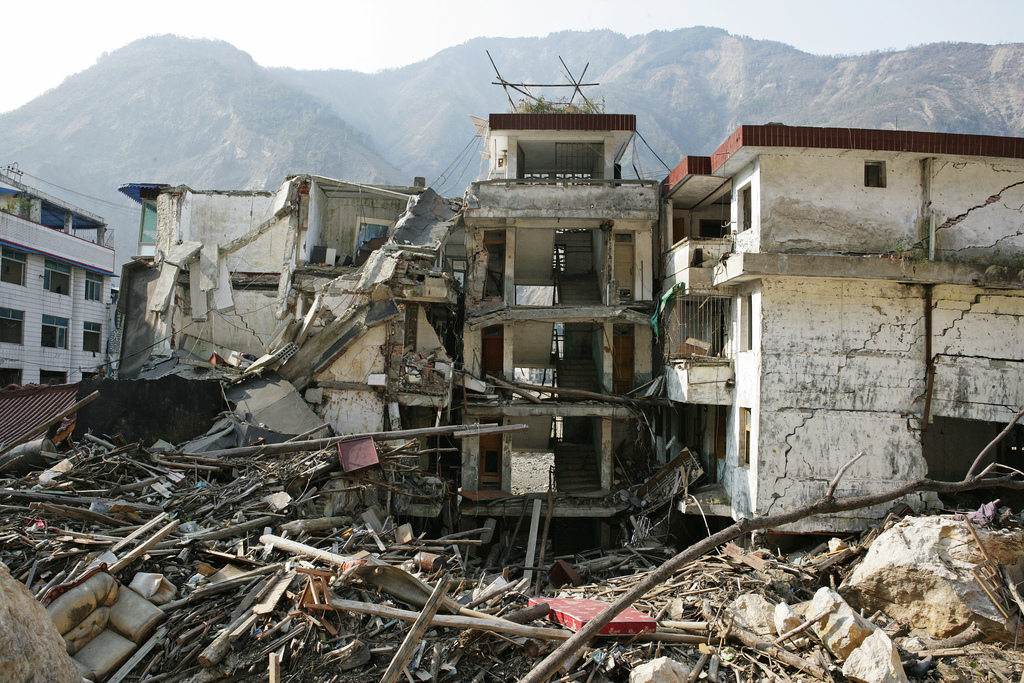
On May 12, 2008, a 7.9 magnitude earthquake in Sichuan Province caused 68,712 deaths, with an estimated 18,000 missing, most of whom were presumed dead.[125] In some areas, only school buildings suffered total damage while other buildings survived, which led the public to suspect shoddy construction and corruption.[126] Since the earthquake occurred in the afternoon during regular school session, students did not have a chance to escape the buildings. In a high school in Juyuan, for example, more than 270 students died.[127] The Beichuan Middle School building, moreover, was reduced to rubble in just 5 seconds.[128] According to a report released by the Sichuan Education Bureau, the earthquake destroyed 7,000 school classrooms, killing between 5,000[129] to 10,000 schoolchildren.[130] It remains unknown how many schoolchildren were severely injured or disabled. As a result of the one-child policy at the time,[131] most of the schoolchildren who died or were injured were the only child in their family, which exacerbated the pain and suffering of their parents.[132]
The shoddy construction was plainly evident as untrained eyes could find irregularities. Parents and rescuers reported that the steel rods found in the broken concrete slabs were no thicker than a ballpoint pen.[133] The twisted steel rods from the debris were so weak that an artist straightened them with his bare hands.[134] Experts from the United States and China agreed that the buildings could have withstood the earthquake if proper steel and concrete materials had been used during their construction.[135] The China Daily, a government newspaper, stated, “We cannot afford not to raise uneasy questions about the structural quality of school buildings.”[136]
Tort litigation would have shed light on whether the earthquake, the construction defects, or a combination of the two, caused the collapse of the school buildings. The construction firms would have had opportunities to defend themselves if they could show they exercised reasonable care in selecting construction materials and complying with the building code. If the construction defects indeed were the cause of the destruction of the school buildings, the parents would justifiably hold the negligent builders liable and put the public on notice of the builder’s tortious conduct to prevent future harm. If litigation uncovered illegal acts, such as corruption, concerned parties including the builders would have been subject to criminal prosecution. Tort lawsuits would have provided an opportunity for both parties to seek justice.
It seems that tort litigation is complementary to the government’s efforts to resolve disputes and maintain social stability. The parents, however, did not even have a chance to protest near the court house. An armed anti-riot police squad forcefully dispersed a protest organized by about 100 parents, who held their deceased children’s pictures in front of the court building.[137] In a separate incident in 2009, the police detained an eight-year-old boy along with his father overnight in prison in order to locate the boy’s uncle who had plan to petition the government for the death of his children in the earthquake.[138]
Despite pledging to investigate the collapsed buildings, the local government ended the investigation hastily by concluding that the earthquake was the sole cause of the collapse of the school buildings.[139] The government may have feared that a thorough investigation would have unearthed corruption or other illegal acts, causing even more public resentment and ultimately threatening social stability. To prevent any further investigation, the government cordoned off[140] and “bulldozed the remains of many schools” only a month after the earthquake.[141] Subsequently, the central government issued a report attributing the deaths and injuries of school children to shoddy construction, but it did not serve as a legal basis for parents to sue because the restrictions on civil litigation were still in place.
By circumventing the court proceedings, the government forced the parents to accept a comprehensive package, which paid $8,800 for the death of a child and $5,600 per parent for a pension.[142] The pension payment was intended to replace the benefits that the parents would have received after retirement if their children lived to adulthood.[143] The parents were initially not willing to accept the payment because it was too low. Once the parents accepted the compensation, they had to sign a contract promising not to protest against the government about the schools that collapsed. Instead of admitting responsibility for mismanagement, the contract portrayed the payment as a social benefit that the government granted to the parents. To receive the “benefit,” the parent had to agree, “From now on, under the leadership of the party and the government, we will obey the law and maintain social order……We vow resolutely not to take part in any activity that disturbs post-earthquake reconstruction.”[144]
VIII. Conclusion
Through the lens of the socialized liability principle, the analysis of leading case sheds light on the various unique features of the TLL. Socialized liability allows Chinese courts to hold a party who is not at fault liable for victim’s injuries. Conversely, it also permits courts to deny claims against a party who is at fault in mass tort cases in the name of maintaining social stability. Despite its elusiveness, socialized liability serves a vital purpose as it ensures that the injured victim will receive compensation in non-class action litigation regardless of whether the defendants are at fault in traditional negligence terms. Otherwise, the government fears that uncompensated victims may resort to undesirable dispute-resolution channels, such as openly petitioning the government, protesting in front of government buildings, posting embarrassing exposés online, or venting anger through acts that threaten public safety, all of which could undermine social stability.[145]
In cases of mass torts, however, the government fears that victims suffering similar injuries could form an influential group and collectively fight in court against tortious SOEs as well as private companies possibly backed by the government for corrective reasons. Inquiries into fault could expose problems of mismanagement and corruption, attracting unnecessary attention and arousing public resentment. The advent of social media, albeit tightly censored in China, makes it difficult for the government to block information. The strategy for the government, therefore, is preemptively to prevent victims from congregating online or on the streets by compelling them to accept government-determined compensation, although grossly inadequate in monetary terms, and to promise not to pursue further litigation. The government then directs courts not to take their claims, bars lawyers from litigating mass tort cases, and invokes criminal laws to punish disgruntled agitators. The government takes all these measures in the name of maintaining social stability, the cornerstone of the dubious legal concept of socialized liability.
Scholars often refer to Article 24 as an example of equitable liability, which is clearly a misnomer as it is certainly inequitable to hold a party not at fault liable in cases where there is no justification for imposing strict liability. Yet, scholars are correct that there is a “benefit” created by compelling a non-fault party to pay or by shielding a party who is at fault from litigation. But they have missed the crucial question of where the “benefit” goes. The analysis based on socialized liability principle reveals that the “benefit” goes to the state, which fails to provide a social safety net. In this sense, courts have become a tool for the government to redistribute wealth, compensate the victims, and maintain social stability. The concerns about social stability and state interests take precedence over any analysis of fault in non-strict liability cases. Even though socialized liability defies the traditional notion of justice, it remains a pragmatic tool in the TLL precisely because of its flexible, adaptive, and ambiguous nature.
* Chenglin Liu is a Professor of Law, St. Mary’s University School of Law. I am grateful to my colleagues Vincent Johnson, John Teeter, Bonita Roberts, and Bernie Kray for their valuable comments. I would like to express my gratitude to Yang Chenggeng, Gao Qi, Wang Yongxia, Guo Dong and other Chinese law professors for their insights, encouragement and friendship. They helped me with finding Chinese tort law cases and commentaries, without which this article would not have been possible. Also, an anonymous commentator provided his or her critical feedback on the first draft of the article, for which I am grateful. I would also like to thank Katie Neidig, Cali Franks, and Daniella Alvarado for their excellent assistance.
[1] Zhonghua Renmin Gongheguo Qinquan Ze Ren FA (中华人民共和国侵权责任法) [Tort Liability Law of the People’s Republic of China] (promulgated by the Standing Comm. Nat’l People’s Cong., Sept. 26, 2009, effective July 1, 2010), http://www.gov.cn/flfg/2009-12/26/content_1497435.htm.
[2] Id.
[3] Id.
[4] Id. From Chapter I to Chapter IV, the TLL covers General Provisions, Constituting Liability and Methods of Assuming Liability, Circumstances to Waive Liability and Mitigate Liability and Special Provision on Tortfeasors.
[5] See id. at Chapter V to Chapter XI.
[6] TLL, supra note 1, at Art. 1.
[7] Id. at Art. 2.
[8] See generally Yang Gengde (阳庚德), Sifa Chengfa Lun (私法惩罚论) [On the Punitive Nature of Private Law], 21 (6) PEKING U. L. J. (中外法学) 835, 835 (2009). (arguing that it is not settled whether tort law, as a private law, should punish tortfeasors) Li Xia (李霞), Gaokong Paowu Zhiren Sunhai de Falv Jiuji (高空抛物致人损害的法律救济) [The legal remedies for injuries caused by falling objects], J. Shandong U. (Soc. Sci. Ed,) (山东大学学报) 113, 116 (2011) (arguing that Article 87 of the TLL should be based on the principle of private law); Sun Zhengwei (孙政伟), Lun Sifa Shang de Chengfa (论私法上的惩罚)[The penalties based on private law], 140 (5) J. Zhejiang Gongshang U. (浙江工商大学学报) 53, 54 (2016) (arguing the German jurisprudence on the dichotomy of private and public law has deeply influenced the study of Chinese civil law); Zhang Jiayong (张家勇),Lun Tongyi Taopai Ren Dui Taopai Jidongche Zhaoshi de Peichang Zeren–Yi Gongsi Fa de Guanxi Wei Shijiao (论同意套牌人对套牌机动车肇事的赔偿责任—以公私法的关系为视角) [The liabilities for a driver who fraudulently uses a license plate and causes injuries to others—from a perspective of private and public law] 203 (12) JiNan J. (Phi. & Soc. Sci. Ed.) (暨南学报), 101, 108 (2015) (deeming tort law as a private law); Wu Yuanyuan (吴元元), Falv Fu’ai Zhuyi yu Qinquanfa zhi Shi (法律父爱主义与侵权法之失) [Legal paternalism and the failure of tort law], 70 (3) J. East China U. POL. Sci. & L. (华东政法大学学报)133, 133 (2010) (stating that tort law belongs in the category of private law); Bai Jiang (白江), Woguo Ying Kuoda Chengfa Xing Peichang zai Qinquanfa Zhong de Shiyong Fanwei (我国应扩大惩罚赔偿在侵权法中的适用范围) [China should expand the scope of their application of punitive damages in tort cases], 9 (3) Tsinghua U. L. J. 111, 118 (清华法学) (2015) (arguing that a tortious act violates private law).
[9] Shen Huiwen (申惠文), Woguo 《 Qinquan Zeren Fa 》 Sunhai Buchang Tiaokuan De Jieshi Lun (我国《侵权责任法》损害补偿条款的解释论) [Comments On The Interpretation Of The Compensation Provisions In The TLL] 91, J. of SW. U. of Pol. Sci. & L.(西南政法大学学报) (2014) (arguing the TLL is the product of the socialist jurisprudence), http://article.chinalawinfo.com/ArticleFullText.aspx?ArticleId=91118; Yuan Wenquan and Yang Tianhong (袁文全 杨天红),Jiangou Da Guimo Qinquan Zonghe Yingdui Tixi de Biyao Xing Ji Jiben Shexiang—Jiyu Qinquan Zeren Fa de Lifa Mudi建构大规模侵权综合应对体系的必要性及基本设想—基于《侵权责任法》的立法目的 [The necessity of constructing a comprehensive responsive system for dealing with mass torts—A study of the legislative purpose of the TLL], 12 J. S.W. U. Nationalities (L. Sci. Ed.) (西南民族大学学报),93,95(2014)(arguing that mass torts could seriously damage public trust in the government making it necessary to establish a system to provide adequate compensation for tort victims, who could become a potential force to cause social unrest if they are left uncompensated); Yuan Wenquan and Yang Tianhong (袁文全 杨天红), Zhengfu Jiuji Da Guimo Qinquan de Falv Kaoliang政府救济大规模侵权的法律考量 [Some thoughts on the remedies provided by the government in mass torts], 200 (3) J. Soc. Sci. (社会科学辑刊) 90, 90-92 (2012) (arguing the lack of adequate compensation for tort victims threatens social stability); Wu Liangjun (吴俍君), Da Guimo Qinquan Sunhai Duoyuan Jiuji Jizhi de Jiangou大规模侵权损害多元化救济机制的建构 [A multi-faceted approach to providing remedies in mass tort cases], 26 (6) J. Sichuan U. Sci. & Eng. (Soc. Sci. Ed.)(四川科技大学学报, 66, 68-70 (2011) (arguing that providing adequate remedies for victims in mass tort cases is conducive to maintaining social stability); Wang Liming (王利明), Jianli he Wanshan Duoyuan Hua de Shouhai Ren Jiuji Jizhi 建立和完善多元化的受害人救济机制 [Establishing and improving a well maintained and multifaceted system to provide tort victims with legal remedies],4 J. Chinese L. (中国法学) 146, 150 (2009) (claiming the lack of remedies for tort victims would cause social unrest).
[10] The above-cited articles invariably argue the necessity for the government to establish funds for tort victims to maintain social stability. While the government plays a crucial role in providing tort compensation, it frequently directs courts to dismiss torts case brought by individual tort victims, especially, in mass tort cases. See also Section VII of the article.
[11] See Cao Xianfeng (曹险峰), Lun Gongping Zeren De Shiyong —— Yidui 《 Qinquan Zeren Fa 》 Di 24 Tiao De Jieshi Lun Yandu Wei Zhongxin, (论公平责任的适用——以对《侵权责任法》第24条的解释论研读为中心) [The Application of Article 24 of the TLL and the Equitable Liability Principle], J. N.W. U. Pol. Sci. & L. (Legal Sci.), (西北政法大学学报) 104, 105, (2012).
[12] Chen Benhan (陈本寒), Chen Ying (陈英), Gongping Zeren Guize Yuanze De Zai Tantao—Jianping Woguo 《 Qinquan Zeren Fa 》 Di 24 Tiao Lijie Yu Shiyong, (公平责任归责原则的再探讨—兼评我国《侵权责任法》第 24 条的理解与适用) [Comments on Understanding and Applying Article 24 of the TLL], 172 L. REV. (法学评论), 136, 140 (2012).
[13] Id.
[14] Id.
[15] See Cao, supra note 11.
[16] Id.
[17] Id.
[18] Percy R. Luney Jr., Traditions and Foreign Influences: Systems of Law in China and Japan, 52 Law & Contemp. Probs. 129, 140 (1989) (“The German-style Soviet Code’s influence is readily apparent in the General Principles’ ‘socialist’ provisions.”).
[19] Zhonghua Renmin Gonghe Guo Minfa Tongze (中华人民共和国民法通则) [The General Principles of Civil Law (GPCL)] (promulgated by the Nat’l People’s Cong. April 12, 1986, effective Jan. 1, 1987) (Lawinfochina).
[20] Chen Ke (陈科), Gongping Zeren Yiban Tiaokuan de Sifa Shiyong—Yi 100 fen Qinquan An’li Panjueshu Wei Fenxi Yangben (公平责任一般条款的司法适用—以100份侵权案件判决书为分析样本) [The study of the equity principle in the judicial practices by examining 100 torts cases], 1 J. Application of L. (法律适用) 11, 11 (2015). (stating that Article 24 of the TLL is derived from Article 132 of the GPCL)
[21] Dan B. Dobbs, Paul T. Hayden, & Ellen M. Bublick, Hornbook on Torts 4 (2nd ed. 2016). (“In the great majority of cases today, tort liability is grounded in the conclusion that the wrongdoer was at fault in a legally cognizable way.”).
[22] See generally, Justin Yifu Li, Lessons of China’s Transition from a Planned Economy to a Market Economy, The Distinguished WSPIZ and TIGER Lecture at Kozminski School of Management, Warsaw, Poland, Dec. 17, 2004, https://object.cato.org/sites/cato.org/files/serials/files/cato-journal/1996/11/cj16n2-3.pdf.
[23] Scott Cendrowski, China’s Global 500 Companies Are Bigger Than Ever—And Mostly State-Owned, Fortune (Jul. 22, 2015), http://fortune.com/2015/07/22/china-global-500-government-owned.
[24] See Section VII of this Article.
[25] See Susan Trevaskes et al. ed., The Politics of Law and Stability in China, 1 (2014).
[26] Xin Ren, Tradition of the Law and Law of the Tradition, 47–64 (1997).
[27] See Roger V. Des Forges, Ning Luo, Yen-bo Wu, Chinese Democracy and the Crisis of 1989: Chinese and American Reflections, 109 (1993). By China’s official estimates, the number of Chinese students who study abroad each year is between 700,000 and 800,000. See also, Luo Wangshu, More Chinese Set to Study Overseas, China Daily, Mar. 8, 2017, http://www.chinadaily.com.cn/china/2017twosession/2017-03/08/content_28470916.htm.
[28] See Jinghan Zeng, The Chinese Communist Party’s Capacity to Rule: Ideology, Legitimacy and Cohesion, § 1.2 (2015).
[29] See Ian Talley, China Is One of the Most Unequal Countries in the World, IMF Paper Says, Wall. St. J. (Mar. 26, 2015), https://blogs.wsj.com/economics/2015/03/26/china-is-one-of-most-unequal-countries-in-the-world-imf-paper-says/.
[30] See Ansuya Harijani, China Wealth Gap May Be Far Worse Than Official Estimates, CNBC (Apr. 29, 2014), https://www.cnbc.com/2014/04/29/china-wealth-gap-may-be-far-worse-than-official-estimates.html.
[31] See Wei Zhang, Understanding the Law of Torts in China: A Political Economy Perspective, 11 U. Penn. Asian L. Rev. 171, 194 (2016).
[32] Id.
[33] Kjeld Erik Brødsgaard (ed.), Chinese Politics as Fragmented Authoritarianism: Earthquakes, Energy and Environment, 89 (2016).
[34] Gu Weixia, Responsive Justice in China During Transitional Times: Revisiting the Juggling Path Between Adjudicatory and Mediatory Justice, 14 Wash. U. Glob. Stud. L. Rev. 49, 54 (2015) (stating that the government required judges to resolve cases that would cause social unrest through mediation). See also, Lawyers Warned to Shun Milk Suits, South China Morning Post, Sept. 23, 2008, http://www.scmp.com/article/653669/lawyers-warned-shun-milk-suits (stating that the government prohibited lawyers from representing victims in mass torts cases); Jun Xie and Lijuan Sun, Access to Collective Litigation in China: A Tough Work, 3 J. Pol. & L. 45, 48 (2010), http://www.ccsenet.org/journal/index.php/jpl/article/view/5277.
[35] TLL, supra note 1, at Art. 24.
[36] While writing this article, the author reviewed hundreds of cases that applied Article 24 of the TLL from the Supreme People’s Court database, which is available at wenshu.court.gov.cn. From these cases, it is extremely difficult to find any reasoning from the courts, especially the lower courts, as to why and when Article 24 is applicable. The following are typical examples where courts found that defendants were not at fault, but ordered them to share plaintiffs’ losses.
- In China, it is a custom for the groom to carry the bride to their decorated bedroom, a ritual that symbolizes a harmonious and happy life. In such a process, Luo Wenjun slipped and fell on a wet floor while he was carrying his bride Qiu Yingxia. As a result, Qiu flew out of Luo’s arms and hit a pole, receiving severe injuries. Qiu sued Luo for medical expenses and living costs. Although the court found Luo free from fault, it ordered him to pay Qiu RMB 1,045 ($150) based on Article 24 of the TLL. The court did not explain why Article 24 was applicable in this case. Qiu Yingxia Yu Luo Wenjun Jiankang Quan Jiufen Yishen Minshi Panjue Shu岳映霞与罗文军健康权纠纷一审民事判决书 (The Court Order in the Civil Case of Qiu Yingxia v. Luo Wenjun), (甘肃省秦安县人民法院) (Gansu Province Qin’an County People’s Ct., Mar. 24, 2014) <wenshu.court.gov.cn.>;
- In this case, a student slipped and fell on his way from the school’s cafeteria to the dormitory, causing him to lose four front teeth. The student filed a lawsuit against the school for negligence. Even though the court found that the school was not negligent, it ordered that the school pay the plaintiff RMB 14,148 ($ 2,200) for the implantation of his teeth. The court cited Article 24 of the TLL without explaining why and how it applied in this case. Li Yang Yu Pingdu Shi Dijiu Zhongxue Yishen Minshi Panjue Shu李扬与平度市第九中学一审民事判决书 (The Court Order in the Civil Case of Li Yang v. Pingdu No. 9 Middle School), (山东省平度市人民法院) (Shandong Province Pingdu County People’s Ct., June 20, 2013) <wenshu.court.gov.cn.>;
- In this case, a student broke his right hand in a physical education class while he attempted to pass a pommel horse under the teacher’s supervision. The court agreed with the school that the pommel horse routine for basic gymnastic education was a state-required course that all students must learn and pass. However, based on Article 24 of the TLL, the court required the school to share 40% of the student’s loss. Again, the court did not elaborate why the article was applicable. Wei shijie Yu Shanghai Shi Liaoyang Zhongxue Jiaoyu Jigou Zeren Jiufen Yishen Minshi Panjue Shu魏仕杰与上海市辽阳中学教育机构责任纠纷一审民事判决书 The Court Order in the Civil Case of Wei Shijie v. Shanghai Liaoyang Education Bureau (上海市杨浦区人民法院) (Shanghai Yangpu District People’s Ct., April 20, 2015) <wenshu.court.gov.cn.>;
- As guests, the plaintiff and defendant attended a party to celebrate the completion of a new house. According to the local custom, guests participated in a game to hunt for steam-buns. During the game, the defendant accidently fell and landed on the plaintiff’s right foot, causing injuries. The court found that the defendant was not at fault, but it still ordered him to pay RMB 1,300 ($200) for the plaintiff’s medical expenses. In addition, the court ordered the defendant to share one half of the court filing fees, RMB 400 ($60). The court only cited Article 24 of the TLL, but did not offer any explanation why the provision was relevant to the case. Zhou Bifeng Yu Fang Taiyuan Shengming Quan, Jiankang Quan, Shenti Quan Jiufen Yishen Minshi Panjue Shu 周碧凤与方泰源生命、健康权、身体权纠纷一审民事判决书The Court Order in a Civil Case of Zhou Bifeng v. Fang Taiyuan Regarding Rights of Life, Health and Boby (浙江省建德市人民法院) (Zhejiang Province Jiande People’s Ct., Dec. 5, 2014) <wenshu.court.gov.cn.>;
- Wu voluntarily helped Lu to fix a waterpipe without expecting to receive payment. Wu suspended his work because he did not feel well. Several hours later, Wu died of heart failure. Wu’s relatives sued Lu for damages. Even though the court did not find fault with Lu, it held that Article 24 was applicable and required Lu to share 10% of Wu’s medical and funeral expenses. Unlike other cases, the court provided two lines in the judgment reasoning that its holding was to promote the spirit of voluntariness and mutual assistance. In fact, such a ruling is counterproductive, because people would refuse voluntary help for fear of legal liability. Xiong Danying, Wu Maosheng Yu Lu Xiaofeng Yiwu Banggong Ren Shouhai Zeren Jiufen Yishen Minshi Panjue Shu熊单英、吴茂盛与鲁小凤义务帮工人受害责任纠纷一审民事判决书 (The Court Order in the Civil Case of Xiong Danying, Wu Maosheng v. Lu Xiaoyi in a dispute involving death in the course voluntary work (湖北省武汉市武昌区人民法院) (Hubei Province Wuhan City Wuchang District People’s Ct., Dec. 1, 2015) <wenshu.court.gov.cn.>.
[37] Xi Xiaoming (奚晓明), Zhonghua Renmin Gongheguo Qinquan Ze Ren Fa Tiaowen Lijie Yu Shiyong (《中华人民共和国侵权责任法》条文理解与适用) [The Understanding and Application of the TLL], (2010).
[38] See id. at 181–187.
[39] See id. at 182.
[40] Id.
[41] Id. at 185.
[42] Id.
[43] Id.
[44] Id.
[45] Id. at 186.
[46] Id.
[47] Id.
[48] Id. at 184.
[49] The numbers are based on a search on July 21, 2017 on the Supreme People’s Court’s website, www.wenshu.court.gov.cn with the searcher terms: 《中华人民共和国侵权责任法》第二十四条. The search result is available at https://goo.gl/8GV62k (See the left side of the webpage).
[50] Id.
[51] Id. (See the upright corner of the web page.)
[52] The summary of this case (Ou Zuming v. Hydraulic Power) is based on three reports:
- Ou Zuming Yu Chongqing Hangfa Jiafu Dianli Kaifa Youxian Gongsi Caichan Sunhai Peichang Jiufen Shensu, Shenqing Zaishen Minshi Caijueshu (欧祖明与重庆航发嘉涪电力开发有限公司财产损害赔偿纠纷申诉,申请再审民事裁决书) [The Court Order of the Property Disputes between Ou Zuming and Chongqing Hangfa Jiafu Hydraulic Power Co.] <shttp://wenshu.court.gov.cn/ (The link is no long active. A print copy of this report is on file with the author)> (Chongqing High. People’s Ct. Aug. 22, 2016) (China).
- Ou Zuming Yu Chongqing Hangfa Jiafu Dianli Kaifa Youxian Gongsi Caichan Sunhai Peichang Jiufen Er Shen Minshi Pan Jue Shu (欧祖明与重庆航发嘉涪电力开发有限公司财产损害赔偿纠纷二审民事判决书) (The Court Order of the Property Disputes Between Ou Zuming and Chongqing Hangfa Hydraulic Power Co.) < shttp://wenshu.court.gov.cn/ > (Chongqing No.1 Intermediate People’s Ct. Sept. 28, 2015) (China).
- Ou Zuming Yu Chongqing Longzhu Dianli Gufen Youxian Gongsi An’Ju Shuili Fadianchang, Chongqing Longzhu Dianli Gufen Youxian Gongsi Caichan Sunhai Peichang Jiufen Zaishen Shencha Minshi Caiding Shu (欧祖明与重庆龙珠电力股份有限公司安居水力发电厂,重庆龙珠电力股份有限公司财产损害赔偿纠纷再审审查民事裁定书) [The Court Order of the Property Disputes between Ou Zuming and Chongqing Longzhu Hydraulic Power Co.] <shttp://wenshu.court.gov.cn> (Chongqing High. People’s Ct. Jan. 17, 2014) (China).
[53] Id. (2) Ou Zuming argued that releasing water from the river lock was an ultrahazardous activity for which the defendant should be strictly liable. The court disagreed.
[54] GPCL, at Art. 123.
[55] See supra note 52 (1).
[56] Hu Honglan Deng Shangsu Chen Haiyun Tigong Laowu Zhe Shouhai Jiufen Yi’an (胡宏兰等上诉陈海云提供劳务者受害责任纠纷一案), [The Appellate Court Order of the Disputes between Hu Honglan and Chen Haiyun Regarding Personal Injuries] <shttp://wenshu.court.gov.cn> (Beijing No.1 Interm. People’s Ct. Sept. 26, 2016) (China).
[57] Id.
[58] Id.
[59] Id.
[60] See China’s Property Boom Continues as Prices Rise at Record Rate, Fortune, (Oct. 20, 2016), http://fortune.com/2016/10/21/china-property-prices-market/.
[61] See Beijing Fangjia Zoushi (北京房价走势) [The trend of property values in Beijing], http://bj.cityhouse.cn/market/.
[62] Qinquan Anjian Zhidao Anli Pingzhu (侵权案件指导案例评注) [Guiding Cases on Tort Law with Commentaries], 284 (Xi Xiaoming (奚晓明) & Luo Dongchuan (罗东川) eds., 2009).
[63] Id.
[64] Id.
[65] Minfa Tongze (民法通则) [The General Principles of Civil Law] (promulgated by the Nat’l People’s Cong., Apr. 12, 1986, effective Jan. 1, 1987), art. 126 (Lawinfochina).
[66] Xi, supra note 62, at 284.
[67] Id.
[68] Id. at 285.
[69] Id.
[70] Id.
[71] Yao Bin (姚彬) & Li Feng (李丰), Gaokong Paowu Zhiren Sunhai Falü Zeren Zhi Wojian—Qinquan Zeren Fa Di 87 Tiao De Pingxi (高空抛物致人损害法律责任之我见—侵权责任法第87条的评析) [Comments On Article 87 of the Tort Liability Law For Legal Liabilities Involving Injuries by Falling Objects], Douban Net (July 15, 2014), https://www.douban.com/note/373103770/.
[72] Gao Hongwei (高宏伟) & Yu Hao (虞浩), Chongqing “Yanhuigang Shangren” An De Fali Pingxi—Cong Jingjixue Shijiao Xunzhao Yige Zuiyou Jie (重庆 “烟灰缸伤人” 案的法理评析—从经济学视角寻找一个最优解) [A Legal Analysis of The “Falling Ashtray” Case in Chongqing—Finding an Optimal Solution From an Economic Perspective], Douban Net (June 17, 2011), http://article.chinalawinfo.com/ArticleHtml/Article_37071.shtml.
[73] Zuigao Renmin Fayuan Guanyu Queding Minshi Qinquan Jingshen Peichang Zeren Ruogan Wenti De Jieshi (最高人民法院关于确定民事侵权精神赔偿责任若干问题的解释) [The Supreme People’s Court’s Interpretation On Certain Issues Regarding the Determination of Civil Liability for Compensation for Emotional Damages] (promulgated by the Adjudication Comm. of the Sup. People’s Ct., Mar. 8, 2001, effective Mar. 10, 2001), art. 3, http://www.circ.gov.cn/web/site0/tab3189/info51740.htm (China).
[74] Xu Jilin (许纪霖), Guanyu Wusi Baisu, Chen Mingliang Su Wu Si An (关于吴思败诉, 陈明亮诉吴思案) [On Wu’s Loss in Chen Mingliang v. Wu Si], Caixin (财新) (Aug. 11, 2014), http://xujilin.blog.caixin.com/archives/75261.
[75] Id.
[76] Id.
[77] Id.
[78] Id.
[79] Id.
[80] Id.
[81] Phnom Penh & Yangon, How Powerful People Use Criminal-Defamation Laws to Silence Their Critics, The Economist (July 13, 2017), https://www.economist.com/news/international/21724993-some-countries-insulting-politicians-can-lead-jail-how-powerful-people-use.
[82] Id.
[83] Gao Liuzhi (高留志),Qiquan Fa Di 24 Tiao De Lilun Caozong Yu Huanyuan《侵权责任法》第24条的理论操纵及其还原 [The Applications of Article 24 of the TLL] (2013), http://article.chinalawinfo.com/ArticleHtml/Article_79449.shtml.
[84] Ji Zhongxing: Baozha An Beihou De “Si Xun Huan” 冀中星:爆炸案背后的 “死循环” [The Vicious Cycle Because the Beijing International Airport Bombing], Sohu.com (July 24, 2013), http://news.sohu.com/20130724/n382450349.shtml.
[85] Id.
[86] Id.
[87] Id.
[88] Id.
[89] Id.
[90] Id.
[91] Id.
[92] Gui Tiantian (桂田田), Zhang Jingwen(张静雯), Muji Zhe Cheng Ji Zhongxing Zhadan Zai Qi Shouzhong Baozha Bingwei Rengchu Shou Du Jichang Fasheng Baozha (目击者称冀中星炸弹在其手中爆炸 并未扔出首都机场发生爆炸) [Witness Reported That the Bomb Exploded In Ji’s Hand. He Did Not Throw It], Beijing Youth Daily (北京青年报) (July 21, 2013), http://news.qq.com/a/20130721/001464.htm.
[93] Id.
[94] Yi Ren (伊人), Shoudu Jichang Baozha An Shandong Fangmin Bei Yisong Shencha Qisu (首都机场爆炸案山东访民被移送审查起诉) [The Suspect In the Beijing International Airport Bombing Extradited To Shandong For Trial], BBC.Com (Aug. 12, 2013), http://www.bbc.com/zhongwen/simp/china/2013/08/130812_airport_blast_charged.
[95] Shoudu Jichang Baozha An Dangshiren Ji Zhongxing Huo Yinian Jianxing (首都机场爆炸案当事人冀中星获一年减刑) [Ji Zhongxing, Who Caused An Explosion In The Beijing International Airport, Received One Year Reduction From His Six-Year Imprisonment], Sina.com (Dec. 23, 2016), http://news.sina.com.cn/c/nd/2016-12-23/doc-ifxyxvcr7332175.shtml.
[96] See id. One commentator posted, “Who give you [the police] the power to beat [Mr. Ji] and cause him disabled? If this type of injustice continues, your family will be treated the same way one day.” “The one who beat [Mr. Ji] should bear the responsibility.” Other commentators posted, “[Mr. Ji] should be punished, but why have the ones who beat him not been brought to justice?” “Being disabled, how could he live his life?” http://comment5.news.sina.com.cn/comment/skin/default.html?channel=gn&newsid=comos-fxyxvcr7332175&group=0.
[97] Qian Bei (钱蓓),Baoli Shijian Heyi Zhici (暴力事件何以至此?) [What caused violent events?], 9 Shanghai People’s Congress (上海人大), 51(2013) (claiming that an official from Mr. Ji’s home town stated that the violent protest would not have happened, if the Dongguan government promptly investigated the police’s misconduct and compensated Mr. Ji); Wei Wenbiao (魏文彪), Zuihao de Shehui Zhengce Ji Zuihao de Xingshi Zhengce (最好的社会政策即最好的刑事政策) [The best social policy is the best crime prevention policy], 4 Dem. & Sci, (民主与科学) 77 (2013) (claiming the government should improve social safety nets to prevent crimes);Zhu Li (朱 力), Jiduan Shijian Buneng Guijiu Yu MinyuanShangsheng (极端事件不能归咎于民怨上升) (extreme events cannot all be attributed to public angst), 24 People’s Forum (人民论坛) 4 (2013), http://paper.people.com.cn/rmlt/html/2013-08/20/content_1288072.htm (arguing that the lack of social safety nets is the root-cause for the extreme violent events); Guo Lei (郭磊, Liqi Conghe er Lai(戾气从何而来) [Where does the angst come from?] 34 Xin Chan Jing (新产经), 64 (2013) (finding that when the government disproportionally emphasizes social stability, it often takes extreme measures to prevent people from voicing grievances, depriving socially vulnerable groups of opportunity to express their legitimate demands, elevating the social pressure to dangerous levels).
[98] See Ji Zhongxing: Baozha An Beihou De “Si Xun Huan” (冀中星:爆炸案背后的 “死循环”) [The Vicious Cycle Behind the Beijing International Airport Bombing], Sohu.com (July 24, 2013), http://news.sohu.com/20130724/n382450349.shtml.
[99] Chenglin Liu, Escaping Liability Via Forum Non Conveniens: ConocoPhillips’s Oil Spill in China, 17 U. Pa. J.L. & Soc. Change 137, 167 (2014).
[100] Luo Changping (罗昌平), Guangxi Fayuan Bushouli 1 3 Lei Anjian Shexian Guibi Fengxian Zhuanjia Weiji (广西法院不受理13类案件 涉嫌规避风险转嫁危机) [Guangxi Court Denied 13 Types of Cases Fueling the Suspicion of Diverting Crisis], People’s Net (Aug. 12, 2004), http://www.people.com.cn/GB/guandian/35560/2705126.html.
[101] Qian Wei (钱炜), Guangxi Fayuan Bushouli 1 3 Lei Anjian Shenggaoyuan Cheng You Guoqing Jueding(广西法院不受理13类案件 省高院称由国情决定) [Guangxi High Court Defended That Denying 13 Types of Cases Was Due To China’s Special Situation], China.com (Aug. 24, 2004), http://www.china.com.cn/chinese/difang/643257.htm.
[102] Chen Tao (陈涛),Yifa Kangzheng Zhong de “Fayuan Bu Shouli” Xianxiang Yianjiu (依法抗争中的 “法院不受理”现象研究) [On the Phenomenon of “the Court Dismisses the Case” in Rightful Resistance], 1 J.E. China U. Sci. & Tech. (华东理工大学学报)1, 2–5, (2015).
[103] Chris Buckley, People’s Daily Details Allegations Against Lawyers Detained in China, N. Y. Times (July 13, 2015), https://sinosphere.blogs.nytimes.com/2015/07/13/peoples-daily-details-allegations-against-detained-lawyers/.
[104] See Zhou Qiang, Zuigao Renmin Fayuan Guanyu Shenhua Sifa Gongke, Chujin Sifa Gongzheng Qingkuang de Baogao (最高人民法院关于深化司法公开、促进司法公正情况的报告) [The Supreme People’s Court’s Report On Promoting Open Trials And Safeguarding Justice], Xinhua Net (Nov. 11, 2016), http://news.xinhuanet.com/legal/2016-11/09/c_1119880228.htm, (Mr. Zhou Qian, the President of the Supreme People’s Court conceded that judges deny cases for fear of exposing problems).
[105] See Chenglin Liu, Chenglin, Profits Above The Law: China’s Melamine Tainted Milk Incident (2009), 79 Miss. L. J. 371 (2009).
[106] Zhang Weiping (张卫平), Qisu Nan: Yige Zhongguo Wenti de Sisuo (起诉难:一个中国问题的思索) [Difficult to sue: some thoughts on a typical Chinese problem], 6 J. Chinese L. (法学研究) 65 (2009).
[107] See generally, Carl Minzner, Xinfang: Alternative to Formal Chinese Legal Institutions, 42 Stan. J. Int’l. L. 103 (2006).
[108] Chenglin Liu, The Obstacles of Outsourcing Imported Food Safety to China, 43 Cornell Int’l L.J. 249, 291 (2010).
[109] See Yongshun Cai, State and Agents in China: Disciplining Government Officials 86 (2014) (“The occurrence of large scale destructive action or incidents with severe consequences means that local officials have failed to maintain social stability. Responsible officials, including local leaders, are likely to be disciplined for the failure.”).
[110] See Yuwen Li, Administrative Litigation Systems in Greater China and Europe 34 (2016).
[111] Liu Zuoxiang (刘作翔), Faguan Yeji Kaohe Mianlin de Liangnan Kunjing (法官业绩考核面临的两难境地) [The dilemma in the evaluation of judges], People’s Court Daily (人民法院报) (Sept. 18, 2015), http://article.chinalawinfo.com/ArticleFullText.aspx?ArticleId=92319.
[112] Carl F. Minzner, China’s Turn Against Law, 59 Am. J. Comp. L. 956, 937 (2011).
[113] Bufen Fayuan Wei Zhuiqiu Nianzhong Jieanlü Niandi Xianzhi Lian (部分法院为追求年终结案率年底限制立案) [Some courts denied cases at year end to increase case resolution rate], Nanfang Weekend (Dec. 16, 2011), http://news.sina.com.cn/c/sd/2011-12-16/181423645606.shtml.
[114] Zhang, supra note 109, at 74.
[115] Id.
[116] Id.
[117] Ling Li, Corruption in China’s Courts, in Judicial Independence in China: Lessons for Global Rule of Law Promotion 196, 213 (Randall Peerenboom ed., 2010).
[118] Id.
[119] See 最高人民法院关于适用《中华人民共和国民事诉讼法》的解释 Interpretation of the Supreme People’s Court on the Application of the Civil Procedure Law of the People’s Republic of China (Promulgated by the Supreme People’s Ct., Jan. 30, 2015, effective, Feb. 4, 2015.), Art. 263 and Art. 265, http://www.court.gov.cn/fabu-xiangqing-13241.html.
[120] Wang Shu (王姝), Zhongguo Jinnianlai Huanjing Qunti Shijian Pinfa Nianjun Zengsu Da 29% (中国近年来环境群体性事件频发年均增速达 29%) [Social Unrest Related to Environmental Pollution Increased by 29% Annually], Xin Jing Bao (新京报), Oct. 27, 2012, http://news.sohu.com/20121027/n355822896.shtml.
[121] Zhonghua Renmin Gonghe Guo Minshi Susong Fa (中华人民共和国民事诉讼法) [Civil Procedure Law of the People’s Republic of China] (promulgated by the Nat’l People’s Cong., April 9, 1991, effective April 9, 1991, amended June 27, 2017, effective (the amended provisions) July. 1, 2017). 2017 Standing Comm. Nat’l People’s Cong. Gaz. arts. 119, 123.
[122] See Adam Moser & Tseming Yang, Environmental Tort Litigation in China, 41 Envtl. L. Rep. 10895, 10897 (2010).
[123] See Yang Xiaomei (杨晓梅), Huanjin Minshi Susong Li’an Xianzhuang he Yuanyin (环境民事诉讼立案现状和原因) [The Status Quo and Reasons of the Environmental Civil Litigation Filing], 11 Fazhi Jingwei (法制经纬)[ Bells and Whistles at Legal System] Vol. 408, 2008 at 15.
[124] See Moser & Yang, supra note 125, at 10897.
[125] 68,712 Dead from May 12 Earthquake in Sichuan, Xinhua News (May 7, 2009), http://www.china.org.cn/china/news/2009-05/07/content_17736234.htm.
[126] Police Break Up Protest By Parents of China Earthquake Victims, Guardian (June 3, 2008), https://www.theguardian.com/world/2008/jun/03/chinaearthquake.china; see also China Anger over “Shoddy Schools,” BBC (May 15, 2008), http://news.bbc.co.uk/2/hi/asia-pacific/7400524.stm.
[127] Police Break Up Protest by Parents of China Earthquake Victims, Guardian (June 3, 2008), https://www.theguardian.com/world/2008/jun/03/chinaearthquake.china.
[128] Shi Yu (石玉), Mianyang Changwei Fushizhang: Jiang Jianding Beichuan Zhongxue Jiaoxue Lou Zhiliang (绵阳常委副市长:将鉴定北川中学教学楼质量) [Mianyang Deputy Executive Mayor Promised To Investigate The Construction Quality of the Beichuan Middle School Building] ,Diyi Caijing Ribao (第一财经日报) (May 26,2008), http://news.sohu.com/20080526/n257075030.shtml.
[129] By the Official Account of the Chinese Government, 5,000 Students Died or Remain Missing in the Earthquake. Sichuan Earthquake Killed More Than 5,000 Pupils, Says China, Guardian (May 9, 2009), https://www.theguardian.com/world/2009/may/07/china-quake-pupils-death-toll.
[130] Edward Wong, China Presses Hush Money on Grieving Parents, N. Y. Times (July 24, 2008), http://www.nytimes.com/2008/07/24/world/asia/24quake.html?mcubz=0.
[131] In 1979, the Chinese government instituted the notorious one-child policy, which remained in place until 2016. See, Mara Hvistendahl, Analysis of China’s One-Child Policy Sparks Uproar, Sci. Mag., Oct. 18, 2017, http://www.sciencemag.org/news/2017/10/analysis-china-s-one-child-policy-sparks-uproar.
[132] Upon the grieving families’ desperate plea, the local authority granted legal permission to the affected parents to have another child. See, Andrew Jacobs, One-Child Policy Lifted for Quake Victims’ Parents, N.Y.Times, May 27, 2008, http://www.nytimes.com/2008/05/27/world/asia/27child.html (“To lose a child is to lose everything for Chinese parents. A child is their only hope.”).
[133] Police in China Break Up Protests of Grieving Parents, Winston Salem J., (June 6, 2008), https://goo.gl/8GV62k.
[134] Ai Weiwei’s RA Show to House Weighty Remnants from Sichuan Earthquake, Guardian (June 15, 2015), https://goo.gl/8GV62k.
[135] Zheng Yinguang (张映光) et al.,Xuexiao Daota Yuanyu Jianzhu Zhiliang Guocha (学校倒塌缘于建筑质量过差) [Schools Collapsed Because of Poor Construction Quality], Caijing (财经) (June 3, 2008), http://www.caijing.com.cn/2008-06-03/100067212.html.
[136] Geoffrey York, Why China’s Buildings Crumbled, Globe and Mail, May 15, 2008, https://www.theglobeandmail.com/news/world/why-chinas-buildings-crumbled/article672477/.
[137] Police Break Up Protest by Parents of China Earthquake Victims, Guardian (June 3, 2008), https://www.theguardian.com/world/2008/jun/03/chinaearthquake.china.
[138] David Eimer, Relatives of Sichuan Earthquake Victims Imprisoned, Telegraph (May 4, 2009), at https://goo.gl/Nw3VNZ.
[139] Wong, supra note 134.
[140] Cara Ana, Amid Protests, China Ends Access to Collapsed Schools, Boston.com (June 5, 2008), http://archive.boston.com/news/world/asia/articles/2008/06/05/amid_protests_china_ends_access_to_collapsed_schools/?page=full.
[141] Wong, supra note 134.
[142] Id.
[143] According to Chinese culture and law, children are responsible for taking care of their aging parents.
[144] Wong, supra note 134.
[145] The Party and the government attaches great importance to maintaining social stability, which overrides any other interests including the exercise of constitutionally protected rights. On Feb. 7, 2017, the Supreme People’s Court of PRC issued the Notice on the Implementation of the Protection of Judicial Personals, Guanyu Yinfa 《 Renmin Fayuan Luoshi 〈 Baohu Sifa Renyuan Yifa Lüxing Fading Zhize Guiding 〉 De Shishi Banfa 》 De Tongzhi (关于印发《人民法院落实〈保护司法人员依法履行法定职责规定〉的实施办法》的通知) (Article 11 of the Notice prohibits protests in the adjacent area of the court buildings in the forms of siting out, blocking access, distributing leaflets, shouting slogans, and displaying banners. Punishments for violation of the notice range from administrative actions to criminal penalty.) http://www.chinacourt.org/law/detail/2017/02/id/149109.shtml.