[PDF]
By Thompson Chengeta*
The twenty-first century has seen the rise of populist leaders who do not respect human rights. The rise of such leaders has been explained in terms of current world problems like terrorism, migration, influx of refugees, economic stagnation, and cultural backlash against liberties that come with human rights, education, and other freedoms. Populists promise to rectify such problems at any cost, making it clear that nothing will stand in their way—not even fundamental human rights. They publicly support racial discrimination, torture and other violations of jus cogens norms of human rights. Despicable as they may seem, such populist demagogues often have the support of the electorate. This Article discusses whether such “anti-human rights candidates” (defined here as candidates whose record, conduct or proposed plans or policies are inconsistent with fundamental rights) are fit for public office. It further addresses the question whether a state that allows an “anti-human rights candidate” to run for public office violates its international obligations.
Introduction
Is it to be supposed that the ability to fascinate an electorate (as Hitler did) has some connection with the fitness for public office?[1]
—Roger Scruton
The office of the Head of State—indeed, any public office—plays a very important role in the protection of human rights. When assuming office, presidents often swear to defend their countries’ constitutions—constitutions which, in most cases, contain a bill of rights.[2] Across the globe, constitutions play a fundamental role in the daily realities of citizens and political governance.[3] The conduct of public officials, in particular, those in leadership positions, influences values that are respected in society.[4]
In an era of populism—where individuals who speak and act against human rights can still have a majority following—there are important questions that need to be answered: In the name of majority will, should such individuals be allowed to run for public office? Should the electorate be the sole judges of candidates’ fitness for public office? What are the international law obligations of a state when faced with a demagogue who commands a majority following yet speaks against fundamental human rights guaranteed in the state’s constitution and international human rights treaties to which it is a party? These are some of the main questions I seek to answer. This Article is premised on the idea that majoritarianism is not equivalent to democracy and that commitment to human rights norms should be one of the factors considered when determining a candidate’s fitness for public office.
Part I of this Article discusses the main factors that have contributed to populism in the twenty-first century and their impact on human rights. The section questions the primacy afforded to majority rule, in light of democratic processes producing leaders with a questionable record concerning human rights.
Part II of this Article delineates the scope of the arguments, and attempts to preempt arguments against consideration of human rights norms when determining a candidate’s fitness for public office.
Part III is a general discussion of the fitness for public office rule, based on a study of factors that are taken into consideration by states. The section addressed the lack of human rights considerations in such rules.
Part IV is a case study of the rules concerning the impeachment of a head of state. The section discusses this with examples of laws in the United Kingdom, Zimbabwe, South Africa, Philippines and the United States of America, and shows that impeachment is a political process that is largely ineffective to deal with the problem at hand. The section also addresses the question that if a president can be impeached—or can be potentially impeached—for human rights violations, can a candidate who plans to violate the same human rights be prevented from running for public office?
The above question leads to a potential conflict of interest and rights such as the right to vote, freedom of speech, and the right to participate in the political life of one’s country. This is the subject of discussion in in Part V. Further, there is also a discussion of the challenges that are posed by arguments on cultural relativism and universality of human rights when calibrating the fitness for public office rule on a human rights basis.
Part VI considers the important question of whether a state that allows an anti-human rights candidate to run for public office violates its international law obligations. This is more of a “prevention being better than cure” approach to governance.
This is followed by conclusions and recommendations in Part VII. In summary, the research finds that while human rights norms have played a fundamental role in shaping domestic, regional, and international policy, they have been given limited significance as far as the determination of who gets to govern a country. The Article argues that states’ international obligation to respect, promote, and protect human rights justifies ensuring that demagogues who attack guaranteed human rights are prevented from holding public office
I. Twenty-First Century Populism, Democracy,
Majoritarianism and Human Rights
The twenty-first century has seen the rise of populist leaders such as the U.S. President Donald Trump, the president of a French political party, Marine Le Pen, Norbert Hoffer, an Australian politician, Britain’s Nigel Farage, Geert Wilders from the Netherlands, and Julias Malema from South Africa—to mention a few. Several scholars have articulated some of the factors contributing to the twenty-first-century populism and its effects on human rights.[5]
Global problems such as terrorism, migration, and the influx of refugees are among the core factors that have led to a “dangerous rise of populism”[6] within nations and “global attacks on human rights.”[7] Today, the common mantra of demagogues is that human rights norms are essentially a stumbling block to governmental efforts to defend citizens.[8] To gain the support of the electorate, some politicians capitalise on the prejudices of the populace, encouraging a belief that economic stagnation, crime, and security threats are the effects of migration, for example.[9]
Pippa Norris and Ronald Inglehart have cited two of the major causes of populism in the twenty-first century: economic insecurity and cultural backlash.[10] The success of populist leaders is attributed to economic insecurity and social deprivation among those who feel that they have been left behind in modern political and economic developments thereby rallying behind demagogues who promise to address their issues.[11] What about cultural backlash?
The so called “left-behinds” or “less secure strata of society”—comprising mostly of the unemployed, low-wage earners, unskilled workers and generally poor and uneducated populations—have started to resent political classes and “elite politicians” whom they believe are not protecting them from immigrants who are blamed for unemployment and the shrinking of opportunities or the already scarce resources.[12] This has led to “the anti-establishment, nativist, and xenophobic scare-mongering exploited by populist movements, parties, and leaders.”[13] Essentially, politics has become the struggle of “them” versus “us.”[14]
The second factor is the “cultural backlash thesis” where it is suggested that the rise of populist leaders and demagogues is a reaction against “progressive cultural change.”[15] The suggestion is that international norms—such as human rights—have resulted in a “silent revolution” that has seen “an intergenerational shift toward post-materialist values, such as cosmopolitanism and multiculturalism.”[16] In essence, certain privileges, cultural perceptions and identities have been eroded by changes in value-systems, causing great discomfort in certain parts of populations. Those who are disgruntled are, therefore, launching a counter-revolution in the name of populism.[17]
During Trump’s presidential campaign, his mantra was “make America great again” while supporters of Brexit often chanted “we want our country back.”[18] Similar sentiments are present on the African continent, where leaders have been expressing their disapproval of foreign or western countries’ involvement on the continent—essentially arguing for “African solutions to African problems.”[19] These are voices of those who feel that certain value-systems—in particular those based on human rights—are altering their cultures or values they have considered important for a very long time. It is, therefore, a call to return to those values or salvage whatever is left of them.
Mainstream media and social mediaplayed a very significant role in the rise of populism, by giving the populists the coverage needed to disseminate their views.[20] Populists paint an apocalyptic image: they reckon that if something is not urgently done to change the political discourse—where the current leadership is painted as more interested in the rights of terrorists and immigrants than the welfare of its citizens, there will be nothing left for the natives and their children.[21]
Arch Puddington and Tyler Roylance have pointed to the common view among scholars that the form of populism discussed above threatens “the international order of the past quarter-century—rooted in the principles of democracy, human rights, and the rule of law [gives] way to a world in which individual leaders and nations pursue their own narrow interests without meaningful constraints, and without regard for the shared benefits of global peace, freedom, and prosperity.”[22] The fundamental question, from a human rights perspective, is whether these populist leaders are fit for public office.
During his campaign, President Donald Trump “stereotyped migrants, vilified refugees, attacked a judge for his Mexican ancestry, mocked a journalist with disabilities, dismissed multiple allegations of sexual assault…pledged to roll back women’s ability to control their own fertility [and] even toyed with reintroducing torture…if that’s what the American people want.”[23]
Given that the right to freedom from torture and the right to non-discrimination are part of customary international human rights law,[24] it can be argued that Trump’s stance on torture should have resulted in disqualification from standing election for a public office whose duties include protection of human rights.
Kenneth Roth has cited the negative effects of populism as the reason for Trump’s success—where the majority think that it is better to “embrace the autocrat who shows no qualms about asserting his ‘majoritarian’ vision—self-serving as it may be—and subjugating those who disagree”[25] than hold back because of some “fanciful” human rights norms.
The fact that Donald Trump was elected and remains the U.S. president paints a picture that human rights norms are of no essence when determining an individual’s fitness for public office. Before his election, those who wanted Donald Trump’s disqualification from U.S. presidency did so because of potential conflicts of interest between his duties as president and his maintaining his position in some of his businesses.[26] There was no formal attempt to disqualify Donald Trump based on his attitude towards human rights or his plans which apparently are inconsistent with customary international human rights norms.
In general, Devona Walker has noted that in the United States there is “a huge swath of politicians [who] have been linked to white supremacist groups or made outright racist statements.”[27] Yet, such politicians remain in power and can stand for elections. For example, during the 2010 South Carolina Republican primary, Jim Knotts, in reference to President Barack Obama, had this to say about his political rivalry: “[w]e’ve already got a raghead in the White House; we don’t need another raghead in the governor’s mansion.”[28] Knotts was not disqualified although he did lose the election in the end.
In 2004, Senator John McCain used a derogatory term against Asians, saying: “I hated the gooks. I will hate them as long as I live.”[29] Notwithstanding this, McCain was allowed to contest George Bush in the Republican presidential nomination in 2000.[30] In the same year, James Hart won the Republican primary in Tennessee even after he unequivocally vowed that if “elected he would work toward keeping ‘less favored races’ from reproducing or immigrating to the United States” and accused black people of having “‘poverty genes’ that threaten to turn the United States into one ‘big Detroit.’”[31]
Likewise, State Representatives Tommy Woods, Charles Sharpe, John Moore, Congressman Bob Barr, Governor Haley Barbour, and Senator Trent Lott are known supporters or members of the white supremacist group known as the Council of Conservative Citizens, yet they were not excluded from being part of the US government.[32] Lester Maddox, a former governor of Georgia, believed that black people are intellectually inferior to white people and supported segregation to the extent that he “kicked a black man out of his establishment after the Civil Rights Act of 1964 was passed.”[33]
Politicians who make distasteful racial slurs or speak and act against customary human rights norms are not only found in the United States but across the globe.[34] The rise of populism in America and Europe—with a consequence of wanton disregard of human rights norms—has encouraged some of the worst leaders in other parts of the world to continue with their attacks on human rights.[35] For example, President Vladimir Putin of Russia and President Xi Jiping of China now deflect criticism by pointing to similar, if not worse, circumstances in Europe and America.[36]
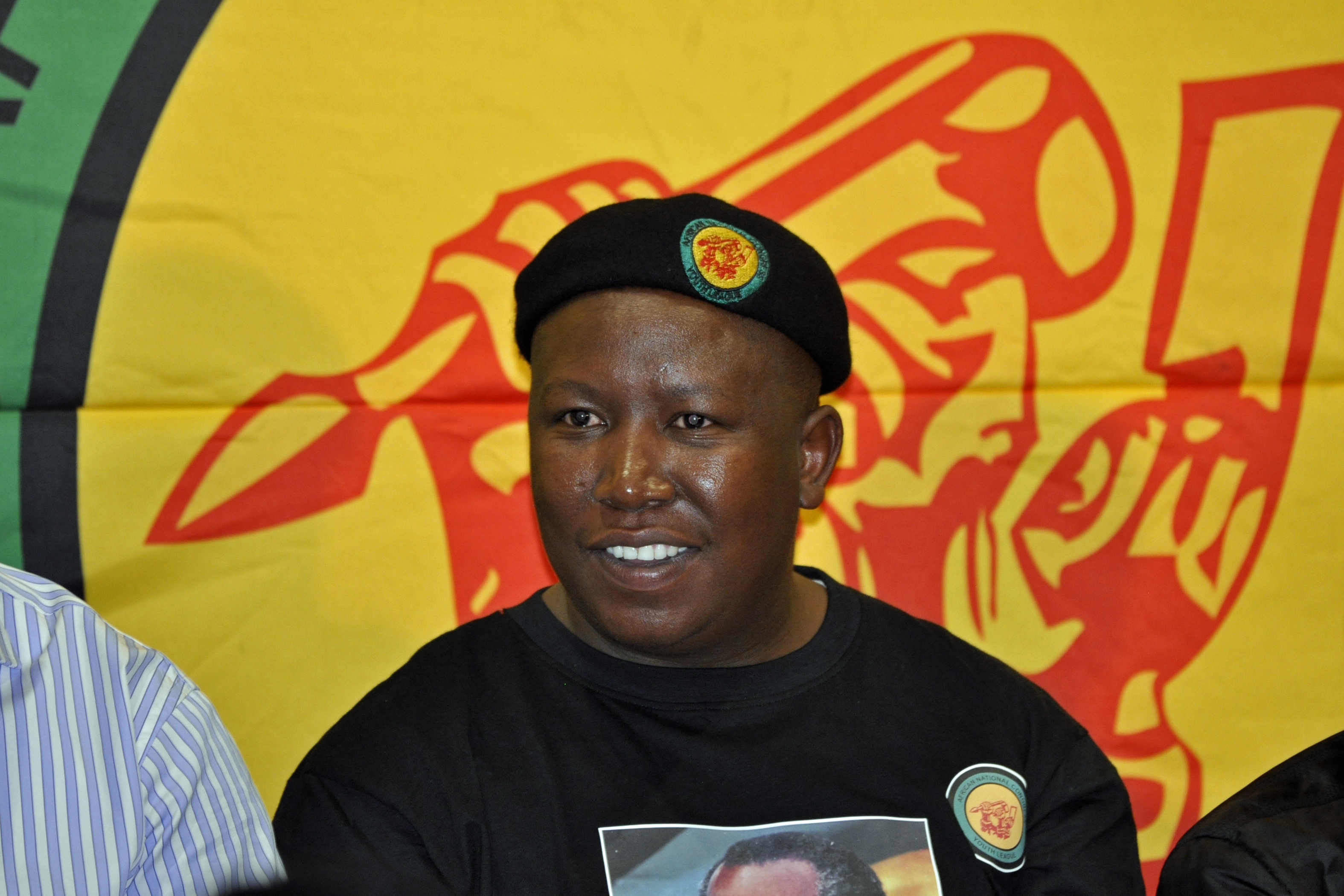
In South Africa, a number of public officials who have uttered racial slurs and whose human rights records are questionable remain in public office.[37] For example, the South African Economic Freedom Fighters’ (“EFF”) president, Julius Malema, has said a number of racial slurs, among them calling a white journalist a “thing.”[38] Although he was charged and convicted of hate speech for singing of the song “dubhula ibhun”’—which means shoot the boer (white person)—Malema is part of the South African Parliament.[39] No matter what the cause of frustration is, racism and racial slurs can never be justifiable. The EFF and Malema may be frustrated by the racial discrimination that black people continue to suffer in South Africa but responses that are equally racist or promote use of violence cannot be justified—especially from individuals occupying public office.
Former Zimbabwean president Robert Mugabe is also notorious for racial slurs against white people. In 2015, on his official visit to South Africa, he was approached by journalists—among them, a white man—and openly stated “I don’t want to see a white man.”[40] During a UN General Assembly meeting in New York, he referred to white people as “pink noses.”[41] Within Zimbabwe, Mugabe unconstitutionally seized land from white farmers, perpetrating racial discrimination in the name of the majority black Zimbabweans. Many people supported his land reform program out of the genuine need of land, despite the fact that the program was tainted with racial discrimination and gross violations of property rights. Like the Americans who supported Trump’s bigotry, supporters of Mugabe’s racial slurs against white Zimbabwean farmers forget that dictators “who sacrifice the rights of others in our name today” do not hesitate “to jettison our rights tomorrow when their real priority—retaining power—is in jeopardy.”[42]
In October 2016, President Muhammadu Buhari of Nigeria said, “my wife belongs to my kitchen and my living room and the other room.”[43] This was his response after his wife commented on his failing political leadership.[44] The irony of the situation is that Buhari said this on his official visit to Germany while standing right next to German Chancellor Angela Merkel, one of the most powerful women in the world.[45] Despite his discriminatory stance towards women in Nigeria, Buhari continues to occupy public office.
These incidents raise questions about whether respect for human rights have any place in assessing a candidate’s fitness for public office, and if it does, what weight is given to it. There are stricter rules in sports—for example, referees can disqualify players from tournaments for uttering racial slurs or engaging in conduct that amounts to racial discrimination.[46] Yet in politics and governance—fields that are more critical to human rights—we have politicians who churn out racial slurs and engage in human rights violations but remain in power and can run for public office. If ours is an age of human rights,[47] why are our standards so low?
Questionable Appointments at Regional and International Organizations
In governance, one can say that “the fish starts to rot from the head.”[48] In other words, if there are problems right from the top, one cannot expect better at the bottom. International organizations such as the United Nations must take lead as far as respect of human rights norms is concerned.
Yet, States whose human rights records should disqualify them from taking leadership roles in human rights intergovernmental organizations have been elected as leaders. For example, in late 2016 Saudi Arabia—a country considered to have “the world’s worst record on women’s rights”[49]—was elected by the United Nations General Assembly to be part of the fourteen Member States which serve three-year terms on the UN Human Rights Council.[50] Electing states with poor human rights records to leadership roles in United Nations human rights initiatives can put pressure on such states to reform. However, it undermines institutional integrity to the extent that the perceived potential advantage is overshadowed or not worthwhile.
In view of Saudi Arabia’s poor human rights record, Human Rights Watch has strongly criticized the election of Saudi Arabia to the Human Rights Council.[51] There are already claims that Saudi Arabia is using its position in the Human Rights Council to cover up its human rights abuses.[52] It is for some of these reasons that Amnesty International has called for the removal or suspension of Saudi Arabia from the Human Rights Council.[53]
How is it possible for the Human Rights Council—an intergovernmental body “responsible for the promotion and protection of all human rights around the globe”[54] —to have a country whose human rights records is among the worst in its leadership? Is Saudi Arabia fit for that role? The Human Rights Council should have mechanisms that guard against this if it is to be an intergovernmental body that is serious about the protection of human rights, lest it will fail like its predecessor, the UN Commission on Human Rights.[55]
Likewise, at the regional level and in full view of Mugabe’s atrocities and human rights abuses, members of the African Union elected him as the chairperson of the African Union.[56] Under Article 4(h) of the African Union’s Constitutive Act, one of the functions of the African Union is “to promote and protect human and peoples’ rights in accordance with the African Charter on Human and Peoples’ Rights and other relevant human rights instruments.”[57] The African Union’s seriousness with human rights is seriously undermined when its members choose to elect a man who stands accused of gross violation of human rights as its chairperson.
Considering that individuals with terrible human rights records or attitudes, like Trump of the United States and Mugabe of Zimbabwe, and states with well documented human rights violations, like Saudi Arabia, continue to be given leadership roles in institutions or offices that are meant to protect human rights, it is not surprising that Kenneth Roth considers human rights values to be under global attack.[58]
Having discussed some of the factors that have contributed to the rise of populist leaders whose ideas and plans are inconsistent with international human rights norms and how some of such leaders have been voted into power, below are research questions that will be discussed in this Article:
- What is the role—if any—of international human rights norms in determining a candidate’s fitness for public office?
- What are the challenges that are posed by arguments on the universality or relativity of human rights norms and conflict of interests when determining an individual’s fitness for public office?
- What are the international law obligations of a state when faced with a demagogue who enjoys the support of the electorate yet speaks or acts against fundamental human rights guaranteed in the state’s constitution, international human rights treaties, or customary international law?
II. Limitations and Scope of Research
Human rights norms have played a fundamental role in influencing the policies that govern humanity. Louis Henkin observed that “ours is the age of human rights” and that “human rights is the idea of our time, the only political-moral idea that has received universal acceptance.”[59] This has been supported by scholars like Philip Alston who contemplated that human rights are “above the rank and file of competing societal goals” because of their “aura of timelessness, absoluteness and universal validity.”[60]
Yet some scholars have asked whether the age of human rights is over because of the prevalence of wars, violence, human rights violations, heinous crimes, and a culture of impunity which has not only seen individual perpetrators going unpunished but powerful states like the United States seemingly ignoring human rights norms in its global war on terror.[61] In late 2016, Kenneth Roth, the Executive Director of Human Rights Watch, observed that there are “global attacks on human rights values” owing to “the dangerous rise of populism” and election to public office of demagogues who have no respect for human rights.[62] If “ours is the age of human rights” as contemplated by Louis Henkin, why are individuals who speak and act against human rights earning the popular vote in countries that are supposed to be leading on human rights protection? It is along these lines that Makau Mutua has argued that the “human rights project” has lost “its power to mobilise outrage and action.”[63]
Notwithstanding these developments, human rights are neither an “era” nor a “project.” As rightfully observed by Philip Alston, human rights are timeless. Human rights are inherent in human beings, and they are human entitlements today and forever.[64] Just as the prevalence of crime does not invalidate criminal laws, the fact that human rights are violated does not mean they cease to exist. Instead, what is needed is for the international community to reaffirm the importance of human rights and demand their respect.[65]
Nevertheless, one has to realise that while citizens should demand respect for human rights for those who seek public office, it is easier in the context of civil and political rights than it is with socio-economic rights. In the civil and political rights domain, it is easy for the electorate, for example, to identify a right that was violated, the violator, and demand a remedy.[66] Consequently, it is easy for the electorate to determine whether an individual seeking to occupy public office has participated in the violation of a right. The case is not the same with socio-economic rights.[67] At the state level, socio-economic rights are subject to progressive realization and states are entitled to a margin of appreciation as far as distribution of resources is concerned.[68]
Furthermore, in human rights advocacy and the society at large, it is easier to mobilize outrage and action against violations of civil and political rights than it is for socio-economic rights. It is for the same reason that when the Author discussed examples of bad politicians above, it is examples of politicians who have acted against civil and political rights. It is unfortunate that we live in a society where economic dictators are acceptable while political dictators are despicable, and it appears the international community is more outraged by political tyranny than economic tyranny.[69] It is in this regard that Makau Mutua has observed that “the bias toward civil and political rights favours vested, narrow class interests and kleptocracies which are entrenched in the bureaucratic, political, and business sectors of society and represent interests that are not inclined to challenge the economic powerlessness” of the citizens.[70]
Therefore, while it may be easy to argue on principle for the exclusion of a candidate from public office based on his or her support for torture, it is less convincing to argue for the exclusion of a capitalist politician whose policies and economic monopoly substantially contributes to the suffering of the poor. Thus, even though socio-economic rights are not irrelevant in the inquiry of an individual’s fitness for public office, this memorandum will largely focus on civil and political rights and their impact on the fitness for office rule.
Many socio-economic human rights are entitlements of citizens that are claimable against the state.[71] Therefore it is difficult to ascertain a candidate’s human rights record, in his or her personal capacity, when they have not previously served in a public office. However, scholars have begun to accept that non-state actors can incur responsibility for human rights violations.[72]
More importantly, when shaping policy at domestic and international level there have been strong suggestions for a multi-disciplinary approach—giving due consideration to values and principles from different fields. Makau Mutua has already criticized an approach that takes human rights as the only discipline that can solve the problems of humanity.[73] This is particularly relevant in a discussion of a candidate’s fitness for public office, which has implications on democracy, state sovereignty, self-determination, the rights of citizens to decide who governs them and the rights of the minority to be protected from the whims of the majority. Makau has noted as follows:
The human rights movement is presented by its scholars and advocates as above politics…movement scholars and activists paint it as a universal creed driven by nobility and higher human intelligence. The idiom of human rights is tinged with metaphors and language that suggest eternity or a final resting point in human history. The basic human rights documents are not presented as either instrumentalist, utilitarian, experimental or convenient. Rather, the authors speak as though such documents are the final truth. This elusive, yet lofty, idealism is almost biblical in its forbidding language. It implies that questioning its doctrine is perverse and unwelcome.[74]
Further, human rights activists have already been warned from adopting approaches that makes them dictators or appear to be usurping democratic processes in the name of advancing a human rights agenda.[75] Though I note from the onset that human rights is not a panacea, one cannot deny the significance of taking human rights seriously when considering whether or not an individual is fit for public office. Thus, while I will argue and emphasize the importance of human rights considerations as far as determining who should be allowed to stand election for public office, I am alive to other disciplines and interests. After all, human rights norms are there to “address mundane human problems” and may as well be part of politics.[76] What is paramount is striking a balance where there are competing interests.
III. Fitness for Public Office Rule
The question whether a candidate’s “ability to fascinate an electorate”[77] is reflective of their fitness for public office is critical in an era where certain demagogues whose speech and actions are against peremptory human rights norms are being elected into office. Normatively and from a human rights perspective, “popular elections do not override the constitutional requirements for probity, integrity and adherence to national values and principles.”[78] Thus, the fact that a candidate is able to command a majority following does not mean that they are fit for public office. For that reason, the electorate cannot be the sole judge of a candidate’s fitness for public office.
In answering the question on the issue of mere majoritarianism and fitness for public office, Roger Scruton has noted that there is a remarkable quality of those who occupy public office because of their inviolable “social and political dignity” as opposed to political firebrands who come to power by appealing to misguided populism and bigotries.[79]
The fitness for public office rule entails the examination of the private and public life of an individual who seeks to occupy public office whether through election or appointment, to determine their fitness to serve.[80] A comprehensive consideration of various jurisdictions across the globe on the fitness for public office rule shows that “it is the law everywhere that when a person becomes a candidate for a public office, his qualifications and fitness for that office may be freely and fully discussed.”[81] There is, of course, a compelling rationale for this. As rightfully pointed out by Kgafela, because “leadership decides the destiny of societies” and “without leadership, all the other rights enshrined in a national constitution remain paper rights that cannot be enjoyed,” “there must be provision for minimum standards of honor coupled with scientific evaluation of fitness for public office.”[82]
It is critical to note factors that are considered when determining a candidate’s fitness for office. While across jurisdictions the common factors that are considered when questioning a candidate’s fitness for public office are past criminal convictions,[83] lack of integrity,[84] financial delinquency,[85] conflict of interest,[86] and ill-health,[87] the Supreme Court of the United States has indicated that “anything which might touch on an official’s fitness for public office is relevant.”[88] Further, in demonstrating the relevance of “every conceivable aspect” of the life of a candidate who seeks to occupy public office when determining their fitness, the US Supreme Court held that no conduct of an official is too “remote in time or place.”[89]
It is along the same lines that the United Kingdom’s Committee on Standards in Public Life (“CSPL”)[90] has pointed out that “private behaviour can legitimately affect an individual’s employment in public office” since what is done and said in private impact on the reputation of a public office.[91] There is no doubt that citizens “draw conclusions about an individual’s public behaviour from what they know of their private behaviour.”[92] There are various examples of politicians who, on account of their “scandalous behaviour,” casting doubt on their fitness for office, have been excluded from public office.[93] The rationale behind this is that if a politician cannot well-behave in private, there is a high risk of them doing the same in public office.[94]
In the name of fitness for public office, various states have pre-employment background investigations. Such pre-employment background investigations are not limited to politicians but also apply to all public safety professionals such as police officers.[95] Of course, while the scrutiny into public officials’ private life is highly necessary,[96] it must be balanced with their right to privacy.[97]
Several jurisdictions have also considered what is meant by “integrity of public officers” in the context of fitness for public office rule. In South Africa for example, in the case of Democratic Alliance v. The President of the Republic of South Africa,[98] the court stated that to determine a candidate’s integrity, there is need for an objective assessment of both the candidate’s personal and professional life.[99] Referring to the Oxford English Dictionary, the Court defined a person of integrity to be one whose character is unimpaired, uncorrupted, incorruptible, sinless, virtuous, upright, honest, trustworthy and sincere.[100]
Likewise, when the Kenyan High Court considered the question of integrity as a factor of determining an individual’s fitness for public office, it noted that ”a person is said to lack integrity when there are serious unresolved questions about his honesty, financial probity, scrupulousness, fairness, reputation, soundness of his moral judgment or his commitment to the national values enumerated in the Constitution.”[101] In relation to criminal convictions and integrity, the Court held that whether or not a person has “been convicted of a criminal offence is not dispositive of the inquiry whether they lack integrity or not.”[102] It is a matter of whether there are, in fact, “plausible allegations which raise substantial unresolved questions about one’s integrity.”[103]
Apparently, while the fitness for public office rule is embedded in various domestic legislations and policies, few expressly mention human rights standards as part of the considerations when determining an individual’s fitness for public office.[104] Likewise, there are no international or regional treaties, policies, declarations, or guidelines articulating the fitness for public office rule and the role of human rights standards when determining a candidate’s fitness for public office.
In light of this, the main question for discussion in this Article is that if “anything which might touch on an official’s fitness for public office is relevant,”[105] what weight should be given to international human rights norms—especially those that are part of customary international law or part of jus cogens when determining an individual’s fitness for public office? Should an individual who speaks or act against customary international human rights law or norms that are part of jus cogens be allowed to stand election for public office—an office whose duties include protecting those same rights? Should it all be left to the electorate or the state—acting out of its international obligations—to decide whether or not a candidate can run for public office? The above questions will be discussed in detail in Part VII of this Article.
IV. Impeachment for Non-Fitness for Public Office
The fitness for public office rule is the basis upon which citizens seek impeachment of those already holding public office. A public official can—after election or appointment to a public office—be impeached if they conduct themselves in a manner that they become unfit to continue serving in that office.
Impeachment is a process—initiated through a formal written allegation or complaint known as articles of impeachment, and usually instituted before a quasi-political court—that is meant to remove a public officer from public office on the grounds that he or she is unfit or no longer fit for public office.[106] In broad terms, it “is a process instigated by the government, or some branch thereof, against a person who has somehow harmed the government or the community.”[107] In this section, I discuss cases of impeachment or attempted impeachment from the United Kingdom, Zimbabwe, South Africa, Philippines, and the United States of America.
A. United Kingdom
Whereas the Office of the Treasurer of His Majesty’s Navy is an office of high trust and confidence, in the faithful and uncorrupt execution whereof, the subjects of this Kingdom are deeply interested…it was the duty of the said Henry Lord Viscount Melville to observe and pursue the provisions and directions of the said act of parliament; yet…not satisfied with the ample revenue so provided for him as aforesaid, nor regarding the duty of his high and important office, did…act and conduct himself fraudulently, corruptly, and illegally.[108]
—Exhibited by the Knights of Citizens and Burgesses
in the impeachment trial of Henry Lord Viscount Melville (1806).
England has the oldest cases of executive and parliamentary impeachment and some scholars have noted that the practice of impeachment originated in the United Kingdom.[109] Although some historians have argued that impeachment was already practiced as early as the Norman period and others tracing it back to ancient Greece or during the thirteenth century in England where royal officials were removed by the King after consultation with parliament[110], there is a general consensus that impeachments—at least in the modern context—started with the removal of Richard Lyons, an English merchant, in 1376.[111] By then, there were identifiable branches of government and impeachment processes that are similar to those of the modern state.[112] Thus, impeachment procedures spread from the United Kingdom to British colonies where they still exist today—albeit, in modern form.
In the United Kingdom, impeachment has never been provided for in UK legislation or the Standing Orders of the Commons. Erskine May has described the procedure as follows:
It rests, therefore, with the House of Commons to determine when an impeachment should be instituted. A member, in his place, first charges the accused of high treason or of certain high crimes and misdemeanors, and after supporting his charge with proofs, moves that he be impeached. If the house deem the grounds of accusation sufficient, and agree to the motion, the member is ordered to go to the lords, “and at their bar, in the name of the House of Commons, and of all the commons of the United Kingdom, to impeach the accused; and to acquaint them that this house will, in due time, exhibit particular articles against him, and make good the same.” The member accompanied by several others, proceeds to the bar of the House of Lords, and impeaches the accused accordingly.[113]
In Great Britain, the last recorded impeachment was in 1806 against Henry Lord Viscount Melville.[114] Since then and for many years, the practice of impeachment was considered obsolete in the country.[115] While the UK Select Committee on Parliamentary Privilege recommended the formal abandonment of impeachment through legislation in the 1967,[116] the 1976[117] and the 1999 Joint Committee on Parliamentary Privilege Report indicated that “the circumstances in which impeachment has taken place are now so remote from the present that that the procedure may be considered obsolete,”[118] no legislation has been passed by the United Kingdom to do away with the process.[119] It has been argued that because no such legislation has been passed, it means impeachment proceedings can still be initiated in the United Kingdom.[120] This was the basis of the attempted impeachment of former Prime Minister, Tony Blair.
Although no British Prime Minister has ever been impeached,[121] there were serious attempts to impeach Tony Blair in 2004.[122] In November 2004, the United Kingdom members of parliament, amongst them Boris Johnson, Alex Salmond, and Nigel Evans, tabled a motion in parliament requesting an investigation and report to the House on the conduct of Tony Blair in relation to the war against Iraq. They wanted the investigating committee to consider:
- the conclusion of the Iraq Survey Group that in March 2003, Iraq did not possess weapons of mass destruction and had been essentially free of them since the mid-1990s,
- the Prime Minister’s acknowledgement that he was wrong when in and before March 2003 he asserted that Iraq was then in possession of chemical or biological weapons or was then engaged in active efforts to develop nuclear weapons or was thereby a current or serious threat to the UK national interest or that possession of weapons of mass destruction then enabled Iraq to inflict real damage upon the region and the stability of the world,
- the opinions of the Secretary General of the United Nations that the invasion of Iraq in 2003 was unlawful, and
- whether there exist sufficient grounds to impeach the Prime Minister on charges of gross misconduct in his advocacy of the case for war against Iraq and his conduct of policy in connection with that war.[123]
Following this, many politicians and groups in the United Kingdom signed a petition for the impeachment and prosecution of Tony Blair[124] for “misleading the British people and using faulty intelligence to go to war.”[125] To support an invasion in Iraq, Tony Blair made unsupported claims that Iraq was in possession of weapons of mass destruction.[126] On this basis, in 2003, the United Kingdom and the United States invaded Iraq.[127] It was later proved that Iraq never possessed such weapons.[128] During the invasion, there were documented gross human rights violations.[129] Before impeachment proceedings could be instituted, Tony Blair resigned.[130]
Surprisingly, the premise of the attempted impeachment of Tony Blair was not necessarily for the human rights atrocities committed during the invasion of Iraq; rather, it was on the basis that he had misled the British Parliamentary Houses.[131] There are very few cases where there have been attempts to impeach a president on the basis that he or she has violated human rights. Some of the examples are discussed below.
B. Zimbabwe
Zimbabwe was under the leadership of Robert Mugabe from 1980 until his resignation in 2017. Over the thirty-seven years of his rule, Mugabe has become notorious across the globe for human rights violations.[132] He is among the ten most well-known dictators in the world.[133] In terms of the Zimbabwean Constitution, the president may be removed from office for “serious misconduct, failure to obey, uphold or defend the Constitution, willful violation of the Constitution or inability to perform the functions of the office because of physical or mental incapacity.”[134]
The main opposition party in Zimbabwe—the Movement for Democratic Change—has made many attempts in the past to impeach Robert Mugabe on the grounds that he has violated the Constitution of Zimbabwe.[135] The recent attempt to impeach Robert Mugabe was made by a Zimbabwean lawyer and human rights activist, Promise Mkwananzi. Mkwananzi is the leader of a social movement known as “Tajamuka” which means “we refuse and we have had enough.”[136]
In late 2016, Mkwananzi made an application to the Constitutional Court of Zimbabwe invoking Section 167 (2) of the Constitution of Zimbabwe and seeking a determination by the Court on whether Mugabe has failed his constitutional obligations under Section 90 (1) and (2) of the Constitution.[137]
Section 90 (1) of the Constitution of Zimbabwe provides that the “president must uphold, defend, obey and respect the Constitution as the supreme law of the nation.”[138] In addition, Section 90 (2) provides that the president must:
promote unity and peace in the nation for the benefit and well-being of all the people of Zimbabwe,[139] recognise and respect the ideals and values of the liberation struggle,[140] ensure protection of the fundamental human rights and freedoms and the rule of law and respect the diversity of the people and communities of Zimbabwe.[141]
Under Section 167 (2), the Constitutional Court of Zimbabwe has jurisdiction to:
hear and determine disputes relating to election to the office of President[142];…disputes relating to whether or not a person is qualified to hold the office of Vice-President[143]; or determine whether Parliament or the President has failed to fulfill a constitutional obligation.[144]
In his affidavit to the Court, Mkwananzi argued that Mugabe’s violations of human rights, such as subjecting citizens to torture and depriving them of freedom of assembly, make him unfit to be president.[145] As evidence of Mugabe’s contravention of his constitutional obligations under Section 90, Mkwananzi referred to the President’s recent public speech:
During the war, we would punish defectors severely . . . we kept them underground like rats; in bunkers . . . it is the same thing we are going to do in independent Zimbabwe. The police are ours and they should see to it that these small party protesters are thrown into jail so that they can taste the food there . . . . I want to warn them very strongly, ZANU PF will not tolerate any nonsense done in the name of religion, keep to your religious side and we will respect you. If you wade into politics, you are courting trouble and we know how to deal with enemies.[146]
Then the petitioner rightfully questioned how an individual who publicly admits to violating human rights in the past and expresses his intent to do so in the future could be fit to be president.[147]
The Constitutional Court of Zimbabwe, however, dismissed the petitioner’s case, because the respondent, President Mugabe, was not properly served with court papers.[148] Therefore, the Constitutional Court did not hear the merits of the case.
Before his resignation, President Mugabe was nominated by his party as its presidential nominee for the 2018 presidential elections.[149] In addition to challenging Mugabe’s fitness for public office, one may ask whether Zimbabwe violated its international obligations by allowing Mugabe to run for president at that time. This question will be addressed in section VII.
C. South Africa
The Constitution of South Africa, adopted in the post-apartheid era, is exemplary of a good constitution and celebrated in Africa and beyond.[150] Some scholars have referred to South Africa’s transition from apartheid to democracy as a “miracle.”[151] The legacy of the apartheid government has, to some extent, shown the dangers of allowing individuals with a racial or ethnic bias in public office.
When Nelson Mandela—the first black president of South Africa—came to power, he advocated for the reconciliation of different races in the country.[152] It is through his efforts that South Africa is referred to as the rainbow nation.[153] Although its achievements may be qualified, South Africa’s Truth and Reconciliation Commission, whose mandate was to “enable South Africans to come to terms with their past on a morally accepted basis and to advance the cause of reconciliation” is one of the celebrated institutions in the post-apartheid era.[154]
Given the South African experience with some of the worst of leaders who advocated for racial segregation and discrimination, one of the fundamental considerations during the constitution-making process was how to put in place mechanisms that would prevent powerful administrators with “wide discretionary powers which they regularly abuse with impunity.”[155] Yet, as discussed above, while checks and balances and other constitutional mechanisms limit the abuse of power by public officials, they can hardly prevent a draconian leader getting into public office in the first place once he or she obtains a majority vote.
Like many other constitutions, the Constitution of South Africa provides for the removal of the president from office. Under the South African Constitution, the president may be removed from office “only on the grounds of a serious violation of the Constitution or the law; serious misconduct; or inability to perform the functions of office.”[156]
Thabo Mbeki, the predecessor of Nelson Mandela, was the first South African president in the post-apartheid era to face impeachment. When Mbeki came to power in 1999, Jacob Zuma was his Vice-President—both belonging to the African National Congress (ANC). After Zuma was implicated in some corruption scandals, President Mbeki dismissed him in 2005.[157] Notwithstanding the dismissal, Zuma won the presidency of the ANC in 2007.[158]
Meanwhile, a number of corruption cases were opened against Jacob Zuma.[159] In one of the cases, South African Judge Nicholson warned against the executive using prosecutions for political gains, noting that in the Zuma corruption cases, Thabo Mbeki had a “baleful political influence.”[160] In September 2008, Thabo Mbeki agreed to resign, amidst accusations that he was abusing power to prosecute Jacob Zuma and after the ANC asked him to step down.[161]
Despite several corruption charges against him and a past accusation of rape,[162] Jacob Zuma was elected the third black president of South Africa in 2009. While in office, Zuma has been further accused of corruption. For example, in the recent Nkandla scandal, the former South African Public Protector, Thulisile Nomkhosi Madonsela, concluded that President Zuma had unduly benefited from state funds.[163]
Notwithstanding calls by politicians and activists, as well as a court order that President Zuma must pay back the money from which he unduly benefited, the president did not budge. This prompted one opposition party to bring suit to the South African Constitutional Court, arguing that the president had failed to uphold his constitutional obligations. After the Court ruled in the 2016 case of Economic Freedom Fighters v. President Jacob Zuma that the president had “failed to uphold, defend and respect the Constitution as the supreme law of the land,”[164] another opposition party, the Democratic Alliance, called for the South African Parliament “to set up an ad hoc committee to investigate the president’s fitness to hold office.”[165] Although the motion failed, the members of opposition parties, those of the Economic Freedom Fighters in particular, continue to refuse to be addressed by President Zuma in parliament, arguing that he is unfit to hold that office.[166]
While in the Zimbabwe Constitutional Court case against President Robert Mugabe the Court did not rule on merits, in the case of President Zuma, the South African Constitutional Court unequivocally determined that Zuma had violated his constitutional obligation. This raises a fundamental question: can a president continue to occupy the office after the Constitutional Court determines that he has violated his constitutional obligations? Does the answer depend on the nature of the constitutional obligations that have been violated? The latter question may seem self-defeating given that a constitution is the supreme law of the land. The question also suggests that there may be a hierarchy among the constitutional obligations of the president. For example, is there a difference in gravity between President Zuma’s failure to comply with his constitutional obligations that relates to corruption and President Mugabe’s failure to comply with his constitutional obligations by violating human rights—among them, the right to life and freedom from torture?
The above questions are important because in cases where a court rules that a president has violated his constitutional obligations—bringing into question his fitness to continue occupying public office—removal from office is not automatic. In addition to providing grounds upon which a president may be removed from office, most states provide for an impeachment procedure—a procedure in most cases that involves voting by members of the parliament or senate.
Thus, it may be possible that a constitutional court finds that the president has violated his constitutional obligations, and yet he still survives impeachment if he commands a majority in the parliament or senate. This supports the argument made above that once a dictator is in power, he may be able to consolidate his power in a way that makes his removal impossible.
D. The Philippines
Under the Constitution of the Philippines, “the President, the Vice-President, the Members of the Supreme Court, the Members of the Constitutional Commissions, and the Ombudsman may be removed from office on impeachment for, and conviction of, culpable violation of the Constitution, treason, bribery, graft and corruption, other high crimes, or betrayal of public trust.”[167] Such impeachment may be initiated only by the House of Representatives.[168]
One of the reasons for the proposed impeachment of former Philippines president, Gloria Macapagal Arroyo, was the allegation that she was:
explicitly and implicitly conspiring, directing, abetting, and tolerating with impunity as a state policy, extrajudicial executions, involuntary disappearances, torture, massacre, illegal arrest and arbitrary detention, forced dislocation of communities and other gross and systematic violations of civil and political rights and engaging in a systematic campaign to cover-up or whitewash these crimes by suppressing and obliterating the evidence, blaming the victims, terrorizing, intimidating and physically attacking witnesses, their relatives, lawyers and supporters, and human rights workers.[169]
In addition to committing human rights abuse, Arroyo’s administration was also notorious for corruption scandals and election rigging.[170] Between 2004 and 2010, President Arroyo faced more than five impeachment attempts—most of which cited human rights abuse, murders of opposition leaders in particular.[171] Yet due to the majority she held in the House of Representatives, Arroyo survived impeachment.[172]
There are two important points to note. First, a president who violates human rights may be deemed unfit for public office and can face impeachment under constitutional provisions. Second, while a president who violates human rights may be ruled unfit for the presidential office, she may still survive impeachment because the procedure is controlled by parliamentary vote. Thus, while some may hope that the election of a president who is unfit for the office can be remedied by impeachment, this will largely depend on her control over parliament.
E. The United States of America
The Nixon impeachment process, because it was done so fairly, has withstood the test of time, and remains a high-water mark in the nation’s efforts to make sure its officials respect the law.[173]
One cannot discuss impeachment of public officials without reference to the United States of America’s impeachment history. The grounds of impeachment in the United States are laid out in the U.S. Constitution which provides that “the President, Vice President and all civil Officers of the United States, shall be removed from Office on impeachment for, and conviction of, treason, bribery, or other high crimes and misdemeanors.”[174] The question is whether it is possible to interpret the phrase “high crimes and misdemeanors” to include human rights violations. Some scholars have argued that the phrase includes human rights violations.[175]
To be removed from office, an official must be formally accused, impeached by the House of Representatives and tried and convicted by the Senate.[176] While impeachment requires a majority vote of the House of Representatives, a conviction requires a two-thirds vote by the Senate.[177] This raises some of the problems already indicated above—a situation where commission of impeachable offences does not necessarily guarantee impeachment.
Over fifteen public officials have been impeached by the House of Representatives[178]—starting with Senator William Blount of Tennessee who was impeached for conspiring with the British to seize Louisiana and Florida from Spain and subsequently expelled by the Senate in 1797.[179] Public officials who have been impeached include “two presidents, a cabinet member, a senator, a justice of the Supreme Court, and eleven federal judges,” who were accused of sexual scandals, bribery, cheating on income tax, perjury, and treason.[180] While President Bill Clinton was impeached on two counts of grand jury perjury and obstruction of justice, what dominated the media was his sexual relationship with former White House intern Monica Lewinsky.[181]
One of the most well-known impeachment cases in the United States is that of former president, Richard Nixon. Faced with inevitable impeachment, Richard Nixon resigned in 1974.[182] The Articles of his Impeachment stated that “Richard M. Nixon has acted in a manner contrary to his trust as president and subversive of constitutional government, to the great prejudice of the cause of law and justice, and to the manifest injury of the people of the United States” by covering up the burglary at the Democratic Party Headquarters committed by five men that were hired by Nixon’s Election Committee.[183] In addition to covering up evidence of the burglary, Nixon was also accused of “illegal wiretapping, misuse of the CIA, perjury, bribery, and obstruction of justice.”[184]
The first U.S. president who was impeached on the grounds of human rights-related issues was Andrew Johnson. He was impeached in 1868 for his “obvious lack of concern for ex-slaves, demonstrated by his veto of civil rights bills and opposition to the Fourteenth Amendment.”[185]
The former U.S. President George Bush was, however, the first president to be clearly accused of human rights violations both within and outside the United States. Yet, “in contrast to the situation with President Nixon, there has been no official reckoning of the actions of President Bush.”[186] In their book, entitled Impeach the President: The Case Against Bush and Cheney, Dennis Loo and Peter Phillips argued that when placed in the wrong hands, the White House presents an “extraordinary and unprecedented threat … to civil liberties, civil rights, the Constitution, international law, and the future of the planet.”[187]
In addition to the accusation that he violated jus ad bellum rules on the use of force,[188] Bush’s Articles of Impeachment contained allegations of human rights violations—in particular, the right to life, freedom from torture, liberty, privacy and self-determination.[189]Responsibility for human rights violations in Iraq was imputed to Bush on the basis of the international criminal law notion of command responsibility.[190]
The United States House of Representatives charged Bush with violating the right to life of several Iraqi civilians when he allowed “the targeting of civilians, journalists, hospitals, and ambulances.”[191]This also violated a number of international humanitarian law (“IHL”) rules such as distinction.[192] Furthermore, Bush violated IHL rules when he used weapons that are indiscriminate in nature and cause superfluous and unnecessary suffering—weapons such as anti-personnel mines, cluster bombs, white phosphorous and depleted uranium weapons—in locations populated by civilians.[193]
In addition to violating the right to life of Iraqi civilians, Bush was accused of violating the right to life of members of the U.S. military when he failed to provide them with available body and vehicle armor.[194] His administration also falsified the number of U.S. soldiers killed in Iraq,[195] in violation of the victims’ relatives’ right to know the truth.[196] It is generally agreed that accountability is an important aspect of the right to life.[197] Additionally, relatives of victims whose right to life has been violated are entitled to a remedy.[198] Nonetheless, the Bush administration granted immunity to mercenaries who had operated in Iraq and committed war crimes and human rights violations.[199] The mercenaries could not be prosecuted under U.S. or Iraqi law[200] for killing “many Iraqi civilians in a manner that observers have described as aggression and not as self-defense.”[201] The U.S. House of Representatives listed these violations as grounds for Bush’s impeachment. Non-prosecution of human rights violators is a violation of the US’s international obligation.[202]
For the Iraqi civilians who survived the indiscriminate attacks by U.S. soldiers, a number of their human rights were violated as well when Bush’s troops engaged in a “collective punishment of Iraqi civilian populations, including but not limited to blocking roads, cutting electricity and water, destroying fuel stations, planting bombs in farm fields, demolishing houses, and plowing over orchards.”[203]
Bush was also accused of violating the right to freedom from torture.[204] Freedom from torture is part of customary international law and is jus cogens.[205] Terror suspects were tortured in Guantanamo Bay and several other locations known as “black sites.”[206] It is ironical that while there was a huge outcry over President Bush’s torture practices and attempted impeachment on the basis of such practices, another presidential candidate—Donald Trump—indicated his support for torture and the electorate still chose him for public office.
Furthermore, Bush’s Articles of Impeachment included the charge that he had violated the right to liberty of many detainees—both U.S. citizens and foreigners—who had been subjected to inhuman and degrading treatment while in detention.[207] Both international human rights law and international humanitarian law prohibit ill-treatment of detainees.[208] The U.S. House of Representatives accused Bush of rounding up and detaining Muslims without charge, denying them access to legal counsel and subjecting them “to systematic abuse, including beating in violation of U.S. law, the Geneva Conventions and basic human rights.”[209]
Within the United States, Bush was accused of violating Americans’ right to privacy. His Articles of Impeachment indicated that the former president had been “spying on American citizens, without a court-ordered warrant, in violation of the law and the fourth amendment.”[210] He was also accused of victimizing whistle-blowers (Valerie Plame Wilson in particular),[211] tampering with free and fair elections and corrupting the administration of justice.[212] There was also an outcry over the possibility that the former president had violated the Iraqi people’s right to self-determination and interfered with their economic rights when he started a war aimed at controlling Iraqi oil.[213]
Notwithstanding the thirty-five grounds that were cited for Bush’s impeachment—including various human rights violations—the U.S. House of Representatives voted 251 to 166 to refer the impeachment process to the Judiciary Committee. The impeachment efforts became moot when Bush’s second presidential term ended in January 2009.
The attempted impeachment of George Bush on the grounds of human rights violations is significant, as it indicates that human rights standards and norms play a part in determining a person’s fitness for public office. What is not clear, however, is whether the United States—upon realizing a candidate’s attitude and planned policies are contrary to customary human rights norms—should sit back and wait for the election of that candidate into public office with the hope that he or she will be impeached. In other words, can a presidential candidate be “impeached” before assuming office because they are unfit for public office?
If a candidate has a record of human rights violations or plans to violate human rights once in office, are there any principled arguments against a state—acting in terms of its international law obligations to protect, promote and fulfill rights of all citizens—that chooses to pre-emptively act and disqualify such a candidate? The case is even stronger in situations where the candidate plans to act against human rights peremptory norms. If the U.S. House of Representatives noted torture as an impeachable offense in the case of George Bush, was there no case for disqualifying Donald Trump’s presidential candidacy on the basis that he considered reintroducing torture?
V. Conflict of Interests and Rights, Relativity, and Universality of Human Rights
While there is a need for States to start taking human rights seriously when considering a candidate’s fitness for office, the exclusion of certain individuals from standing election to public office on that basis is not easy. Some counter-arguments can be made, such as a potential conflict of rights and a concern over the relationship between cultural relativism and the purported universality of human rights. It is therefore necessary to discuss these factors before considering whether a state violates its international law obligations by allowing an anti-human rights candidate to stand for public office.
A. Balancing Competing Interests and Rights
Whenever there is a prima facie conflict of rights, fair balancing is inherent in the binding effect of international human rights law.[214] Moreover, “the search for fair balance between conflicting interests may be universally inherent in [human rights] adjudication.”[215] In some cases, courts will seek “a just balance between the protection of the general interest of the community and the respect due to fundamental human rights.”[216]
A case where an anti-human rights candidate is excluded from standing for election to public office presents a situation of competing interests, if not a prima facie conflict of rights. On one hand, while a population or a portion thereof deserve protection from a demagogue candidate whose proposed policies would interfere with their rights, exclusion of that demagogue from standing for election potentially violates his rights and those of the people who may want to vote for him.
A close example is that of Kenyan President Uhuru Kenyatta, whose fitness for office was challenged in court on human rights grounds. Following the legalization of multi-party democracy in 1991, Kenya witnessed gross human rights violations by certain politicians accustomed to a culture of impunity.[217] The situation worsened during the 2007–2008 elections, when political violence was rampant and over a thousand people died.[218]
Uhuru Kenyatta was arraigned before the International Criminal Court (“ICC”) and faced up to five counts of crimes against humanity. In particular, through command responsibility, he was accused of having “committed or contributed to the commission of crimes against humanity,” namely murder of civilians,[219] deportation or forcible transfer of civilian populations,[220] rape and other forms of sexual violence,[221] persecution of persons belonging to certain groups or of certain political affiliations[222] and “inflicting of great suffering and serious injury to body or to mental or physical health by means of inhumane acts upon civilian supporters of the Orange Democratic Movement political party in Kenya.”[223]
Serious accusations notwithstanding, Uhuru Kenyatta and his Deputy, William Ruto, were selected by their political party as presidential nominees.[224] Some Kenyan citizens challenged Uhuru and Ruto’s nominations in Kenyan court based on various sections of the 2010 Kenyan Constitution, which outlines national principles and values of governance. The petitioners argued that since the ICC confirmed charges against Kenyatta and Ruto, as there were “substantial grounds to believe” that they were either contributors or indirect co-perpetrators to inter alia, crimes against humanity committed in Kenya between December 2007 and January 2008,”[225] it was improper to allow them to stand for election. They argued that the situation was grave “especially where the humanity here refers to the people he [Kenyatta] seeks to govern.”[226] In essence, if the crimes were committed against the people of Kenya, how could Kenyatta claim or be sworn in to protect the rights of the people he had allegedly victimized?[227]
The petitioners also argued that if Kenyatta were allowed to contest in the general election, “the honor, integrity and confidence bestowed on public office under Chapter Six of the Constitution and by Kenyans would be seriously eroded” since “a leader is not only required to be elected and/or selected in a transparent process, but also bring a measure of dignity, legitimacy and trust of the people to the office.”[228] Of course, the petitioners’ argument was also premised on the understanding that personal and institutional integrity is the touchstone of appointment and election to public office.[229]
It is important, however, to recall that confirmation of charges within the ICC does not necessarily imply conviction. It is for that reason that following the Pre-Trial Chamber’s decision confirming charges against Uhuru and others,[230] the presiding judge, Judge Ekaterina Trendafilova, emphasized that “the accused were still presumed innocent and not barred from holding public office in Kenya”.[231] Uhuru and Ruto themselves adopted the same line of argument when their nomination was challenged in Kenyan court. They argued that “under the Rome Statute establishing the ICC there are no specific prohibitions barring any suspect committed to trial from holding public office or State office in the Republic of Kenya.”[232] They further argued that “those standing for election will face the judgment, vetting and assessment of the public as to their integrity. The only condition that applies is that the elections are free and fair.”[233] Uhuru’s political party also claimed that “its right as a political party to field candidates for the presidential election and to vote for those candidates would be prejudiced” if its presidential nominees were excluded from the general election.[234]
In its judgment, the Kenyan High Court noted the right of Kenyan citizens to participate in political parties, the right of every adult citizen to stand as candidate for public office without undue restriction and the right of every citizen to free, fair and regular elections as a cornerstone of the Kenyan Constitution.[235] In this regard, the court then ruled that the right of Uhuru’s political party “to field its candidates for the presidential election would be prejudiced by disqualification of [Kenyatta and his deputy] from running.”[236] It further held that while Kenyatta and his deputy face allegations of gross human rights violations, they have a right to be presumed innocent until proven guilty.[237] Accordingly, to disqualify their candidacy “would be a violation of the [citizens’] democratic right to elect representatives in a free and fair election by universal suffrage,”[238] a “right [that] must remain their best possession in a democratic society and is inalienable.”[239] Kenyatta’s case was subsequently withdrawn from the ICC for lack of evidence directly incriminating him and co-accused persons.
Yet when it comes to fitness for public office and human rights, the case of Kenyatta is distinguishable from candidates who openly speak and act against human rights, especially those that are part of customary international law. The suggestion is not that candidates should be barred from running for public office based on mere suspicion or accusations. Rather, where there is undeniable public record of a candidate speaking, acting or planning to violate human rights, the state should be able to invoke its international obligations to protect everyone within its territory and exclude such individuals.
More importantly, the Kenyan Court noted that in a democratic society where a party seeks to enforce rights that conflict with other fundamental rights, “there must then be a delicate balance.”[240]As already noted above, a proposal to exclude from public office those who speak or act against customary human rights or peremptory norms of human rights law presents competing rights such as the right to freedom of expression, the right to vote, and the right to participate in the political processes of one’s own country.
It is important to note, however, that in balancing competing interests,[241] rights can be limited for the common good[242] if the limitation is for a legitimate aim,[243] necessary,[244] proportionate,[245] justified in a democratic society[246] and consistent with the constitution and international law.[247]
The argument in this Article is that there is legitimacy, necessity and justification for a state—in line with its international obligations to protect, promote, respect and fulfil the human rights of all its citizens[248]—to exclude an anti-human rights candidate from a public office whose duties include protection of human rights. In fact, as will be argued below, it is part of state obligation to exclude such an individual.
B. Cultural Relativism, Universal Human Rights, and the Fitness for Public Office Rule
Deciding who rules a state is an important element of state sovereignty.[249] Generally, states are unwilling to let any foreign state or agency influence who gets to govern their sovereign territories.[250] Emphasizing that the fitness for office rule should take into account a candidate’s attitude towards human rights, and the impact of his or her proposed plans and policies to human rights, raises the question of whether there is a potential danger of foreign norms and standards—those that have not been formerly accepted by a state through ratification of an international treaty—unduly influencing countries’ sacred processes of selecting who gets to govern. This calls for a discussion on the notions of cultural relativism, universal human rights and the fitness for office rule.
There is no doubt that many of our values are subject to cultural relativity.[251] Cultural relativism—a doctrine supported by the idea of self-determination and communal autonomy—holds that certain values in a particular community cannot be criticized by outsiders.[252] To that end, the idea of cultural relativism appears to be at loggerheads with the idea that human rights are universal. The clash is at its worst in the case of radical cultural relativists—those who believe “that culture is the sole source of the validity of a moral right or rule”[253] —and those who believe in radical universalism, the idea “that culture is irrelevant to the validity of moral validity of moral rights and rules.”[254] In many instances, however, it would appear that cultural relativism and universalism exist on a continuum, and scholars have rejected an approach that supports an idea of radical cultural relativism or radical universalism.[255] Thus, in the end, while “the universality of human nature and rights serves as a check on the potential excesses of relativism,” “the relativity of human nature, communities, and rights serves as a check on the potential excesses of universalism”[256] and moral imperialism.[257] This balance is well struck in a world where basic human rights are understood to be relatively universal with “recognition of the possible need for limited cultural variations.”[258]
Stemming from this relativism, states have expressed different views on the content of religious freedoms, women’s rights, reproductive rights such as the right to abortion, and rights of the Lesbian, Gay, Bisexual, Transgender and Intersex (LGBTI) communities— only to mention a few. Such differences may potentially complicate how one construes the role of human rights law in the fitness for public office rule.
There are varying views across the globe with regard to the rights and freedoms of the LGBTI communities. Based on cultural relativism narratives, there are debates on whether the protection of LGBTI is included in the Universal Declaration of Human Rights.[259] Thus, while many western countries accept the protection of the rights of LGBTI, several African states have argued that homosexuality is “un-African” and accuse western states for trying to force homosexuality on Africans.[260]
Within the United Nations fora, African states have since “forged an alliance with the Organization of Islamic Conference in opposing initiatives to afford greater protection to LGBT rights.”[261] However, this view has been interrogated and challenged, showing that in actual fact, there is nothing un-African about homosexuality. In fact, there is evidence that shows that “pre-colonial Africa entertained a diverse set of ways in which non-heterosexuality and non-heteronormativity were expressed and it was colonialism that introduced the now widespread religious and legal norms that policed sexuality and gender.”[262]
Nevertheless, in the context of fitness for public office rule, a question still exists as to whether an individual’s candidacy to public office can be excluded, based on his or her negative attitude towards the protection of LGBTI rights, when there are diverging views on the issue. This question will be answered after a discussion of other examples.
Religious freedom is another right around which the issue of cultural relativism and human rights universalism is also prominent. There have been various disagreements in the United Nations regarding the protection and interpretation of religious freedoms.[263] The United States Commission on International Religious Freedom has listed many states across the globe that fail to recognize the universal right to religious freedoms.
In many Islamic states, communities have refused to accept human rights standards that demand equality between men and women on the basis of religion and culture—the reason why some Islamic states are not party to the Convention on the Elimination of All Forms of Discrimination Against Women.[264] In many Islamic states, there is also no freedom of religion, as Islam is believed to be the only legitimate religion.[265] Further, there are various states that have blasphemy laws; many western human rights NGOs have criticized such laws as a violation of the freedom of religion.[266]
Likewise, the Vietnamese government has for long vigorously rejected any criticism by foreign states and human rights NGOs about its limitations of religious freedoms in Vietnam,[267] indicating that “no country has the right to impose any political, economic, or cultural model on others.”[268] John Gillespie has observed that the conduct of the Vietnamese government is evidence of a relativist approach on the right to religion, an approach that is starkly different from the international community’s understanding of that right.[269]
It is important to note, however, that perceptions on freedom of religion and its regulation can change over time as a result of globalization and other factors—Thailand and Indonesia being good examples.[270] Further, it has long been argued that most religious values that are considered to be at loggerheads with certain human rights norms are in fact distorted by their proponents who think that if citizens are allowed human rights, they may use them “as weapons to challenge party power.”[271] It is along these lines that some scholars have stated that there is a politicization of Islam—that is, a situation where Islam is interpreted in a way that benefits or consolidates the power of the rulers.[272]
There are also clashes in many United Nations World Conferences on Women that are caused by cultural differences.[273] It is in this light that Tracy Higgins has asked the following question: “In the face of profound cultural differences among women, how can feminists maintain a global political movement yet avoid charges of cultural imperialism?”[274] She has since acknowledged that “cultural relativism permeates the politics of any discussion of women’s rights on the international stage.”[275] Not only has cultural relativism been central to the debate on the role of women, some Islamic states such as Saudi Arabia and Sudan also actually boycotted the 1994 United Nations Population Conference because of issues relating to reproductive rights.[276]
In view of the disagreements on cultural relativism and the role of women in public life, it becomes difficult to question, for example, President Buhari of Nigerian’s fitness for public office for publicly discriminating against women, and stating that his wife “belongs to his kitchen and his living room and the other room.”[277]Unfortunately, this male chauvinistic view is supported by some women too—even in the western world, for example, a supporter of Donald Trump believes that women should never be in leadership positions.[278]
Following the above discussion of examples that illuminate the question of cultural relativism versus human rights universalism, the question follows whether, under the proposition that the fitness for public office rule must account for a person’s attitude and human rights record, a candidate who speaks against religious freedoms, refuses equality of men and women on the basis of religion, expresses opinions against abortion or recognition of same sex marriages or any other rights, should be disqualified from standing election for a public office whose duties include protection of human rights?
The above questions can be answered by considering three points. First, one must look at a country’s domestic legislation, in particular, a state’s constitution. Where a presidential candidate or a candidate for any public office speaks or acts against human rights that are provided for in the constitution of the country within which he is running for office, his candidature should be excluded. It will not matter whether the rights in question are universally accepted in the world. Thus, for example, a candidate who speaks against homosexuality or plans to implement policies that violates the rights of the LGBTI community in South Africa should have his candidature excluded because in South Africa such rights are guaranteed in the constitution.[279] That particular candidate cannot claim or resort to the African cultural relativism argument on homosexuality because the country within which he or she seeks public office has laws providing protection for that specific group of people.[280]
Second, a candidate’s attitude towards human rights can be assessed against the international human rights treaties and other instruments that have been signed and ratified by the country within which he or she is running for public office. Thus, where a country has ratified, for example, the International Convention on the Elimination of all forms of Discrimination Against Women, a candidate who speaks or acts against women’s rights that are provided for in that treaty should not be allowed to stand for election to public office.
Third, many of the basic values that human rights treaties seek to protect are similar across cultures and communities around the world. This is one of the reasons why the Universal Declaration of Human Rights has been largely embraced by world nations.[281] Thus, while there is undeniable cultural variability, there is also “a certain core of human nature.”[282] This is the reason why slavery, genocide, caste systems and other practices that “deny the existence of a morally significant common humanity, are almost universally condemned, even in the most rigid class societies.”[283]
Thus, there are certain human rights norms and standards that are part of customary international law and jus cogens. For example, the prohibition of racial discrimination[284] and the prohibition of torture[285] are part of customary international law. Thus, in relation to racial discrimination and torture, there is no argument of cultural relativism. A candidate who, running for public office, speaks against these rights or plans to implement policies that are against rights that are protected under customary international law or are norms of jus cogens should not be allowed to stand election for public office.
Yet we have candidates like Donald Trump who not only proposed policies that violate the customary norms on racial discrimination and torture but also, after being elected president of the United States, have since implemented some of such policies.[286]
VI. Fitness for Public Office and State International Human Rights Obligations
Having discussed the fitness for public office rule, limitations on the role of human rights in determining the fitness of a candidate for public office and cases where nations sought to impeach individuals from public office on allegations of human rights violations, this section discusses whether a state violates its international obligations when it allows an anti-human rights candidate to run for public office.
While Elizabeth Holtzman, a former member of the United States House of Representatives and a member of the House Judiciary Committee which recommended the impeachment of President Richard Nixon, correctly observed that democracy is seriously threatened when politicians are allowed to “trumpet their crimes, proudly and publicly, without any fear that they will be held to account,”[287] I add that when nations allow anti-human rights candidates to run for public office, the long held views that “human rights is the idea of our time”[288] and that “ours is a human rights age”[289] are significantly undermined.
Further, in addition to Elizabeth Holtzman’s argument that failure to hold to account former presidents for crimes committed while in public office paints a picture that we are agreeable to impunity and support politicians who instigate “torture, disappearance, cruel and inhuman treatment, abrogation of our treaties [and] violation of our laws”[290]; allowing an anti-human rights candidate to run for public office suggests that human rights norms are insignificant and can be easily discounted in the fitness for public office inquiry.
A. State Responsibility for Human Rights Violations
Under customary international human rights law, states are the bearers of international human rights obligations.[291] In general, a state is responsible for human rights violations where such violations are committed by state organs such as the judiciary, legislature, executive and its bureaucracy.[292] Even where a state agent—for example, a police or administrative officer—acts outside his authority, the state is still responsible, as long as such agent purportedly acted in his official capacity.[293]
In countries that have a federal government like in the United States of America, the national government is responsible for actions of state governments. Thus, where a state government appoints a racist governor or passes a draconian law in violation of international human rights law, it is the federal or national government that is responsible.[294]
From an international human rights law standpoint, I argue that states have an international obligation to prevent human rights violations,[295] and such an obligation includes taking the necessary measures to exclude from public office, candidates who plan to implement policies that are inconsistent with human rights norms once they assume public office. This can be more fully explained in terms of state obligations to respect, ensure, protect, promote and fulfil human rights of citizens and persons within a state’s jurisdiction.
The United Nations Office of the High Commissioner for Human Rights has summarized the obligations of states as follows:
The obligation to respect means that States must refrain from interfering with or curtailing the enjoyment of human rights. The obligation to protect requires States to protect individuals and groups against human rights abuses. The obligation to fulfil means that States must take positive action to facilitate the enjoyment of basic human rights.[296]
Thus, there is no doubt that state obligations entail not only the obligation to provide a remedy but also to act and prevent human rights violations—including by private entities.[297] The state obligations to respect, ensure, promote, protect and fulfil the rights of citizens are more fundamental when dealing with actions of non-state actors.[298] For example, the duty to protect entails that a state “must exercise due diligence by taking reasonable measures to prevent and punish actions by a private actor that prejudice the human rights of another.”[299] In the case of Velasquez Rodriguez v Honduras, the court noted as follows:
An illegal act which violates human rights and which is initially not directly imputable to a state…can lead to international responsibility of a state, not because of the act itself but because of the lack of due diligence to prevent the violation.[300]
It is in the same light that the United Nations Human Rights Committee observed that a state can be found liable for human rights violation for “permitting or failing to take appropriate measures or to exercise due diligence to prevent, punish, investigate of redress the harm caused by…acts [of] private persons or entities.”[301]
Along the same lines, there is a general agreement in international practice[302] that “an omission by state can constitute a human rights violation, even if the actual harm was inflicted by private parties”.[303] Before occupying public office, candidates for public office are private citizens. Thus, a demagogue who speaks, act and plans to violate human rights once does so as a private person or entity. If a state does not disqualify such a person from a presidential race or any other public office election, is that an actionable omission?
For a state to be found liable for human rights violation based on an omission, there should have been some action realistically expected from the state,[304] since not every non-action of a state qualifies as an omission.[305] There must be a clear wrongful act or omission attributable to the state that is in violation of its international obligation.[306]
Where there is a clear obligation, a state is expected “to do all that can reasonably be expected to prevent human rights abuses by private parties.”[307] It has been observed that “the expectation upon a state increases if the state knows, or should have known, that a person or entity poses a risk to another’s enjoyment of human rights.”[308] In the context of the right to life, the court, in the case of Osman v United Kingdom held that a state fails its obligation to protect and prevent a violation if:
The authorities knew or ought to have known at the time of the existence of a real and immediate risk to the life of an identified individual or individuals from the criminal acts of a third party and that they failed to take measures within the scope of their powers.[309]
An anti-human rights candidate presents two possible compelling scenarios. First, there is a situation where a candidate has occupied public office before—or an incumbent who intends to run for another term—is individually responsible for human rights violations or is liable through command responsibility. Based on the history of that candidate, the state knows that if allowed to run for another term in public office, the anti-human rights candidate is likely to continue to violate the rights of other citizens. Therefore, by allowing that candidate to run for public office again, the state fails in its obligation to protect since it could have prevented human rights violations that are eventually committed by a candidate who unequivocally indicated that they would do so once they occupy public office.
The second scenario is where a candidate—before and during his or her campaign—proposes to implement plans that are inconsistent with human rights that are guaranteed in the state’s constitution, treaties that the state has ratified and human rights norms that are part of customary international law once he or she assumes public office. It is not diligent on the part of the state to leave it up to the electorate to “judge” that candidate. States are not obligated to protect only the majority but the minority also. It is, therefore, a fatal omission on the part of the state to allow such an anti-human rights candidate to run for public office. Just in as much as a state is liable for not taking any measures against a criminal who indicates his or her intention to kill another citizen, a state is responsible for not taking measures against a candidate who indicates that they will implement discriminatory policies once in power.
Of course, once an anti-human rights candidate wins an election, he or she becomes an agent of the government. One could therefore say, that either way, a state that allows an anti-human rights candidate to run for public office will be responsible in the end as the person becomes a state agent. However, that is only the case where the anti-human rights candidate wins the election. This Article proposes considerations of human rights norms in the fitness for public office in a manner that makes states obligations regardless of whether an anti-human rights candidate wins the election or not. The principle is neither incumbent upon such candidates winning or losing elections, nor their prospects of success. Rather, a state that allows anti-human rights candidates to run for public office should be liable even where such candidates subsequently lose elections.
The obligations of the state in the above sense should be seen in the same light of inchoate crimes such inciting genocide—crimes “that do not require the completion of a harmful act in order for criminal liability to be assigned.”[310] Along the same lines, it should not be a defense that while a candidate—in his or her political campaign—promised to torture suspects for example, he or she has not tortured anyone since occupying public office. Allowing such a candidate to run for public office has far-reaching implications for human security—in particular, individual security—in the first place. The concept of human security and how it is threatened by populist demagogues who disregard human rights is discussed below.
Of course, the responsible authorities must consider several factors before disqualifying a candidate from running for public office because their actions, speech or proposed plans are inconsistent with human rights. In addition to the gravity of the violation and balancing of competing interests discussed above, the responsible state or institution must ascertain that the state has an obligation to respect, protect, promote and fulfil the right in question by virtue of it being provided in its constitution, treaties it has ratified or customary international law.
In short, if a candidate has been convicted of torture or promises to torture suspects once he or she assumes public office, the state has an obligation to exclude such a candidate from running under its international obligation to prevent human rights violations. Failure to do so is an actionable omission on the part of the state and inflicts state responsibility for human rights violation.
B. Human Security, Human Rights, and Populist Leaders
Populist demagogues—in particular, candidates running for public office—who make public their intentions to implement certain plans that will violate rights of certain groups once they assume public office negatively impact on human security and human rights in general.[311] While mechanisms within democratic institutions may make it difficult for such populist leaders to action their proposed policies, the fact that they have made their intentions public makes some citizens insecure.
For whatever reason, it is inhumane for some citizens to live in fear and insecurity—in the case of populist demagogues, citizens dreading that one day their leaders will interfere with their constitutionally protected rights.[312] As one scholar noted, every human being needs security and “security is a condition or feeling of safety, of being protected.”[313] Human security is thus broadly defined to mean “freedom of individuals from any threat or unfavorable situations.”[314]
When President Donald Trump promised to implement plans that would interfere with the rights of some citizens, some commentators assured those who were targeted that once the president elect assumed office, it would be difficult or impossible to implement his proposed discriminatory policies.[315] Many of such commentators expressed faith in the checks and balances that exist in the United States laws and political system.[316]
While checks and balances play a fundamental role in any democracy,[317] this should not be used as an excuse to allow anti-human rights candidate to run for public office. Most importantly, checks and balances are only effective where the president does not choose to appoint like-minded people to positions and institutions that are intended to “check and balance” his office and exercise of executive power.
International human rights law, in particular, “the Universal Declaration of Human Rights and the wider body of human rights instruments are all meant to make human beings secure in freedom, in dignity, with equality, through the protection of their basic human rights.”[318]
While during election campaigns the harms and threats posed by populist or anti-human rights candidates running for public office may not be easily quantified or measured, they enormously affect the security of other citizens once they occupy public office. For example, since the time President Donald Trump has assumed office, some Muslim and immigrant families constantly live in fear of deportation or other forms of interference with their rights.[319]
As for populists and demagogues who tout national security threats as justification for ignoring or violating of human rights norms,[320] it should be emphasized that individual, national and international security are intertwined, and that “individual security must be the basis for national security, and national security grounded in individual security must be the basis of international security,”[321] if the world is to see everlasting peace.
Human rights are better protected in peace time than in armed conflict.[322] This is one of the reasons why for the past decades, humanity has been promoting collective security and a sense of international community.[323] The United Nations jus ad bellum norms—those that prohibit the use of force unless in self-defense or under authorization of the UN Security Council—have roots in humanity’s need for collective security.[324] Yet most of the policies—both domestic and foreign—of populist leaders are not only nativist, self-centered and self-preserving but may lead us to another world war.[325] An increased number of populist leaders across continents—those who choose not to exercise restraint—may result in conflicts spreading across the globe.
C. Possible Legal Measures to Bar Anti-Human Rights Candidates
Legal measures are part of the many measures that a state can take to prevent anti-human rights candidates from assuming public office. Expectedly, one of the institutions that can play an important role in the regulation of who gets to be accepted as a candidate for public office are institutions that are responsible for national elections. Such institutions are generally provided for in national constitutions and governed by domestic electoral law.
Most countries across the globe have electoral commissions or agencies that are tasked with the administration of elections. One common role for such electoral commissions is the registration of voters and candidates for public office. For example, Kenya’s Independent Electoral and Boundaries Commission lists requirements for those who aspire to run for public office. In addition to being a Kenyan citizen, a registered voter and other requirements such as possession of a university degree recognized in Kenya, the presidential candidate:
- Must meet the moral and ethical requirements under the Leadership and Integrity Act;
- Must not have been found to have abused or misused state or public office or contravened Chapter Six of the Constitution; and
- Must not have been dismissed or removed from public office for contravening the provisions of Articles 75, 76, 77 and 78 of the Constitution.[326]
Article 3 (2)(b) of the Leadership and Integrity Act [Chapter 182] provides in terms of the “Guiding values, principles and requirements” that among other things, a public officer should be an individual who respects “the rights and fundamental freedoms provided for under Chapter Four of the [Kenyan] Constitution.”[327] Further, the same Act also provides that in terms of the rule of law, a state official shall be someone who, in carrying his or her duties does “not violate the rights and fundamental freedoms of any person.”[328] Chapter Six of the Kenyan Constitution contains further rules on the integrity of public office—provisions that can be interpreted to include respect for human rights.
There is, therefore, a legal framework in Kenya under which an anti-human rights candidate may be excluded from running for public office. What remains to be seen is whether these provisions can be effectively implemented. As already discussed above, there was an attempt to bar the current president, Uhuru Kenyatta, from running from public office on the grounds of alleged human rights violations.
The Election Commission of India has a somewhat similar framework that provides for constitutional and statutory qualifications and disqualifications of candidates for public office. Some of the statutory disqualifications are based on conducts that are inconsistent with the right to non-discrimination. For example, Section 8 of Representation of the People Act of 1951 contains a statutory disqualification where a candidate can be disqualified for having violated the Indian Protection of Civil Rights Act of 1955.[329] Section 4 of the Indian Protection of Civil Rights Act of 1955 criminalizes discrimination on religious grounds. A person convicted under this Act is subject to disqualification from running for public office.
Further, Section 8 of the Representation of the People Act of 1951 provides for the disqualification of “a person convicted of an offence punishable under Section 153A (offence of promotion of enmity between different groups on ground of religion, race, place of birth, residence, language, etc.”[330] or convicted under “section 505 (offence of making statement creating or promoting enmity, hatred or ill-will between classes.”[331]
The point for these examples is that it is possible to have legislation and policies that disqualify candidates from public office on the grounds of their speech or actions that are inconsistent with certain human rights norms. It is unfortunate that many states—including those that are viewed and highly rated for human rights protection—have no laws, policies or mechanisms that prevent anti-human rights candidates from running for public office. Many appear to have left it all to the electorates to decide. That approach is not only immoral but in violation of a state’s international obligations to prevent human rights violations as discussed above. Surely, a candidate’s ability to fascinate and get the majority votes in an election does not mean that candidate is fit for public office—in particular, offices that are meant to protect human rights.
D. Enforcement Challenges
There is no doubt that enforcement of the fitness for public office rule in terms of human rights norms is extremely difficult. However, that it is difficult does not mean that it is impossible. If anything, there are several advantages that can be gained from enforcing the fitness rule in terms of human rights.
First, one of the biggest challenges faced in setting human rights norms as one of the core factors in the inquiry into a candidate’s fitness for public office is lack of political will. If fitness for public office was strictly enforced and compliance with human rights norms strictly considered, many holders of public office would fail the test and be barred from seeking another term. For that reason, it is likely that many politicians—in particular, dictators—are unlikely to accept or set a fitness for public office rule that disqualifies them from positions of power based on their human rights records.
The advantage of having such a rule, however, is that holders of public office would be discouraged from violating human rights if there is an independent system or institution that would disqualify them from running for another term if they violated human rights. Thus, while in public office, it is not only about pleasing the majority or electorate so that they may vote for you when you seek another term, it is about acting in line with human rights standards provided for in the national constitution, ratified human rights treaties and those that are part of customary international law.
Hate speech, racial slurs, promotion of election violence and other human rights violations are rampant during election time.[332] In the past, this problem has largely bedeviled the African continent and other developing countries. However, with the rise of populist demagogues in America and Europe, some developed countries now face the same challenges. A fitness for public office rule that warrants disqualification of a candidate for such conduct is likely to eliminate such forms of human rights violations.
Of course, while a fitness for public office rule that is grounded in human rights could eliminate instances of racial slurs and hate speech, it does not mean that perceptions of a racist or hateful politicians are changed—it simply means that they are prohibited from expressing such perceptions in public. The downside of such a situation is that the electorate may never know a candidate’s true colors and may be caught unawares once the candidate assumes office. It may be argued, therefore, that the electorate had an advantage by knowing, for example, the true opinions of Donald Trump before he assumed office. If such opinions are known in advance, citizens, human rights organizations, and other relevant institutions are better prepared to fight for their rights.
Nevertheless, there are more advantages in forcing candidates for public office to lead by example—even before they assume public office. As was mentioned in the introduction of this Article, members of the public are influenced by the conduct of holders of powerful public office. Thus, while a strict fitness for public office rule may push candidates’ true beliefs underground, there are immense benefits to be accrued. After all, if a candidate expresses harmful beliefs after assuming public office, he or she can always be impeached or excluded from running for another term.
VII. Conclusion and Recommendations
Given that the office of the president and other public offices play a fundamental role in the realization of human rights, human security and global peace, it is critical to thoroughly screen persons who occupy such offices. While several state have the fitness for public office rule, very few spell out human rights as one of the factors considered in the inquiry of a candidate’s fitness for public office.
As a result, candidates who have spoken and acted against human rights are elected to public office. This situation has proven to be worse in face of radical populism where populists are openly attacking human rights standards. We are at a point where leaders in countries that have previously shown respect for human rights are unashamedly and publicly trumpeting their disdain for human rights.
Populist leaders have managed to convince the electorate that human rights standards are a stumbling block to government efforts to protect the citizens from global threats such as terrorism and negative effects of migration. In this era, therefore, it is worrying to leave it up to to the electorate to judge the acceptability of a candidate for public office. Such an approach is not democracy but an epitome of majoritarianism where all that matters is what the majority says.
Constitutional democracy and states’ international obligations to respect, promote, protect and fulfil human rights requires states to take reasonable measures to prevent human rights violations. Where a candidate for public office promises to take action that is inconsistent with human rights once he or she occupies public office, it is the obligation of the state to prevent such a candidate from running for public office.
Of course, preventing a candidate from running for public office limits the rights of that candidate and those who would otherwise want to vote for him or her. However, human rights can be limited where there is a legitimate purpose and in accordance with conditions that have been discussed in this Article. After all, states already disqualify candidates from running for public office on other grounds such as age. This Article has argued that there is even a stronger case for states to exclude anti-human rights candidates from running for public office.
It is therefore recommended to all states that in line with their international obligations, they should take measures that bar anti-human rights candidates from running for public. Such measures can be enforced by electoral commissions that register voters and public office aspirants. Instead of only emphasizing other factors that are considered in the fitness for public office inquiry—factors such as age, financial probity and criminal records—they should add a condition that a candidate can be barred or disqualified for conduct, speech and actions that are inconsistent with human rights that are guaranteed in the state’s constitution, human rights treaties and customary international law. Kenya and India are examples of countries that have such conditions—although their systems could be made clearer and stronger.
As for the general public and human rights NGOs, there is a basis to approach national courts and regional courts where a state allows an anti-human rights candidate to run for public office. There is no doubt that NGOs have in the past played a fundamental role in the setting of norms and their enforcement. For that reason, NGOs can take a leading role in ensuring that states do not neglect their international obligation to protect by preventing human rights violations—in this instance, allowing someone who has policies that will clearly violate human rights.
The United Nations and other regional inter-governmental organizations can also come up with guidelines on the fitness for public office rule within which the role of human rights can be articulated and emphasized. Such guidelines can be drafted in the same spirit of the existing United Nations guiding principles such as those on business and human rights, internally displaced persons, use of force and firearms only to mention a few.
* Thompson is a Fellow at the South African Research Chair in International Law. He holds a LL.D (Human Rights) and a LLM from the University of Pretoria, a LLM from Harvard Law School and LL.B from Midlands State University
[1] Roger Scruton, The Meaning of Conservatism 52 (2001).
[2] Michael Lacey & Knud Haakonssen, A Culture of Rights: The Bill of Rights in Philosophy, Politics and Law 1791 and 1991, at 447 (1992); Matthew A. Pauley, I Do Solemnly Swear: The President’s Constitutional Oath: Its Meaning and Importance in the History of Oaths 5 (1999).
[3] Charles Fombad, Separation of Powers in African Constitutionalism 13 (2016); Daniel Maldonado, Constitutionalism of the Global South: The Activist Tribunals of India, South Africa, and Colombia 365 (2013).
[4] Mutuwafhethu John Mafunisa, Public Service Ethics 26 (2000).
[5] See, e.g., Pippa Norris & Ronald Inglehart, Cultural Backlash: Trump, Brexit and the Rise of Authoritarian Populism (2018); Kenneth Roth, Human Rights Watch, The Dangerous Rise of Populism: Global Attacks on Human Rights Values, (2017) https://www.hrw.org/world-report/2017/country-chapters/dangerous-rise-of-populism.
[6] Roth, supra note 5, at 1.
[7]Id.; see also Rikke Andreassen & Kathrine Vitus, Affectivity and Race: Studies from Nordic Contexts 24 (2016); Benjamin Moffitt, The Global Rise of Populism: Performance, Political Style, and Representation 127 (2016); Marc Rosenblum& Daniel Tichenor, The Oxford Handbook of the Politics of International Migration 12 (2012); Charles Clarke, The EU and Migration: A Call for Action 2 (2011).
[8] Roth, supra note 5; see also Philip Alston & Ryan Goodman, International Human Rights 383–85 (2012); Russell Ong, China’s Security Interests in the Post-Cold War Era, 124 (2013).
[9] Exposing the Demagogues: Right-wing and National Populist Parties in Europe 96, 346, 359 (Karsten Grabow & Florian Hartleb eds., 2013).
[10] See Pippa Norris & Ronald Inglehart, Trump, Brexit, and the Rise of Populism: Economic Have-Nots and Cultural Backlash (Harvard Kennedy School, Faculty Research Working Paper Series, 2016).
[11] Id. at 2.
[12]Id.; see also Senem Aydın-Düzgit & Fuat Keyman, The Trump Presidency and the Rise of Populism in the Global Context 5 (2017), http://ipc.sabanciuniv.edu/wp-content/uploads/sites/84/2017/01/The-Trump-Presidency-and-the-Rise-of-Populism-in-the-Global-Context.pdf
[13] Norris & Inglehart, supra note 10, at 10; see also Ewen Speed & Russell Mannion, The Rise of Post-truth Populism in Pluralist Liberal Democracies: Challenges for Health Policy, 6 Int’l J. Health Pol’y & Mgmnt. 250 (2017).
[14] Norris & Inglehart supra note 10, at 2; see also Francisco Panizza, Populism and the Mirror of Democracy 8 (2005); Stephen Coleman & Karen Ross, The Media and the Public: “Them” and “Us” in Media Discourse 1 (2015).
[15] Norris & Inglehart supra note 10, at 3.
[16] Id.; see also Brendon O’Connor, A Political History of the American Welfare System: When Ideas Have Consequences 159 (2004).
[17] Norris & Inglehart supra note 10, at 3.
[18] Jan-Werner Muller, What Is Populism? 38 (2016); William Outhwaite, Brexit: Sociological Responses 91 (2017); Harry Mount, Summer Madness: How Brexit Split the Tories, Destroyed Labour and Divided the Country 13 (2017).
[19] David Moore, An ARC of Authoritarianism in Africa: Toward the End of a Liberal Democratic Dream?, in The Politics of the Right: Socialist Register 2016, at 207 n.11 (Leo Panitch & Greg Albo eds., 2015; Guy Martin, African Political Thought 8 (2012).
[20] Cas Mudde & Cristobal Kaltwasser, Populism: A Very Short Introduction 114 (2017); Toril Aalberg et al., Populist Political Communication in Europe 378 (2016); Maria Ranieri, Populism, Media and Education: Challenging Discrimination in Contemporary Digital Societies (2016); Margaret Robertson & Po Tsang, Everyday Knowledge, Education and Sustainable Futures: Transdisciplinary Approaches in the Asia-Pacific Region 110 (2016).
[21] Roth, supra note 5.
[22] Freedom House, Populists and Autocrats: The Dual Threat to Global Democracy (2017), https://freedomhouse.org/report/freedom-world/freedom-world-2017
[23] Roth, supra note 5; see also Shirin Sinnar, Human Rights, National Security, And The Role Of Lawyers In The Resistance, 13 Stan. J. Civ. Rts. & Civ. Liberties 37 (2017).
[24] Daniel Moeckli, Human Rights and Non-discrimination in the “War on Terror 67 (2008); William Aceves, The Anatomy of Torture: A Documentary History of Filartiga v. Pena-Irala 571 (2007).
[25] Roth, supra note 5.
[26] James Nelson & John Bonifaz, Legal Scholars: Why Congress Should Impeach Donald Trump, Time (Feb. 6, 2017), http://time.com/4658633/impeach-donald-trump-congress/.
[27] See Devona Walker, Top 12 Racist Politicians of Modern History, Alternet (Aug. 1, 2010), http://www.alternet.org/story/147702/top_12_racist_politicians_of_modern_history.
[28] Danielle McGuire & John Dittmer, Freedom Rights: New Perspectives on the Civil Rights Movement 357 (2011); Clarke Rountree, Venomous Speech: Problems with American Political Discourse on the Right and Left 420 (2013).
[29] Haivan Hoang, Writing against Racial Injury: The Politics of Asian American Student Rhetoric 112 (2015).
[30] See Bush Win Stun McCain, Guardian (Feb. 21, 200) https://www.theguardian.com/world/2000/feb/21/uselections2000.usa.
[31] Walker, supra note 27.
[32]Id.; see also Heidi Beirich & Bob Moser, Mississippi Senator Trent Lott and Georgia Congressman Bob Barr Have Connections to White Supremacist Group Council Of Conservative Citizens, Southern Poverty L. Center, (Oct. 14, 2004), https://www.splcenter.org/fighting-hate/intelligence-report/2004/mississippi-senator-trent-lott-and-georgia-congressman-bob-barr-have-connections-white.
[33] Herman Mason, Politics, Civil Rights, and Law in Black Atlanta, 1870-1970, at 8 (2000); Bob Short, Everything is Pickrick: The Life of Lester Maddox (1999).
[34] Ian López, Dog Whistle Politics: How Coded Racial Appeals Have Reinvented Racism and Wrecked the Middle Class 129 (2015).
[35] Roth, supra note 5.
[36] Id.
[37] See Gwen Ngwenya, Racist Black South Africans Who Kept Their Jobs?, Thought Leader (Jan. 7, 2016), http://thoughtleader.co.za/amandangwenya/2016/01/07/racist-black-south-africans-who-kept-their-jobs%E2%80%A8/.
[38] Id.; see also Racism Can Never Be Justified: Judge in Malema Case, Sowetan Live (Sept. 12, 2011), http://www.sowetanlive.co.za/news/2011/09/12/racism-can-never-be-justified-judge-in-malema-case?mode=true; Charges Against Malema for Racial Slur, IOL (Nov. 7, 2011), http://www.iol.co.za/news/crime-courts/charges-against-malema-for-racial-slur-1172814.
[39] Afri-Forum v. Malema (2011) (6) SA 240 (EqC) at 68 (S. Afr.)
[40] Matt Payton, Robert Mugabe Sparks Racism Row by Offending a White Journalist, Metro (Oct. 10, 2015), http://metro.co.uk/2015/04/10/robert-mugabe-sparks-racism-row-by-offending-a-white-journalist-5143830/#ixzz4Xkd9aURi.
[41] See Flashback: Mugabe Takes a Swipe at the UN, Whites and Obama, Lusaka Times (Jan. 31, 2017), https://www.lusakatimes.com/2017/01/31/mugabe-takes-swipe-unwhites-obama/; Chielozona Eze, Postcolonial Imaginations and Moral Representations in African Literature and Culture 72 (2011); Sarah Britten, McBride of Frankenmanto: The Return of the South African Insult 172 (2007).
[42] Roth, supra note 5.
[43] See Nigeria’s President Buhari: My Wife Belongs in Kitchen, BBC (Oct. 14, 2016), http://www.bbc.co.uk/news/world-africa-37659863
[44] See id.; Amin Ngharen & Christiana Akogwu, Gender Equality, Education and Sustainable Development in Nigeria in the 21st Century: An Appraisal, 5 Int’l J. of Advanced Stud. in Econ. & Pub. Sec. Mgmt. 203, 205 (2017).
[45] Id.
[46] For instance, “Any person . . . who insults the human dignity of a person or group of persons by whatever means, including on the grounds of skin colour, race, religion or ethnic origin, incurs a suspension lasting at least ten matches or a specified period of time, or any other appropriate sanction.” Union of European Football Association, European Football Disciplinary Regulations, art. 14 (2013), http://www.ecaeurope.com/Legal/UEFA%20Documents/2013_0241_Disciplinary%20Regulations%202013.pdf; see also Michael E. Jones, Sports Law 141 (1999); Daniel Leberfeld, NFL Referee Outlines New Rules on Taunting, Touchbacks, and Chop Blocks, Breitbart (Aug. 18, 2016), http://www.breitbart.com/sports/2016/08/18/a-rare-interview-with-an-nfl-game-referee-4812896/; Russia Facing Disqualification from Euro 2016 over Racist, Violent Behaviour from Fans, N.Y. Daily News (June 14, 2016), http://www.nydailynews.com/sports/soccer/racist-violent-fans-russia-facing-euro-disqualification-article-1.2673096.
[47] See generally Louis Henkin, The Age of Rights (1990); Joseph Jacob, Civil Justice in the Age of Human Rights 2 (2016); Catherine Dupra, The Age of Dignity: Human Rights and Constitutionalism in Europe (2016).
[48] Bob Garratt, The Fish Rots from the Head: Developing Effective Boards xvii (2010).
[49] See UN Elects Saudi Arabia to Human Rights Council, Oversight on Women’s Rights, United Nations Watch (Nov. 19, 2016 10:55 PM), http://www.unwatch.org/15032-2/.
[50] See General Assembly, by Secret Ballot, Elects 14 Member States to Serve Three-year Terms on Human Rights Council, United Nations (Oct. 28, 2016), http://www.un.org/press/en/2016/ga11848.doc.htm.
[51] Joyce Bukuru, How Saudi Arabia Kept Its UN Human Rights Council Seat, Hum. Rts. Watch (Nov. 1, 2016), https://www.hrw.org/news/2016/11/01/how-saudi-arabia-kept-its-un-human-rights-council-seat.
[52] Leah Schulz, Saudi Uses Role on UN Human Rights Council to Cover Up Its Abuses, Middle East Eye (Oct. 24, 2016), http://www.middleeasteye.net/columns/saudi-and-un-human-rights-council-where-membership-has-its-abuses-37959358.
[53] Suspend Saudi Arabia from the UN Human Rights Council, Amnesty Int’l (2016), https://act.amnestyusa.org/ea-action/action?ea.client.id=1839&ea.campaign.id=53020.
[54] See United Nations Human Rights Council, Off. High Comm’r for Hum. Rts., http://www.ohchr.org/EN/HRBodies/HRC/Pages/AboutCouncil.aspx (last visited Jan. 1, 2018).
[55] Joyce Bukuru, supra note 51.
[56] See Robert Mugabe Elected African Union Chairman, Sky News (Jan. 30, 2015), http://news.sky.com/story/robert-mugabe-elected-african-union-chairman-10373326.
[57] Constitutive Act of the African Union art. 4(h), July 1, 2000, 2158 U.N.T.S. 3.
[58] Roth, supra note 5
[59] Louis Henkin, The Age of Rights ix (1990).
[60] Philip Alston, Making Space for New Human Rights: The Case of the Right to Development, 1 Harv. Hum. Rts. Y.B. 3 (1988).
[61] See Makau Mutua, Is the Age of Human Rights Over?, in Routledge Companion to Literature and Human Rights 450–58 (Sophia A. McClennen & Alexandra Schultheis Moore eds., 2016).
[62] Roth, supra note 5.
[63] Mutua, supra note 61 at 451.
[64] Johannes Morsink, Inherent Human Rights: Philosophical Roots of the Universal Declaration 4 (2009); Reis Monteiro, Ethics of Human Rights 173 (2014); O.P Dhiman, Understanding Human Rights 264 (2011).
[65] Roth, supra note 5, at 16.
[66] Kenneth Roth, Defending Economic, Social and Cultural Rights: Practical Issues Faced by an International Human Rights Organization, 26 Hum. Rts. Q. 63, 68–71 (2004).
[67] Id.
[68] See Danie Brand & Christof H. Heyns, Socio-Economic Rights in South Africa 244 (2005); Kirsty McLean, Constitutional Deference, Courts and Socio-Economic Rights in South Africa 44 (2009).
[69] Makau Mutua, Human Rights in Africa: The Limited Promise of Liberalism, 51 Afr. Stud. Rev. 17, 30–35 (2008) [hereinafter Mutua, Human Rights in Africa]; Makau Mutua, Human Rights Standards: Hegemony, Law, and Politics 177 (2016).
[70] Mutua, Human Rights in Africa, supra note 69, at 34.
[71] Sue Farran, Human Rights in the South Pacific: Challenges and Changes 118 (2009).
[72] See generally Andrew Clapham, Human Rights Obligations of Non-State Actors (2006); Zehra Arat, Non-State Actors in the Human Rights Universe 29 (2006); Manisuli Ssenyonjo, International Human Rights Law: Six Decades After the UDHR and Beyond 410 (2016).
[73] Mutua, Human Rights in Africa, supra note 69 at 25.
[74]Id.
[75] John Guidry et al., Globalizations and Social Movements: Culture, Power, and the Transnational Public Sphere 164 (2000).
[76] Id.
[77] Roger Scruton, The Meaning of Conservatism 52 (3d ed. 2001).
[78] International Centre for Policy and Conflicts v. The Hon. Attorney-General (2013) [2013] eK.L.R. 4 (H.C.K.) (Kenya).
[79] Scruton, supra note 77.
[80] See Douglas Fraleigh & Joseph Tuman, Freedom of Expression in the Marketplace of Ideas 178 (2010).
[81] See 47 The American and English Annotated Cases: Containing the Important Cases Selected from the Current American, Canadian, and English Reports, 691 (1917); see also Robert Post, Constitutional Domains: Democracy, Community, Management 393 (1995); Garrison v. Louisiana, 379 U.S. 64, 77 (1964); Monitor Patriot Co. v. Roy, 401 U.S. 265, 271–72 (1971).
[82] Kgafela Kgafela II, The King’s Journal: From the Horse’s Mouth 118 (2014).
[83] See Australian Constitution 1934 s 17; Commonwealth Electoral Act 1918 (Cth) s 326 (Austl.); Crimes Act 1914 (Cth) s 28 (Austl.); South African Police Service Act 68 of 1995 §§ 9, 17DA; see also Nihal Jayawickrama, The Judicial Application of Human Rights Law: National, Regional and International Jurisprudence 692 (2002); Christopher Anzalone, Supreme Court Cases on Political Representation, 1787-2001, at 559 (2016); Israel Law Reports 55 (Jonathan Davidson ed., 2002).
[84] See Committee on Standards in Public Life, Standards Matter: A Review of Best Practice in Promoting Good Behaviour in Public Life 25 (14th rep. 2013); Nanda Kishore Reddy et al., Ethics, Integrity and Aptitude 37 (2015).
[85] See, e.g., Peter Schweizer, Clinton Cash: The Untold Story of How and Why Foreign Governments and Businesses Helped Make Bill and Hillary Rich (2016); Bryan Harris, South Korean President Faces Impeachment over Corruption Scandal, Fin. Times (Dec. 6, 2016), https://www.ft.com/content/6774e266-bdb2-11e6-8b45-b8b81dd5d080.
[86] W. Bartley Hildreth et al., Handbook of Public Administration 60 (2d ed. 1997).
[87] See, e.g., South African Police Service Act 68 of 1995 § 34; James Hamplin, The Bizarre Words of Donald Trump’s Doctor, Atlantic (Aug. 2016), https://www.theatlantic.com/health/archive/2016/08/bornstein-trump-linguistics/497840/. There was an extensive discussion on Trump’s health and his fitness for office when his doctor released a medical report containing language was unacceptable to many.
[88] See Garrison v. Louisiana, 379 U.S. 64, 77 (1964); see also Cong. Research Serv., The Constitution of the United States of America: Analysis and Interpretation 1209 (Kenneth R. Thomas et al. eds., 2004); Nick O’Neill et al., Retreat from Injustice: Human Rights Law in Australia 472 (2d ed. 2004).
[89] See Monitor Patriot Co. v. Roy, 401 U.S. 265, 277 (1971).
[90] The United Kingdom Committee on Standards in Public Life “advises the Prime Minister on ethical standards across the whole of public life in the UK. It monitors and reports on issues relating to the standards of conduct of all public office holders.” See Committee on Standards in Public Life, https://www.gov.uk/government/organisations/the-committee-on-standards-in-public-life (last visited Feb. 24, 2018).
[91] Committee on Standards in Public Life, Standards Matter: A Review of Best Practice in Promoting Good Behaviour in Public Life (Fourteenth Report), 2013, HC, at 25 (UK).
[92] Id; see also Kate Cooper, The Virgin and the Bride: Idealized Womanhood in Late Antiquity ix (1999).
[93] Committee on Standards in Public Life, supra note 91.
[94] Committee on Standards in Public Life, supra note 91; see also Don Pember, Mass Media Law 150 (4th ed. 1987).
[95] Frank A. Colaprete, Pre-Employment Background Investigations for Public Safety Professionals 276 (2012).
[96] See David Horner, Understanding Media Ethics 181 (1st ed. 2014).
[97] Nanda Kishore Reddy & Santosh Ajmera, Ethics, Integrity and Aptitude: For Civil Services Main Examination 37 (1st ed. 2014); Horner, supra note 96.
[98] Democratic Alliance v. The President of the Republic of South Africa 2012 (1) SA 417 (SCA) at 42 ¶ 116 (S. Afr.).
[99] Id.
[100] Id.; see also Alden Bradford, History of Massachusetts, from the Year 1790, to 1820, at 85 (1829).
[101] Trusted Society of Human Rights Alliance v. Attorney General & 2 Others, (2012) [2012] eK.L.R. 39 (H.C.K.) (Kenya).
[102] Id.; see also Monitor Patriot Co. v. Roy, 401 U.S. 265, 273 (1971).
[103] Trusted Society of Human Rights Alliance [2012] eK.L.R. at 39.
[104] See Constitution (Zimb.); Constitution (Kenya).
[105] Garrison v. Louisiana, 379 U.S. 64, 77 (1964).
[106] See Impeachment, Black’s Law Dictionary (2d ed. 1910).
[107] Buckner F. Melton Jr., The First Impeachment: The Constitution’s Framers and the Case of Senator William Blount 25 (1st ed. 1999).
[108] Great Britain House of Lords, The Trial, by Impeachment, of Henry Lord Viscount Melville, for High Crimes and Misdemeanors 1–8 (1806).
[109] Jacob Cooke, The Federalist 439 (1961); Matthew Romney, The Origins and Scope of Presidential Impeachment, 2 Hinckley J. Pol. 67, 70 (2000); Glen Rangwala et al., A Case to Answer: A First Report on the Potential Impeachment of the Prime Minister for High Crimes and Misdemeanours in Relation to the Invasion of Iraq, 59–70 (2004).
[110] See Melton, supra, note 107 at 24–25.
[111] See id.; Jack Caird, Impeachment 6 (House of Commons Library, Briefing Paper No. CBP7612, 2016), http://researchbriefings.parliament.uk/ResearchBriefing/Summary/CBP-7612#fullreport.
[112] See Melton, supra, note 107 at 24–25.
[113] Thomas Erskine May, A Treatise Upon the Law, Privileges, Proceedings and Usage of Parliament 38 (1st ed. 1844) (emphasis added).
[114] See Caird, supra note 111, at 3.
[115] Id.
[116] Select Committee on Parliamentary Privilege, Report, 1967–68, HC 34, ¶ 115 (UK).
[117] Select Committee on Parliamentary Privilege, Third Report, 1976–77, HC 41, ¶ 18 (UK).
[118] Joint Committee on Parliamentary Privilege, Paper, 1998–99, HL43-I, HC 214-I, ¶ 16 (UK).
[119] See Caird, supra note 111, at 7.
[120] Rangwala et al., supra, note 109 at 60.
[121] See Caird, supra note 111, at 4.
[122] John Nichols, The Genius of Impeachment: The Founders’ Cure for Royalism 182 (2011).
[123] See Caird, supra note 111, at 9–10.
[124] See Inam Ahmed & Shakhawat Liton, A War for Oil #11: The Rise and Fall of Blair, Daily Star (Apr. 2, 2018), https://www.thedailystar.net/backpage/the-rise-and-fall-blair-1556254.
[125] Bonnie Hinman, Tony Blair 109 (2006).
[126] See Rangwala et al., supra, note 109 at 7.
[127] See Warren Chin, Britain and the War on Terror: Policy, Strategy and Operations 77–105 (2016).
[128] Raymond Copson, The Iraq War: Background and Issues 31 (2003).
[129] See Elspeth Guild, War Or Crime?: National Legal Challenges in Europe to the War in Iraq 261 (2009); Rachel Kerr, The Military on Trial: The British Army in Iraq 1 (2008).
[130] Chris Nineham, The People v. Tony Blair: Politics, the Media and the Anti-War Movement 2 (2013).
[131] See Rangwala et al., supra, note 109 at 7.
[132] See generally Amnesty International, Zimbabwe: Deteriorating Human Rights Situation, AI Index AFR 46/4639/2016 (Nov. 2016); Tiseke Kasambala, “You Will Be Thoroughly Beaten”: The Brutal Suppression of Dissent in Zimbabwe (2006); Catholic Commission for Justice and Peace in Zimbabwe, Gukurahundi in Zimbabwe: A Report on the Disturbances in Matabeleland and the Midlands, 1980–1988 (2008); Peter Godwin, The Fear: Robert Mugabe and the Martyrdom of Zimbabwe (2011); James Arnold & Roberta Wiener, Robert Mugabe’s Zimbabwe (2012).
[133] Tim Ferguson, World’s Worst Rulers: Scratch One Now?, Forbes (Aug. 22, 2011), https://www.forbes.com/sites/timferguson/2011/08/22/worlds-worst-rulers-scratch-one-now/#4da61ab26190.
[134] Constitution, § 97 (2013) (Zimb.).
[135] See Tatenda Dewa, MDC Renews Efforts to Impeach Mugabe, Nehandara Radio (Aug. 11, 2016), http://nehandaradio.com/2016/08/11/opposition-mdc-t-renews-efforts-impeach-mugabe.; Fungi Kwaramba, MDC wants to Impeach Mugabe, Daily News (Dec. 11, 2014), https://www.dailynews.co.zw/articles/2014/12/11/mdc-wants-to-impeach-mugabe.; Mugabe Fights Impeachment, BBC News (Oct. 25, 2000), http://news.bbc.co.uk/2/hi/africa/990362.stm.
[136] See Tajamuka/Sesjikile Campaign, Pindula, http://www.pindula.co.zw/Tajamuka/Sesjikile_Campaign (last visited July 31, 2018)
[137] See Frank Chikowore, Court to Rule on Mugabe’s ‘Fitness’ To Continue as President, Huffington Post S. Afr. (Jan. 15, 2017), http://www.huffingtonpost.co.za/2017/01/15/court-to-rule-on-mugabes-fitness-to-continue-as-president.
[138] Constitution § 90 (1) (2013) (Zimb.).
[139] Id., § 90 (2)(a).
[140] Id., § 90 (2)(b).
[141] Id., § 90 (2)(c).
[142] Id., § 167 (2)(b).
[143] Id., § 167 (2)(c).
[144] Id., § 167 (2)(d).
[145] Affidavit of Promise Mkwananzi, Promise Mkwananzi v The President of the Republic of Zimbabwe and The Minister of Justice, Legal & Parliamentary Affairs ¶¶ 25–30 (2016) (Zim.), http://www.shutdownzim.net/wp-content/uploads/sites/84/2016/08/mkwananzi_constitutional_application_160807.pdf.
[146] Id., ¶¶ 40-41.
[147] Id., ¶¶ 41.1 and 41.2.
[148] See Charles Laiton, ConCourt Rejects “Mugabe Unfit” case, News Day (Feb. 9, 2017), https://www.newsday.co.zw/2017/02/09/concourt-rejects-mugabe-unfit-case/.
[149] See Zimbabwe’s Zanu-PF Confirms Mugabe as 2018 Election Candidate, BBC (Dec. 17, 2016), http://www.bbc.com/news/world-africa-38353298
[150] Saul Dubow, South Africa’s Struggle for Human Rights 9 (2012).
[151] Id.
[152] See Cath Senker, Mandela and Truth and Reconciliation 26 (2014) .
[153] See generally Donald Woods, Rainbow Nation Revisited: South Africa’s Decade of Democracy (2000).
[154] See South African Truth and Reconciliation Commission, http://www.justice.gov.za/Trc.; see also Lyn Graybill, Truth and Reconciliation in South Africa: Miracle or Model? 7 (2002); Katherine Elizabeth Mack, From Apartheid to Democracy: Deliberating Truth and Reconciliation in South Africa PAGE? (2014).
[155] Fombad, supra note 3, at 325.
[156] S. Afr. Const., § 89, 1996. Judges may be removed in terms of Section 177, the Public Protector in terms of Section 194.
[157] National Director of Public Prosecutions v. Zuma 2009 (2) SA 277 (SCA) ¶ 4 (S. Afr.).
[158] See Elke Zuern, The Politics of Necessity: Community Organizing and Democracy in South Africa 180 (2011).
[159] Jacob Gedleyihlekisa Zuma v National Director of Public Prosecutions 2014 (4) SA 35 (SCA) (S. Afr.).
[160] Id. ¶ 210.
[161] See Frank Chikane, Eight Days in September: The Removal of Thabo Mbeki (2012) for an account of events that led to the removal or resignation of former president Thabo Mbeki. See also Katie Cooksey, Thabo Mbeki to Step Down as South African President After ANC Request, Guardian (Sep. 20, 2008), https://www.theguardian.com/world/2008/sep/20/southafrica1.
[162] See Jacob Gedleyihlekisa Zuma v. National Director of Public Prosecutions 2009 (1) SA 54 (N) (S. Afr.); State v. Jacob Gedleyihlekisa Zuma, 2006 (S. Afr.), http://www.saflii.org/za/cases/ZAGPHC/2006/45.pdf.
[163] See Phillip de Wet, Nkandla: The Great Unravelling (2014).
[164] Economic Freedom Fighters v Speaker of the National Assembly and Others; Democratic Alliance v Speaker of the National Assembly and Others 2016 (3) SA 580 (CC) ¶ 83 (S. Afr.), http://constitutionallyspeaking.co.za/wp-content/uploads/sites/84/2016/03/CCT-143-15-and-CCT-171-15-EFF-v-Speaker-of-the-National-Assembly-and-Oth-.pdf.
[165] See DA Says President Jacob Zuma Violated the Constitution, ENCA (Sep. 1, 2015), https://www.enca.com/south-africa/da-says-president-jacob-zuma-violated-constitution.
[166] See S’thembile Cele, EFF Heads Back to Con Court So Parliament Can Punish Zuma, City Press (Feb. 14, 2017), http://city-press.news24.com/News/eff-heads-back-to-con-court-so-parliament-can-punish-zuma-20170214.
[167] Constitution art. XI, § 2 (1987) (Phil.).
[168] Id., art. XI, § 3 (1).
[169] See Neri Javier Colmenares & Bayan Muna, Summary of 2008 Impeachment Complaint vs. Arroyo, GMA News Online, http://www.gmanetwork.com/news/story/126477/news/summary-of-2008-impeachment-complaint-vs-arroyo.
[170] See Center for People Empowerment in Governance, Fraud: Gloria M. Arroyo and the May 2004 Elections 242 (2006); Permanent Peoples’ Tribunal, Repression & Resistance: The Filipino People vs. Gloria Macapagal-Arroyo, George W. Bush, et al. 4 (2007); see also Gloria Macapagal-Arroyo, Sandals, Impeachment Efforts, Coup Attempts and Protests, Facts and Details, http://factsanddetails.com/southeast-asia/Philippines/sub5_6b/entry-3855.html.; Cecilio Duka, Struggle for Freedom: A Textbook on Philippine History 361 (2008).
[171] Arroyo, supra note 170.
[172] Id.
[173] Elizabeth Holtzman & Cynthia Cooper, Cheating Justice: How Bush and Cheney Attacked the Rule of Law and Plotted to Avoid Prosecution? and What We Can Do about It 3 (2012).
[174] U.S. Const. art. IV.
[175] See Borgna Brunner, A Short History of Impeachment: High Crimes and Misdemeanours, Infoplease, http://www.infoplease.com/spot/impeach.html.
[176] U.S. Const. arts. II, III.
[177] Id.
[178] See Brunner, supra note 175.
[179] See Buckner F. Melton, The First Impeachment: The Constitution’s Framers and the Case of Senator William Blount (1998).
[180] Brunner, supra note 175.
[181] George C. Kohn, The New Encyclopedia of American Scandal 80 (2001).
[182] See generally Harry P. Jeffrey & Thomas Maxwell-Long, Watergate and the resignation of Richard Nixon: impact of a Constitutional crisis (2004).
[183] Stanley Kutler, Watergate: A Brief History with Documents 186 (2010).
[184] Brunner, supra note 175.
[185] See Brunner, supra note 175; see also Chester G. Hearn, The Impeachment of Andrew Johnson 120 (2007); Jonathan Birnbaum & Clarence Taylor, Civil Rights Since 1787: A Reader on the Black Struggle 155 (2000).
[186] Holtzman & Cooper, supra note 173, at 3; see also Elizabeth Holtzman, The Impeachment of George W. Bush: A Practical Guide for Concerned Citizens (2006).
[187] See Preface, Impeach the President: The Case Against Bush and Cheney (Dennis Loo & Peter Phillips eds., 2011).
[188] Bush was accused of creating “a secret propaganda campaign to manufacture a false case for war against Iraq” on the basis that Iraq presented an imminent threat to the United States. See H.R. Res. 1258, 110th Cong. (2007–2008); Khondakar Golam Mowla, 1 The Judgment Against Imperialism, Fascism and Racism Against Caliphate and Islam 595 (2008); House Democratic Judiciary Committee Staff, The Constitution in Crisis: The High Crimes of the Bush Administration and a Blueprint for Impeachment 12 (2013). On the prohibition on use of force see U.N. Charter art. 2, para. 4; see also The Oxford Handbook of the Use of Force in International Law 79 (Marc Weller et al. eds., 2015); Christopher Joyner, International Law in the 21st Century: Rules for Global Governance 166 (2005).
[189] See H.R. Res. 1258, supra note 188; see also Dave Lindorff & Barbara Olshansky, The Case for Impeachment: The Legal Argument for Removing President George W. Bush from Office 189 (2007); Francis A. Boyle, Tackling America’s Toughest Questions: Alternative Media Interviews 4 (2014); 154 Cong. Rec. 16470 (2008); International Human Rights Law in a Global Context 155 (Felipe Gómez Isa & Koen de Feyter eds., 2009).
[190] See generally Guénaėl Mettraux, The Law of Command Responsibility (2009).
[191]Executive Power and Its Constitutional Limitations: Hearing Before the H. Comm. on the Judiciary, 110th Cong., 47, 319 (2009); H.R. Res. 1258, supra note 188.
[192] See Protocol Additional to the Geneva Conventions of 12 August 1949, and Relating to the Protection of Victims of International Armed Conflicts (Protocol I), 8 June 1977 arts. 48, 51(2), 52(2), 1125 U.N.T.S. 3; Protocol Additional to the Geneva Conventions of 12 August 1949, and Relating to the Protection of Victims of Non-International Armed Conflicts (Protocol II), 8 June 1977 art.13(2), 1125 U.N.T.S. 610. The rule to distinguish between civilians and combatants is part of customary international law. See Jean-Marie Henckaerts & Louise Doswald-Beck, Customary International Humanitarian Law 3 (2005).
[193] H.R. Res. 1258, supra notes 188.
[194] H.R. Res. 1258, supra note 188; Executive Power and Its Constitutional Limitations, supra note 191.
[195] Executive Power and Its Constitutional Limitations, supra note 191; H.R. Res. 1258, supra note 188.
[196] Koen Feyter, Out of the Ashes: Reparation for Victims of Gross and Systematic Human Rights Violations 62 (2005); Arist von Hehn, The Internal Implementation of Peace Agreements After Violent Intrastate Conflict: Guidance for Internal Actors Responsible for Implementation 189 (2011).
[197] See, e.g., Christof Heyns, Report of the Special Rapporteur on Extrajudicial, Summary or Arbitrary Executions, ¶ 46, U.N. Docc. A/HRC/26/36 (Apr. 1, 2014).
[198] See generally Ivana Schellongova, The Right to a Remedy for Victims of Violations of Human Rights (Institut Universitaire de Hautes Études Internationales, 2005).
[199] Michael Haas, George W. Bush, War Criminal?: The Bush Administration’s Liability for 269 War Crimes 53-54 (ABC-CLIO, 2009).
[200] H.R. Res. 1258, supra note 188; see also James Swanson, The Bush League of Nations: The Coalition of the Unwilling, the Bullied and the Bribed—the GOP’s War on Iraq and America 157 (2008).
[201] H.R. Res. 1258, supra note 188.
[202] Kresimir Kamber, Prosecuting Human Rights Offences: Rethinking the Sword Function of Human Rights Law 143, 159, 170 (2017).
[203] Executive Power and Its Constitutional Limitations, supra note 191; H.R. Res. 1258, supra note 188.
[204] Philip N.S. Rumney, Torturing Terrorists: Exploring the Limits of Law, Human Rights and Academic Freedom 82 (2014); H.R. Res. 1258, supra note 188; see Convention Against Torture and Other Cruel, Inhuman, or Degrading Treatment or Punishment art. 2, Dec. 10, 1984, 1465 U.N.T.S. 85.
[205]Daniel Moeckli et al., International Human Rights Law 84 (2d ed., 2014).
[206] Alan W. Clarke, Rendition to Torture 171 (2012); Securing Africa: Post-9/11 Discourses on Terrorism 204 (Malinda S. Smith ed., 2013).
[207] H.R. Res. 1258, supra note 188.
[208] See, e.g., Geneva Convention Relative to the Treatment of Prisoners of War art. 3, Aug. 12, 1949, 6 U.S.T. 3316, 75 U.N.T.S. 135; see also Nigel Rodley & Matt Pollard, The Treatment of Prisoners under International Law 127 (3d ed., 2009); Claudio Grossman et al., Advocating for Human Rights: 10 Years of the Inter-American Moot Court Competition 878 (2008).
[209] H.R. Res. 1258, supra note 188; see also Securing Africa, supra note 206, at 107.
[210] H.R. Res. 1258, supra note 188; see also Dennis Loo & Peter Phillips, Impeach the President: The Case Against Bush and Cheney xiv (2011); Cindy Sheehan, Dear President Bush 109 (2006).
[211] Nancy S. Lind & Bernard I. Tamas, Controversies of the George W. Bush Presidency: Pro and Con Documents 42 (2007); H.R. Res. 1258, supra note 188; The Iraq War Encyclopedia 485 (Thomas R. Mockaitis ed., 2013). For more about Valarie’s exposure and betrayal see Valerie Plame Wilson, Fair Game: My Life as a Spy, My Betrayal by the White House (2007).
[212] H.R. Res. 1258, supra note 188; see also Walter M. Brasch, Sinking the Ship of State: The Presidency of George W. Bush 521 (2008).
[213] H.R. Res. 1258, supra note 188; see also W.D. Wright, The American Three-Party System: Hidden in Plain Sight 229 (2012).
[214] Jonas Christoffersen, Fair Balance: A Study of Proportionality, Subsidiarity and Primarity in the European Convention on Human Rights 198 (2009).
[215] Id.
[216] Case “relating to certain aspects of laws on the use of languages in education in Belgium” (“the Belgian linguistic case” (merits) 6 Eur. Ct. H.R. (ser. A) at 32 (1968); see also Case 4-73, J. Nold, Kohlen- und Baustoffgroßhandlung v. Comm’n of the European Cmtys., 1974 E.C.R. 491.
[217] See Int’l Ctr. for Policy & Conflicts & 5 others v. The Hon. Att’y Gen. & 4 others (2013) eKLR, ¶¶ 1–5.
[218] See Press Conference by the Prosecutor of the International Criminal Court Luis Moriono-Ocampo, https://www.icc-cpi.int/NR/rdonlyres/AC13413D-D097-4527-B0AE-60CF6DBB1B68/281313/LMOINTROstatement26112009_2_2.pdf
[219] See Rome Statute of the International Criminal Court arts. 7(1)(a) and 25(3)(a), July 17, 1998, 2187 U.N.T.S. 3; see also Prosecutor v. Kenyatta, ICC-01/09-02/11, ¶ 21 (Sept. 21, 2011).
[220] See Rome Statute of the International Criminal Court arts. 7(l)(d) and 25(3)(a); see also Prosecutor v. Kenyatta, ¶ 21.
[221] Prosecutor v. Kenyatta, ¶ 21.
[222] See Rome Statute of the International Criminal Court arts. 7(l)(h) and 25(3)(a)
[223] See Rome Statute of the International Criminal Court arts. 7(l)(k) and 25(3)(a); see also Geneva Convention art. 3.
[224] See Danielle Beswick & Paul Jackson, Conflict, Security and Development: An Introduction 178 (2d ed., 2014).
[225] Int’l Ctr. for Policy & Conflicts & 5 others v. The Hon. Att’y Gen. & 4 others (2013) eKLR, ¶ 13 (Kenya); see also The War Report: Armed Conflict in 2013, at 288 (Stuart Casey-Maslen ed., 2014).
[226] Int’l Ctr. for Policy & Conflicts, (2013) eKLR ¶ 41.
[227] Id. ¶ 22.
[228] Id. ¶¶ 15–16.
[229] Id. ¶ 20; see also Ctr. for Pub. Interest Litig. & Another v. Union of India & Another, 2011,(2) UJ 908 (SC) (India).
[230] See Prosecutor v. Kenyatta, ICC-01/09-02/11-382-Red (Jan. 23, 2012).
[231] Ken Opalo, Kenya: ICC Accused Ruto and Kenyatta May Still Run for President, Afr.Arguments (Jan. 24,2012), http://africanarguments.org/2012/01/24/kenya-icc-shakes-up-politics-but-ruto-and-kenyatta-may-still-run-for-president-by-ken-opalo/
[232]Int’l Ctr. for Policy & Conflicts & 5 others v. The Hon. Att’y Gen. & 4 others (2013) eKLR, ¶ 14 (Kenya).
[233]Id. ¶ 135.
[234]Id.
[235]Id. ¶ 140.
[236]Id.
[237]Id. ¶¶ 155,168.
[238]Id. ¶ 147.
[239]Id. ¶ 156.
[240]See S.W.M v. G.M.K (2012) eKLR (Kenya).
[241] Obbo and Another v. Attorney-General (2004) AHRLR 256 (UgSC 2004) ¶¶ 28–31 (Uganda); see also Olivier De Schutter, International Human Rights Law: Cases, Materials, Commentary 517 (2014); Globalization of Law and Human Rights: From Norms to Fulfillment 68 (Alison Brysk ed., 2013).
[242]Kemai and Others v. Attorney General and Others (2005) AHRLR 118 (KeHC 2000) ¶ 40 (Kenya); see also Brian Stiltner, Religion and the Common Good: Catholic Contributions to Building Community in a Liberal Society 152 (Rowman & Littlefield eds., 1999); Jatindra Kumar Das, Human Rights Law and Practice 31 (2016).
[243]Ndyanabo v. Attorney-General (2002) AHRLR 243 (TzCA 2002) ¶¶ 18, 33–37, 40, 41, 44 (Tanzania); Helen Fenwick, Civil Liberties and Human Rights 726 (4th ed. 2007).
[244] Media Rights Agenda and Others v. Nigeria (2000) AHRLR 200 (ACHPR 1998) ¶¶ 64–71 (Nigeria); Alex Conte, Human Rights in the Prevention and Punishment of Terrorism: Commonwealth Approaches: The United Kingdom, Canada, Australia and New Zealand 313 (2010).
[245] Michel Rosenfeld & András Sajó, The Oxford Handbook of Comparative Constitutional Law 740 (2012); Attorney-General v. ’Mopa (2002) AHRLR 91 (LeCA 2002) ¶ 33 (Lesotho).
[246] Tom Campbell, Protecting Human Rights: Instruments and Institutions 154 (2003); Amnesty International and Others v. Sudan (2000) AHRLR 297 ¶¶ 59, 80 (Sudan).
[247] Civil Liberties Organisation v. Nigeria (2000) AHRLR 186 (ACHPR 1995) ¶ 15 (Nigeria); Bertrand Ramcharan, The Right to Life in International Law 257 (1985).
[248] See The Foundation of International Human Rights Law, United Nations, http://www.un.org/en/sections/universal-declaration/human-rights-law/.
[249] Arturo Santa-Cruz, International Election Monitoring, Sovereignty, and the Western Hemisphere: The Emergence of an International Norm 166 (2013); Mark Robert Killenbeck, The Tenth Amendment and State Sovereignty: Constitutional History and Contemporary Issues 143 (2002).
[250] Killenbeck, supra note 249, at 143.
[251] Jack Donnelly, Cultural Relativism and Human Rights, 6 Hum. Rts. Q. 400 (1984); Lauren Fielder, Transnational Legal Processes and Human Rights 25 (2016).
[252] Fielder, supra note 251, at 25; see also Giuliana Ziccardi Capaldo, The Global Community Yearbook of International Law and Jurisprudence 2014, at 24 (2015); Burns Weston & Anna Grear, Human Rights in the World Community: Issues and Action 49 (2016).
[253] Donnelly, supra note 251, at 25.
[254] Id.
[255] Donnelly, supra note 251, at 401; Malcolm Evans & Rachel Murray, The African Charter on Human and Peoples’ Rights: The System in Practice, 1986–2000, 225 (2002).
[256] Donnelly, supra note 251, at 401; Malcolm Evans & Rachel Murray, supra note 255, at 225.
[257] Peter Danchin, Cultural Relativism and Universalism, Col. University, http://ccnmtl.columbia.edu/projects/mmt/udhr/preamble_section_7/concept_history_2.html; see also Guyora Binder, Cultural Relativism and Cultural Imperialism in Human Rights Law, 5 Buff. Hum. Rts. L. Rev. 211 (1999).
[258] Donnelly, supra note 251, at 419.
[259] Sharon Yecies, Sexual Orientation, Discrimination, and the Universal Declaration of Human Rights, 11 Chi. J. Int’l L. 789 (2011).
[260] Abadir M Ibrahim, LGBT Rights in Africa and the Discursive Role of International Human Rights Law, 15 Afr. Hum. Rts. L.J. 263 (2015).
[261] Id. at 265; see also Human Rights Council, “Human Rights Council Panel on Ending Violence and Discrimination against Individuals Based on their Sexual Orientation and Gender Identity” Geneva, Switzerland, Mar. 7, 2012.
[262] Ibrahim, supra note 260, at 263.
[263] See Matt Cherry, United Nations: Debates Freedom of Religion or Belief, Int’l Ethical & Humanist Union (Oct. 31, 2012), http://iheu.org/story/un-debates-freedom-religion-or-belief [http://www.perma.cc/0rCta3DXGk3].
[264] Marie-Luisa Frick & Andreas Mülle, Islam and International Law: Engaging Self-Centrism from a Plurality of Perspectives 19 (2013).
[265] See generally United States Commission on International Religious Freedom, The Right to Freedom of Religion & Belief: An Analysis of Muslim Countries (2005).
[266] See Human Rights First Welcomes New U.N. Text on Religious Intolerance, Hum. Rts. First (Mar. 22, 2013), http://www.humanrightsfirst.org/2012/11/28/human-rights-first-welcomes-new-u-ntext-on-religious-intolerance.
[267] See Remarks by Foreign Ministry Spokesman Luong Thanh Nghi on the Passage of Viet Nam Human
Rights Act 2013, Vietnam Ministry of Foreign Affairs, http://www.mofa.gov.vn/en/tt_baochi/pbnfn/ns130805202859 [http://www.perma.cc/0mEA6knJFw8]; see also John Gillespie, Human Rights as a Larger Loyalty: The Evolution of Religious Freedom in Vietnam, 47 Harv. Hum. Rts. J. 107–08 (2014).
[268] See Vietnam’s Viewpoints and Policies on Human Rights, Vietnam Ministry of Foreign Affairs (2007), http://www.mofa.gov.vn/en/ctc_quocte/ptklk/nr040819162124/ns070731133659/view#bstmJ2ObW8If.
[269] Gillespie, supra note 267, at 108.
[270] See the 2011 Report of the United States Department on International Freedom reports on Thailand, available at http://www.state.gov/documents/organization/192879.pdf, and Indonesia available at http://www.state.gov/documents/organization/192841.pdf; see also Gillespie, supra note 267, at 146.
[271] Gillespie, supra note 267, at 146.
[272] Shabnam J. Holliday, Defining Iran: Politics of Resistance 18 (2016).
[273] See United Nations Report of the Fourth World Conference on Women, 39, http://www.un.org/womenwatch/daw/beijing/pdf/Beijing%20full%20report%20E.pdf; Tracey Higgins, Anti-Essentialism, Relativism and Human Rights, 19 Harv. Women’s L.J. 89 (1996).
[274] Higgins, supra note 273 at 89.
[275]Id. at 90.
[276] See Alan Cowell, Vatican Rejects Compromise on Abortion at U.N. Meeting, N.Y. Times, Sept. 7, 1994, at Al, A8; Higgins, supra note 273 at 90.
[277] See Nigeria’s President, supra note 43.
[278] See Stephen D. Foster, Trump Supporter Says Women Shouldn’t Be Allowed To Be Leaders, Addicting Info (Oct. 27, 2016), http://addictinginfo.org/2016/10/27/watch-trump-supporter-says-women-shouldnt-be-allowed-to-be-leaders/.
[279] See S. Afr. Const. § 9 (3) (“The state may not unfairly discriminate directly or indirectly against anyone on one or more grounds, including race, gender, sex, pregnancy, marital status, ethnic or social origin, colour, sexual orientation, age, disability, religion, conscience, belief, culture, language and birth.”).
[280] Id.
[281] Donnelly, supra note 251, at 414.
[282] Donnelly, supra note 251, at 415; see also Christof Heyns & Karen Stefiszyn, Human Rights, Peace and Justice in Africa: A Reader 104 (2006).
[283] Danchin, supra note 257.
[284] Malcolm Shaw, International Law 266 (2003); see also the Dissenting Opinion of Judge Tanaka in the South-West Africa Cases, 1966 I.C.J. Rep. 3, 293, 37 ILR, 243, 455.
[285] United Nations Office of the High Commissioner for Human Rights, Preventing Torture: An Operational Guide for National Human Rights Institutions 1 (2010), http://www.ohchr.org/Documents/Countries/NHRI/Torture_Prevention_Guide.pdf; see also Erika De Wet, Prohibition of Torture as an International Norm Of Jus Cogens and Its Implications for National and Customary Law, 15 Eur. J. Int’l L. 97–121 (2004).
[286] See Amnesty Int’l U.K., Theresa May, Demand an End to Trump’s Muslim Ban (Aug. 21, 2017), https://www.amnesty.org.uk/actions/donald-trump-muslim-refugee-travel-ban?gclid=CLmiksiG_dECFe4Q0wodjpgP1w; Matthew Weaver and Spencer Ackerman, Trump Claims Torture Works But Experts Warn of Its “Potentially Existential” Costs, Guardian (Jan. 26, 2017), https://www.theguardian.com/us-news/2017/jan/26/donald-trump-torture-absolutely-works-says-us-president-in-first-television-interview.
[287] Holtzman & Cooper, supra note 173, at 5; see also Michael Goodhart, Democracy as Human Rights: Freedom and Equality in the Age of Globalization 181 (2013).
[288] Henkin, supra note 59, at ix; see also Zachary Elkins et al., Getting to Rights: Treaty Ratification, Constitutional Convergence, and Human Rights Practice, 54 Harv. Int’l L.J. 61 (2013).
[289] Elkins et al., supra note 288; see also Joseph Jacob, Civil Justice in the Age of Human Rights 2 (2016); Catherine Dupra, The Age of Dignity: Human Rights and Constitutionalism in Europe (2016).
[290] Holtzman & Cooper, supra note 173, at 5; see also Daniel Rothenberg, Memory of Silence: The Guatemalan Truth Commission Report 157 (2016); Henrik Alffram, Human Rights Watch, Ignoring Executions and Torture: Impunity for Bangladesh’s Security Forces 71 (2009).
[291] Sarah Joseph & Adam Fletcher, Scope of Application, in International Human Rights Law 120 (Daniel Moeckli et al. eds., 2014); Rebecca Cook, Human Rights of Women: National and International Perspectives 229 (2012).
[292] Article 4 of the International Law Commission on Articles of Responsibility of States for Internationally Wrongful Acts, A/56/10, ch IV.E. I; see also Joseph & Fletcher, supra note 291, at 123.
[293] Article 7 of the International Law Commission on Articles of Responsibility of States, supra note 292; see also Sarma v. Sri Lanka, CCPR/C/78/D/950/2000 (July 31, 2003).
[294] See the case of Toonen v. Australia CCPR/C/50. D.488/1992 (April 4, 1994) wherein a state passed a law discriminating against gays and lesbians and the federal government was found responsible.
[295] Olivier Schutter, International Human Rights Law: Cases, Materials, Commentary 453 (2014); 1 Dinah Shelton & Paolo Carozza, Regional Protection of Human Rights 578 (2013); Juan Carlos, The Rights of Victims in Criminal Justice Proceedings for Serious Human Rights Violations 88 (2013).
[296] See International Human Rights Law, United Nations Off. High Comm’r for Hum. Rts., http://www.ohchr.org/EN/ProfessionalInterest/Pages/InternationalLaw.aspx.
[297] Francisco Martin et al., International Human Rights and Humanitarian Law: Treaties, Cases, and Analysis 71 (2006).
[298] Moeckli et al., supra note 205, at 124.
[299] Moeckli et al., supra note 205, at 124; see also Kjetil Larsen, The Human Rights Treaty Obligations of Peacekeepers 128 (2012); Anuradha Kumar, Human Rights 174 (2002); Office of the High Commissioner for Human Rights, ‘International Human Rights Law and the Role of the Legal Professions, 17, http://www.ohchr.org/documents/publications/training9chapter1en.pdf
[300] Velasquez Rodriguez v Honduras, Inter-Am. Ct. H.R. (ser.C) No. 4 ¶ 172 (July.29 1988).
[301] Human Rights Committee General Comment 31, para 8.
[302] Martin et al., supra note 297, at 71.
[303] Nïraj Nathwani, Rethinking Refugee Law 60 (2003); Burns Weston & Anna Grear, Human Rights in the World Community: Issues and Action 175 (2016).
[304] Nathwani, supra note 303, at 60; see also Markos Karavias, Corporate Obligations Under International Law 170 (2013); Moeckli et al., supra note 205, at 124.
[305] Nathwani, supra note 303, at 60; Moeckli et al., supra note 205, at 119. Further, in international human rights law, “a state is clearly not responsible for every act or omission which harms human rights.” Maria Eriksson, Defining Rape: Emerging Obligations for States Under International Law? 190 (2011).
[306] Dinah Shelton, Remedies in International Human Rights Law 48 (2015); Moeckli et al., supra note 205, at 119.
[307] Moeckli et al., supra note 205, at 124; see also Nathwani, supra note 303, at 60; Weston & Grear, supra note 252, at 175.
[308] Moeckli et al., supra note 205, at 124; see also Francesco Francioni & Natalino Ronzitti, War by Contract : Human Rights, Humanitarian Law, and Private Contractors 85 (2011); United Nations Committee Against Torture, Selected Decisions of the Committee Against Torture, Volume 1 UN, 2008, p. 83.
[309] Osman v. United Kingdom, (2000) 29 EHHR 245, para 116; see also SERAC v. Nigeria, Communication Number 155/96 (2002); Opuz v. Turkey (2010) 50 EHHR 28; A v. United Kingdom (1999) 27 EHHR 611.
[310] Larry May, Genocide: A Normative Account (2010) 189.
[311] 2 Honor Fagan & Ronaldo Munck, Globalization and Security: Social and Cultural Aspects 348 (2009).
[312] Peter Ramsay, The Insecurity State: Vulnerable Autonomy and the Right to Security in the Criminal Law (2012) 131; Nadera Shalhoub-Kevorkian & Nādirah Shalhūb-Kīfūrkiyān, Security Theology, Surveillance and the Politics of Fear (2015) 47; Robert Hanlon & Kenneth Christie, Freedom from Fear, Freedom from Want: An Introduction to Human Security (2016) 65; Shepherd Iverson, One Korea: A Proposal for Peace (2013) 95; Dorothy Estrada-Tanck, Human Security and Human Rights under International Law: The Protections Offered to Persons Confronting Structural Vulnerability (2016) 39.
[313] See Bertrand Ramcharan, Human Rights and Human Security, Disarmament F., no. 1, 2004, at 39, 40.
[314] Okechukwu Ukaga et al, Natural Resources, Conflict, and Sustainable Development: Lessons from the Niger Delta 141 (2012).
[315] See Francis Fukuyama, Is American Democracy Strong Enough for Trump? The Case Against Panic, Politico, (Jan. 23, 2017), http://www.politico.com/magazine/story/2017/01/donald-trump-american-democracy-214683; Erica Alini, American Institutions Will Stop Trump from Destroying the Country (Even If He Wants to), Quartz, (Nov. 29, 2016), https://qz.com/846177/donald-trump-checks-and-balances-why-the-constitution-history-and-congress-will-limit-trumps-damage/; Stacy Hilliard, Don’t Panic About President Trump—The Real Power in U.S. Politics Lies Elsewhere, Newsweek, (Nov. 10, 2016), http://www.newsweek.com/2016-presidential-election-donald-trump-checks-and-balances-congress-519513; Constrained? America’s System of Checks and Balances Seems to Be Working but There Is Still Plenty to Worry About, Economist (Apr. 1, 2017), http://www.economist.com/news/briefing/21719787-there-still-plenty-worry-about-americas-system-checks-and-balances-seems-be.
[316] Constrained, supra note 315.
[317] Jamie Mayerfeld, The Promise of Human Rights: Constitutional Government, Democratic Legitimacy, and International Law 4 (2016).
[318] Ramcharan, supra note 313, at 40.
[319] Inglehart & Norris, supra note 10, at 5; see also Molly Ball, Donald Trump and the Politics of Fear, Atlantic, (2016), https://www.theatlantic.com/politics/archive/2016/09/donald-trump-and-the-politics-of-fear/498116/; Mikey Smith, US Immigrants “Living In Fear” As Donald Trump’s Crackdown Sees Hundreds Arrested in Raids, Mirror, (Feb. 12, 2017), http://www.mirror.co.uk/news/politics/immigrants-living-fear-donald-trumps-9803648.
[320] See Inglehart & Norris, supra note 10, at 2.
[321] See Ramcharan, supra note 313, at 40.
[322] Julie Mertus & Jeffrey Helsing, Human Rights and Conflict: Exploring the Links Between Rights, Law, and Peace-building 490 (2006).
[323] Bardo Fassbender, Securing Human Rights?: Achievements and Challenges of the UN Security Council 38 (2011); Richard Claude & Burns Weston, Human Rights in the World Community: Issues and Action 240 (2006).
[324] Marc Weller, The Oxford Handbook of the Use of Force in International Law 50 (2015).
[325] Inglehart & Norris, supra note 10, at 5.
[326] See Requirements for Elective Post, Candidate for Presidential Election (and Running Mate), Kenyan Indep. Electoral & Boundaries Commission, https://www.iebc.or.ke/registration/?aspirant (last visited Aug. 1, 2018).
[327] The Leadership and Integrity Act (2012) Cap. 182 § 3(2) (Kenya).
[328] Id. § 7(3).
[329] Representation of the People Act, No. 43 of 1951, India Code, § 8(b).
[330] Id. § 8(a); see also Election Commission of India, Handbook for Candidates 15 (2014), http://eci.nic.in/eci_main1/current/CandidateHandbook2014_19032014.pdf
[331] Id.; see Representation of the People Act, § 8(a).
[332] Daniel Ochieng, Political Discourse in Emergent, Fragile, and Failed Democracies, 3 (2016); Gideon Pimstone, Hate Speech, the Constitution and the Conduct of Elections 26, 46 (1999).