Online Scholarship

Student Features

Georgia’s Long Path to Europe Leads to New Human Rights Laws

By Phillip Takhar*

Georgia has hoped, for some time, to join the European Union (EU). While progress towards this goal has been slow, Georgia has been working with the EU on a visa free travel agreement that is seen as an important step toward further integration with Europe. At the same time, the European Commission has used these negotiations to push for significant changes in certain areas of Georgian law. Specifically, the Visa Liberalisation Dialogue and Action Plan for Visa Liberalisation has led to significant liberalization of laws relating to stateless individuals and antidiscrimination. These legal changes, however, are only likely to last if the EU is willing to keep its side of the bargain and extend visa free travel to Georgians in a timely manner.

Background

Georgia, like other former Soviet Republics, is in a difficult geopolitical position. While the country would like to join the EU (although popular support is less strongly in favor than in the past), Russia vigorously opposes integration and has used propaganda, and other forms of soft power, to further diminish the idea’s popularity. For its part, Europe has been cautious about developing its relationship with Georgia so as to avoid provoking Russia. Some have argued that this may lead Georgia to move closer to the Kremlin. Pro-Russian groups have formed in Georgia over the last few years and, in 2016, even gained some seats in parliament. Still, the country’s reelection of the Georgia Dream, a pro-EU membership party, is an indication that pro-Russian sentiments have not yet met with widespread approval.

Georgia sees visa free travel status as a concrete step towards developing a stronger economic bond with Europe that will hopefully be part of its path to eventual EU membership. Georgia and the EU have been negotiating visa liberalisation since June 2012. As part of these negotiations, Georgia was required to implement an Action Plan for Visa Liberalisation (VLAP) which consisted of numerous legal, political, and bureaucratic reforms that needed to be undertaken in order for a visa agreement to be reached. Compliance with the VLAP has been assessed through four progress reports and focused on four areas: passport and travel document security, border management, internal security, and fundamental rights for its residents. Areas that have been of particular note include the status of stateless individuals and anti-discrimination against minorities in Georgia.

The Status of Stateless Individuals

In 1961 the United Nations signed the Convention on the Reduction of Statelessness to give stateless individuals certain rights to establish nationality. Most European Union member states are signatories of the Convention and the European Commission used the Convention as a standard for Georgian reform in the VLAP.

Given that Georgia shares a border with Turkey, it receives around one hundred asylum seeking applications every year. There are currently an estimated 770 stateless individuals in the country, a number that has been reduced from around 1670 over the past seven years. While the issue of statelessness is clearly important in Georgia, prior to the VLAP the President would only grant asylum to stateless individuals in “exceptional cases.”

In the first VLAP progress report, the Commission noted approvingly that Georgia’s Commission on Migration Issues Working Group on the Reduction of Statelessness had prepared a draft law on Georgian citizenship that used the 1961 UN Convention as a benchmark. Georgia had not yet signed the 1961 UN Convention, but it was considering doing so.

In the second progress report the Commission reported that Georgia had passed the Law on the Legal Status of Aliens and Stateless Persons, which recognized rights and established legal guarantees for stateless individuals in compliance with the VLAP. In particular, this legislation created a process for stateless individuals to obtain residence permits and temporary identification cards. It also guaranteed equal legal protection for stateless individuals. In addition to these domestic reforms, Georgia also resolved to ratify the 1961 United Nations Convention on the Reduction of Statelessness and passed a Law on Georgian Citizenship to match the Convention’s principles.

The third and fourth progress reports noted that these reforms fulfilled Georgia’s VLAP benchmark for freedom of movement for aliens and stateless individuals.

Anti-Discrimination against Minorities

The European Commission also used the VLAP to change Georgian anti-discrimination law. Georgia has long had issues with protection of minority rights. After the Soviet Union fell, feelings of nationalism, a lack of political representation and protection for ethnic minorities, and massive poverty created a dire situation for the Kurdish, Armenian, Azeri, and other minorities in Georgia. Unfortunately, employment and education discrimination, as well as more general public xenophobia, has historically been acceptable in Georgia. While the country did eventually create anti-discrimination laws, they did not apply to private parties. In a 2010 report, the European Commission against Racism and Intolerance stated that there were no recorded cases in which an individual was legally compensated for suffering racial discrimination.

In the first VLAP progress report, the European Commission noted that Georgia was working on a new piece of legislation intended to combat discrimination based on several categories in line with Council of Europe recommendations, including race, sex, citizenship, nationality, and religion. The Commission noted, however, that it was unclear whether the law would apply only to the public sector.

In the second progress report, the Commission reported that the Law on the Elimination of All Forms of Discrimination had been passed. This law implemented the previously noted features and was very broad in scope. It contained protections for both direct and indirect discrimination and introduced proactive measures to enhance gender equality. Despite concern that the law might only apply to government action, these protections were also extended to the private sector. In addition, this law gave the Public Defender of Georgia the responsibility to monitor issues related to discrimination for the purpose of eliminating it. The Public Defender has a number of enumerated duties, including working with international organizations and increasing awareness of the anti-discrimination law amongst those who could use it to protect their rights.

While the third progress report noted that the Anti-Discrimination law was an important step, it asserted that more work had to be done. It particularly recommended continued efforts to raise awareness of the law among its citizenry and civil servants and train legal professionals in the new law’s provisions.

In the fourth progress report, the Commission noted that the Public Defender had started an information campaign to fulfill part of its responsibility under the Anti-Discrimination Law. This campaign used a variety of media to educate the public about diversity and equality, in line with the Commission’s third progress report recommendations. Additionally, Georgia adopted a Strategy for Civic Equality and Integration that aimed to politically empower ethnic minorities.  Assessing these developments as a whole, the Commission concluded  that Georgia’s anti-discrimination benchmark had been achieved.

Aftermath of the Visa Liberalisation Action Plan

The fourth VLAP progress concluded that Georgia had met its benchmarks in every area of concern. It remarked that, while there would still be a need to continually monitor implementation of new laws and policies, Georgia had made remarkable progress in the areas of rule of law and justice reform.

However, despite achieving these benchmarks, Germany, France, and Italy voted against granting Georgia visa free travel status at an EU ambassador’s meeting in June of this year. Germany argued that the number of burglaries in Georgia needed to be investigated further before allowing unrestricted travel into the EU and requested that a suspension mechanism be put into any visa free agreement with Georgia, allowing the EU to freeze the agreement if it were abused by individuals staying in EU member states pass the 90-day limit.

This vote was a disappointing delay for Georgia, which had met the EU Commission’s legal requirements and hoped for a positive resolution of the issue this summer. Nevertheless, Georgian Prime Minister Kvirikashvili stated that Georgia had made impressive progress and was still committed to the visa liberalisation process and, more generally, eventual EU membership. In September, the European Parliament Committee on Civil Liberties, Justice and Home Affairs, approved visa free travel liberalisation, and this past month the European Commission approved Georgia’s bid. Georgia now must wait for the European Parliament to agree on an appropriate suspension mechanism before the visa agreement can take effect. It is expected that the plan will be approved by the end of the year.

Conclusion

The Law on the Legal status of Aliens and Stateless Persons and the Law on the Elimination of All Forms of Discrimination are both major developments in Georgian law. However, these changes are resisted by some Georgians who would prefer to turn back towards Russia. Progressive laws can only be maintained in the face of this opposition if there is stability in Georgia’s regional partnership with the EU. The EU’s goal of promoting human rights in the region would be well served by encouraging the continuation of these Georgian laws. Though Georgia has been in compliance with VLAP benchmarks since last December, implementation of the visa liberalisation agreement has already been delayed by four months. Hopefully, the EU won’t delay much more in rewarding Georgia for its efforts.


* Phillip Takhar is a 2019 J.D. candidate at Harvard Law School and a Feature Editor of the Harvard International Law Journal.
Content, Online Scholarship

Did the Creation of the United Nations Human Rights Council Produce a Better “Jury”?

[PDF]

By Adam S. Chilton & Robert Golan-Vilella*

Abstract

In 1946, the United Nations (UN) created a body comprised of member states known as the Commission on Human Rights (CHR) to promote international human rights. The CHR was consistently plagued with accusations that it was a bad “jury” because its members frequently had abhorrent human rights records. To remedy this problem, in 2006 a reform eliminated the CHR and replaced it with a new body with modified membership rules known as the Human Rights Council (HRC). It is not clear, however, whether the 2006 reform was effective. Using data on the human rights practices of all members of the UN and the relevant bodies from 1998 to 2013, we evaluate whether the 2006 reform helped fix the CHR’s membership problem. We find that the human rights records of the members of the HRC are better on average than the records of the CHR’s members were, but that the human rights records of the members of the HRC still are worse than the average UN member not on the HRC.

Introduction

One of the primary goals of the United Nations (UN) is advancing human rights around the world. To accomplish this goal, the UN has created two successive bodies, comprised of member states, charged with promoting and protecting human rights.

The first of these bodies, the Commission on Human Rights (CHR), was established in 1946 as a subsidiary body of the Economic and Social Council (ECOSOC). Initially created with eighteen member states, the CHR expanded to fifty-three members over the course of its existence.[1] Those members were chosen according to regional groupings, with a certain number of seats assigned to each region.

Many states elected to the CHR, however, were notorious human rights violators. This, critics argued, made the CHR an ineffective vehicle for promoting human rights. For instance, Human Rights Watch Executive Director Kenneth Roth vividly compared the CHR to “a jury that includes murderers and rapists, or a police force run in large part by suspected murderers and rapists who are determined to stymie investigation of their crimes.”[2] Similarly, UN Secretary-General Kofi Annan wrote, “States have sought membership of the [CHR] not to strengthen human rights but to protect themselves against criticism or to criticize others.”[3]

In large part to address the problem that the CHR’s members were among the worst human rights violators, the UN undertook a major reform in 2006 (the “2006 reform”) that eliminated the CHR and replaced it with a new UN body called the Human Rights Council (HRC).[4] The HRC had several new rules regarding how its members would be selected. These included: First, the HRC’s members are chosen by all of the UN’s 193 member states, rather than by the fifty-four countries that make up the ECOSOC. Second, there was a reduction in the body’s number of members, from fifty-three to forty-seven. Third, unlike in the CHR, members of the HRC are not eligible for immediate reelection after serving two consecutive terms. Fourth, states must be elected individually to the HRC. By contrast, in the CHR, regional groups often followed the practice of putting forward “clean slates” of potential candidates that the ECOSOC would practically have to rubber-stamp.[5] One thing that did not change, however, is that the HRC still has a fixed number of seats allocated to each regional group.

Although this was a major change to the UN human rights system, it is still unclear whether the 2006 reform actually produced a better jury. To empirically assess this question, we built a dataset that combines information on all members of the UN, the CHR and the HRC from 1998 to 2013 with a recently developed measure of human rights practices. Using this data, we found that the human rights records of the HRC’s members are better on average than they were previously under the CHR, but that the average HRC member still has a worse human rights record than the average UN member not on the council.

I.  Background

The few commentators to discuss the effect of the reforms on the HRC’s membership have largely based their assessments on qualitative observations. For example, Katherine Short, looking at “the first election for membership of the council,” contended that it “showed significant improvements in comparison to the Commission.”[6] Five years later, Conall Mallory argued that the new membership provisions have “thus far yielded only moderate success.”[7] Meanwhile, some of the HRC’s critics, such as U.S. Representative Ileana Ros-Lehtinen, argue that because “some of the world’s worst human rights violators” are on the HRC, it remains fundamentally flawed and needs to be reformed or dissolved.[8]

To our knowledge, the only attempt to empirically examine the effect of the 2006 reform on human rights records of the members was made by Eric Cox in 2010.[9] Cox used data from Freedom House’s rankings for “Political Rights and Civil Liberties” to count the number of “free,” “partially free,” and “not free” states in each body in the three years before and four years after the 2006 reform. Cox found that there was a very modest level of overall improvement in the records of members of the HRC as compared to those of the CHR.

However, Cox’s work had several limitations. Because it was written in 2010, there were only four years of data on HRC membership available. Additionally, Cox did not compare the countries that made up the CHR or the HRC to other UN members. Finally, Cox did not look at the ratings for the losing candidates in any of the HRC elections.

Here, we provide a more complete picture of the effects of the transition from the CHR to the HRC. To do so, we have compiled data on the members of the UN and these two human rights bodies from 1998 to 2013—eight years under the CHR and eight years under the HRC. We have also compiled information on the UN regional groups[10] that each country belongs to and the candidates that have stood for election to the HRC since the 2006 reform.

The data on human rights records that we use for this analysis are the “Human Rights Scores” created by Christopher Fariss.[11] The Human Rights Scores are a latent measure of repression that combines information from thirteen other data sources on human rights. The Human Rights Scores range from roughly -3 to 3; a score of 0 represents an average human rights record based on all of the years contained in the dataset, and a score of 1 represents a Human Rights Score that is one standard deviation better than average.[12] This measure has the advantage of correcting for changes in reporting standards that potentially bias other sources of human rights data. Given this advantage, this measure has already been widely used in the human rights literature.[13]

II.  Results

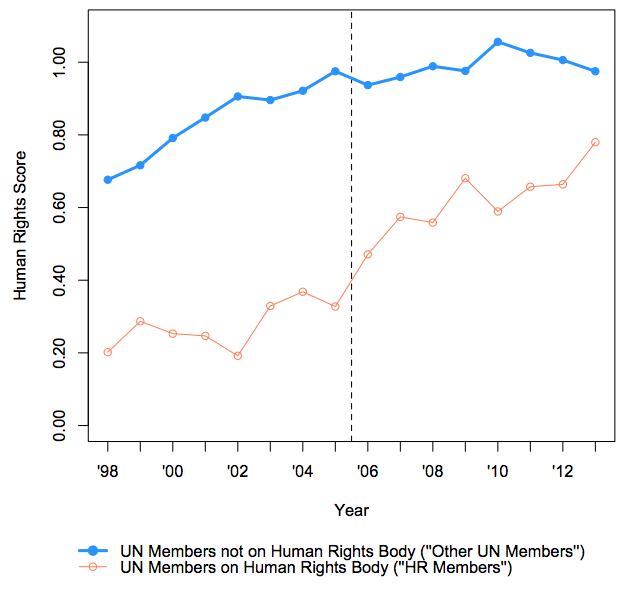
Figure 1 presents our primary results. It plots the average Human Rights Score of UN Members that were not on the relevant human rights body (“Other UN Members”) as well as the average Human Rights Score of UN members that were on the CHR before 2006 or the HRC after 2006 (“HR Members”). Consistent with other research using the Fariss 2014 data,[14] Figure 1 shows that the Human Rights Scores of both groups improved between 1998 and 2013.

There are two noteworthy results in Figure 1. First, HR Members consistently have worse Human Rights Scores than Other UN Members. This is true both before and after the 2006 reform. Over the entire 16 years of data, the average Human Rights Score for HR Members is 0.45 and the average for Other UN Members is 0.92—a difference of 0.47. To put this in perspective, this is roughly the same as the difference between Moldova (0.46) and Greece (0.97) in 2010.

Second, the 2006 reform has helped to close the gap between HR Members and Other UN Members. From 1998 to 2005, the average difference between these two groups was 0.57. After the 2006 reform, however, this difference closed to 0.37. In other words, the 2006 reform does appear to have made some progress towards the goal of creating a “jury” with better human rights records.


Figure 1: Members’ Human Rights Records Before & After 2006 Reform

screen-shot-2016-10-27-at-9-12-14-pm


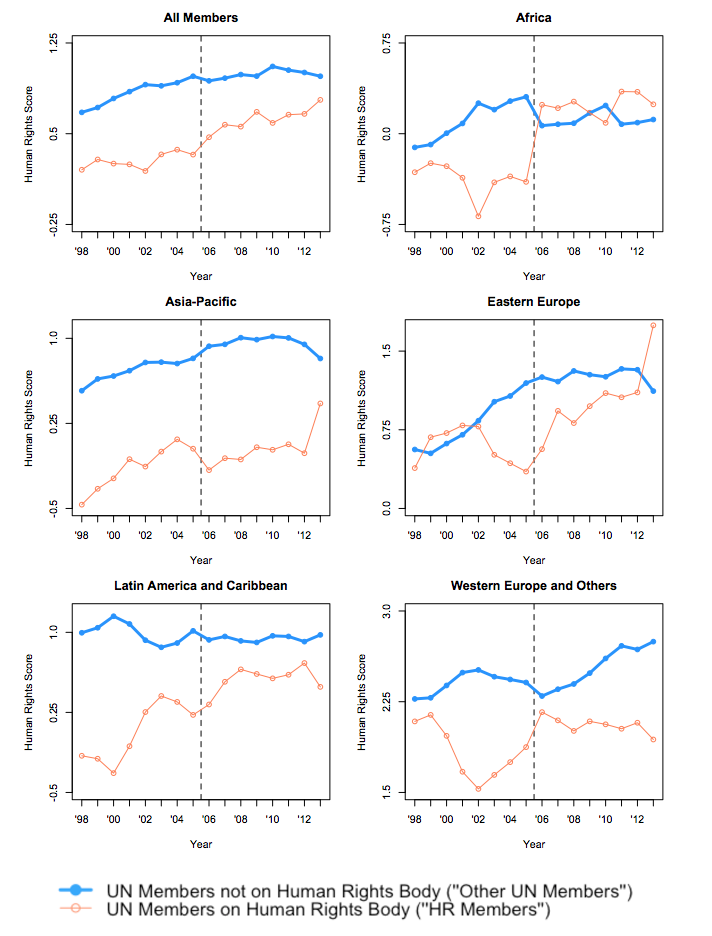
But, as previously noted, despite the progress since 2006, the Human Rights Scores of HR Members are still worse than the records of Other UN Members. Since both bodies’ members are chosen by region, Figure 2 explores why this gap persists by disaggregating the results by region (the top left panel recreates Figure 1 and the other 5 panels show the data for each of the regional groups).


Figure 2: Members’ Human Rights Records Before & After 2006 Reform By Region

screen-shot-2016-10-27-at-9-12-27-pm


As Figure 2 shows, since the 2006 reform there has been considerable regional variation in the differences between the human rights records of HR Members and Other UN Members. Within the Africa region, for example, the HR Members have actually had better Human Rights Scores than Other UN Members on average since 2006 (0.24 compared to 0.11). For both the Asia-Pacific and Western Europe and Others region, however, the Human Rights Scores of the HR Members still lag behind those of the Other UN Members from those same regions. Since 2006, in the Asia-Pacific region the Human Rights Scores for HR Members have been 0.93 lower than Other UN Members from the region, and in the Western Europe and Others region the Human Rights Scores for HR Members have been 0.48 lower than Other UN Members from the region.


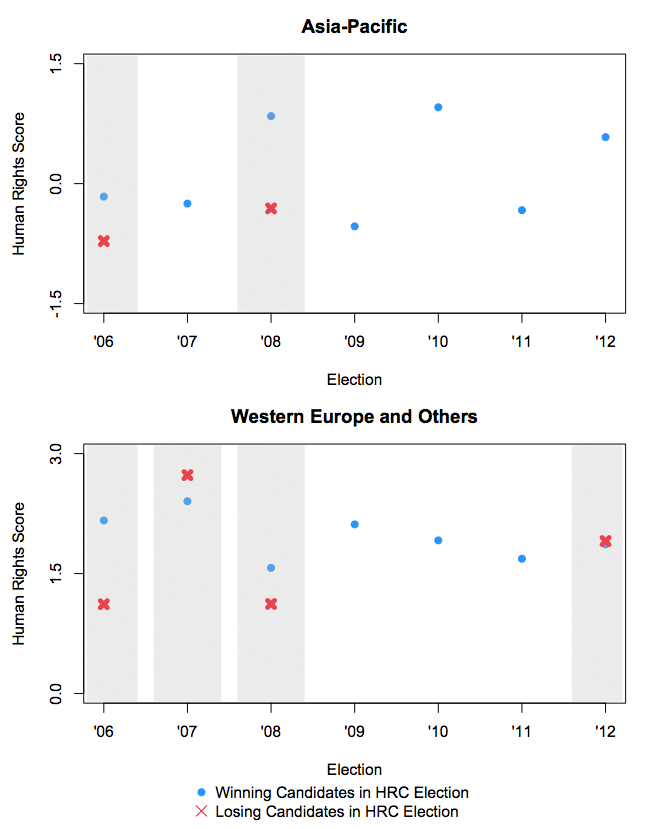
Figure 3: Human Rights Records of Candidates in Human Rights Council Elections


The large discrepancies in these two regions raise the question of whether the states chosen for the HRC are the best available candidates in any given year or region. To further explore this issue, Figure 3 plots the average Human Rights Scores for the winning and losing candidates for the Asia-Pacific and Western Europe and Others seats in HRC elections between 2006 and 2012. The gray bars represent contested elections. As the figure illustrates, in many years elections to the HRC simply are not contested. When they were contested, the candidates that won the elections typically had higher average Human Rights Scores than candidates that lost the elections. In short, the gap in Human Rights Scores between HR Members and Other UN Members cannot be closed further unless members with better records contest the elections.


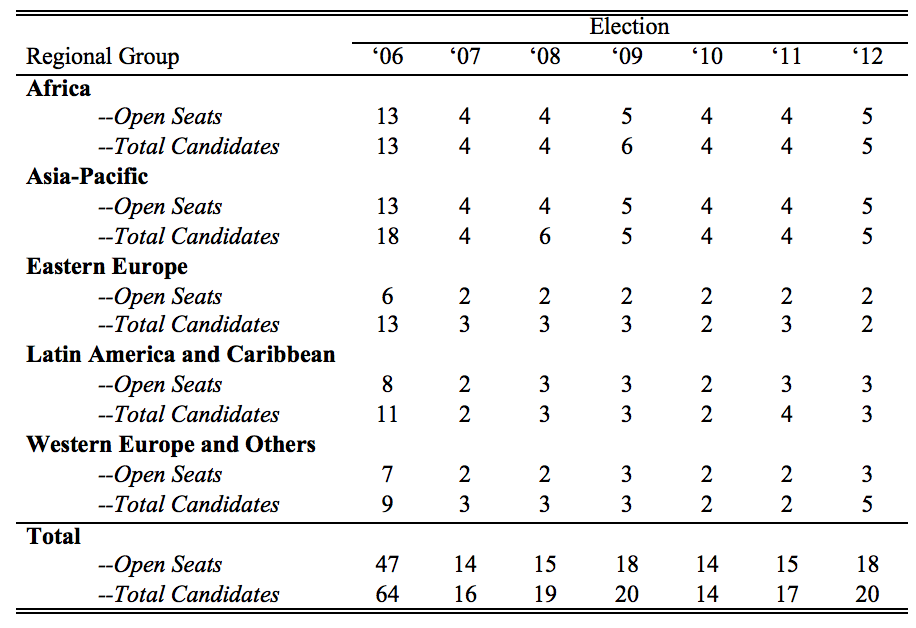
Table 1: Open Seats & Candidates for HRC Elections by Regions

Table 1
Other regions frequently had uncontested elections as well. Indeed, HRC elections for all regions frequently go uncontested. Table 1 illustrates this by presenting information on the number of open seats and candidates by region for HRC elections from 2006 to 2012. As the results show, in twenty-one of thirty-five regional elections—a full sixty percent of regional elections—the number of candidates was identical to the number of open seats. Given the available candidates, in many cases countries simply do not have the option of electing countries with better human rights records. Of course, countries with better human rights records might not win if they stood for election. These countries may be opting not to run because they have reason to believe they will lose. But the results do demonstrate that there is a significant connection between the remaining gap in human rights records between HR Members and Other UN Members and the lack of competitive regional elections for the HRC in many years.

III.  Conclusion

Our research suggests that the 2006 reform that eliminated the CHR and replaced it with the HRC did result in members with better human rights records. Nonetheless, the gap in human rights records between HR Members and Other UN Members was not eliminated by the reform; on average, Other UN Members still have better records than the members of the HRC. This gap varies across regions and is in part driven by the fact that uncontested elections are still quite common.

It is important to note, however, that human rights records are not the only measure of a country’s fitness to be on the HRC. For example, some small countries with excellent human rights records may lack the diplomatic capacity to serve effectively as council members, and some large countries with poor human rights records may be valuable members because of the perspectives they bring. Considerations such as these suggest that completely eliminating the gap in human rights records between the HR Members and Other UN Members may not be possible or even desirable.


Adam S. Chilton is an Assistant Professor of Law at the University of Chicago Law School. Robert Golan-Vilella is a 2018 J.D. Candidate at the University of Chicago Law School.

[1] Paul Gordon Lauren, “To Preserve and Build on its Achievements and to Redress its Shortcomings”: The Journey from the Commission on Human Rights to the Human Rights Council, 29 Hum. Rts. Q. 307, 326 (2007).

[2] Kenneth Roth, Despots Pretending to Spot and Shame Despots, Int’l Herald Trib. (Apr. 17, 2001), http://www.nytimes.com/2001/04/17/opinion/despots-pretending-to-spot-and-shame-despots.html.

[3] U.N. Secretary-General, In Larger Freedom: Towards Development, Security and Human Rights for All, ¶ 182, U.N. Doc. A/59/2005 (Mar. 21, 2005).

[4] See Steven Seligman, Politics and Principle at the UN Human Rights Commission and Council (1992­–2008), 17 Isr. Aff. 520, 520–21 (2011).

[5] Conall Mallory, Membership and the UN Human Rights Council, 2 Can. J. Hum. Rts. 1, 30 (2013); see also Lauren, supra note 1, at 326.

[6] Katherine Short, From Commission to Council: Has the United Nations Succeeded in Creating a Credible Human Rights Body?, 9 Sur – Int’l J. on Hum. Rts. 147, 156 (2008).

[7] Mallory, supra note 5, at 1.

[8] Ileana Ros-Lehtinen, A Human Rights Council Worthy of the Name, Wash. Times (Dec. 9, 2015), http://www.washingtontimes.com/news/2015/dec/9/ileana-ros-lehtinen-un-human-rights-council-must-b/.

[9] See Eric Cox, State Interests and the Creation and Functioning of the United Nations Human Rights Council, 6 J. Int’l L. & Int’l Rel. 87 (2010).

[10] The data on UN regional groupings is available at: United Nations Regional Groups of Member States, United Nations, http://www.un.org/depts/DGACM/RegionalGroups.shtml (last visited Aug. 5, 2016).

[11] The Human Rights Scores are presented and explained in Christopher J. Fariss, Respect for Human Rights Has Improved over Time: Modeling the Changing Standard of Accountability, 108 Am. Pol. Sci. Rev. 297 (2014).

[12] For an extended discussion of Fariss’s Human Rights Scores, see Adam S. Chilton & Mila Versteeg, The Failure of Constitutional Torture Prohibitions, 44 J. Legal Stud. 417 (2015).

[13] See, e.g., id.; Christopher J. Fariss, The Changing Standard of Accountability and the Positive Relationship between Human Rights Treaty Ratification and Compliance, Brit. J. Pol. Sci. (forthcoming), http://ssrn.com/abstract=2517457.

[14] See, e.g., Fariss, supra note 13.

Online Scholarship

The Framing of International Adjudication for Corporate Misconduct

[PDF]

By Daniel Litwin & Elsa Savourey

International courts and arbitral tribunals, the mechanisms we identify with international adjudication as binding third-party dispute settlement, do not have a universal and fixed meaning. In today’s increasingly diverse landscape of international adjudication, these mechanisms are described and classified according to different and often competing frames that stem from lawyers’ assumptions and views about international courts and arbitral tribunals.[1] The meaning of these mechanisms is framed in terms of, inter alia, lawyers’ expertise in a specialized regime (such as trade law, human rights law, or environmental law) and, more broadly, their background in domestic legal systems.

A discussion about international jurisdiction for corporate misconduct, either as a jurisdiction using existing mechanisms or through the creation of new mechanisms, requires that we understand these frames. The frames lawyers use to understand international courts and arbitral tribunals condition how they are structured and institutionalized, and what criteria are used to determine whether these mechanisms are, for example, legitimate, working for the public interest, and effective. Thus, recognizing and identifying these frames should precede any discussion about an international jurisdiction for corporate misconduct.

In this brief contribution, we review a number of the proposals for an international jurisdiction for corporate misconduct that have been put forward in a recent Harvard International Law Journal online symposium (“ILJ online symposium”) and draw attention to the possible frames that may shape their analysis.[2] We begin by looking at one of the most widely shared frames: the background of international lawyers as domestic lawyers. Subsequently, we consider the frames that stem from specialized international legal regimes and take the example of investment arbitration and its influence on proposals for arbitral tribunals for corporate misconduct. Further, we review the effect of these frames on non-juridical mechanisms including the complex sanctions-regime that already exists for corporate misconduct. We conclude with a call for moving beyond these existing frames in order to open space for self-reflection and new thinking.[3]

  1. Thinking in Terms of the Domestic Context

Proposals for an international court to address corporate misconduct may be framed with presumptions and perceptions from the domestic legal training that forms the basic legal education of most international lawyers.[4] This background serves the longstanding assumption that the international legal system should contain the judicial branch that is characteristic of domestic systems.[5] Thus, according to this view, international courts form an innate part of the international legal system, and the domestic judiciary is a benchmark for its international counterpart.

The rise of specialized international legal regimes, self-contained and fragmented,[6] has challenged the idea of a hierarchical system of international courts with the International Court of Justice (“ICJ”) analogous to a domestic supreme court. Yet this has not been followed by inquiries into the internal structure and practices of international courts as traditionally conceived in terms of analogy to the domestic context.[7] Debating the relevance of this sort of analogy could contribute to creative thinking. In that sense, it opens the possibility of considering the various challenges and practices specific to the implementation of an international jurisdiction for corporate misconduct on its own terms.

Recognizing the differences between international courts and domestic courts also opens room for a discussion on the increased significance of domestic jurisdictions in constraining transnational corporate misconduct. If international courts are distinct as to structure and practices from their domestic counterparts, each with their specific rationalities, then it is easier to see domestic and international mechanisms as complementary rather than in perpetual struggle for authority and hegemony. Thinking in terms of complementarity is all the more important as, for example, domestic and European legal instruments increasingly require companies to respect human rights in the course of their activities and their supply chains. As a result, corporate misconduct can increasingly be brought before domestic civil and criminal courts.[8]

Thus, in an increasingly globalized world, are international courts not simply one key piece amongst others in the creation of a new era of global corporate accountability? From this perspective, international and domestic mechanisms each have a reasonable claim to authority. This dismissal of hegemony and recognition of complementarity, leads to a complex series of possible judicial configurations. Action may be taken by domestic courts at the host state or home state level,[9] and at the international level by existing or new mechanisms. To address the complexity of these possible configurations, we need to move away from ready-made solutions that are imported from existing frames.

  1. Thinking in Terms of Specialization

Discussions about international jurisdiction are also framed by specialized international legal regimes. These specializations, such as trade law or human rights law, lead to an understanding of international courts and arbitral tribunals as they are implemented in a specialized regime. As a result, although the term “court” appears to retain a general and objective meaning, it means very different things when it is assimilated to, for instance, the International Criminal Court or the International Tribunal for the Law of the Sea, as they prioritize distinct concerns.

Take the example of international arbitration and investment arbitration. The perceived success of investment arbitration, at least in terms of case-load and effectiveness, has seen it advanced frequently in this Symposium as a model or tool for arbitrating corporate misconduct. Yet this approach by analogy risks putting forward or giving precedence to the specialization of investment arbitration as a “best practice” although arbitration in this specialization is structured to pursue objectives different from corporate misconduct.

Thinking along specialized frames aligns the design of an eventual arbitral tribunal for corporate misconduct with that of a system designed for the significantly different purpose of investment protection. This framing risks inhibiting the conception of international arbitration for corporate misconduct in new terms or at least terms aligned with concerns raised by corporate misconduct. For instance, considerations of statist consent are important in investment arbitration, but these considerations may obfuscate a rethink of alternative means of conceiving consent in a post-Westphalian international arbitration turned to victims of corporate misconduct.[10]

Along similar lines, criticisms of arbitration that refer nearly exclusively to the inadequacies and shortcomings of investment arbitration on the grounds that it lacks of legitimacy and public accountability[11] run the risk of framing the possible structure and practices of international arbitration in terms exclusively developed by the investment context. By equating investment arbitration with international arbitration more generally, these criticisms, paradoxically, serve to frame international arbitration in terms of the very investment regime they criticize. This confusion limits the possibilities of international arbitration to those developed in the investment context.

  1. Thinking Beyond Adjudication?

The same caution with analogic thinking to the domestic legal system can be extended more broadly to the perceived need for international jurisdiction in the first place—the topic of the ILJ online symposium. If analogies to the domestic context require that we envision some form of international jurisdiction, then existing non-judicial means to address corporate misconduct are necessarily perceived as insufficient and incomplete. As a result, the achievements of non-judicial mechanisms can lose their luster in the process.

The United Nations Guiding Principles on Business and Human Rights and the OECD Guidelines on Multinational Enterprises have created impetus for the development of non-judicial mechanisms. These mechanisms are being developed by private and public entities, at the domestic or international level. They are opening new avenues of redress for victims whose human rights were adversely impacted by corporate misconduct.

For example, a number of companies have developed grievance mechanisms as a means to identify potential and actual adverse impacts on human rights and means of redress for victims. Similarly, the OECD National Contact Points offer stakeholders and members of civil society a means to resolve human rights based conflicts between affected communities and companies. Admittedly, these mechanisms are still in development; the perceived requirement for international jurisdiction, however, could take attention away from their continued development and articulation with existing international and domestic judicial mechanisms.

Besides, a focus on a single international jurisdiction mechanism may overshadow the complex sanctions-regime that already exists for corporate misconduct. These sanctions can be reputational (when misconduct affects a company’s reputation), they can be operational (when the continuation of a project is put in jeopardy because some fundamental rights of local communities have not been respected), and they can be financial (when the multilateral development banks and private banks withdraw funding for a project found to be non-compliant with human rights). This sanctions-regime deserves more scrutiny. It could be more amenable and adaptable to the complexities of corporate misconduct than international jurisdiction, and it could be further accompanied by the development of more accessible remedies for victims of corporate misconduct than judicial proceedings.

Afterword

This contribution has sought to query how decisions about the internal structure and practices of international mechanisms for corporate misconduct could be framed by lawyers according to the terms of domestic legal systems or specialized legal regimes. Emphasizing frames raises a new set of questions and places a different focus on the question formulated in the ILJ online symposium. Instead of speaking in terms of the possibility of international adjudication for corporate misconduct, we suggest speaking in terms of its possibility but according to which frame.

Our observations and questions are not meant to close the door to international courts or arbitral tribunals as jurisdictions for corporate misconduct. However, if we consider action against corporate misconduct to be a legitimate pursuit, then we need to move beyond discussions confined solely to the creation of these mechanisms in order to critically engage with how international adjudication is described and re-described.[12]

In particular, focus should be placed on the assumptions and background beliefs behind the terms “international court” and “international arbitration”:[13] What should these terms mean in the context of corporate misconduct, and what do these meanings entail? Discussions should not be limited to narratives that portray the mere act of creation, in this case an international court or arbitral tribunal for corporate misconduct, as the means to normalize complicated tensions among competing frames. Identifying the multiple frames that can be used to describe international courts and tribunals provides a map of consensus and dissensus. This map allows us to reveal current assumptions and existing boundaries so that we may knowingly account for them or move beyond them when debating the development of international jurisdiction for corporate misconduct.


* Daniel is a graduate from McGill University (B.C.L./LL.B.) and the University of Cambridge (LL.M.). He is a Legal Adviser at the Iran-United States Claims Tribunal. Elsa is an attorney-at-law and a graduate from Harvard Law School (LL.M.) and from Sciences Po Law School and Pantheon-Sorbonne (Masters). She is part of the Business and Human Rights practice group of Herbert Smith Freehills.

[1] We understand frames as the predispositions (or principles of organization) that delimit our perception of the real. See generally Erving Goffman, Frame Analysis: An Essay on the Organization of Experience (1974).

[2] We speak only in terms of “frames” due to the limited scope of this contribution. We have not engaged with similar ideas such as “interpretive communities,” “structural bias,” “expertise”, or “unreliable narration.” For a recent overview, see Matthew Windsor, Narrative Kill or Capture: Unreliable Narration in International Law, 28 Leiden J. Int’l L. 743 (2015).

[3] The need for innovation and new thinking has been noted by several contributors to the ILJ online symposium. See, e.g., Ana Maria Mondragón, Corporate Impunity for Human Rights Violations in the Americas: The Inter-American System of Human Rights as an Opportunity for Victims to Achieve Justice, Harvard Int’l L. J. Online (July 7, 2016) and Angel Gabriel Cabrera Silva, Legal Innovations for Corporate Accountability under International Law: A Critique, Harvard Int’l L. J. Online (July 7, 2016).

[4] See, e.g., James Crawford, Chance, Order, Change: The Course of International, General Course on Public International Law 152−53 (2014).

[5] See Martti Koskenniemi, The Fate of Public International Law: Between Technique and Politics, 70 Modern L. Rev. 1, 1−2 (2007).

[6] See UN International Law Commission, Fragmentation of International Law: Difficulties Arising from the Diversification and Expansion of International Law, A/CN.4/L.682 (Apr. 13, 2006).

[7] For a discussion on this method of inquiry, see Mikael Rask Madsen, Sociological Approaches to International Courts, in Cesare P. R. Romano, Karen J. Alter & Chrisanthi Avgerou, eds., Oxford Handbook on International Adjudication (2014).

[8] See, e.g., U.K. Modern Slavery Act 2015 (c. 30), art. 54; Directive 2014/95/EU of 22 October 2014 amending Directive 2013/34/EU as regards disclosure of non-financial and diversity information (L330/1); Regulation (EU) 2016/679 of 27 April 2016 on the protection of natural persons with regard to the processing of personal data and on the free movement of such data, and repealing Directive 95/46/EC (General Data Protection Regulation) (L119/1)

[9] In the ILJ online symposium, see, e.g., Gabriela Quijano, Where Can Victims of Corporate Human Rights Atrocities Turn for Justice?, Harvard Int’l L. J. Online (July 7, 2016).

[10] See the various approaches to obtaining consent suggested in the ILJ online symposium by Juan Pablo Calderón-Meza, Arbitration for Human Rights: Seeking Civil Redress for Corporate Atrocity Crimes, Harvard Int’l L. J. Online (July 7, 2016).

[11] In the ILJ online symposium, see Amb. David Scheffer, Corporate Liability under the Rome Statute, Harvard Int’l L. J. Online (July 7, 2016).

[12] On this process in international law, see, e.g., Koskenniemi, supra note 5, at 7.

[13] On changes in the meaning of international adjudication from the perspective of its paraphernalia, see Daniel Litwin, Stained Glass Windows in the Peace Palace: Constructing International Adjudication’s Identity, in Objects of International Law, Jessie Hohmann & Daniel Joyce, eds. (forthcoming 2016).

Content, Student Features

History in Action: Colombia Prepares for Plebiscite on Peace Deal

By Kelsey Jost-Creegan*

This article is the first of a series of articles to be published on the Colombian Peace Process over the course of the next weeks. We hope to offer in-depth and substantive analysis to an English-speaking and international audience, reflective of the many rich debates that are currently taking place in Colombia.  


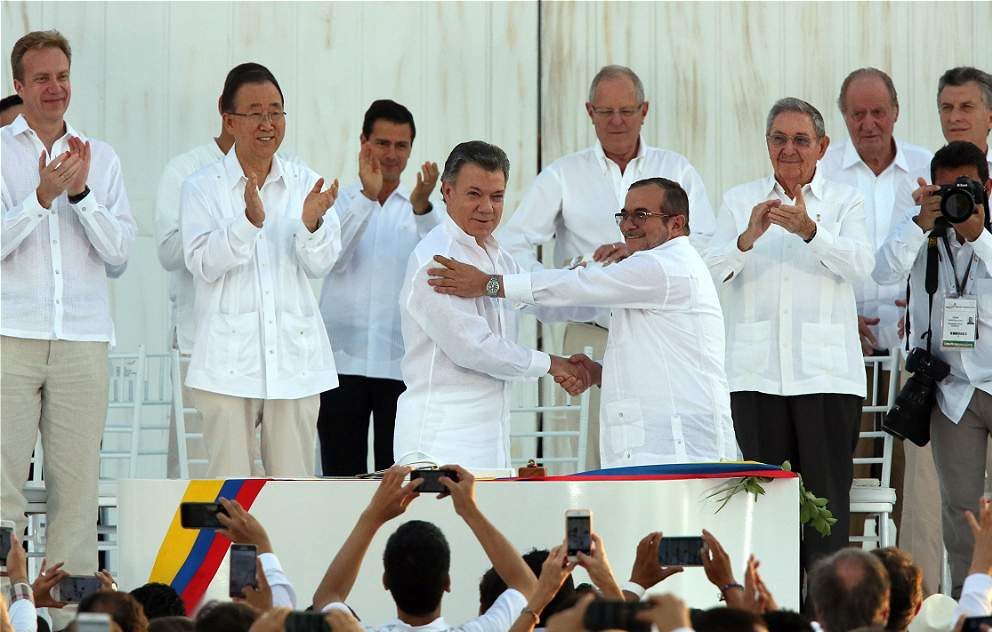
This Sunday, Colombian citizens will decide whether to approve the Peace Agreement reached on August 24th between the Colombian government and the Revolutionary Armed Forces of Colombia – People’s Army (FARC). The Agreement was signed on Monday, September 26th in Cartagena, Colombia, but a favorable vote is essential for the Peace Process to move forward.


Background: The Colombian Conflict

The Colombian Conflict is the longest-running armed conflict in the Western Hemisphere, and the only one that continues to be active. The conflict has left over 260,000 people dead, 45,000 people disappeared, and 6.6 million people displaced. The conflict is highly complex and involves a number of actors that have evolved over time, including leftist guerrillas, right-wing paramilitaries, and national armed forces.

Atrocious crimes—murder, disappearance, displacement, sexual violence, torture, and massacres—have been committed at different points in the conflict by all parties involved. The Latin America Working Group explains, “[r]ural, impoverished, and marginalized communities—including Afro-Colombians, indigenous, and women—were disproportionately affected by the violence.”

The current conflict has its roots in the formation of armed leftist guerilla movements that spread across Latin America in the 1960s, opposing political elites and extreme socioeconomic and regional inequality. While these movements were in some ways novel, political violence revolving around issues of land rights and rural inequality had been a reoccurring problem since Colombia’s founding. Conflicts in the 1920s between landowners and small-scale farmers in Colombia’s coffee region, the 1948 assassination of presidential candidate Jorge Eliécer Gaitán, and the subsequent ten years of conflict known as “La Violencia” are just a few examples of this unrest.


Revolutionary Armed Forces of Colombia – People’s Army (FARC)

The FARC, formed in 1964, was one of these guerilla groups. It follows a Marxist-Leninist ideology, and has its roots in campesino (peasant farmer) advocacy for land rights. It began as one of a number of campesino groups fostered by the Communist Party (PCC) that declared “independent republics” in the countryside, where the government’s institutional presence had always been weak. The FARC’s campesino forebears declared an independent “Republic of Marquetalia” in 1964. When the government responded with heavy military force—sending nearly 2,000 soldiers to counter a settlement with less than 100 members—the campesinos retreated into the jungle. Two months later, the 48 remaining campesinos signed the Agrarian Program of the Guerrillas, effectively establishing the FARC.

Beginning in the 1970s, and increasing significantly in the 1980s, the FARC became involved in drug trafficking and kidnapping to finance their movement. Their involvement with drugs began by imposing taxes on farms growing drugs, but with time escalated to include direct production and export. Right-wing paramilitary groups also consolidated and expanded during this period, prompting a severe escalation in violence.

Over time, the FARC transformed significantly. In 1982 the organization “transformed . . . from a defensive group to an offensive national entity.” In the 1990s it broke off from the PCC, although it continued to preach Marxist-Leninism. It was around this time that the FARC developed the highly hierarchical structure under which it has operated to this day.

It is estimated that, at its peak, the FARC had nearly 20,000 members, though that number has diminished to between 6,300 and 7,000 active members today. The FARC is also believed to have an affiliated militia; estimates for the number of militia members vary anywhere from 5,800 to 13,000 and there is little consensus as to their role and whether they are armed.


The New Peace Agreement: 4 Years of Negotiations, 6 Parts, and 300 Pages

The current Peace Agreement is the result of nearly four years of negotiations held in Havana, Cuba. Formal negotiations, which began on November 19, 2012, followed two years of preliminary negotiations to determine negotiation process.

This is not the first time that the Colombian government has tried to negotiate with the FARC. Presidents Belisario Betancur (1982–1986) and Andrés Pastrana (1998–2001) both oversaw negotiations. However, both attempts failed and the violence continued. This is the first time the groups have reached a full agreement and, accordingly, the first time such an agreement will be put to a vote.

The Final Agreement for the End of the Conflict and the Construction of a Stable and Lasting Peace is lengthy and complex—composed of Six Parts and totaling nearly 300 pages, it covers topics ranging from land reform to drug policy to transitional justice. Later articles in this series will provide a detailed breakdown of each Part.

Given the Agreement’s length and complexity, there have been concerns about the extent to which the voting population will be able to make an informed decision, particularly given the quick turnaround between its release and vote (just over a month). To this end, the Colombian High Commissioner for Peace established a website summarizing the Agreement’s main points in both Spanish and a variety of indigenous languages. Civil society organizations have also made audio recordings, online videos, and Whatsapp groups to cover main takeaways and answer questions.


The Approval Process: Where are we now?

A multistep approval process began to unfold once the Agreement was announced.

Developments to Date

  • August 24: The Colombian government and the FARC announce they have reached agreement.
  • September 24: The FARC announces that its members have unanimously approved the deal through a Congress of Block Leaders, each block being a regional unit of the rebel army. The FARC has used similar Congresses to make important decisions since its inception, though most were held earlier in the FARC’s history. This Congress of Block Leaders was held in Llanos de Yarí, and was the first open to civilians and the press.
  • September 26: President Santos and FARC leader Rodrigo Lodoño—alias Timochenko—sign the Agreements in Cartagena, the first formal part of the Peace Process to take place on Colombian soil. Note that President Santos signed the Agreement before the Plebiscite, likely a political decision made in the hopes of building momentum going into Sunday’s vote.


The Plebiscite

The Plebiscite will ask: Do you support the agreement to end the conflict and construct a stable and lasting peace? A simple majority of at least 13% of registered voters is needed to pass the agreement (approximately 4.4 million votes).

The Plebiscite’s legal standing is complex. In Colombia, a plebiscite is a form of political participation similar but not identical to a referendum; while a referendum generates a binding decision about a piece of legislation, a plebiscite aims to gauge whether there is support for presidential action. According to the Colombian Constitutional Court, the Plebiscite has three goals: (1) obtain democratic legitimacy; (2) make the Agreement more lasting (on the theory that future politicians would be more likely to uphold it); and (3) accordingly, offer the parties guarantees in moving forward with the Agreement’s terms. Officially, it is only binding on the President, meaning that, in theory, Congress could independently move forward with the deal even if voters turn it down, and may even be able to restore the President’s power to implement the Agreement. Conversely, a majority vote in favor of the agreement would also not be legally binding—the government will still need to pass its ‘Legislative Act for Peace,’ which includes amendments to five Constitutional articles. However, it seems unlikely that other government organs will move forward if the Agreement is not approved by the Plebiscite, as it would lack a public mandate. Theoretically the President could also negotiate another agreement, but the parties have said that they would not return to negotiations if this one doesn’t pass, potentially pushing the possibility for peace further into the future.


The Political Landscape: Support and Opposition

The weeks leading up to the Plebiscite have been rife with political tensions as political leaders on both sides of the issue press their case to the public.

Public polling on the agreement have been mixed, but several recent surveys suggest that the agreement will pass. When asking how citizens would vote if the Plebiscite were tomorrow, Cifras & Conceptos found that 54% would vote yes and 34% no, Opinómetro found that 55.3% would vote yes and 38.3% would vote no, and Ipsos found that 72% would vote yes and 28% no. However, even these three most recent polls indicate that the gap has narrowed since July.

The government has been campaigning in favor of the agreement, claiming that the deal represents a critical opportunity for peace and the best deal possible in light of four years of intensive negotiation. Americas Society/Council of the Americas argues that, “the burden of proof is on the Yes campaign, which some say has the burden of convincing us to choose peace—a hypothetical concept for many of the country’s 48 million who’ve lived their own lives under the 52-year conflict.” The government has also emphasized that the Agreement prohibits amnesty for crimes against humanity and war crimes and provides a process for victim rights.

Opposition to the Agreement continues to be voiced by important political leaders, including Presidents Álvaro Uribe (2002–2010) and Andrés Pastrana (1998–2002) and former Inspector General Alejandro Ordóñez. The opposition has focused on crimes committed by the FARC and argues that the FARC would effectively be granted impunity for those crimes. They also argue against provisions that would allow FARC members to participate in the political process.


International Involvement

The international community has been heavily involved in the lead-up to the Plebiscite.

On Tuesday, September 13th the United Nations Security Council approved the creation of a political mission, composed of “450 observers and a number of civilian,” to monitor and verify a future ceasefire. That mission is already on the ground, ahead of schedule. The U.N. Mission also supported a seven-day training session on monitoring the ceasefire in early September.

A number of international organizations, including UNICEF and the International Organization for Migration, are also participating in coordinated action agreed upon in Havana to oversee the demobilization of minors recruited by the FARC.


Looking forward

While most media coverage has framed this Agreement as the end of Colombia’s internal armed conflict, in reality it is only an essential first step towards achieving an end to the war and constructing a lasting peace. The demobilization of the FARC and the implementation of other measures outlined by the Peace Agreement would be an enormous achievement in deescalating the conflict. However if the Agreement passes it will be necessary to stay alert to the power vacuum that dismantling the FARC would create and the different actors that could be waiting to fill that vacuum. Ultimately, achieving peace with the remaining leftist guerrilla group—the National Liberation Army (ELN)—and dismantling successor paramilitary groups and other criminal organizations will be essential to building peace. Later articles in this series will explore these dynamics.


* Kelsey Jost-Creegan is a 3L at Harvard Law School and a former Article Editor with the Harvard International Law Journal. During law school she completed a semester exchange at the Universidad de Los Andes in Bogotá and interned at the Centro de Estudios de Derecho, Justicia y Sociedad – Dejusticia and the Centro de Estudios para la Justicia Social – Tierra Digna.
Online Scholarship

Online Symposium: An International Jurisdiction for Corporate Atrocity Crimes

[View PDF Version]

The Harvard International Law Journal Online presents its Online Symposium, “An International Jurisdiction for Corporate Atrocity Crimes.” This special feature series, which gathers short contributions from distinguished academics and practitioners in relevant fields, explore the topic of an international jurisdiction for corporate atrocity crimes. Are international forums to pursue such cases even appropriate or feasible? And if so, what form or forms might such tribunals take?

The first section compiles features that address the problem of having—or currently not having—binding norms for corporate actors and explores the creation and enforcement of such obligations. Ambassador Luis Gallegos and Daniel Uribe recount the lessons from previous attempts to establish international tribunals for human rights abuses by private actors and encourage efforts to establish a legally binding international agreement on business and human rights. Sara McBrearty offers a private sector perspective in describing the primary challenges facing the business and human rights treaty proposed by Ecuador in the U.N. Human Rights Council. Benjamin Ferencz and Federica D’Alessandra write on the need to hold private enterprises accountable through criminal punishment and civil liability as deterrent factors. Finally, Caroline Kaeb explores the feasibility and role of monitorships within a comprehensive regime of criminal penalties.

The second section offers a critique by questioning the feasibility and appropriateness of resorting to international forums for corporate atrocities. Angel Gabriel Cabrera Silva explores the effectiveness of creating new international bodies and laws to address corporate atrocities. Gabriela Quijano recommends focusing at the moment on the domestic criminal systems of the home and host states of corporations.

The third section then presents a contrasting viewpoint that analyzes how the International Criminal Court (ICC) might serve in addressing corporate atrocities. Ambassador David Scheffer finds that corporate atrocities can be investigated and prosecuted before the ICC, albeit with complex amendments to the Rome Statute. Jelena Aparac believes that the amendment of the Rome Statute to include corporations, rather than international arbitration, would be the most opportune solution for international justice. Finally, in an interview with Luis Moreno-Ocampo, the first prosecutor of the ICC describes his views on the limits of the ICC’s role in addressing corporate atrocities.

The fourth group of features explores the possibility of providing international jurisdiction for corporate crimes in regional forums. ICC Judge Chang-ho Chung surveys the existing approaches of regional courts toward corporate human rights violations, and discusses the need to establish an Asian Pacific Court of Human Rights. Commissioner Jésus Orozco-Henríquez finds it likely that the Inter-American System will be increasingly open to address the liability of corporations. In light of the promise of the Inter-American System, Ana María Mondragón argues for the Inter-American System of Human Rights to take steps toward enshrining standards of protections against corporate human rights abuses.

The fifth group of features explores the creation of an entirely new international forum to adjudicate corporate atrocities, with Juan Pablo Calderón-Meza proposing alternatives to an international court via arbitration rules driven by civil society. Likewise, Claes Cronstedt and Robert Thompson propose broadening the reach of existing international arbitration framework into an International Arbitration Tribunal on Business and Human Rights that would include human rights disputes involving multinational businesses and victims. In contrast, Maya Steinitz argues that given democratic legitimacy reasons, public adjudication of mass torts is preferable to private sector arbitrations.

We thank our contributors for participating in this issue and hope that the articles contained in this volume will offer another step forward in the pursuit of international justice. We also thank our contributors who were able to attend the launching event at Harvard Law School on April 7, 2016 to present their writings and ideas in person. Videos of the event’s speakers are available with their respective articles.

Introductory remarks to the Online Symposium’s launching event 

Content, Online Scholarship

The Contributions of the Obama Administration to the Practice and Theory of International Law

[ See Professor Jack Goldsmith’s Essay ]

In this essay, a slightly revised version of the Sherrill Lecture delivered in April, Professor Jack Goldsmith shares his insights on the Obama administration’s contributions to the practice and theory of international law.

Note: This essay is published in the print edition of the Harvard International Law Journal, Volume 57. Please cite this essay as follows: Jack Goldsmith, The Contributions of the Obama Administration to the Theory and Practice of International Law, 57 Harv. Int’l L.J. (2016).


Professor Jack Goldsmith is the Henry L. Shattuck Professor at Harvard Law School, Senior Fellow at the Hoover Institution, and on the Board of Advisors of the Harvard International Law Journal.
 

Scroll to Top