
Symposia
Other Symposia, Symposia
Corporate Accountability, Human Rights and Pursuing Justice in the Ecuadorian Amazon
A Reflective Essay by a panelist at the 2010 Harvard International Law Journal Symposium: “International Dispute Resolution in Practice”
Introduction
Texaco operations in Ecuador began in 1964 and continued until 1992. Until 1990, Texaco served as sole operator of a concession covering approximately 1,500 square miles of Ecuador’s Amazon rainforest. Texaco alone was responsible for planning, constructing and operating more than 350 well sites in a region that was, and still is, the ancestral home to numerous indigenous and farming communities. In violation of Ecuadorian laws and regulations, as well as standard operating practices being used in the United States at the time, Texaco engineered and oversaw a system responsible for what experts believe is the worst oil-related environmental disaster in the world.[1]
Seventeen years ago, 30,000 indigenous people and farmers, now led by Ecuadorian attorney, Pablo Fajardo, filed a class action lawsuit against Texaco for a long list of grievances.
Pablo Fajardo was born in the village of El Carmen, Manabí, on July 8, 1972. In 1987 he migrated to the Ecuadorian Amazon town of Shushufindi where he still resides. At the age of 17, Mr Fajardo became founder of the Human Rights Committee of Shushufindi, an organization that still exists today, and, from 1996 to 2003, worked for the Apostolic Vicariate of Aguarico as head of the Human Rights Office in Shushufindi. Mr Fajardo attended the Universidad Técnica Particular de Loja where, in 2003, he graduated as a lawyer in the courts of the Republic of Ecuador. He has attended courses on Human Rights and Environmental Management at the Universidad Politécnica Salesiana de Quito and completed his Masters Degree in International Environmental Law at the Universidad Central del Ecuador.
In 2003, the Amazon Defense Coalition retained Mr Fajardo as an assistant lawyer and, in that position, he helped coordinate and develop the legal case brought by indigenous and farming communities from the provinces of Orellana and Sucumbios against multinational oil company Chevron[2] for serious violations against the environment and people of the region.
In June 2005, Mr Fajardo assumed the role of lead counsel for the plaintiffs and has served in this role until the present. For his tireless work defending the environment and advocating greater respect for human rights and social justice, Pablo Fajardo was awarded the 2007 CNN World Heroes Award in the ‘Fighting for Justice’ category. In April 2008, Mr Fajardo received further recognition when he was awarded the Goldman Environmental Prize, regarded by many as the “Green Nobel Prize”.[3]
In the following reflection piece, Pablo Fajardo details his experiences throughout the Aguinda v. Chevron lawsuit, how and why he became involved in the case, and the challenges he has faced.
Article
Although taking on this case was a great personal challenge for me, I was always aware of two aspects of it that would work in my favor. First of all, I live in the area affected by Chevron’s operations, and therefore I know personally the effects of the environmental and human rights abuses commited by the company in the Ecuadorian Amazon. Fully understanding the reality of the situation, I can speak with conviction: I know that I am speaking the truth. Furthermore, I am a human being who believes in God, life, justice and solidarity. Along with the indigenous peoples and farmers in the Amazon, my co-workers and I fight for justice and for life.
My involvement in the lawsuit against Chevron is the result of many years of personal experience and hard work. It began with my parents’ migration from the coast of Ecuador to the Amazon in search of a better life. When I arrived in the Amazon, the area affected by the company’s operations, I began to see the environmental problems first hand. I soon became involved in social work with the Catholic Church and I learned more about the effects of Chevron’s operations on health, indigenous culture and all aspects of life in the region.
We began to realize the need for a group to fight in defence of human rights because, in my city, there was nowhere for affected people to reach out for help. Subsequently, as part of the Human Rights Committee of Shushufindi, we joined the Amazon Defense Coalition to unite with indigenous groups and affected farmers throughout the region.
As soon as I completed my legal studies, I became part of the team working to defend the affected people and the environment. In 2005, I had to assume direct responsibility and legal representation of all those affected by the operations of Texaco in the Ecuadorian Amazon. So, my involvement in the case against Chevron was progressive. It was out of conviction and with the sole desire of achieving justice.
Throughout this case we have learned positive, negative, and at times, confusing lessons. The case involves five indigenous nationalities as well as other settlers in the region. It includes many cultures, customs and worldviews. Yet all of these people have put aside any differences they may have to work together in the pursuit of justice and respect for their human rights. Uniting these diverse cultures has been a great achievement.
This unity has been further reinforced through the building of a strong international support network. We have learned how to form a team with very different players, with people of the Ecuadorian rainforest, and those from big cities such as Quito. We work with people from a variety of countries, including the United States, allowing us to build a global team that is small, but very strong.
The lessons we have learned have been accompanied by great challenges, not least in the area of international human rights. Despite the fact that many national and international legal instruments have been established to protect human rights, they are all too often neglected. Furthermore, multinational corporations are not bound by these conventions; the legislation only applies to governments, effectively rendering big business immune to international accountability. Among these rights, the least respected is the right to a healthy and ecologically balanced environment, which, to me, is the most important human right we have. The right to a healthy environment is the very foundation of health, culture and the economy. By respecting this right, we protect life itself.
The conflict surrounding this right is of great concern and involves three major societal groups. Businesses and corporations primarily intend to reap profit and grow economically while States are required to help develop society as a whole, although frequently give absolute priority to economic growth. Finally, the general population demands that corporations and states respect their rights, including their right to a healthy environment and a life with dignity.
This socio-economic conflict shows little sign of subsiding. Rather, it seems more likely to increase. For businesses and many governments, more stringent environmental regulations appear to threaten economic growth, a threat that is taken very seriously. However, this lawsuit is not against business. We are not against economic development, and indeed we believe that business must grow, but not at the expense of human life. The problem is not business; the problem is the manner in which businesses operate.
Of course, there are many elements that obstruct justice within the state and internationally. The economic power of corporations often determines state economic policy and international environmental law. Corporations look to invest in states where there are better trade conditions and security for investments. Factors in creating ‘business friendly’ conditions include limiting regulation of employment and environmental legislation. By way of example, note how China, has become the great factory of the United States and the world, arguably at the expense of human rights.
One of my biggest disappointments has been the discovery of systematic corruption implemented by Chevron during the supposed remediation of the affected areas in the early 1990s. Corporate executives, Chevron lawyers and former officials of various Ecuadorian governments have been implicated in acts of corruption and deception linked to the fraudulent clean-up. They have sought to benefit economically, but in turn have caused or prolonged the worst oil related environmental disaster in history.
Another obstacle, much greater than I could have imagined, is the manipulation of scientific evidence by expert scientists to serve their own interests. In the same context, it is deplorable to see how Chevron has abused (and continues to abuse) the law in Ecuador and the United States of America to ensure that this grave and inhumane crime go unpunished.
Chevron has manipulated the international legal system from the moment the case was first filed in New York. For nine years Texaco vigorously argued under the doctrines of forum non conveniens and international comity that the case should be dismissed and, instead, be tried in Ecuador. To transfer the case to Ecuador, Texaco submitted fourteen separate expert affidavits from Ecuadorian lawyers and scholars (including their own Ecuadorian lawyers in the current trial), attesting to the fairness, independence and competency of the Ecuadorian judiciary.[4] Chevron also promised, as a condition of the dismissal, to submit to jurisdiction in Ecuador and abide by any final judgment in the trial.[5] Chevron was eventually successful in its plea and in 2002 the Southern District Federal Court of New York finally dismissed the case to be re-filed in their requested forum, Ecuador. Chevron praised the ruling, stating that it was “pleased with the ruling…[which] vindicate[d] Chevron[]’s long-standing position that the arguments we have made to the court: The appropriate forum for this litigation is Ecuador…”[6] The communities, who had already waited a decade for redress, now had a limited time to re-file their claims in their home country.
Now, almost eight years later, Chevron is continuing this ‘forum shopping’ strategy in an attempt to delay the case even further.
On September 23, 2009, shortly before what the company expected to be an adverse judgment in the Ecuadorian case, Chevron filed a Notice of Arbitration against The Republic of Ecuador for alleged violations of the terms of the Bilateral Investment Treaty between the United States and Ecuador. Chevron claims that the Ecuadorian Courts have failed to provide the company with due process of law, despite seven years of extensive litigation with over 60,000 chemical samplings and hundreds of thousands of pages of trial testimony. As part of the relief, Chevron requests that the arbitration panel declare that the company has no liability for environmental remediation in Ecuador as a result of the former consortium between Texaco and Ecuador. They also request that Ecuador be ordered to inform the court in Lago Agrio that the company has been released any remaining and future remediation of environmental damage.
In short, Chevron seeks to remove the case from the Ecuadorian Courts after fighting for almost ten years to prove that Ecuador was the appropriate forum for the trial. This is being done despite the companies earlier promises to accept jurisdiction and abide by any judgment, and after consuming almost seven years of resources of the impacted communities who have sought nothing more than a public resolution of their claims in a public and neutral forum. The international arbitration claim has the potential to set a precedent that will have a profound effect on human rights law, public international law and the field of international arbitration. If allowed to proceed, Chevron’s request will essentially strip 30,000 plaintiffs of their legal right to seek justice for decades of human and environmental rights abuses.
Because the arbitral process makes no provision for the plaintiffs to appear, intervene, or even be notified of the private proceedings, those whose rights are most at risk are left without a voice, without access to information and without redress in the event of an adverse decision.
In many respects we must move forward. We need to understand that the environmental disaster caused by Texaco in Ecuador is not an Ecuadorian problem; it is a global issue. The double standard that companies employ in their operations demonstrates an immoral attitude of racism and discrimination. In their home countries, where regulations are more rigid (or more effectively enforced) corporations operate and act responsibly, but these same companies go to an institutionally deficient country and apply different standards that are designed to cut costs without any regard for the environment or human health.
The first step we must take is to research and monitor the actions of multinational corporations, particularly when they operate in developing regions. Secondly, we must accept the fact that environmental issues know no borders, and therefore the struggle to protect environmental rights should include all people from all countries. We must come together in the pursuit of justice, respect for life, and protection of the environment in which we live.
Finally, we must take a global perspective, but from a local reality, consciously regulating our consumption. The luxuries that we desire may often be complicit in the killing of other humans. For example, many people adorn themselves with expensive jewellery; never thinking of the many hundreds of barrels of water contaminated with mercury to extract those few grams of gold. People are dying, poisoned by mercury, for this extravagance. This is but one of many examples; we must reflect on what we consume and make conscious, moral decisions. Powerful companies, such as Chevron, must also address their business decisions from a moral perspective, and when they do not, legal frameworks must be in place to allow those affected to seek justice.
Though all evidence at trial, including Chevron’s own samplings, prove extensive contamination, and despite the fact that a verdict is near, Chevron has publicly stated: “We’re not paying and we’re going to fight this for years if not decades into the future.”[7] In violation of sworn promises it made to the US federal court in order to move the case to Ecuador, Chevron’s general counsel and the company’s spokesman has said that notwithstanding an adverse judgment, the company would “fight until hell freezes over, and then we’ll fight it out on the ice.”[8] Chevron has made clear that it believes itself above the law and immune to accountability in any nation in which the communities seek redress. With its unlimited resources and complete disregard for the communities, Chevron has shown that it does not respect the liberty of indigenous and farmer communities to assert their legal rights. This arrogance and sense of impunity was illustrated by one Chevron lobbyist who stated “We can’t let little countries screw around with big companies like this – companies that have made big investments around the world.”[9]
In light of this mindset, and the legal difficulties faced when holding multinational corporations accountable for even egregious wrongdoings, accountability in the face of non-compliance remains a large challenge.
[1] The dumping of toxic waste in inhabited regions that relied on water for drinking was prohibited in the United States decades before Chevron began operations in Ecuador. A process called “re-injection” was the standard practice, promoted by the American Petroleum Institute in an oil field primer in 1962. Texaco itself owned a patent on the re-injection technology at the time of operations in Ecuador. For violation of U.S. operating standards see, e.g. Louisiana anti-dumping statute: Order No. 29-A, Statewide Order Governing the Drilling for and Producing of Oil and Gas in the State of Louisiana, State of Louisiana Department of Conservation, Minerals Division, May 20, 1942 (“When a well starts producing salt water, the operator or company shall report that condition to the Department. No salt water shall be allowed to run into the natural drainage channels of the area. Permits must be secured before disposing of salt water underground.”) amended by Statewide Order No. 29-B, Revision of Statewide Order No. 29 & 29-A Governing the Drilling for and Producing of Oil and Gas in the State of Louisiana, La. Admin. Code tit. 43 § 129 (1943) (“When a well starts producing salt water, the operator or company shall report that condition to the Department. Permits must be secured before disposing of salt water underground.”) (subsequently amended and reorganized); “Texas Oil and Gas Statewide Rulebook, Railroad Commission of Texas,” 16 Tex. Admin. Code § 3.8 (1976) (subsequently amended and reorganized). For information about Ecuadorian laws that were violated see, e.g. La Ley sobre Yacimientos o Depósitos Hidrocarburos (Mineral Deposits Law), 332 Registro Oficial (Separata), October 21, 1921; Ley de Agua (Water Law), 69 Registro Oficial (Separata), May 30, 1972; Ley de Hidrocarburos (Law of Hydrocarbons) Nov. 15, 1978 (amended by R.O. No. 306. Aug. 13, 1982); Ley de Prevención y Control de Contaminación Ambiental (Law of Prevention and Control of Environmental Contamination), 418 Registro Oficial (Separata), Sept. 10, 1976.
[2] In 2001, following a corporate merger, Texaco was acquired by Chevron. Hereinafter “Texaco” will be used only when specifically referring to the company’s actions prior to the merger with Chevron.
[3] Richard Goldman, Saluting the Unsung Local Heroes, BBC News, Apr. 20, 2009, available at http://news.bbc.co.uk/2/hi/science/nature/8004152.stm.
[4] For copies of 14 affidavits, see ChevronToxico, Examples of Chevron’s High Praise of Ecuador’s Courts (2009), http://chevrontoxico.com/assets/docs/affidavit-packet-part2.pdf.
[5] See Texaco Inc.’s Memorandum of Law in Support of Its Renewed Motions to Dismiss Based on Forum Non Conveniens and International Comity, Aguinda v. Texaco Inc. and Jota v. Texaco Inc. (S.D.N.Y. Jan. 11, 1999) (promising “If this Court dismisses these cases on forum non conveniens or comity grounds, [Chevron] will agree as follows: (i) first, it will accept service of process in Ecuador and not object to civil jurisdiction of a court of competent jurisdiction in Ecuador as to Aguinda…plaintiffs; …(ii) second, [Chevron] will waive statute of limitations-based defenses that may have matured between the dates when the Aguinda …plaintiffs filed their Complaints in this Court…and 60 days after dismissal[] by this Court to give plaintiffs an opportunity to re-filed in Ecuador; (iii) third, plaintiffs and [Chevron] may utilize the extensive discovery obtained to date in lawsuits to be filed in Ecuador…; and (iv) fourth, [Chevron] will satisfy judgments that might be entered in plaintiffs’ favor, subject to [Chevron’s] rights under New York’s Recognition of Foreign Money Judgments Act, NYCPLR 5301 et seq. (McKinney 1998)) (emphasis added).
[6] Press release, Texaco Inc., ChevronTexaco Issues Statement on U.S. Circuit Court Decision Affirming Dismissal of Ecuador Litigation (Aug. 19, 2002).
[7] Ben Casselman, Chevron Expects to Fight Ecuador Lawsuit in U.S., Wall St. J., July 20, 2009, at B3, available at http://online.wsj.com/article/SB124804873580263085.html.
[8] Chevron in Ecuador, Chevron to Get an Award?, http://www.chevroninecuador.com/2009/10/chevron-to-get-award.html (Oct. 27, 2009).
[9] Michael Isikoff, A $16 Billion Problem, Newsweek, Jul. 26, 2008, available at http://www.newsweek.com/id/149090.
Other Symposia, Symposia
Progress of Sexual Harassment Law in India, China and Hong Kong
A Reflective Essay by a panelist at the 2010 Harvard International Law Journal Symposium: “International Dispute Resolution in Practice”
I. Sexual Harassment: A Global Problem
This short article discusses tort liability[1] for sexual harassment of women in India, China and Hong Kong. Sexual harassment is a violation of a woman’s freedom of her person, her dignity, bodily integrity and sexual autonomy. A woman may be sexually harassed virtually anywhere: in the workplace, educational institutions, hospitals, marketplace, shops, bars, discos, elevators, Internet bars, public buses, trains and even in planes. Sexual harassment occurs if the impugned act is unwelcome or unsolicited.
Incidents of sexual harassment are increasing exponentially, especially in Asian countries, which have over half the world’s population. In India, a woman is sexually harassed every 12 minutes.[2] In China, 80% of working women experienced sexual harassment at some stage of their career.[3] In Germany, a survey indicated that 93% of working women were victims of sexual harassment as of 1998.[4] Approximately 6 of 10 nurses in Australia have experienced sexual harassment.[5] In Hong Kong most complaints received by the Equal Opportunities Commission (EOC) in some recent years were of sexual harassment.[6] In the United States over 50% of employed women had been sexually harassed.[7] In Canada 51% of women reported having experienced sexual violence at least once[8] and in Singapore almost 50% women have been victims of sexual harassment.[9] The above statistics affirms that sexual harassment is a global problem.
Graver forms of sexual harassment such as rape, incest, violent assault have been criminalized in almost all countries. Efforts to address sexual harassment problems started with the enactment of anti-discrimination laws prohibiting sexual harassment in the workplace.[10] This movement was led by the United States. Title VII of the United States Civil Rights Act 1964 forbids sexual harassment (including same sex) in the field of employment.[11] Several factors contributed to the specific and explicit recognition of sexual harassment internationally as a wrong in the workplace including the following:
First, the emphasis on gender equality and the identity of women found in documents like the Preamble to the Charter of the United Nations and the Universal Declaration of Human Rights spurred greater focus on gender equality and identity of women.[12]
Second, as women began to play an important role in political, social and economic spheres of society, they succeeded in politicizing what was private and domestic.[13]
Third, the United Nations and many countries through their constitutional framework and laws began to emphasize on the equality of individuals irrespective of their sex or sexual orientation. Scholars like Catharine MacKinnon attacked the stereotyping of women as a sexual being.[14]
Fourth, the attention to sexual harassment of women resulted both from humanistic and, more importantly, economic considerations- if women are not equally integrated into the workforce and not free from hostile work environment, it would lead to absenteeism and stress related healthcare problems resulting in increased cost of businesses and loss of production.
The author focuses on sexual harassment law and policy of three countries: India, Hong Kong and China with some reference to the Australian position. India, China and Hong Kong hold most of the female population of the world. While India and China epitomise Asian values that relegate women to the domestic and private spheres, Hong Kong represents a mix of traditional Asian culture with western characteristics.
II. India
India, in particular, presents irreconcilable contradictions. India produced the world famous book, Kama Sutra on the art of love making. Deriving inspiration from this classic on sex, in the 10th or 11th century, were built Khajuraho stone temples. On these temples are carvings explicitly depicting sexual acts by two or more persons in provocative postures. Women are also worshipped as goddesses in India. But on the other hand, they are objects of torture and harassment.
India does not have any specific legislation on sexual harassment yet. However, the Supreme Court of India in Vishakha[15] has declared sexual harassment to be unlawful under constitutional guarantee of the right to life and gender equality, other constitutional provisions, and international conventions.
The Supreme Court defines sexual harassment to include any unwelcome physical contact or advances, demands or requests for sexual favours, sexually coloured remarks, displaying of pornography and other unwelcome physical, verbal or non-verbal conduct of a sexual nature.[16] (The Supreme Court requires all workplaces, educational institutions and organised service sectors, private or public[17] with more than 50 employees to introduce sexual harassment prevention policy and set up a complaints committee to investigate into sexual harassment complaints. The complaints committee is required to submit an inquiry report which is treated as the last word on the incident.[18] Prior to Vishakha, the only remedy for sexual harassment was to initiate a criminal proceeding. The then law did not specifically provide for awarding monetary compensation. In Vishakha, the Supreme Court did not deal with the question of compensation to the victim. However in subsequent cases the courts have granted tort damages to sexual harassment victims.[19]
The National Commission for Women (NCW) can intervene where the Vishakha guidelines are not followed by an employer.[20] The NCW drafted the Sexual Harassment of Women at their Workplace (Prevention) Bill which is still pending before Parliament. The Bill does not apply to agriculture, construction and home based unorganised work sectors, among others[21] and excludes men and same sex harassment from its purview.[22] However it relaxes the burden of proof on a woman complaining of sexual harassment,[23] and there is a proposal to amend the Bill to specifically cover students, research scholars and those working in unorganised sector.[24]
There is an all-out attempt to protect women. The Sexual Harassment Bill is but one example. There are national laws on eve teasing (street sexual harassment) and a Bill to reserve 33% of seats in the national Parliament and provisional assemblies to women in the pipeline.[25] In big cities like Delhi and Mumbai, seats are reserved for women in local trains, ladies special buses are running, and there are women-only taxis driven by women drivers.[26] One wonders if these extraordinary measures will reduce the incidents of sexual harassment. In the author’s view such strategies are retrograde steps.
III. China[27]
The story of China is somewhat similar to India. Women occupy subordinate position to men and are traditionally viewed as a root cause of all evils.[28] If a husband has a mistress or a girl is sexually harassed, it is often treated that it was due to her fault. According to Confucius a woman must be dependent on her father, her husband or her son.[29] Chairman Mao Zedong said women “hold half the sky”. Yet there has been no dramatic improvement in the position of women. Ironically, although they constitute 45% of the work force, they are still harassed in the workplace. Further only 30% of sexual harassment claims of women succeed.[30] This success rate is however higher than in Hong Kong.
A national law against sexual harassment of women was implemented in 2007[31] declaring sexual harassment of women violates public security and subjects the wrongdoer to penalties as well as civil claims.[32] There are also provincial laws declaring sexual harassment unlawful.[33] Interestingly, a Sichuan Province law prohibits male political leaders from employing female secretaries.[34] Chinese courts have granted monetary compensation and other remedies to victims of sexual harassment but the compensation given to them appears to be just a token. Again, sexual harassment law in China (like India) only protects women when they are harassed by men. Further, it does not relax the victim’s burden of proof or provides for an effective ‘internal complaints committee’ to investigate sexual harassment complaints. Moreover, there is no mandatory requirement for companies and institutions in China to promulgate a code of conduct for employees to warn them against committing sexual harassment.
IV. Hong Kong
Hong Kong, inhabited overwhelmingly by Chinese people, remains one of the leading international business centres in Asia and the world. There are a large number of foreign tourists throughout the year and many non-Chinese are employed in private and public sectors, judiciary and educational institutions. Almost all well known international companies have offices in Hong Kong and Hong Kong’s culture and practices are different from those of China. Hong Kong laws are heavily influenced by the English legislation and common law. The law on sexual harassment is contained in the Sex Discrimination Ordinance (SDO) enacted in 1996.[35] The SDO makes sexual harassment a tort. The provisions of the SDO are modelled upon Australian federal and state laws. Hong Kong’s legislation is an improvement on its Australian counterpart. Hong Kong perhaps presents one of the better pieces of legislation on sexual harassment in the common law world. But while the legislators have succeeded, the judges have not proved equal to the task. The SDO § 2 (5)(a) provides that a person sexually harasses a woman[36] if the person makes an unwelcome sexual advance, or makes an unwelcome request for sexual favours, or engages in other unwelcome conduct of a sexual nature in relation to her in circumstances in which a reasonable person having regard to all the circumstances would have anticipated that she would be offended, humiliated or intimidated. Section 2(5)(b) provides that a person, alone or together with other persons, engages in conduct of a sexual nature, which creates a sexually hostile or intimidating work environment for her.
There are several salutary features of the Hong Kong legislation. First, it declares sexual harassment unlawful not only in employment but also in educational institutions and other fields.[37] Second, it specifically provides under section 46(3) that anything done by a person in the course of employment shall be treated as done by the employer as well as by him, whether or not it was done by the employer’s knowledge or approval unless the employer took reasonable steps to prevent the employee from perpetrating the alleged act of sexual harassment, which is difficult for the employer to prove. This provision was enacted to make employers proactive in protecting their employees for otherwise the worse the sexual harassment was the less the likelihood of the employer being liable. Third, the SDO expressly provides for awarding punitive and exemplary damages to a victim of sexual harassment.[38] By contrast many other jurisdictions (e.g. Australia) do not provide for awarding such damages.[39] Fourth, the SDO requires the Equal Opportunities Commission of Hong Kong to play a constructive role in resolving sexual harassment disputes and provide legal assistance to victims. Fifth, the SDO also specifically declares creating a sexually hostile or intimidating work environment unlawful.
Despite these salutary aspects of the SDO, it has many shortcomings. First, although the definition of sexual harassment is fairly comprehensive, it does not cover sexual harassment unless the act of the wrongdoer can be brought within the scope of the harassee’s employment, educational or other participatory activities set out in the SDO.[40] Second, the emphasis in the SDO is on the protection of women and not men, so same sex sexual harassment is not covered. Third, the burden of proof on the complainant is heavy. The courts apply an objective test to determine whether or not sexual harassment was committed. This test is problematic.[41]
Claims have been rejected on the ground that the complainant:
1) was highly sensitive to physical contact;
2) did not resist the unwelcome sexual act
3) flaunted herself;
4) had a prior consensual relationship with the wrongdoer;
5) delayed reporting the matter;
6) did not object out of economic considerations; and
7) complained of a statement which was couched in neutral terms (e.g. sex is beautiful, sex is good and such terms).
For example, one case held that asking a junior employee what sexual services, short of sexual intercourse, might be offered by a prostitute or whether or not a prostitute could be a virgin was not sexual harassment of the employee because that question was not particularly directed against her.[42]
V. Prognosis for Reform
It is not easy to change the ingrained attitude of perpetrators of the wrong of sexual harassment. However, the following comments and suggestions may be noted:
First, despite the magnitude of the problem, Asian countries have not adopted a holistic approach to dealing with the problem of sexual harassment. Legislation declaring sexual harassment unlawful, judicial decisions awarding damages, or complaints committees giving out punishment cannot control the widespread prevalence of sexual harassment. The whole society, including political leaders, social scientists and religious reformers should be involved in spreading the message that sexual harassment is a heinous and demeaning practice. The media, the television, radio and newspapers must engage in concerted attempts to change the mindset of harassers.
Second, complaints committees, complaints tribunals, equal opportunity commissions, grievance federations (if any), human rights commissions and courts dealing with sexual harassment cases should have adequate representation of women. In India the Sexual Harassment of Women at their Workplace Bill 2007 as well as the Vishakha guidelines provide that a sexual harassment complaints committee must be chaired by a woman and half its members must also be women. These steps may prevent male bias against women and ensure that fairer decisions are made.
Third, sexual harassment is pervasive, but legislation covers only limited, specified situations in which it occurs.[43]
Fourth, since there are inherent difficulties with proving a case of sexual harassment, once the complainant has established a prima facie case, the burden of proof should shift to wrongdoer to prove his innocence.
Fifth, the low level of damages awarded in Hong Kong[44] means that being convicted may have no deterrent effect on the wrongdoer. Unfortunately, the SDO’s direction to grant exemplary damages had not had much impact on the judges in Hong Kong. The damages awarded in Hong Kong do not take into account the area’s high per capita income. In the United States, the average out-of-court settlement for a victim of sexual harassment is US $300,000.[45]
Sixth, to control sexual harassment at the workplace, employment contracts must contain a clause that if an employee is found guilty of sexual harassment that would lead to termination of the employee’s job after due procedure.
Seventh, sexual harassment cases may lead to problems for the victim’s family. This must be dealt with by women organizations and they should provide counselling services to the victim as well as her family members.
Eighth, women organisations and civil society should play a proactive role to change the patriarchal norms and standards that have largely permeated within the fabric of Asian societies.[46]
There is no duty higher than treating women with respect, dignity and honor.
[1] See generally, D.K. Srivastava, Recognizing Sexual Harassment as a Tort, 1999 Hong Kong Law.: Official J. L. Soc. Hong Kong 33-38.
[2] National Crime Records Bureau (NCRB), Crime Clock 2002, available at http://ncrb.nic.in/ciiprevious/data/cd-CII2002/cii-2002/crime%20clock.htm.
[3] See D.K Srivastava and Minkang Gu, Law and Policy issues on Sexual Harassment in China: Comparative Perspectives, Or. Rev. Int’l L. 46 n.17 (2009).
[4] International Labour Organization, When Working Becomes Hazardous, World of Work (1998), available at http://www.ilo.org/public/english/bureau/inf/magazine/26/violence.htm.
[5] Julie Cogin & Alan Fish, Sexual harassment – a touchy subject for nurses, 23 J. Health Org. & Management 442-62 (2009).
[6] Equal Opportunities Commission, Work Review- Statistics, available at http://www.eoc.org.hk/EOC/GraphicsFolder/ShowContent.aspx?ItemID=5157.
[7] Jennifer Coburn, Viewpoint: Sexual Harassment: Why is Society Shocked?, National Org. Women, available at http://www.now.org/nnt/01-97/shocked.html.
[8] SACHA Sexual Assault Centre, Statistics, available at http://www.sacha.ca
[9] Association of Women for Action and Research (AWARE), Survey Report 2007-08, available at www.aware.org
[10] The United Kingdom also prohibits sexual harassment including same sex harassment in the employment field under the Sex Discrimination Act, 1975.
[11] Mary Beard, Woman as a Force in History, 1946: VII Equality as the Escape from Subjection, http://www.marxists.org/archive/beard/woman-force/ch07.htm, See also Ac. Krtashivananda Avt., Women’s Liberation Struggle http://www.scribd.com/doc/14018396/Womens-Liberation-Struggle; Sheila Rowbotham, Hidden from History: 300 years of Women’s Oppression and the Fight Against It, http://www.marxists.org/subject/women/authors/rowbotham-sheila/hidden-history.htm.
[12] United Nations Charter, June 16, 1945, 59 Stat. 1031, T.S. No. 993, 3 Bevans 1153; The Universal Declaration of Human Rights, G.A. Res. 217A (III), U.N. GAOR, 3rd Sess., pt. 1, at 71, U.N. Doc. A/810 (1948).
[13] For discussion on the public/ private divide, see Nivedita Menon, Recovering Subversion: Feminist Politics Beyond the Law 1-26 (2004).
[14] Catharine A. MacKinnon, Sexual Harassment of Working Women 151-54 (1979).
[15] Vishakha & Others v. State of Rajasthan, A.I.R. 1997 S.C. 3011.
[16] Id.
[17] In this judgment, the Supreme Court went further than the general constitutional mandate in that it applied the law declared by it not only to public but also to private sectors. After the Supreme Court’s decision, several universities introduced sexual harassment policies, see, e.g. University of Delhi, Policy on Sexual Harassment, http://www.du.ac.in/du/SexHarass.pdf. Universities all over the world have such policies, see, e.g. Harvard University Faculty of Arts and Sciences, Sexual Harassment Guidelines, http://www.fas.harvard.edu/home/dean-and-administration/policies-for-faculty-students-and-staff/sexual-harassment-guidelines.shtml.
[18]Medha Kotwal Lele v. Union of India & Others W.P.(Crl.) No. 173-177/1999.
[19]In other cases, the Supreme Court has also held that when a government employee sexually harasses a woman, the government is vicariously liable to pay her compensation. See Bodhisattwa Gautam v. Subhra Chakraborty, A.I.R. 1996 S.C. 922; State of Rajasthan v. Mst. Vidhyawati, A.I.R. 1962 S.C. 933.
[20] See The National Commission for Women Act, No. 20 of 1990; India Code (1990).
[21] Almost 400 million of India’s workforce is in unorganised sectors, of which at least 120 million are women. Kiran Moghe, Underestanding the Unorganised Sector, http://infochangeindia.org/200709206491/Agenda/Women-At-Work/Understanding-the-unorganised-sector.html; Ministry of Labour and Employment, Unorganised Sector in India: Social Security and Welfare Funds, http://labour.nic.in/ss/UNORGANISEDSECTORININDIA-SocialSecurityandWelfareFunds.pdf.
[22] There are also criticisms that neither Vishakha nor the proposed Bill takes into account the plight of men. A complaints committee in the University of Delhi found a former vice principal guilty of harassing male students. Swaha Sahoo, Delhi’s Faculty of Shame, Hindustan T., Sept. 26, 2008. Critics of Vishaka say that a woman may sexually seduce a man with her extremely subtle ways, dressing and gestures and movements, which has never been considered sexual harassment. See Sexual Harassment at Workplace Laws- Loopholes, http://www.citehr.com/18649-sexual-harassment-workplace-laws-loopholes.html The same critics question why women’s groups in India do not address the issue of sexual harassment and abuse of men and boys.
[23] The Protection against Sexual Harassment of Women Draft Bill 2005, Chapter VI, § 54 (2005), available at http://www.wcd.nic.in/draftsexharassment.htm.
[24] See, e.g. Himanshi Dhawan, Sexual harassment bill to cover students, T. India, June 18, 2010, available at http://timesofindia.indiatimes.com/india/Sexual-harassment-bill-to-cover-students/articleshow/6060823.cms; Bill against sexual harassment likely in parliament’s monsoon session, T. India, July 5, 2010, available at http://timesofindia.indiatimes.com/india/Bill-against-sexual-harassment-likely-in-parliaments-monsoon-session/articleshow/6131681.cms.
[25] Eve teasing is currently punished by the Indian Penal Code. India Pen. Code §§ 292, 294.5, 509.
[26] Joy of India’s women-only trains, BBC News, Oct. 10, 2009, available at http://news.bbc.co.uk/2/hi/south_asia/8290377.stm; My City, Hindustan T. March 14, 2010 at 6; Geeta Pandey, Delhi launches women-only buses, BBC News, Dec. 31, 2002, available at http://news.bbc.co.uk/2/hi/south_asia/2617757.stm.
[27] This part of the article is much based on Srivastava & Gu, Law and Policy Issues on Sexual Harassment in China: Comparative Perspectives, supra note 3.
[28] Id.
[29] See, e.g. Keith Pratt, Sex and Aesthetics in Traditional China 3-4 (1997); Delia Davin, Women in the Countryside of China, in Women in Chinese Society 243 (Margery Wolf & Roane Witke eds., 1975); Julia Kristeva, About Chinese Women (1977).
[30] Srivastava & Gu, Law and Policy Issues on Sexual Harassment in China: Comparative Perspectives, supra note 3.
[31] Law on the Protection of Women’s Rights and Interests (Apr. 3, 1992) (amended Aug. 28, 2005) (P.R.C.). “Gender equality has been written into China’s law system for the first time since August, 2005 when the Amendment to the Law was passed at the 17th meeting of the Standing Committee of the 10th National People’s Congress. In April 2007, a sexual harassment case in Shaanxi Province was first to use this revised law in China and the victim won the lawsuit.” See Law on the Protection of Women’s Rights to be Improved, available at http://www.womenofchina.cn/Issues/Rights_Protection/200269.jsp.
[32] Protection of Rights and Interests of Women ch. VII, art. 58 (P.R.C.), 2006 CHINA LAW LEXIS 10212. In China, national legislation usually sets out general principles while administrative bodies or local governments implement rules and regulations. See ALBERT HONGYI (HUNG-YEE) CHEN, AN INTRODUCTION TO THE LEGAL SYSTEM OF THE PEOPLE’S REPUBLIC OF CHINA (LexisNexis 3d ed. 2004).
[33] The Shanghai implementation of the National Law on the Protection of Rights and Interests of Women prohibits the “sexual harassment of women in the form of spoken and written language, images, electronic information and bodily gestures…” Shanghai Legislators Specify Forms of Sexual Harassment, Xinhua News Agency, Oct. 26, 2006, available at http://www.gov.cn/english/2006-10/26/content_423978.htm.
[34] Huang Xianming, Sichuan Issues New Rules Prohibiting Employment of Female Secretaries by Men Holding Leadership Positions, HUAXI CITY NEWSPAPER, July 14, 2003, http://news.sina.com.cn/c/2003-07-14/10431338407.html.
[35] Sexual Discrimination Ordinance, (1996) Cap. 480, 1. (H.K.) [hereinafter SDO].
[36] Id. at §§ 16, 17, 23, 24, 39.
[37] Id. at § 2.
[38] Id. At § 82
[39] For example, in Australia only compensatory damages can be awarded.
[40] See SDO, supra note 35 at §§ 16 (trade unions etc.), 17 (qualifying bodies), 23 (employment), 39 (educational establishments), and 40 (other sexual harassments). See also Id. at § 24.
[41] D.K. Srivastava, Proving the Wrong of Sexual Harassment: The Futility of Applying the Objective Test, 5 J. Chinese & Comp. L., 205-220 (2002).
[42] Ratcliffe v Secretary for Civil Service and Another [1999] 4 HKC 237.
[43] The SDO does not ban all forms of sexual harassment, but instead requires the victim’s case to fall within a list of situations specified in the SDO. See SDO §§ 16, 17, 23, 24, 39 and 40.
[44] SDO, supra note 35 at § 82 (“The financial penalty imposed under subsection (5) shall not exceed $10000 for the first occasion on which a penalty is imposed, and $30000 for the second and any subsequent occasion on which a penalty is imposed in respect of the same person.”).
[45] An ounce of prevention can avert a million-dollar lawsuit, UC Berkeley News, Jan. 26, 2006, available at http://berkeley.edu/news/berkeleyan/2006/01/26_training.shtml.
[46] Even in the contemporary liberalised Indian society, an off the cuff remark by a woman that she endorses pre-marital sex could lead to 22 criminal cases against her. See Supreme Court: Khushboo free to opine on pre-marital sex, Reuters, April 28, 2010, available at http://in.reuters.com/article/idINIndia-48073220100428.
This short article discusses tort liability[1] for sexual harassment of women in India, China and Hong Kong. Sexual harassment is a violation of a woman’s freedom of her person, her dignity, bodily integrity and sexual autonomy.


The Harvard International Law Journal 2009 Symposium
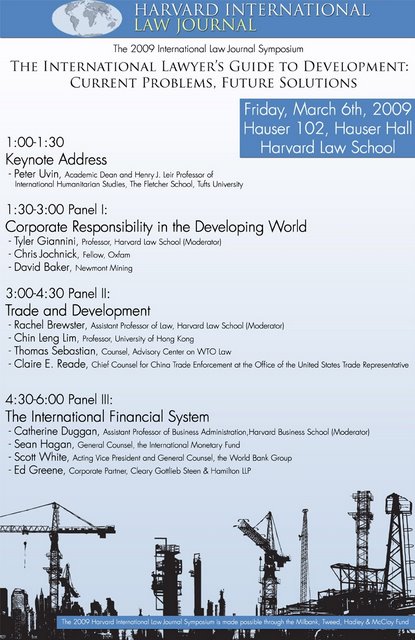 Friday, March 6th, 2009
Hauser 102, Hauser Hall
Harvard Law School
Schedule
Friday, March 6th, 2009
1:00-1:30pm – Keynote Address
Peter Uvin, Academic Dean and Henry J. Leir Professor of International Humanitarian Studies, The Fletcher School, Tufts University
1:30-3:00pm – Panel I: Corporate Responsibility in the Developing World
Tyler Giannini, Professor, Harvard Law School (Moderator)
Chris Jochnick, Fellow, Oxfam
David Baker, Newmont Mining
3:00-4:30pm – Panel II: Trade & Development
Rachel Brewster, Assistant Professor of Law, Harvard Law School (Moderator)
Chin Leng Lim, Professor, University of Hong Kong
Edwin Kneedler, Deputy Solicitor General, U.S. Solicitor General’s Office
Thomas Sebastian, Counsel, Advisory Center on WTO Law
Claire E. Reade, Chief Counsel for China Trade Enforcement, Office of the U.S. Trade Representative
4:30-6:00pm – Panel III: The International Financial System
Catherin Duggan, Assistant Professor of Business Administration, Harvard Business School (Moderator)
Sean Hagan, General Counsel, International Monetary Fund
Scott White, Acting Vice President and General Counsel, World Bank Group
Ed Greene, Corporate Partner, Cleary Gottlieb Steen & Hamilton LLP
The 2009 Harvard International Law Journal Symposium is made possible through the Milbank, Tweed, Hadley & McCloy Fund
Panel Descriptions:
Panel I: Corporate Responsibility in the Developing World
Development projects present special problems for both the company engaged in development and the host nation. These problems can be resolved through legal mechanisms, informal dispute resolution, or through overt power by one side. The panel will discuss experiences from the planning, execution, and post project phases of international development work focusing on disputes that arose, the manner in which they were resolved, and share ideas about how the process could function better.
Panel II: Trade & Development
Unlike Washington-based international financial institutions (i.e. the World Bank and International Monetary Fund), the World Trade Organization provides a unique forum for developing countries to protect their concerns through legal participation and law-making rights. But with the Doha round of negotiations dragging on into its eighth year and the rise of regional trade agreements, does the WTO still work for developing countries? In light of this question, some of the topics the panel will discuss are: tensions between other international agreements and the WTO agreement; the development of the legal principles shaping “special and differential” treatment; the rise (and fall?) of coalition forming; and the particular challenges facing lawyers representing least-developed countries.
Panel III: The International Financial System
Though the international financial system is undoubtedly global in scope, there are surprisingly few standards and norms to which all global actors are required to subscribe. The fragmentation of the system has a large impact on these actors – from individual investors to financial lending institutions and sovereign states – which has become even more apparent in the current economic environment. The International Financial System panel will first discuss the existing problems surrounding international financing. It will then examine models of regulatory reform to prevent global financial crises in the future. The panel will conclude by assessing the effect of these mechanisms on developing economies.
Speaker Bios:
Peter Uvin is the Academic Dean and The Henry J. Leir Professor of International Humanitarian Studies at the Fletcher School of Tufts University. He has taught at Brown University, New Hampshire College and the Graduate School of Development Studies, Geneva. He is also the winner of 2006 Guggenheim Fellowship and the 1999 Herskovits Award for most outstanding book on Africa. Dean Uvin regularly consults for multilateral and bilateral aid agencies and ministries of foreign affairs, as well as NGOs. He serves on the Editorial board for Kumarian Press and the Journal of Peacebuilding and Development. He is the author of Aiding Violence: The Development Enterprise in Rwanda, Human Rights and Development, and The Influence of Aid in Situations of Violent Conflict. He has Licences in Diplomatic Science and in Political Science from the University of Ghent and a PhD in Political Science from the Institut Universitaire de Hautes Etudes Internationales, University of Geneva.
Edward F. Greene is a partner in the New York office of Cleary Gottlieb Steen & Hamilton LLP. Mr. Greene’s practice focuses on securities, corporate governance, regulatory and financial services reform and other corporate law matters. Mr. Greene served as General Counsel of the Securities and Exchange Commission from 1981 to 1982 and Director of the Division of Corporation Finance from 1979 to 1981. From 2004 to 2008, Mr. Greene served as General Counsel of Citigroup’s Institutional Clients Group. He oversaw all legal aspects related to the group’s activities with issuers and investors worldwide, including investment banking, corporate lending, derivatives, sales and trading, and transaction services. He served as Chairman of the Institutional Clients Group Business Practices Committee in connection with his responsibility for regulatory and transactional matters. Mr. Greene originally joined the firm in 1982 and returned in 2009. Mr. Greene received an LL.B. degree from Harvard Law School in 1966 and an undergraduate degree from Amherst College in 1963.
Sean Hagan is General Counsel and Director of the Legal Department at the International Monetary Fund. In this capacity, Mr. Hagan advises the Fund’s management, Executive Board and membership on all legal aspects of the Fund’s operations, including its regulatory, advisory and lending functions. Mr. Hagan has published extensively on both the law of the Fund and a broad range of legal issues relating to the prevention and resolution of financial crisis, with a particular emphasis on insolvency and the restructuring of debt, including sovereign debt. Prior to beginning work at the IMF, Mr. Hagan was in private practice, first in New York and subsequently in Tokyo. Mr. Hagan received his Juris Doctor from the Georgetown University Law Center and also received a Masters of Science in International Political Economy from the London School of Economics and Political Science.
Scott White has been the Acting Vice President and Group General Counsel of the World Bank since April 2008. He is Deputy General Counsel and also served as Acting General Counsel from February-August 2006. He joined the Bank in 1984. His background is in providing legal and institutional advice in respect of the Bank’s capital markets, derivatives, liquid asset management and pension investment operations and for new financial products as well as in the financial policy and risk management areas. He has been counsel to the Audit and Budget Committees of the Board of Executive Directors of the Bank and to the Bank’s Pension Finance Committee, which supervises the investments of the Bank’s pension plan. In recent years, Mr. White also has been involved in the legal aspects of the Bank’s anti-corruption work, serving as liaison to the 2007 independent Volcker Panel that reviewed the effectiveness of the Bank’s Department of Institutional Integrity and on the Working Group on Implementation of the Volcker Panel’s recommendations to strengthen the Bank’s anti-corruption unit. Prior to coming to the Bank, Mr. White was a lawyer in private practice in Washington, D.C. and in New York. He graduated from Princeton in 1973, majoring in the Woodrow Wilson School of Public and International Affairs, and from Columbia Law School in 1976.
Dave Baker is the Vice President and Environment and Chief Sustainability officer of Newmont Mining Corporation. He joined Newmont in 1980 as a mine geologist. He was elected Vice President, Environmental Affairs in 1991. Mr. Baker spent a significant amount of his career addressing the regulatory implications on mining operations of state and federal programs, including CERCLA, RCRA, Clean Water Act, Clean Air Act and the Nevada Mining and Reclamation statutes. He has extensive experience in the development, permitting and financing of major mining projects in the international arena, including the United States, Africa, Indonesia, Peru and Uzbekistan. In addition to the environmental affairs responsibilities, he also served as Vice President, Environmental, Health and Safety, and Vice President for Government Affairs.In his current position, Mr. Baker has broad responsibility for developing and implementing Newmont’s strategy for environmental affairs and community development as we head into an era of increasing focus and expectation on corporate transparency, substantive community engagement and the broader issues around sustainability.Mr. Baker received his Bachelor of Science degree in Earth Sciences – Geology from the University of Arizona and has completed the Harvard Business School’s Advanced Management Program in 1997.
Chris Jochnick is the Director of the Private Sector Department at Oxfam America and Coordinator of the Private Sector Team of Oxfam International. Mr. Jochnick is the co-founder of the Center for Economic and Social Rights (NY) and the Centro de Derechos Economicos y Sociales (Ecuador). He has worked for over fifteen years on issues of human rights and corporate accountability, including seven years in Latin America supporting grassroots campaigns around trade, health and extractive industries. He has participated in a number of multi-stakeholder initiatives and sits on the Steering Committee of the Voluntary Principles on Security and Human Rights and on the International Advisory Panel of JO-IN. Prior to joining Oxfam, Mr. Jochnick worked as a corporate attorney with the Wall Street law firm of Paul, Weiss, Rifkind, Wharton and Garrison, where he advised companies on environment and social liabilities. Mr. Jochnick is a graduate of Harvard Law School, a former MacArthur Research and Writing fellow and Echoing Green fellow. He recently co-edited the book Sovereign Debt at the Crossroads (Oxford, 2007) and has lectured widely on issues of human rights, business and development. He teaches a course on business and human rights at Harvard Law School.
Prof. Tyler Giannini was co-director of EarthRights International (ERI), an organization at the forefront of efforts to link human rights and environmental protection. As a founder of ERI, Giannini spent a decate in Thailand conducting investigative fact-finding efforts on human rights abuses in Burma and groundbreaking corporate accountability litigation. In particular, Giannini was co-counsel in the landmark Doe v. Unocal litigation. The case sought to hold the corporation accountable for abuses surrounding the Yadana gas pipeline project in Burma, and was settled in early 2005. Giannini holds graduate degrees in law and foreign policy from the University of Virginia, where he was a member of the law review. Mr. Giannini will co-teach (with Bonnie Docherty) the seminar Human Rights and the Environment:advocacy seminar in the Fall Term 2009 and will co-teach (with Chris Jochnick) the seminar Business and Human Rights in the Spring Term 2009.
Claire E. Reade was appointed Chief Counsel for China Trade Enforcement at the Office of the United States Trade Representative in August 2006. She coordinates USTR efforts to ensure China’s compliance with its international trade commitments, especially its WTO obligations. She also co-chairs the China Enforcement Task Force at USTR. Prior to joining USTR, Ms. Reade was a senior partner at Arnold & Porter where she was an international trade litigator and counselor. She represented American and foreign clients in major international trade disputes and other trade matters. Ms. Reade is a member of the Council on Foreign Relations, a former chair of the American Bar Association International Trade Law Section, a former member of the ABA Council on Asia, and a frequent speaker on international trade law issues. An honors graduate of Harvard Law School, Ms. Reade also holds a Masters of Arts in Law and Diplomacy from the Fletcher School of Law and Diplomacy at Tufts University. After receiving her law degree from Harvard, she spent 1979 -1980 in Taipei, Taiwan, studying Chinese dispute resolution procedures under a Harvard Sheldon Fellowship, pursuing her studies in written and spoken Mandarin Chinese. She and her husband have two grown children.
Prof. Chin Leng Lim’s research focuses on free trade agreements, democracy, constitutionalism and international law in Asia. At the University of Hong Kong, Professor Lim also teaches courses on Constitutional Law, Human Rights in Hong Kong, Global Business Law and International Economic Law. Before joining the University of Hong Kong in 2007, he was a faculty member of the National University of Singapore; Queen Mary, London; and the University of Wales, Aberystwyth. Outside academia, Professor Lim worked as a UN lawyer dealing with Gulf War reparations in Geneva (UNCC), and as a member of the Singapore Attorney-General’s staff where he advised on international law and acted as counsel to Singapore in FTA negotiations. Professor Lim also recently served as an APEC Human Resources Working Group expert on free trade agreements, as an advisor to the Timor-Lesté Prime Minister’s Office, and trains Asian trade policy officials for the WTO’s RTPC Programme. Professor Lim was born in Malaysia and educated there at the Free School, as well as in England at Buckingham and University College, Oxford. He attended the Fletcher School while earning an LL.M. degree from Harvard, and received his Ph.D. from Nottingham in 1995. He is currently writing on the first generation of Afro-Asian international lawyers, and their efforts to create a more balanced post-colonial legal order.
Thomas Sebastian is Counsel at the Advisory Centre on WTO Law in Geneva. In that capacity he represents developing and least developed countries in proceedings before the WTO dispute settlement system and provides advice on issues of WTO law. Mr. Sebastian holds a BA. LLB (Honours) degree from the National Law School of India University as well as BCL and MPhil degrees from Oxford University which he attended on a Rhodes Scholarship. Prior to joining the ACWL, he worked briefly as a Visiting Research Fellow at the Centre for International Development at the Kennedy School of Government and as a Clerk to the Chief Justice of India. He has published articles on issues of WTO law in the Harvard International Law Journal and the Journal of International Economic Law.

The Harvard International Law Journal 2008 Symposium
Friday, April 18th, 2008
Ropes Gray Room, Pound Hall
Harvard Law School
The 2008 Harvard International Law Journal Symposium is made possible through the Milbank, Tweed, Hadley & McCloy Fund
Schedule
Friday, April 18th, 2008
12:00pm – Panel I: Comparative Constitutional Perspectives
Ropes Gray Room, Pound Hall
Irwin Cotler, Member of Parliament & Former Minister of Justice, Canada
Noah Feldman, Professor, Harvard Law School
Taghrid Hikmet, Justice, High Criminal Court of Jordan
Frank Michelman, Professor, Harvard Law School (Moderator)
2:00pm – Remarks by Harvard Law School Dean Elena Kagan
Ropes Gray Room, Pound Hall
2:15pm – Panel II: The U.S. Constitution & International Law
Ropes Gray Room, Pound Hall
Sarah Cleveland, Professor, Columbia Law School
David Golove, Professor, NYU Law School
Edwin Kneedler, Deputy Solicitor General, U.S. Solicitor General’s Office
John McGinnis, Professor, Northwestern Law School
Ernest Young, Professor, Duke Law School
Mark Tushnet, Professor, Harvard Law School (Moderator)
4:15pm – Panel III: Approaches to Human Rights: International Law and Constitutionalism
Ropes Gray Room, Pound Hall
Laurence Helfer, Professor, Vanderbilt Law School
Mattias Kumm, Professor, NYU Law School
Gerald Neuman, Professor, Harvard Law School
Anne Peters, Professor, University of Basel
Ran Hirschl, Professor, University of Toronto (Moderator)
6:15pm – Wine & Cheese Reception
John Chipman Gray Room, Pound Hall
Panel Descriptions
Panel I: Comparative Constitutional Perspectives
Drafters of new constitutions face many difficult choices in fasioning stable political and legal institutions. These choices are more trying in the context of ethnic conflict, in which there is a heightened need to achieve domestic public legitimacy while meeting international demands. Iraq and Afghanistan present compelling examples of nascent constitutions forged with the input of the international community and against the backdrop of ethnic conflict. The Afghan Constitution stresses the state’s commitment to international law and human rights norms while maintaining deference to established Islamic shari’a and empowering the Supreme Court to review international treaties and covenants. Similarly, concern exists that the Iraqi Constitution, with its requirement that international treaties to which Iraq is a signatory not contradict Islam, enables Iraq to limit its international obligations. Do these new constitutions merely pay lip service to international law, or do they ensure an important role for international law in each country’s domestic legal hierarchy?
A constitutional issue frequently arising in ethnic conflict situations is the legal treatment of hate speech. Accordingly, hate speech offers an instructive case study for how constitutional and international law have been used to respond to ethnic tensions. In Kosovo and East Timor, the U.N. sought to address human rights issues, and hate speech in particular, within the legislative frameworks established in those new states. Yet even in countries as ostensibly similar as Canada and the United States, hate law jurisprudence highlights the different ways in which countries have balanced constitutional and international law. In its pioneering Mugesera case, the Supreme Court of Canada upheld the deportation of a Rwandan politician widely considered to have sparked the Rwandan genocide with his hateful public speeches. In so holding, the Court helped cement the ill-defined crime of incitement to genocide, and aligned Canadian provisions regarding crimes against humanity with international law. This result raises important questions about hate speech in other modern contexts, such as whether the remarks of Iranian President Ahmadinejad, suggesting that Israel be “wiped off the map,” are justiciable in an international law context.
By focusing on these different perspectives on the interaction of domestic constitutions and international law in the context of ethnic tensions, this panel seeks to explore ways in which these tensions have been managed (or mismanaged) across countries with different legal systems, histories, values, degrees of development, and ethnic compositions.
Panel II: The U.S. Constitution and International Law
Although the debate over how international law ought to interact with the U.S. Constitution is longstanding, the attacks of September 11, 2001, and the ensuing war on terror have shone new light on this well-worn question. Prosecuting the war on terror while abiding by international standards has proven to be a difficult and controversial balancing act—one characterized not by the unidirectional influence of international law on constitutional norms, but rather by a rich and complex interchange between the two. In recent years, several important questions have been brought to bear, including the extent to which the Constitution binds the U.S. to norms of international law, the extent to which international law acts as a constraint on domestic legislation or on Presidential powers, and the extent to which the U.S. Constitution should be understood as incorporating norms of global, in addition to domestic, justice.
No better are these simmering tensions exemplified than in the Supreme Court’s recent Medellin v. Texas decision and in the pending Iraq and Guantánamo habeas corpus cases.
In Medellin, the Court held that although the Optional Protocol to the Vienna Convention on Consular Relations might be binding as a matter of international law, it does not have domestic binding effect because it is not self-executing and no legislation on the books had put its obligations into effect. The decision raises serious questions about the binding nature of the United States’ many treaty commitments.
In the forthcoming Munaf v. Geren and Geren v. Omar opinions, the Court will have to decide whether federal courts can exercise jurisdiction over habeas petitions brought by U.S. citizens detained by multinational forces in Iraq. Relatedly, in Boumediene v. Bush, the Court will decide whether the 2006 Military Commissions Act, which stripped detainees of the right to challenge in federal courts their indefinite designation as enemy combatants, violates the constitutional rights of those detainees to federal habeas relief. This group of habeas cases raises important issues with respect to the relationship between the Constitution and U.S. participation in international organizations, but also with respect to the relationship between international law and extraterritorial application of the Constitution.
While it is true that a number of these questions and concerns have arisen in the context of the war on terror, it remains to be seen how these issues will relate to other pressing national interests that converge on the international plane. Are the same principles applicable to concerns that also arise in times of peace, such as human rights violations and environmental degradation? Does the Constitution allow for the U.S. government to delegate authority to international institutions and officials who are not chosen by the U.S. citizenry? What is the proper role for customary, as opposed to treaty-based, international law in U.S. courts?
By focusing on these questions and more, this panel will highlight the expanding and increasingly complex interaction between the U.S. Constitution and international law.
Panel III: Approaches to Human Rights: International Law and Constitutionalism
The intersection between constitutionalism and human rights regimes, both domestic and supranational, has been a fertile ground for scholarship in recent years. In particular, the emergence of regional human rights regimes has substantially altered the legal landscape in this area. The European Court of Human Rights (“ECtHR”) and the Inter-American Court of Human Rights (“IACtHR”) are illustrative examples of such regimes.
The ECtHR has in many ways become a victim of its own success. The Court faces a daunting docket crisis stemming from the expanding number of states subject to its jurisdiction, its favorable reputation, its expansive interpretations of individual liberties, a distrust of domestic judiciaries in some countries, and entrenched human rights problems in others. In response to the burgeoning backlog of cases, numerous proposals for restructuring have been tabled by the European Council. These proposals – ranging from enhancing the judicial filtering mechanism to improving domestic remedies for redressing violations – raise fundamental questions about the Court’s future identity. How these proposals should be understood, and whether they or not they should be implemented, are questions meriting urgent and careful consideration.
The IACtHR serves as an interesting counterpoint to the ECtHR in several key ways. Having elaborated a significant body of human rights jurisprudence through interpretation of regional human rights conventions and the adaptation of European and global precedents, the Court has aspired to influence beyond its region by offering innovative interpretations of human rights and by identifying norms as jus cogens. The effects of such expansive interpretation, both with respect to the inter-American community and the wider international community, remain to be seen.
The intersection of international human rights law and constitutionalism has not been limited to the realm of supranational human rights courts.
The European Court of Justice (“ECJ”) will soon decide whether or not European Union enforcement of a U.N. Security Council decision imposing economic sanctions on individuals with suspected terrorist affiliations contravenes certain fundamental rights. The most pressing human rights concerns relate to the difficulty for the afflicted individual to challenge the sanctions imposed against him. This preclusion quite explicitly implicates the right to a fair trial and an effective remedy. A collision between U.N. and E.U. legal systems could jeopardize the implementation of United Nations sanctions by several powerful European countries. In effect, if such sanctions were to be invalidated, E.U. member states would have to implement new laws giving effect to U.N. measures on their own territory, without running afoul of the ECJ’s ruling.
By exploring an illustrative cross-section of issues involving fundamental rights, this panel seeks to sketch the contours of how international law and domestic constitutions interact to shape human rights law.
Speaker Bios
Panel I: Comparative Constitutional Perspectives
Irwin Cotler is a Canadian Member of Parliament, first elected in a by-election in November 1999 with 92% of the vote, in what was characterized as “the most stunning electoral victory in this century by any standard”. He was re-elected in the general elections of November 2000, June 2004, and January 2006, with the highest Liberal majority in the country. On December 12, 2003, the Prime Minister appointed him Minister of Justice and Attorney General of Canada where he helped transform the face of the judiciary through the appointment of two outstanding women justices to the Supreme Court of Canada, making the Supreme Court of Canada the most gender representative Supreme Court in the world. As Minister, he also made the pursuit of international justice a priority, including, in particular, the combating of mass atrocity and genocide, and initiated the first-ever prosecution in Canada for incitement to genocide. Mr. Cotler is currently on leave as a Professor of Law at McGill University, where he is Director of its Human Rights Program, and Chair of InterAmicus, the McGill-based International Human Rights Advocacy Centre. He has been a Visiting Professor at Harvard Law School, a Woodrow Wilson Fellow at Yale Law School, and is the recipient of nine honorary doctorates, whose citations refer to him as “a scholar and advocate of international stature”.
Taghrid Hikmet is a judge on the International Criminal Tribunal for Rwanda, a position she has held since 2003. Judge Hikmet was the first female judge in Jordan, serving initially as Assistant of the Prosecutor General (1996-1998), then as a Judge on the Court of Appeal (1998-2002), and now as a Judge on the High Criminal Court. Prior to serving as a judge, she was a lawyer before Jordanian civil and criminal courts (1982-1996), the head of an educational institute in Amman (1978-1982), and a teacher in Jordanian schools (1965-1978). Judge Hikmet is a consultant for the Jordanian Center for Human Rights Studies, the chairwoman of the Higher Committee for the Election of the Jordanian National Committees for Women, and the President of the Family Protection Project in Jordan – an initiative aimed at reducing domestic violence, sexual abuse, and child abuse. In recognition of her work on the Family Protection Project, Judge Hikmet was awarded a United Nations Human Rights prize in 2003. She was also a 2007 recipient of the American Society of International Law’s “Prominent Women in International Law Award.” Judge Hikmet is a graduate of Damascus University, having received both a B.A. in Law and an M.A. in General International Law. Her research interests include women’s rights, human rights, and family law.
Noah Feldman is Professor of Law at Harvard Law School, specializing in constitutional studies, with particular emphasis on the relationship between law and religion, constitutional design, and the history of legal theory. He is also a contributing writer for the New York Times Magazine and an adjunct senior fellow at the Council on Foreign Relations. Before joining the Harvard faculty, Feldman was Cecelia Goetz Professor of Law at New York University School of Law. He was named a Carnegie Scholar in 2005. In 2004, he was a visiting professor at Yale Law School and a fellow of the Whitney Humanities Center. In 2003 he served as senior constitutional advisor to the Coalition Provisional Authority in Iraq, and subsequently advised members of the Iraqi Governing Council on the drafting of the Transitional Administrative Law or interim constitution. From 1999 to 2002, he was a Junior Fellow of the Society of Fellows at Harvard University. Before that, he served as a law clerk to Justice David H. Souter of the U.S. Supreme Court (1998 to 1999) and to Chief Judge Harry T. Edwards of the U.S. Court of Appeals for the D.C. Circuit (1997 to 1998). He received his A.B. summa cum laude in Near Eastern Languages and Civilizations from Harvard University in 1992. Selected as a Rhodes Scholar, he earned a D.Phil. in Islamic Thought from Oxford University in 1994. He received his J.D. from Yale Law School in 1997, serving as Book Reviews Editor of the Yale Law Journal. He is the author of four books: Fall and Rise of the Islamic State (Princeton Univ. Press 2008); Divided By God: America’s Church-State Problem and What We Should Do About It (Farrar, Straus & Giroux 2005); What We Owe Iraq: War and the Ethics of Nation Building (Princeton Univ. Press 2004); and After Jihad: America and the Struggle for Islamic Democracy (Farrar, Straus & Giroux 2003).
Frank I. Michelman is Robert Walmsley University Professor, Harvard University, where he has taught since 1963. He is the author of Brennan and Democracy (1999), and has published widely in the fields of constitutional law and theory, property law and theory, local government law, and jurisprudence. Professor Michelman is a past President of the American Society for Political and Legal Philosophy, and a fellow of the American Academy of Arts and Sciences. In 2005, he was awarded the American Philosophical Society’s Phillips Prize in Jurisprudence. He is a member of the Board of Directors of the United States Association of Constitutional Law and of the National Advisory Board of the American Constitution Society. Over the past several years, he has maintained an active interest in matters of constitutionalism in South Africa.
Panel II: The U.S. Constitution & International Law
Sarah Cleveland is Louis Henkin Professor of Human and Constitutional Rights at Columbia Law School. Prior to joining the faculty at Columbia Law School, Professor Cleveland was Marrs McLean Professor of Law at the University of Texas School of Law, where she also served as Faculty Director of the Transnational Worker Rights Clinic and was the recipient of the 2000 Excellence in Teaching Award. Professor Cleveland has also previously taught at Oxford University, Harvard Law School, and the University of Michigan Law School, and was a law clerk to Justice Harry A. Blackmun of the Supreme Court of the United States (1993-1994), and to Judge Louis F. Oberdorfer of the United States District Court for the District of Columbia (1992-1993). Professor Cleveland’s areas of expertise include international human rights, foreign affairs and the Constitution, international trade and labor rights, and international law in U.S. courts. She has authored or co-authored numerous amicus briefs, particularly regarding the legal rights of foreign nationals, and served as an expert on the Afghanistan Transitional Commercial Law Project Working Group, drafting a labor code for post-Taliban Afghanistan, and on the Erlenborn Commission, reviewing the provision of legal services to aliens in the United States. She serves on the legal advisory committees of several human rights organizations, including the Center for Justice and Accountability in San Francisco, and the International Labor Rights Fund and the Farmworker Justice Fund in Washington, D.C.
David M. Golove is Hiller Family Foundation Professor of Law at the New York University School of Law. He has secured a reputation as one of the most original and promising scholars in constitutional law. In a recent book-length article for the Michigan Law Review, “Treaty-Making and the Nation: The Historical Foundations of the Nationalist Conception of the Treaty Power,” Professor Golove comprehensively considers a question of constitutional law that has been controversial from the moment of the nation’s birth in 1776 and remains so today: Can the United States government, through its power to make treaties, effectively regulate subjects that would otherwise be beyond the reach of Congress’s enumerated legislative powers? For example, a treaty prohibiting the death penalty? He answers yes, and in doing so has produced both a major work of legal historical scholarship and an important legal and constitutional defense of federal power. In 1995, an article by Professor Golove in the Harvard Law Review dealt with another fundamental issue in foreign relations law: the undeniable fact that many international accords today are approved not through the treaty processes mandated in the U.S. Constitution, but by majority votes of both houses. In a more recent article published in the NYU Law Review, he challenges the distinguished constitutional scholar Laurence Tribe, in a debate over the interpretation of the Treaty Clause, which Professor Golove defended in his Harvard Law Review article. In 1999, Professor Golove published a piece in the University of Colorado Law Review supporting the President’s authority to order military operations to implement a United Nations Security Council Resolution without authorization by Congress. He received his B.A. from Berkeley in 1979 and has law degrees from Boalt Hall and Yale. He teaches Constitutional Law and International Law. Professor Golove is a member of the faculty Executive Committee of the NYU Institute for International Law and Justice and Director of the J.D.-LL.M. program in international law.
Edwin S. Kneedler is a Deputy Solicitor General in the United States Department of Justice. He is responsible for reviewing Supreme Court briefs and appeal and amicus recommendations in court of appeals cases on behalf of the United States Government in a variety of subject areas, including cases involving the Departments of State, Interior, Agriculture, Labor, and Health and Human Services, as well as many constitutional and administrative law cases involving federal agencies generally. Ed has participated in the briefing or oral argument of a number of cases in the Supreme Court on behalf of the United States concerning separation of powers, including INS v. Chadha, Bowsher v. Synar, and Morrison v. Olson, as well as cases involving foreign relations, including Dames & Moore v. Regan, Crosby v. National Foreign Trade Council, Garamendi v. American Insurance Ass’n, and Sosa v. Alvarez, and numerous cases under the Foreign Sovereign Immunities Act. Ed has also been extensively involved over the years in cases in the Supreme Court and lower courts in cases involving the Alien Tort Statute, immunities of foreign officials, and the Act of State Doctrine. Ed is a 1974 graduate of the University of Virginia Law School. He served as a law clerk to Judge Browning of the Ninth Circuit from 1974 to 1975. He joined the Office of Legal Counsel in the Department of Justice in October 1975. He then joined the Office of the Solicitor General in June 1979. He was appointed a Deputy Solicitor General in 1993.
John O. McGinnis is Stanford Clinton Sr. Professor of Law at the Northwestern University School of Law. Professor McGinnis clerked for the Hon. Kenneth W. Starr, U.S. Court of Appeals for the District of Columbia. From 1987 to 1991, Professor McGinnis was deputy assistant attorney general in the Office of Legal Counsel at the Department of Justice. He is a scholar in both the area of constitutional and international law. Professor McGinnis has been appointed chairman of the government’s advisory committee on free trade agreements and labor standards. The Office of the U.S. Trade Representatives also has added him to the roster of Americans who can be appointed as panelists to resolve World Trade Organization disputes. He is a past winner of the Paul Bator award given by the Federalist Society to an outstanding academic under 40. He contributes regularly to both law reviews and popular journals.
Mark Tushnet is William Nelson Cromwell Professor of Law at Harvard Law School. He received his undergraduate degree magna cum laude from Harvard College in 1967. He received a J.D. and M.A. in history from Yale University in 1971. He clerked for Judge George Edwards and Justice Thurgood Marshall before beginning to teach at the University of Wisconsin Law School in 1973. In 1981 he moved to the Georgetown University Law Center, and in 2006 to Harvard Law School. He has been a visiting professor at the University of Texas, University of Southern California, University of Chicago, Columbia University, New York University, and Harvard law schools. Professor Tushnet is the co-author of four casebooks, including the most widely used casebook on constitutional law, Constitutional Law (with Stone, Seidman, and Sunstein). He has written more than a dozen books, including a two-volume work on the life of Justice Thurgood Marshall, A Court Divided: The Rehnquist Court and the Future of Constitutional Law, and Weak Courts, Strong Rights: Judicial Review and Social Welfare Rights in Comparative Constitutional Law, and edited eight others. He has received fellowships from the Rockefeller Humanities Program, the Woodrow Wilson International Center for Scholars, and the John Simon Guggenheim Memorial Foundation, and has written numerous articles on constitutional law and legal history. He was President of the Association of American Law Schools in 2003. In 2002 he was elected a fellow of the American Academy of Arts and Sciences.
Ernest Young is Professor of Law at the Duke University School of Law. Professor Young studies constitutional law, foreign affairs and the Constitution, and federal courts. He is one of the nation’s leading authorities on the constitutional law of federalism, having written extensively on the Rehnquist Court’s “Federalist Revival” and the difficulties confronting courts as they seek to draw lines between national and state authority. He also is an active commentator on foreign affairs law, where he focuses on the interaction between domestic and supranational courts and the application of international law by domestic courts. Professor Young also writes on constitutional interpretation and constitutional theory. He has been known to dabble in maritime law and comparative constitutional law. A native of Abilene, Texas, Professor Young joined the Duke Law faculty in 2008, after serving as the Charles Alan Wright Chair in Federal Courts at the University of Texas at Austin School of Law, where he had taught since 1999. He graduated from Dartmouth College in 1990 and Harvard Law School in 1993. After law school, he served as a law clerk to Judge Michael Boudin of the U.S. Court of Appeals for the First Circuit (1993-94) and to Justice David Souter of the U.S. Supreme Court (1995-96). Professor Young practiced law at Cohan, Simpson, Cowlishaw, & Wulff in Dallas, Texas (1994-95) and at Covington & Burling in Washington, D.C. (1996-98), where he specialized in appellate litigation. He has also been a visiting professor at Harvard Law School (2004-05) and Villanova University School of Law (1998-99), as well as an adjunct professor at Georgetown University Law Center (1997). Elected to the American Law Institute in 2006, Professor Young is an active participant in both public and private litigation in his areas of interest. He was the principal author of a brief on behalf of leading constitutional scholars in the Supreme Court’s decision on federal regulation of medical marijuana, Gonzales v. Raich, and he filed an amicus brief on behalf of Alabama and four other states in the Texas Court of Criminal Appeals in Medellin v. Dretke, a case concerning presidential power and the authority of the International Court of Justice over domestic courts.
Panel III: Approaches to Human Rights: International Law and Constitutionalism
Laurence R. Helfer is Professor of Law and the Director of the International Legal Studies Program at Vanderbilt University Law School. He has authored numerous publications and lectured widely on his diverse research interests, which include interdisciplinary analysis of international law and institutions, human rights, international intellectual property, and international litigation and dispute settlement. His articles have appeared in leading American law reviews, including the Yale Law Journal, the Columbia Law Review, the California Law Review, the Virginia Law Review, the University of Pennsylvania Law Review, and the Vanderbilt Law Review, as well as in numerous specialized international law journals. Professor Helfer is a member of the editorial board of the peer-reviewed Journal of World Intellectual Property and serves as an expert advisor to the United Nations Food and Agriculture Organization. He recently received an International Research Incubator grant from the Center for the Americas at Vanderbilt to support an interdisciplinary research project on “The Politics of Intellectual Property Litigation in the Andean Community.” Professor Helfer also provides advice and assistance to non-governmental organizations that engage in human rights advocacy. He is a Visiting Professor of Law and the John Harvey Gregory Lecturer on World Organization at Harvard Law School during Spring 2008.
Ran Hirschl is Professor of Political Science and Law at the University of Toronto, and holds a senior Canada Research Chair in Constitutionalism, Democracy & Development. He completed his B.A., LL.B., and M.A. at Tel-Aviv University, and received his M.Phil and Ph.D. from Yale University in 1999. His primary areas of interest are comparative constitutional law and politics, and comparative legal institutions. He is currently serving as the Jeremiah Smith Jr. Visiting Professor of Law at Harvard Law School. He has been a Fellow at the Center for Advanced Study in the Behavioral Sciences, Stanford, and at Princeton University’s Program in Law and Public Affairs, and has recently been appointed a Global Faculty member at NYU’s Hauser Global Law School. He has published extensively on comparative constitutional law and politics in journals such as Comparative Politics, Political Theory, Annual Review of Political Science, Law & Social Inquiry, American Journal of Comparative Law, Human Rights Quarterly, International Journal of Constitutional Law, and the Canadian Journal of Law and Jurisprudence, as well as numerous articles in law reviews and chapters in edited collections, most recently in The Migration of Constitutional Ideas (Cambridge, 2006), and the Oxford Handbook of Law & Politics (Oxford, 2007). He is the editor (with Christopher L. Eisgruber), of a special symposium issue of I-CON International Journal of Constitutional Law entitled “North American Constitutionalism,” and the author of Towards Juristocracy: The Origins and Consequences of the New Constitutionalism (Harvard Univ. Press, 2004). He is currently completing two new books (both of which will also be published by Harvard Univ. Press) entitled: Sacred Judgments: The Dilemma of Constitutional Theocracy, and Lex Comparativus Novo: Comparative Legal Studies for the 21st Century.
Gerald L. Neuman is J. Sinclair Armstrong Professor of International, Foreign, and Comparative Law at Harvard Law School. Prior to joining Harvard Law School, Neuman was the Herbert Wechsler Professor of Federal Jurisprudence at Columbia Law School, as well as a member of the faculty at the University of Pennsylvania Law School (1984-1992). Neuman’s current research areas include habeas corpus and the rule of law, the rights of foreign nationals, transnational dimensions of constitutionalism, and the inter-American human rights regime. Neuman is a co-author of the casebook Human Rights (Foundation Press), and the author of Strangers to the Constitution: Immigrants, Borders, and Fundamental Law (Princeton Univ. Press).
Mattias Kumm is Professor of Law and Director of the LL.M / J.S.D. program in International and Comparative Law at the New York University School of Law. He has studied Law, Philosophy, and Political Sciences in Kiel, Paris, and Cambridge, MA, and has taught at the Fletcher School of Law and Diplomacy, the European University Institute in Florence, and was an ‘Ethics Fellow’ at the Kennedy School of Government and a Jean Monnet Fellow at Harvard Law School before joining the NYU School of Law in Fall 2000. He has taught as a Visiting Professor at Bucerius Law School in Hamburg, Germany, as well as the University of Navarra, Spain and the National University of Singapore. Professor Kumm’s research focuses on issues of European and comparative constitutional law, international law and philosophy of law. Professor Kumm is a member of the faculty Executive Committee of the Institute for International Law and Justice.
Anne Peters is Professor of Public International and Constitutional Law at the University of Basel, a position she has held since 2001. In the academic year 2004-05, she was Dean of the Faculty of Law. Prior to taking up her tenured post, Professor Peters was Assistant Professor at the Walther-Schücking Institute of Public International Law at the Christian-Albrechts-University Kiel, where she obtained the Habilitation qualification on the basis of her Habilitation thesis “Elemente einer Theorie der Verfassung Europas” (Elements of a Theory of the Constitution of Europe). Born in Berlin in 1964, Anne Peters studied Law, Modern Greek and Spanish at the Universities of Würzburg, Lausanne, and Freiburg im Breisgau and pursued post-graduate studies at Harvard Law School. She was a fellow of the National Scholarship Fondation of the German People (Studienstiftung des Deutschen Volkes) and was awarded the prize from the Scientific Society at Freiburg im Breisgau for her doctoral dissertation on territorial referenda in international law in 1995. Her research activities cover the field of general public international law, especially its constitutionalization, European constitutional law, constitutional theory and constitutional comparison and national and international human rights. Anne Peters was in 2004 elected into the executive board of the European Society of International Law and in 2007 into the Swiss National Research Council of the National Science Foundation.