
Symposia

Annual Symposia, Symposia

The Harvard International Law Journal 2016 Symposium

The Harvard International Law Journal invites you to attend its annual Symposium, to be held in Hauser Hall on the Harvard Law School Campus on Friday, February 26, 2016. All are welcome to attend. This year’s theme is “International Law in Domestic Practice” and will feature a keynote address, followed by three panel discussions, each highlighting various ways in which international law impacts or can be used as a tool in domestic law, policy and advocacy. Please see below for a detailed program and list of participants. A campus map can be found here. For additional information, please contact Chris Mirasola ([email protected]) or Marissa Yu ([email protected]).


Harvard International Law Journal

“International Law in Domestic Practice”

Friday, February 26, 201612:00 – 5:30pmHauser Hall, Harvard Law School

No RSVP required. Lunch and refreshments will be served.

12:00 – 1:00pm ⬩ Hauser 104
Keynote: John B. Bellinger III, Former Legal Adviser to the Department of State; Partner, Arnold & Porter

Mr. Bellinger is a partner in the international and national security practices of Arnold & Porter LLP in Washington, DC. He served as The Legal Adviser for the U.S. Department of State under Secretary of State Condoleezza Rice from April 2005 to January 2009. Mr. Bellinger negotiated a number of treaties and international agreements, including the Third Additional Protocol to the Geneva Conventions; represented the United States before the International Court of Justice in Mexico v. United States (Medellin) and the Iran-U.S. Claims Tribunal; and initiated a successful dialogue with U.S. allies and international organizations on human rights and international humanitarian law issues.

1:15 – 2:30pm ⬩ Hauser 105
Panel 1: Corporate Planning Through International Law

Sponsored by Debevoise & Plimpton LLP

This panel will discuss how multinational corporations and state actors can use international investment treaties, tax law, and political risk insurance to plan for growth and development in an increasingly global economy.

  • Julian Arato (Moderator), Assistant Professor of Law, Brooklyn Law School
  • Patrick Pearsall, Chief of Investment Arbitration, Office of the Legal Adviser, Department of State
  • Steven Dean, Professor of Law, Tax Law, Brooklyn Law School
  • Ivan Illescas, Senior Counsel, Multilateral Investment Guarantee Agency (MIGA)
  • Mark Beckett, Partner, Chadbourne & Parke LLP

2:45 – 4:00pm⬩ Hauser 105
Panel 2: Leveraging International Law in Domestic Human Rights Advocacy

This panel will explore venues where domestic human rights advocacy may leverage international law for greater efficacy, including LGBT issues, the Black Lives Matter movement, immigration vetting procedures, and access to justice in the civil context.

  • Zachary Kaufman (Moderator), Fellow, Belfer Center for Science and International Affairs, Harvard Kennedy School
  • Andrew Lorenzen-Strait, Deputy Assistant Director for Custody Management, ICE, U.S. Department of Homeland Security
  • Justin Hansford, Assistant Professor of Law, St. Louis University School of Law
  • Risa Kaufman, Executive Director, Human Rights Institute; Lecturer in Law, Columbia Law School
  • Ryan Thoreson, Robert L. Bernstein International Human Rights Fellow, Human Rights Watch

4:15 – 5:30pm ⬩ Hauser 105
Panel 3: International Law in the American Legal System: Spotlight on Refugee and Asylum Law

This panel will examine how international law has shaped American refugee and asylum law by considering how American courts apply international law and standards in asylum petitions, tensions between refugee and asylum policy and national security, and more.

  • Sabi Ardalan (Moderator), Lecturer on Law, Assistant Director of the Harvard Immigration and Refugee Clinic, Harvard Law School
  • Deborah Anker, Director, Harvard Immigration and Refugee Clinic, Harvard Law School
  • Juan P. Osuna, Director, Executive Office for Immigration Review
  • Leslie E. Vélez, Senior Protection Officer, United Nations High Commissioner for Refugees
  • Hardy Vieux, Legal Director, Human Rights First

5:30 – 7:30 pm ⬩ The Pub, WCC
Reception

Please join us for an opportunity to interact with the speakers and other participants in an informal setting. Appetizers and drinks will be served; complimentary drink tickets will be available in between panel sessions.

Our Sponsors:

Dean of Students Conference Fund

Debevoise_Logo_Black_transparent


The Committee:

Christopher Mirasola, Executive Editor, JD/MPP ’18
Marissa Yu, Executive Editor, JD ’17
Milana Karayanidi, LLM ’16
Alessandra La Vaccara, LLM ’16
Rebecca Rattner, JD ’17
Lara Townzen, JD ’18
Caroline Wilson, JD ’17

Annual Symposia, Symposia

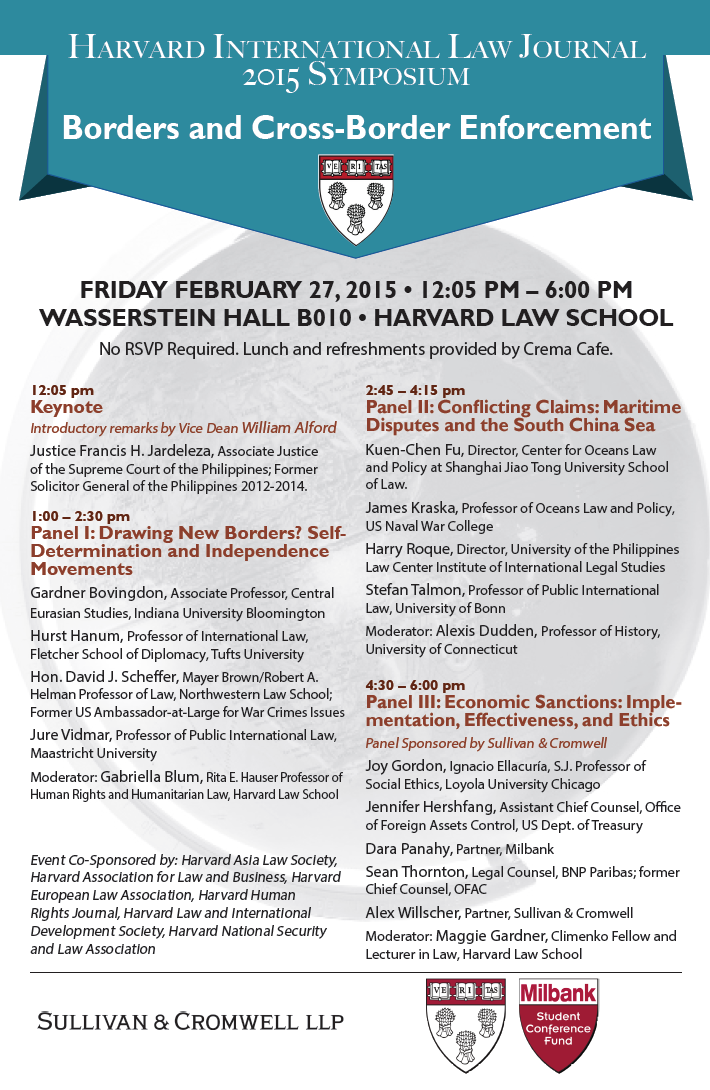
The Harvard International Law Journal 2015 Symposium

The Harvard International Law Journal invites you to its annual Symposium, to be held Friday, 2/27 from 12-6pm in WCC B010.

This year’s installment, titled “Borders and Cross-Border Enforcement,” will provide students, practitioners, and academics with a forum to discuss the evolution and challenges of defining borders and cross-border projections of law today.

The Symposium will feature a keynote address followed by panels on Independence Movements; Maritime Disputes in the South China Sea; and Economic Sanctions.

Please click here to access the Symposium website.

For additional information, please contact Samuel Chang or Ying Xia.

Please click here for the complete schedule of events.

Symposia

HILJ Symposium

More information is available about the panelists at: https://journals.law.harvard.edu/ilj/symposium/about/panelists/

ILJ’s 2013 symposium wrapped up with a lively discussion about the role of environmental and human rights in international investment arbitration. Tyler Giannini, Clinical Professor of Law for the Human Rights Program and International Human Rights Clinic at HLS, moderated the panel in the form of a question and answer session. The panelists, hailing from across the globe and with experience as counsel, arbitrators, advisers, and academics, represented a variety of international viewpoints on the topic.

Professor Giannini began the conversation by asking panelists to address how the international investment regime relates to or differs from the human rights regime. Professor Joost Pauwelyn explained that protections for international investors and human rights do share a common root, although investment protection began first. Both regimes seek the protection of rights against abuse. However, Professor Pauwelyn drew the distinction that the investment regime’s purpose—to facilitate investment—is more utilitarian. The investment regime only protects certain classes of people, i.e. alien investors of certain nationalities, while we are all born into human rights. Unlike the rights of international investors, human rights are enforced in a court system and their enforcement internationally first requires exhaustion of domestic remedies. Professor Pauwelyn also asked: With an eye to determining who can waive investor rights, are investor rights individual rights, like human rights, or are they derivative rights from the state? Finally, Professor Pauwelyn expressed his concern that small investors cannot adequately access protection in the costly investment regime and that this may negatively impact the system’s credibility.

Panelists next addressed the role of human rights and environmental law in the current investment regime. Professor Attila Tanzi explained that respondent states have been reluctant to raise environmental law and human rights arguments out of the concern that they might enhance the position of potential claimants before domestic courts. According to Professor Tanzi, the current trend in international investment arbitrations with respect to human rights and environmental law is “compatibility in separation,” meaning it is the obligation of the state to carry out both. Professor Tanzi hopes that investment arbitrations can move toward “compatibility in integration.” Mr. Gómez-Pinzón responded that, as an arbitrator, he would apply environmental or human rights law if it was applicable to the case. On the other hand, professor Boisson de Chazournes called for political elites negotiating investment treaties to take a greater role in incorporating human rights and environmental law because arbitrators have little opportunity to maneuver to include those areas of law in the current regime. Professor Pauwelyn responded that avenues to incorporate more human rights and environmental law in the investment regime already exist, such as Article 42 of the ICSID Convention (referring “to such rules of international law as may be applicable”) but that arbitrators need greater expertise in this area of law.

Addressing the role of soft law human rights and environmental law instruments in foreign private investment, Professor Boisson de Chazournes questioned the legal standing and role of these instruments in the interpretation of customary international law, given they do not reflect state practice but private corporate practice. She suggested that they can perhaps be complementary tools to assist filling in international law gaps. Professor Pauwelyn looked to arbitrators current references to the International Bar Association guidelines as a potential model for the incorporation of human rights and environmental law soft law instruments into the investment regime.

Finally, commenting on the future of investment law’s relationship to environmental and human rights, Mr. Gómez-Pinzón predicted that the evolution would be slow and cautious, with the lead taken by states negotiating bilateral investment treaties. There has already been a greater tendency for transparency and amicus participation in arbitrations, but private companies will likely resist increasing transparency. Judge Brower, the symposium’s keynote speaker, with the last word, cautioned the panel against engaging in a theoretical discussion of a problem that no one has found to yet exist. Noting that the international investment regime has been evolving for years, he encouraged adopting a long view of the system and emphasized that if anything, loss of investor confidence, would be the ruin of the system.

Symposia

HILJ Symposium

More information is available about the panelists at: https://journals.law.harvard.edu/ilj/symposium/about/panelists/

The second panel of ILJ’s 2013 symposium consisted of distinguished academics and practitioners with years of experience in investment arbitration. The panelists discussed remedies and damages in investment arbitration, and in particular the availability and desirability of primary remedies.

Professor van Aaken, from the University of St. Gallen, presented an overview of the types of remedies offered in public international law, commenting on the apparent peculiarity of the investment regime which generally offers only secondary remedies as opposed to other international public law regimes, such as trade and human rights, which offer predominantly primary remedies such as restitution and declaratory relief. Both states and investors seem to prefer secondary remedies in investment arbitration cases. States view primary remedies as infringements on their sovereignty and investors prefer pecuniary awards as they are more easily enforceable. Professor van Aaken, however, noted that the advantages of primary remedies are lost by focusing exclusively on secondary remedies. These advantages include giving investors greater control within the domestic administrative and judicial systems as well as other branches of the government, and providing states with another option if the damages claimed are exceedingly high. Professor van Aaken recommended that investment arbitration tribunals could capture the advantages of both types of remedies by taking greater account of national legal systems and procedures. This would give greater levels of protection to the investor and also be more palatable to states.

Hamsel Pham, partner at White & Case, described various treaty provisions on permissible remedies, concluding that generally treaties are reluctant to force states to comply with non-pecuniary remedies. He discussed the few cases where ICSID had granted non-pecuniary remedies, concluding that this was a rare occurrence, partly because claimants rarely ask for primary remedies, and when they do tribunals are wary of granting them.

Janis Brennan, partner at Foley Hoag, discussed primary remedies in the context of interim and provisional measures within the international arbitration system. She discussed the differences between ICSID and UNCITRAL, whereby ICSID tribunals may only grant provisional measures but cannot grant an interim award whereas UNCITRAL has provisions to grant an interim award by order. However, according to her, this distinction may not matter for enforceability purposes.

Brennan also discussed the tension between sovereignty implications versus “arbitrator activism” that has colored the investment arbitration system, and given rise to concerns that states will increasingly exit the system if they perceive it to threaten their regulatory authority. A controversial case in this respect was Chevron v. Ecuador, where Chevron has asked a UNCITRAL tribunal to order Ecuador to suspend a domestic court’s judgment, which the company has refused to appeal. Ecuador has argued that it cannot demand that its judiciary not enforce a judgment that is otherwise valid. The implications of this and other similar cases on the investment arbitration system as a whole remain to be seen.

Symposia

HILJ Symposium

More information is available about the panelists at: https://journals.law.harvard.edu/ilj/symposium/about/panelists/

“The Design of the Investment Arbitration System: Consistency and Precedent” addressed current design flaws in the investment arbitration system. Panelists focused on the consistency of judgments and enforcement, and potential fixes to the system.

The first speaker, Prof. Pieter Bekker, explored the roles of various participants in the arbitration tribunal and how to ensure that the regime continues to meet its constituents’ expectations. Citing an essay by the panel’s moderator, Prof. Jeswald Salacuse, that was published in a recent book, Prof. Bekker noted that challenges to the regime may foil states’ expectations and therefore undermine the regime. But “it is the regime’s users that constitute the greatest threat,” Prof. Bekker said, and he went on to map the responsibilities of various users.

Parties must appoint knowledgeable and impartial arbitrators, and, when arbitral institutions make appointments, they should choose arbitrators who do not have a reputation for preferring common or civil law. Arbitrators themselves should pay more attention to the formal sources of international law, including Article 38 of the Statute of the International Court of Justice and Article 31 of the Vienna Convention on the Law of Treaties. These are both pillars of the public international legal structure, but rarely cited in arbitral opinions. Counsel, finally, should be mindful of transnational ethical obligations imposed by their bar. In summary, Prof. Bekker suggested that there was “room for improvement” in the way that constituents approach the “intricacies and sensitivities inherent in the hybrid and developing regime of investment treaty arbitration.”

The next speaker, Caroline Richard, noted that, while the vast majority of investment awards are fully paid and settled, investor-state arbitration presents unique enforcement risks. States have immunities not available to individuals or companies, which can make the enforcement of awards against State assets more difficult, particularly when (i) the State in question has few commercial assets outside its borders (by design or by circumstance), and (ii) the prospect of enforcing the award before the State’s own courts is unappealing or unrealistic.

She further noted that in those exceptional cases where States have failed to comply with ICSID awards – notably, the case of Argentina – investors have resorted to using the political leverage of their home states, such as lobbying for trade sanctions, to pressure States into complying with awards. But this development puts politics back into a regime that had been designed to de-politicize investor-state disputes, raising the possibility of political fallout and leaving investors at the mercy of their home states.

Another panelist, Jeremy Sharpe, discussed trends in recent BITs.  Many modern BITs clarify that investor protection cannot come at the expense of other important values, such as protecting public health and the environment.  These BITs often define the substantive protections much more precisely, and some tie certain important protections, such as fair and equitable treatment, to customary international law.  Many new BITs also define more precisely how claims may be brought and presented, offering detailed provisions on consent to arbitration, consolidation of claims, the conduct of proceedings, and so forth.  The arbitration process, for its part, has tended toward more transparency, with more participation by non-disputing treaty parties and acceptance of amicus briefs, for example.

Harvard Law School’s own Professor Mark Wu—filling in on short notice for a couple of speakers who were absent because of the day’s snowstorm—expressed skepticism that the design flaws in the international arbitral system will be resolved. He identified two broad categories of inconsistency problems affecting the investment arbitration process. First, the arbitration process does not include a process to ensure consistent rulings on specific points of law. Second, arbitration does not seem to treat all legal actors equally, at least to constituents of the system—states, in particular, perceive their treatment as disparate. Noting that solutions to both problems have been proposed and debated for decades, but that the realpolitik of powerful states with vested interests preclude any significant design fix, Professor Wu predicted that these inconsistencies are here to stay, and are unlikely to lead to the replacement of the current investment arbitration system.

Finally, Professor Salacuse, the panel’s moderator, asked the panelists whether investment arbitration processes should make greater use of alternative dispute resolution (ADR), given its success and prominence in the United States. Ms. Richard noted that while investors often prefer alternative dispute resolution methods such as mediation, states do not. They find that settlement is politically costly and they prefer to obtain the political cover that comes from being bound by arbitrators’ decisions.

Symposia

HILJ Symposium: Keynote Address

On March 8, 2013, the Honorable Charles Brower offered a vociferous defense of the international commercial arbitration regime in his keynote address, “From ‘Dealing in Virtue’ to ‘Profiting from Injustice’: Tending Toward the Re-Statification of International Investment Dispute Resolution.”

Judge Brower has, among other positions, served as a judge of the Iran–United States Claims Tribunal in the Hague, the Netherlands; a Judge Ad Hoc of the Inter-American Court of Human Rights; and as a leading arbitrator.

Judge Brower began his talk by discussing recent “assassination attempts on the system” of international arbitration. He cited Profiting from Injustice, a recent report by the Transnational Institute that is highly critical of international arbitration. Bolivia, Venezuela, and Ecuador have all withdrawn from ICSID; Venezuela has taken the further step of denouncing all bilateral investment treaties (BITs). Australia’s current Labor government, too, has announced that it will no longer enter into treaties providing for international arbitration.

These critics claim that investor–state arbitration is “antithetical to sustainable development” and imperialistic, Judge Brower said. Yet “the critics are operating totally based on emotion and not on data, not on fact.”

Southern states have signed many BITs between themselves, Judge Brower pointed out, and the terms of those treaties are not much different from those signed with countries in the global north. Moreover, studies suggest that BITs produce investment and are positively correlated with foreign direct investment.

Another criticism of arbitration panels is that arbitrators—“yours truly and others,” as Judge Bower put it—are prejudiced against states. The late President Hugo Chávez of Venezuela claimed in a speech made in early 2012 that ICSID tribunals sided with investors 232 times out of 242 in 2010. But this is not true, Judge Brower argued. ICSID’s own statistics [pdf] show that, of all cases decided up until June 30, 2012, investors only won in 48% of cases. In 22% of cases, tribunals declined jurisdiction; they dismissed all claims in 29% of cases; and dismissed claims as manifestly without merit in 1% of cases. Judge Brower mentioned a study from 2009 by Susan Franck that came to a similar conclusion.

Judge Brower also responded to critiques of particular cases, noting that “the fact that someone disagrees with the result does not necessarily mean that it is wrong, let along that it is the result of prejudice.”

Finally, Judge Brower took aim at critics of international investment arbitration who claim that investment treaties limit democracy and the freedom of action in the host state. Treaties, he noted, are an exercise of a state’s sovereignty—“that is a principle so well established that it is beyond serious doubt”—nor, he said, has he “seen evidence to the effect that governments fail to act because they are afraid of what will happen to them under the treaty.”

What is worse than leaving the system? Tinkering, said Judge Brower. He was particularly critical of proposals to create a sitting appelate tribunal, noting that this may lead to greater politicization as arbitrators jockey for appointment by their states. By contrast, the current system of serving as an international arbitrator “is the highest merit system you can imagine.” He added, “You’re never better than your last case.”

Scroll to Top