
Content
Response: Coexistence, Cooperation, Conflict: What Role for International Law?
by Nico Krisch*
Monica Hakimi’s intriguing new piece, The Work of International Law, presents a timely challenge for schematic accounts of international law currently spreading through scholarship. Pushing international law’s intimate relationship with conflict into the foreground, Hakimi calls into question the widespread focus on cooperation as the main goal and yardstick of the international legal order. Hakimi aims especially at recent rational-choice-inspired accounts of international law in the United States, but her account also encompasses more European-style approaches that see international law as an alternative to conflict, as a tool for helping states to work together rather than clash. At times her article paints cooperative views of international law too broadly, but overall its charge is correct: an excessive focus on cooperation is likely to make us misunderstand the way international law works, and misconstrue our standards for evaluating it normatively.
Hakimi urges us to recognize that international law not only seeks to defuse conflict, but also enables it, in particular by creating the playing field on which international disputes can be staged and by producing normative positions that actors can mobilize in their favor. On this account, states will often only become aware of a potential conflict, and will initiate conflicts, because of the way legal positions are framed. Cooperation and conflict then often appear as symbiotic and no longer as antithetical. This dynamic has repercussions for our view of international law: in Hakimi’s words, “[c]onflict is part of the project of international law”.
Hakimi’s diagnosis is largely convincing: think, for example, of the way in which territorial sovereignty raises the stakes of borders and invites conflict over their location. Yet Hakimi’s approach is incomplete because it unearths only a small part of international law’s tight link with conflict. The conflicts the piece highlights appear as rather benign: conflicts over the meaning of legal norms, as in WTO law; or conflicts that are instrumental for pursuing positively valued goals like cooperation or peace, as with Security Council action in the Iran nuclear conflict or military action licensed under the ius ad bellum. But hasn’t international law been implicated in conflicts in a much deeper, and likely more pernicious, way? Has it not given cover, over centuries, for the appropriation of large parts of the earth by European powers? Does it not allow, as in the interpretation of the non-intervention norm, for all kinds of economic coercion by wealthy states? Does it not maintain a neoliberal trade and investment regime even as more and more countries see it as an imposition? And has it not licensed a nuclear arms race between the superpowers?
The conflicts arising from these issues do not figure in the article, and their omission is not accidental. A key reason for the omission is that Hakimi seeks to give not merely an account of what international law does, but also an account that is defensible, one that lets international law appear in a positive light, one that suggests what international should do. As a result, Hakimi highlights international law’s role in fostering conflicts with a rather positive connotation. But a convincing picture of international law need not be normatively justifiable. Many parts of the actual “work of international law” might be eminently unjustifiable, or at least appear so from the vantage point of some participants. Hakimi’s intention of rescuing international law from unwarranted normative charges—typically grounded in its limited ability to bring about compliance and cooperation—constrains her from developing the full potential of her conflictual account.
Hakimi also hides the depth of international law’s conflictual character because she employs a somewhat agentic depiction of international law. In a way that is not uncommon in legal scholarship, international law is seen to have “goals” and “a project,” and this rhetoric nudges us towards identifying benign goals and projects—especially if we see ourselves as participants in the practice of international law. If, in contrast, we depict international law as an institution, as a site in which actors struggle for their different goals and projects, and which produces effects in the world, we are bound to be more open to the potentially negative and often unintended effects this institution might have. Actors may be shaped by international law, but they also approach it instrumentally—and typically not simply to achieve “cooperation” but also, or primarily, to enshrine their own views and values, hoping to use international law to shift international politics as far as possible towards their own substantive goals. In such a picture, conflict is not merely an occasional effect, but it sits at the center of the international legal edifice: law is a reflection of conflict as well as a continuation of it, sometimes through balancing different positions, sometimes through privileging certain of them in institutionalized forms of domination.
Conflict is thus ubiquitous in international law, just as it is in domestic law. In fact, domestic law is often seen as a vehicle of conflict, even of violence. Robert Cover’s essay, Violence and the Word is a famous example. In the international realm, different literatures pursue similar themes; critical approaches of various kinds have contributed especially important insights into the ways in which social and political conflict is enacted through (and often hidden behind) legal institutions. Likewise, we might borrow from international relations scholars of different leanings—from realist to Marxist to Foucauldian—to better understand the way law and institutions are implicated in international conflict.
But of course, these approaches have mostly analytical and critical aims, and this is not only, or not even primarily, what Hakimi is after. As suggested above, she seeks to develop an account of international law that embraces conflict normatively. Even though she does not frame it explicitly in this way, she appears to be motivated by the question: When would it be legitimate for international law to foster or allow for conflict, and what kind of conflict would that be? The result of such an inquiry is a different metric of assessment for international law—one in which conflict, or a failure of cooperation, does not directly lead to a negative score.
Hakimi takes the first steps in this inquiry, and she persuasively shows that there is much to be gained from pursuing it. Law can be highly valuable when it provides a space of contestation, exhibits existing disagreements, or empowers weak actors to initiate struggle. Construing an evaluative yardstick for this, however, is a huge task, one that would require both deep empirical analysis and normative theorizing. “The Work International Law Should Do” would include conflict as well as cooperation and other goals. But in what combination, and for which contexts, remains an open question, with widely varying answers depending on one’s origin, perspective and values.
* Nico Krisch is a Professor of International Law at the Graduate Institute of International and Development Studies, Geneva.
Content
Response: International Law and the Constitutive Virtues of Antagonism
by Jean d’Aspremont*
It is encouraging to finally read a piece that seriously debunks the narrative of the failure of international law and all the presuppositions that underpin it. And it is even more exciting to find such a repudiation being articulated in one of those top-tier scholarly journals where the idea of a failure of international law is so often invoked to justify reform or intervention.
In The Work of International Law, Monica Hakimi captures some of the key presuppositions that nourish the narrative of international law’s failure with the descriptive notion of the “cooperation thesis.” In her article, the cooperation thesis refers to the shared assumption that, in a chaotic and decentralized international arena, international law is meant to help global actors curb their disputes as well as promote their shared goals. Said differently, Hakimi uses the cooperation thesis to describe the common belief of international lawyers that international law deters, defuses and resolves conflicts while also advancing common aims. In Hakimi’s view, the cooperation thesis is not only the manifestation of some core presuppositions of 21st century international lawyers, but also functions as an evaluative tool whereby international lawyers continuously measure the performance of international law. The cooperation thesis enables international lawyers to portray existing and persisting conflicts as pathological cases of international law’s failure. As a result, the cooperation thesis (and the presuppositions it rests on) allows international lawyers to pinpoint some deficiencies of international law, thereby justifying their own reformist enterprises or interventions. After spelling out these scholarly ailments, Hakimi embarks on a repudiation of the presuppositions that form the cooperation thesis. She does so by navigating through an impressive sample of doctrinal and theoretical scholarly works, demonstrating an admirable mastery of contemporary debates about international law. Her charge draws on the idea that international law itself enables conflicts, which explains why existing and persisting conflicts do not necessarily reveal any failure or deficiency of international law. She concludes that conflict is simply part of how international law works and why global actors engage with it.
The argument is compelling. As far as the main claim is concerned, there is very little I would disagree with. I personally welcome this charge against the dominant ethos whereby international law is uncritically presented as both the antidote to conflicts and as a cooperation-enhancing pill. I have always believed that there are better ways to articulate (and vent) the dominant cosmopolitan spirit of international lawyers[1] than through liberal constructions that relegate disruption and antagonism to the periphery.[2] Yet—and this is where my criticism lies—I find that the courage and erudition of Hakimi could have been pushed further. I contend here that her compelling critique stops prematurely. What is more, because she falls short of bringing her charge to completion, it may be that she ends up rehabilitating the very attitude that she seeks to debunk.
My criticism about the incompleteness of Hakimi’s argument and its possible contradictions develops in two ways. First, I start with Hakimi’s claim that conflict is part of how international law works. In her view, international law “facilitates” and “enables” conflict while also providing a share vocabulary to disagree and “define, understand, and have a dispute.” She similarly stresses that international law provides the requisite ground rules for conflict and allows them to communicate their discontent. Whilst I find such contention incontestable, I think that the relationship between international law and conflict is not fully appreciated. In my view, Hakimi’s claim fails to recognize that international law and conflict are mutually constitutive. On the one hand, international law constitutes the social reality where it is meant to intervene[3] and thus the categories of how international lawyers and global actors experience and see the world.[4] This social reality constituted by international law is itself conflictual.[5] International law is constitutive of the very conflict in which it is invoked and meant to intervene.[6] It is no coincidence that those conflicts known to experts invoking international law are, to give but a few examples, between states over borders and exclusive economic zones, or with non-state entities about access to government or effective control over a territory, or with individuals whose rights have not been sufficiently complied with. On the other hand, the conflicts constituted by international law—and the antagonisms they epitomize—are constitutive of the argumentative practice of international law. Short of antagonism, international legal claims and discourses would have no raison d’être. If we take pains to articulate international legal arguments, it is because we seek to universalize our own interests when they seem compromised by competing interests. [7] It could even be said that the making of any legal claim presupposes antagonism and conflict without which there would be no need to seek refuge in the universality of international law. Hakimi’s claim falls short of acknowledging that the relationship between international law and conflict is not one of facilitation but mutual constitution.
Second, and most importantly, my criticism of Hakimi’s treatment of the cooperation thesis builds on what I perceive as being a contradiction which is itself the result of her charge being not pushed far enough as was explained above. Indeed, she claims that conflicts facilitated and enabled by international law may be beneficial and conducive to cooperation. She writes that “an intense or prolonged conflict is often an ingredient for such cooperation” and adds that enabling conflict is part of the project of suppressing it, concluding that conflict and cooperation are symbiotic and interdependent. The problem with her position is not that the causality between conflict and cooperation is undemonstrated. The problem is primarily that in positing a symbiosis between conflict and cooperation, she upholds the dichotomy between two idealized and objectivized situations, namely those of conflict and cooperation, and vindicates the possibility that the latter replace the former. I wonder whether this claim about the symbiosis between conflict and cooperation ends up doing exactly what the paper seeks to repudiate, i.e. embracing the presumption that part of international law’s project is to suppress conflict. The impression that the paper ultimately salvaged the ideal of a suppression of conflict by international law is reinforced by the celebration, at the end of the paper, of a new “research agenda” that allows international lawyers to study when “conflict help(s) stabilize the global order and reduce the risk of devastating war.” The line between this new “research agenda” and the necessity to suppress conflict found in the cooperation thesis seems very thin. All-in-all, the reader is left with the feeling that the paper eventually upholds the liberal foundations of the cooperation thesis by negating the constitutive power of conflict and vindicating the need to suppress it. It is my impression that, had Hakimi pushed her claim further, she would not have run the risk of rehabilitating one of the presuppositions at the heart of the cooperation thesis.
Notwithstanding my regret that the claim elegantly articulated by Hakimi is not pushed further at the risk of creating contradictions, the paper demonstrates a great command of doctrinal and theoretical debates about international law and usefully challenges discourses about the failure of international law. Yet, I am left with one ultimate and lingering question. After all, if we are not able to fully dispose of the cooperation thesis and of some of its presuppositions, as is unintentionally shown by the article, it is maybe because the suppression of conflict by international law belongs to these myths that nourish and perpetuate what we do and want to continue to do. In other words, it may be that the idea of a suppression of conflict by international law remains a necessary justificatory paradigm which allows international lawyers, on the entire spectrum of approaches, to legitimate their projects, critiques, reforms, and interventions as much as their modes of legal reasoning. Be they liberal reformers identifying insufficiencies within international law to justify their reforms or interventions, or be they critics in need of tautologies and contradictions to justify their post-structuralist skepticism, international lawyers may be condemned to keep these myths[8] alive,[9] whether or not they actually believe in them. What if the cooperation thesis was simply one of these foundational myths?
∗ Jean d’Aspremont is a Professor of Public International Law, University of Manchester, Professor of International Legal Theory, University of Amsterdam, and Director of the Manchester International Law Centre (MILC).
[1] See Sahib Singh, The Potential of International Law: Fragmentation and Ethics, 24 Leiden J. Int’l L. 23, 43 (2011) (“International law was animated by a cosmopolitan universalism, but international lawyers forgot the spirituality of this venture when universalism was demonstrated as an impossibility.”).
[2] On such an understanding of liberalism, see Chantal Mouffe, The Return of the Political 121 (1993).
[3] As far as the definitional power of international law is concerned, see Philip Allott, The Idealist’s Dilemma: Re-Imagining International Society (June 9, 2014), http://www.ejiltalk.org/the-idealists-dilemma-re-imagining-international-society/ (“The whole of the law is a vast work of fiction, a masterpiece of the human imagination, creating its own entirely artificial reality. Lawyers—even practising lawyers—are creative writers, re-inventing the story of the law every day.”). See also Philip Allott, Language, Method and the Nature of International Law, 45 Brit. Y.B. Int’l L. 79, 118 (1971); James R. Crawford, International Law As Discipline and Profession, 106 ASIL Proceedings 471, 486 (2012) (“We are collectively part of the makers of that world”); Jack M. Balkin, The Proliferation of Legal Truth, 26 Harv. J.L. & Pub. Pol’y 101, 103 (2003) (“Law has power over people’s imaginations and how they think about what is happening in social life.”).
[4] See generally David Kennedy, International Legal Structures (1987). See also Balkin, supra note 3, at 104 (“It is a form of cultural software that shapes the way we think about and apprehend the world.”).
[5] Paul W. Kahn, The Cultural Study of Law: Reconstructing Legal Scholarship 30 (1999) (“We must accept the proposition that there is nothing natural about the legal order, that it is a constructed social world that could be constructed differently.”).
[6] The ability of law to define the very conflict it intervenes in has been recognized as one of the most critical forms of power. See Pierre Bourdieu, The Force of Law: Toward a Sociology of the Juridical Field, 38 Hastings L.J. 805, 838 (1987) (“Law is the quintessential form of symbolic power of naming that creates the things names.”). See also id. at 837 (“What is at stake in this struggle is monopoly of power to impose a universally recognized principle of knowledge of the social world . . . .”). On the idea that Bourdieu and Foucault allowed us to better understand how lawyering is connected to knowledge production, see Nikolas M. Rajkovic, Rules, Lawyering, and the Politics of Legality: Critical Sociology and International Law’s Rule, 27 Leiden J. of Int’l L. 331, 335 (2014). This idea is now widely accepted in (international) legal scholarship. See Martti Koskenniemi, The Politics of International Law: 20 Years Later, 20 Eur. J. of Int’l L. 7, 11 (2009); Balkin, supra note 3, at 113 (“Law is most powerful when we see the world through its eyes, when its understanding becomes part of our understanding, and when its truth becomes part of our truth.”). See also S. Marks, International Judicial Activism and the Commodity-Form Theory of International Law, 18 Eur. J. of Int’l L. 199, 202 (2007).
[7] On the universalizing effect of legal claims, see Bourdieu, supra note 6, at 844; Martti Koskenniemi, Hegemonic Regimes, in Regime Interaction in International Law: Facing Fragmentation 305, 311 (Margaret A. Young ed., 2012). Compare with Balkin, supra note 3, at 108 (“What law does, and can do, is proliferate ideas, concepts, institutions and forms of social imagination, which can attach themselves to, reorganize, and even displace existing forms of social understanding, social practice, and social reality.”). Such universality is elusive. See Martti Koskenniemi, The Mystery of Legal Obligation, 3 Int’l Theory 319, 324 (2011) (“Law’s power and attraction lie in its offering what appears a universal point of view, its ability to raise mere opinions onto a status of what is (universally) right. And yet this universal standpoint constantly eludes us. Rules show themselves as mere interpretations, principles are challenged by equally powerful counter principles, etc.”).
[8] On the myth of Westphalia, see generally Andreas Osiander, Sovereignty, International Relations, and the Westphalian Myth, 55 Int’l Organization 251 (2001); Pärtel Piirimäe, The Westphalian Myth and the Idea of External Sovereignty, in Sovereignty in Fragments: The Past, Present and Future of a Contested Concept 64 (Hent Kalmo & Quentin Skinner, eds., 2010); Benno Teschke, The Myth of 1648: Class, Geopolitics, and the Making of Modern International Relations (2009). More generally, see David Kennedy, International Law and the Nineteenth Century: History of an Illusion, 17 Quinnipiac L. Rev. 99, 121 (1997); Martti. Koskenniemi, The Gentle Civilizer of Nations: The Rise and Fall of International Law 1870-1960 95, 143 (2001).
[9] See generally Jean d’Aspremont, International Law as a Belief System (forthcoming 2017).
Content
Professor Hakimi’s Reply on The Work of International Law
by Monica Hakimi*
Thanks to the Harvard International Law Journal for hosting a symposium on my Article and to the four respondents for their thoughtful contributions. In the Article, I distill and then criticize a prominent view about the role of international law in the global order. The view—what I call the “cooperation thesis”—is that international law serves to foster a particular kind of cooperation, specifically to help the participants achieve their common aims and curb their disputes. Lawyers who subscribe to this view of course appreciate that international law is, like all law, often contentious in operation. But they posit that, unless such conflict is overcome, it detracts from cooperation and evinces the limits of international law. That view is wrong. It incorrectly assumes that cooperation and conflict are antithetical—that they pull in opposite directions, such that international law fosters one by curtailing the other. In fact, international law fosters both simultaneously. Even as it helps the participants achieve their shared goals and reconcile their differences, it also helps them have and sharpen their disputes. The two kinds of interactions are not antithetical but interdependent. I will not use this Reply to rehash that argument. I will simply address the main criticisms and questions that the respondents raised.
A. Does My Argument Go Too Far?
Of the four respondents, Professor Bodansky seems the most critical of my piece. He contends that the cooperation thesis is not specious, as I claim it to be; “it is, at worst, incomplete.” According to Bodansky, the thesis is partly true because global actors sometimes use international law to promote their shared objectives and resolve their disputes. He offers the example the Montreal Protocol on Substances that Deplete the Ozone Layer. Bodansky says that the Protocol “establishes a cooperative regime to promote states’ common interest in preserving the stratospheric ozone layer.” He acknowledges that this regime “might be understood as enabling conflict, by using ambiguous terms that permit differing interpretations and by authorizing parties to use trade measures against non-participating states.” But he argues that characterizing the Protocol as conflict-enabling would be “misleading” because the Protocol clearly fosters cooperation.
Bodansky’s criticisms are misdirected. I do not deny that global actors sometimes use international law for the ends that the cooperation thesis envisions—to advance their common agendas or move past their differences. The thesis is wrong because it presupposes that conflict is an obstacle to those ends and, therefore, a problem that international law must overcome. To the extent that Bodansky claims that international lawyers do not adhere to that view, I disagree. Statements like the following are routine:
- “[A] dispute itself implies disagreement and non-cooperation” and must be addressed to avoid “the danger of an impasse in dispute settlement.”[1]
- “The international legal system . . . tends to evolve norms that reduce friction and controversies among states and to foster systemic equilibrium by prescribing how controversies may be avoided, mitigated, or resolved.”[2]
- “International law represents a system of norms and processes for resolving competing claims,” and, in turn, promotes peace and the respect for generally accepted, basic rights.[3]
- “The purpose of international law, conventionally viewed, is to reduce interstate conflict and facilitate interstate cooperation. . . .”[4]
These statements reflect the cooperation thesis. They suggest that international law does or must curtail conflict in order to foster cooperation.
The cooperation thesis is evident even in Bodansky’s own response to my Article. He begins by framing my inquiry in terms of whether “the function of international law [is] to promote cooperation or conflict” (emphasis added). Notice his use of the disjunctive. He then repeatedly depicts conflict as oppositional to cooperation. He says, for example, that “litigation is associated with conflict. . . . But transactional law, in contrast, is interest-based and generally promotes cooperation” (emphasis added). His invocation of the Montreal Protocol is illustrative. He claims that characterizing the Protocol as conflict-enabling is misleading because the Protocol promotes cooperation. What’s actually misleading is his insistence that the Protocol promotes cooperation but not conflict. It promotes both. The contract analogy simply drives home the point. Even when a contract helps the parties reach a mutually beneficial goal, it creates new grounds and reasons for them to disagree. It entitles them to fight over its application and to contest behavior that now constitutes a breach.
This brings me to Bodansky’s normative claim. He asserts that, although an instrument like the Montreal Protocol “can sometimes lead to litigation, . . . that is not their object. Litigation is a sign of failure rather than success.” I’m not sure exactly what he means by an instrument’s “object.” If he means that the parties to the Protocol intended not to foster conflict but to achieve a particular result—to preserve the stratospheric ozone layer—then he is probably correct. But the functions that a legal instrument serves are not always the ones that it was originally intended to serve. Though the Montreal Protocol helps the parties work together to preserve the stratospheric ozone layer, it also helps them disagree about various facets of that project.
Two propositions follow. First, even if we assess the success of international law as Bodansky does—in terms of whether it advances a shared agenda—disputes about that agenda would not betray its failure. As I explain in the Article, and as Bodansky concedes, conflict is often an ingredient for, rather than an impediment to, achieving a common objective. This can be so even if the conflict is protracted or lacks real substantive resolution. It means that litigation is not necessarily “a sign of failure.” Second, Bodansky’s metric for assessing success is myopic. When international law does not help the participants reach a specific goal or reconcile their differences, it might (successfully) do other things. If nothing else, international law might help these actors disagree, which can itself be valuable.
B. Does My Argument Not Go Far Enough?
Whereas Professor Bodansky argues that I overstate international law’s role in enabling conflict, Professors d’Aspremont and Krisch suggest that I do not press that claim hard enough. D’Aspremont criticizes my Article on two grounds. First, he says that I did not adequately acknowledge that “the relationship between international law and conflict is not one of facilitation but of mutual constitution.” His point is that international law both constitutes and is constituted by the conflicts in which it is invoked. I made a similar point in my Article, though I used different language. I argued that cooperation and conflict are synergistic—by which I meant that each depends on and helps generate the other.
Second, d’Aspremont argues that, “in positing a symbiosis between conflict and cooperation, [I] uphold[] the dichotomy between two idealized and objectivized situations, namely conflict and cooperation, and vindicate[] the possibility that the latter replace the former.” That was not my intention. In arguing that conflict and cooperation are symbiotic, I aimed to show that the two go hand-in-hand; one does not evince or lead to the absence of the other. Indeed, I used the World Trade Organization and the jus ad bellum to make precisely this point: although international law curbs some trade or forcible conflicts, it facilitates and even fuels others. In addition, I underscored that these conflicts themselves reflect a kind of cooperation, though not the kind that the cooperation thesis prizes. In order for adversaries to engage in an intelligible conflict, they need to be able to communicate their positions and make sense of each other’s moves. Having a cooperative base—common ground rules with which to convey their discontent and structure their interactions—enables their dispute. Again, conflict and cooperation are not inherently dichotomous. They are intertwined.
Krisch’s main criticism of my Article is more normative. He suggests that international law has been implicated in much deeper, more pernicious ways than I admit. In his view, my effort to portray international law “in a positive light” and to defend it from “unwarranted normative charges . . . constrains [me] from developing the full potential of [my] conflictual account.” Krisch is correct that I do not examine the full range of conflicts that international law invites or all of their potentially destructive effects. But my normative agenda was not to portray international law as, on the whole, justifiable. It was to underscore that the two most common attacks on international law—that it is ineffective or illegitimate to the extent that it does not curb conflict—rest on the cooperation thesis and are conceptually flawed. These attacks must be refined to reflect the fact that conflict does not necessarily betray a failure of cooperation or a deficiency in international law. Conflict is instead part of the project of international law.
C. Next Steps
Professor Meyer seems the most sympathetic to my descriptive and normative claims. He focuses on an important follow-up question: “how one can tell whether a particular conflict is consistent with international law’s purposes.” Meyer rightly notes that “some conflicts surely are challenges to the larger system of international law, rather than efforts to work within it. And some conflicts surely make us worse off than we were ex ante.” He hypothesizes that international law might be least adept at productively channeling value conflicts. In his view, “an aversion to value-driven conflicts” and the associated “[a]ppeals to technocracy” are “built into much of international law” and risk exacerbating inevitable conflicts. Meyer’s descriptive account might or might not be accurate. But he and I agree that international law “needs to become more comfortable with value conflicts.” I explore this theme in greater depth in a separate article, “Constructing an International Community,” which is forthcoming in the American Journal of International Law.
* Monica Hakimi is a Professor of Law at the University of Michigan Law School.
[1] Anne Peters, International Dispute Settlement: A Network of Cooperational Duties, 14 Eur. J. Int’l L. 1, 9–11 (2003) (emphasis added).
[2] Anthony D’Amato, Groundwork for International Law, 108 Am. J. Int’l L. 650, 652 (2014).
[3] Steven R. Ratner, The Thin Justice of International Law: A Moral reckoning of the Law of Nations 1 (2015); see also id. at 2, 73 – 76.
[4] Gregory C. Shaffer & Mark A. Pollack, Hard Versus Soft Law in International Security, 52 B.C. L. Rev. 1147, 1152 (2011).
Content
Response: Tim Meyer on The Work of International Law
by Tim Meyer*
Monica Hakimi’s The Work of International Law could not arrive at a more important time. In pointing out that international law exists to facilitate conflict as much as to promote cooperation, she insightfully diagnoses conflict aversion as a malady that often afflicts international lawyers. As Hakimi argues, much conceives of international law’s goal as the mitigation of conflict. To the contrary, Hakimi convincingly asserts that cooperation and conflict go together. Yet in February 2017, the central question teed up by Hakimi’s article is how we distinguish conflict that is consistent with the viability of the international legal system from conflict that represents a threat to it.
The Work of International Law opens by describing the “cooperation thesis” – the notion that international law is designed to curb conflicts and promote a shared agenda. The cooperation thesis, in Hakimi’s view, has both positive and normative aspects. Both, Hakimi argues, are incorrect. As a descriptive matter, international law often does not mitigate conflict; it facilitates it in the same way that the rules of chess facilitate conflict between two players. A more legal analogy might be to property rights or other kinds of legal entitlements. In theory, clear entitlements should reduce the scope for conflict. In practice, however, entitlements often promote conflict, either because they are not clear enough or because of behavioral biases. As Hakimi points out, international agreements and customary international law are indeterminate most of the time. They thus provide states with some sense of their own rights and with the means to clarify and expand those rights. Moreover, as in litigation, if two opposing sides are both optimistic about their own chances for success – a common psychological bias – reaching a negotiated resolution becomes more difficult. Just as litigation is a form of conflict that provides a resolution to a dispute that could not be peacefully settled, so too is conflict under international law a means to promote the long-term settlement of disputes.
Hakimi’s point might be understood in slightly different terms: conflict is a form of bargaining. Clausewitz perhaps most famously captured this notion when he said that “war is the continuation of politics by other means.” Thomas Schelling formalized this idea of armed conflict as a form of bargaining in the 1960s, and a robust literature in international relations continues to think about armed conflicts as one means through which states seek to allocate resources and power. Underlying this literature is the notion that conflict is a means of signaling determination to the other side and imposing costs to deter or end a conflict. In the legal context of foreign affairs law, Edward Corwin famously described the Constitution as “an invitation to struggle for the privilege of directing American foreign policy.” Hakimi is right to note that international law – with its vague obligations, fragmented institutions (including the lack of robust judicial review), and, in the case of customary international law, unclear rules regarding its creation – invites much the same kind of struggle.
Viewed in this light, it should hardly be a surprise that international law promotes and facilitates conflict. Without conflict of some kind, differing views on legal rights are hard to work out. Hakimi is thus also right to critique the normative cooperation thesis, the view that international law should mitigate conflict, as a framework for evaluating international law. States are both subject and authors of international law. That means that in choosing whether to cooperate, states must evaluate their actions both in terms of compliance with existing law and in terms of their lawmaking effects. A failure to comply with the law does not necessarily indicate a lack of commitment to international law generally. Rather, it may indicate a commitment to changing the law and the terms on which cooperation occurs. Perhaps the most famous example of lawmaking through noncompliance is the expansion of the territorial sea to twelve miles, a shift in customary law brought about in part by widespread violation of the traditional three-mile limit. A slightly different example would be U.S. unilateral action in response to what it perceived as unlawful conduct under GATT 1947. States agreed to create the WTO Dispute Settlement Body – arguably the most successful interstate tribunal – in part to rein in U.S. unilateralism. Isabel Hull’s magnificent book, A Scrap of Paper: The Breaking and Making of International Law During the Great War, describes in great detail how the laws of war were challenged and ultimately changed in response to state action leading up to and during World War I.
However, to say that conflict can be consistent with international law’s purposes invites the question of how one can tell whether a particular conflict is consistent with international law’s purposes. After all, some conflicts surely are challenges to the larger system of international law, rather than efforts to work within it. And some conflicts surely do make us worse off than we were ex ante. How are we to discern efforts to renegotiate the system’s rules from efforts to tear down the system? Less apocalyptically, how can we tell whether conflict will make the international system better or worse?
Part of the challenge, of course, lies in our lack of perspective in judging our own historical moment. What seems like folly today may seem like wisdom with the passage of time, and vice versa. Michael Reisman once wrote that “international lawyers frequently respond to the appearance of a discrepancy between existing and emerging legal arrangements by heatedly rejecting the new with a fury of virtuous unanimity against the evil whose name is Change.” Hakimi’s article serves as a reminder that change, and the conflicts that bring it about, should not be feared merely because they are new.
The more serious part of the problem, though, is that we are in the midst of a contest over the values that underlie the international legal system. In recent years international agreements and debates in international legal thought have tended to focus on technocratic metrics, like compliance, that at least in principle are capable of measurement. This trend is particularly clear in two aspects of trade law. First, agreements on regulatory harmonization, such the WTO’s Agreement on Sanitary and Phytosanitary Measures or the regulatory harmonization chapter of the Trans Pacific Partnership, push states to use technical information such as the best available science or cost-benefit analysis to design their domestic regulatory programs. Second, debates about trade more broadly have tended to emphasize that liberalized trade creates enormous gains. Trade’s defenders have thus expressed befuddlement over voters’ decisions to pull Britain out of the EU or elect Donald Trump President on a platform of renegotiating or rolling back trade deals.
In part, these appeals to technocracy are aimed at promoting cooperation and encouraging a shared agenda – exactly what the cooperation thesis envisions. If legal and policy disputes can be resolved by measuring whether GMOs cause adverse health effects or trade creates wealth, then seemingly intractable problems might be solved. Yet as recent events have shown, technocracy is limited in its ability to defuse conflicts over core values. British voters outside of London (and Scotland) and American voters off the coasts appear willing to sacrifice the gains from trade (which are of course very real) if it might mean a more equitable distribution of the gains from trade, or if it might restore a lost sense of control over their communities. Technocratic arguments that these voters are wrong – that rolling back trade or restricting immigration will not bring jobs back or create stronger or safer communities – fail to persuade because many voters are not interested in what is measurable. They want a legal regime that they perceive as in step with their values.
It is here that I part ways, at least tentatively, with Hakimi. She writes in conclusion that the cooperation thesis’s flaw is “in assuming that [conflict and cooperation] are antithetical—that one detracts from and must be reduced in order to achieve the other. In fact, international law promotes them both. It helps the participants find and work toward areas of agreement, even as it helps them crystallize and sharpen their differences.” I think this is true much of the time, especially when the core values underlying a legal regime are not contested. But value-driven conflicts can expose the limits of international law’s ability to productively channel conflict. Appeals to technocracy attempt to paper over these fissures, but I worry that – by pretending that conflicts can be resolved without addressing underlying difference in core values – appeals to technocracy actually exacerbate conflicts.
Put differently, I do not think the cooperation thesis is just a pathology of international legal scholarship or thought. I think an aversion to value-driven conflicts is built into much of international law itself. In the end, my prescription is the same as Hakimi’s. International law needs to become more comfortable with value conflicts. The long-term viability of, for example, the trade regime may well depend on its ability to accommodate greater dissent from liberalized trade’s central premises. Conflict can certainly spur those changes. But conflict can also break the tool – international law – for future use.
* Tim Meyer is a Professor of Law and Enterprise Scholar at Vanderbilt University Law School.

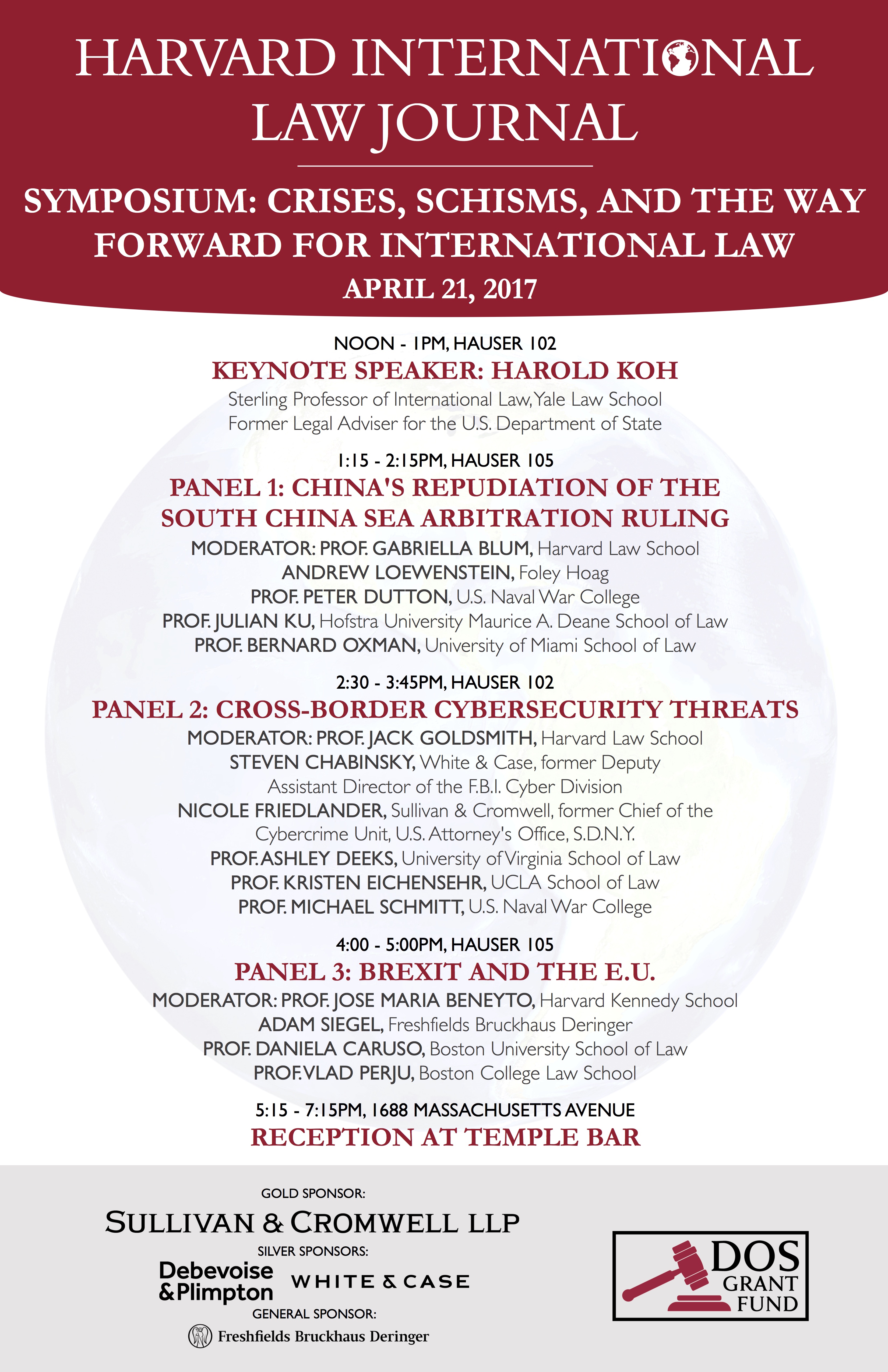
Harvard International Law Journal Symposium 2017: Crises, Schisms, and the Way Forward for International Law
Friday, April 21, 2017 from noon-7:15PM
(Please see below for locations)
Follow us on Twitter:
#ILJSymp2017
On April 21, 2017, ILJ hosted its annual Spring Symposium, this year on the impact of major current events on international organization and cooperation. Our keynote speaker was Harold Koh, former Legal Adviser at the State Department, followed by three panels on the South China Sea Arbitration Ruling, Cross-Border Cybersecurity Threats, and Brexit and the E.U.
This ILJ Spring Symposium brought together some of the foremost experts and practitioners in their respective fields, including the lawyers who represented the Philippines in the South China Sea arbitration, government leaders in cybersecurity enforcement, and major voices in security debates.