Author name: bakcan

Content, Online Scholarship, Perspectives

The Obligation of Non-Refoulement and Its Erga Omnes Partes Character

PAVITRA KHAITAN & JVALITA KRISHAN*

I. Introduction

In the context of the rights of refugees within the framework of humanitarian and customary international law, the principle of non-refoulement is an essential form of protection. Non-refoulement “prohibits states from removing or transferring individuals from their jurisdiction or effective control when there are substantial grounds for believing that the person would be at risk of irreparable harm upon return, including persecution, torture, ill-treatment, or other serious human rights violations.”[1] The 1951 Convention Relating to the Status of Refugees has enshrined the prohibition of refoulement in treaty law under Article 33. This provision bans a contracting party from returning a refugee in any manner to the borders of territories that are known to threaten the life and freedom of said refugee “on account of their race, religion, nationality, membership of a particular social group, or political opinion.”[2] Clause 2 of Article 33 provides for two exceptions if there are reasonable grounds for either regarding a refugee as a threat to the security of the country or the refugee as a danger to its community upon a final judgment convicting them of a serious crime.[3] This paper explores the importance of the non-refoulement principle and the complex ways in which states bypass its implementation. It also sets out to prove non-refoulement as an obligation erga omnes partes for state parties to the Convention. The resultant inference is that state parties to the 1951 Refugee Convention may bring a suit to the International Court of Justice (ICJ)[4] against any nation in violation of the principle of non-refoulement.

II. Non-refoulement Compliance During COVID-19

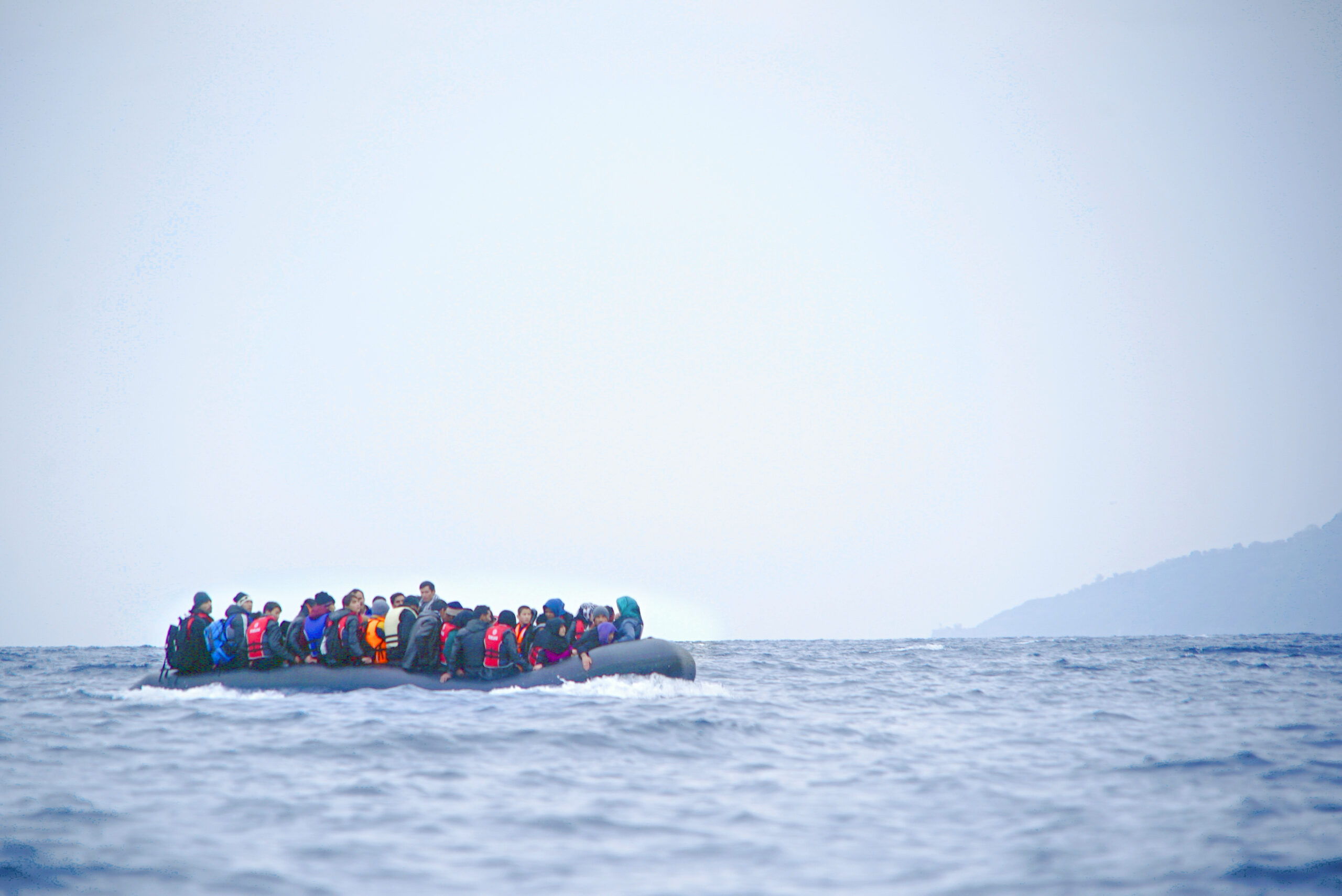
The non-refoulment principle has been evaded by several states in recent years as governments halted migration procedures to prevent the spread of COVID-19. These policies left no exception for those seeking refuge.[5] For example, the Belgian government introduced measures effectively suspending refugees’ right to seek refuge on account of the coronavirus. It then created an online registration system that caused lengthy wait times for refugees seeking an appointment with concerned officials.[6] And several reports and interviews of asylum-seekers conducted by Human Rights Watch show that Greek law enforcement officials coordinated returns of asylum-seekers to Turkey, where they were then placed on small inflatable rafts and set adrift in Turkish territorial waters.[7] Both these countries are signatories to the Convention. The U.N. High Commissioner for Refugees (UNHCR) opined in its advisory capacity that non-refoulement constitutes a non-derogable provision of international refugee protection but that the application of the two categories of exceptions whereby the refugee is considered a danger to the security of the country or a final judgement convicting the refugee of a serious crime renders them a danger to the community of the country requires an individualised determination by each country in which the refugee seeks asylum.[8]

However, the exceptions do not extend to a pandemic circumstance that warrants a blanket policy of turning away all refugees without assessing their claims.[9] UNHCR declared that “the imposition of a blanket and indefinite measure against the admission of all asylum seekers, or of those of a particular nationality, could lead to a risk of the violation of the principle of non-refoulement.”[10] The UNHCR further added that in case of a confirmed public health crisis such as the ongoing pandemic, alternative available measures such as the implementation of quarantine and isolation to manage the safe arrival of asylum-seekers must be considered to continue safeguarding the right to seek asylum and the principle of non-refoulement.[11] Thus, states that are parties to treaties with provisions relating to non-refoulement such as the 1951 Refugee Convention and Protocol of 1967 relating to the Status of Refugees (which creates an obligation to process asylum claims) must prioritise compliance with their treaty obligations by ensuring that refugees are not returned to their countries of origin if such return would pose a threat to their well-being while also imposing pandemic health protocol measures.[12] The least a state under these obligations can do is grant the refugee temporary admission until states take on greater collective responsibility to share the role of the protection of refugees.[13]

III. General Methods to Evade Compliance

Mechanisms utilized by states to restrict the entry of asylum-seeking refugees do not only limit themselves to pandemics. Consider the track record of states that are parties to treaties containing a refoulement prohibition and refugee rights. Belgium in the 1990s had a ninety percent rejection rate of asylum-seekers at its borders and an extraordinarily high threshold of eligibility aimed at preventing illegal immigrants. These barriers were so severe that genuine refugees were discouraged from approaching the state through elaborate institutional mechanisms and preferred entering illicitly.[14] Similarly, members of the European Union (EU) have imposed unrealistic visa requirements for states that produce refugees such as Romania, Sri Lanka, and Iraq.[15] The Schengen Border Control (SBC) regulation which governs the border control of persons crossing the external borders of EU member states is silent on the definition of ‘refugees and persons seeking international protection.’[16] The effect of this is that refugees are assimilated into the general ‘third-country national’ category and are subjected to criterion under Article 6 of the SBC which include possession of valid travel documents and proof of their intention and ability to return to their country of origin prior to the expiry of their permitted duration of stay.[17] Such conditions imposed on refugees whose documentation status and departure from the country often remains indeterminable, results in the pre-emptive gatekeeping of persons of specific nationalities and their right to seek asylum. The phenomenon of refugees irregularly moving from the country where they have received protection to seek permanent settlement or asylum elsewhere came about owing to the unavailability of long-term educational and employment opportunities that promote local integration and resettlement of refugees.[18] The concept of “safe third country” was created to address the destabilising effect of such irregular movement on the organised international efforts to protect refugees[19] but conveniently denies the vetting of asylum requests due to the mere fact of such a refugee having previously transited a country deemed safe.[20] Germany’s policy is one such example that sent refugees back to the transit country without any verification of the existence of proper asylum procedures and protection of refugees.[21]

The “non-suspensive effect” is another problematic mechanism by which states like Austria, France, and Sweden absolve themselves of the responsibilities of integrating refugees into their jurisdiction. The non-suspensive effect arises because refugees who appeal the decision denying them entry cannot remain in the country during the pendency of the appeal, and are therefore forced to remain illegally as their lives are threatened in their country of origin.[22] States even go so far as to confine their interpretation of the definition of refugees to only include those facing persecution from the state,[23] when reality many asylum-seekers face life-threatening danger from non-state agents such militant extremist groups. The currently unrecognised de facto Taliban government that effectively reoccupied Afghanistan in 2021 is just one example.[24]  Nowhere in Article 33 does the provision specify that the threat to the life and freedom asylum-seekers must emerge from state persecution alone. Such a restrictive understanding of the prohibition of non-refoulement is violative of a refugee’s right to seek asylum and find recourse in state parties to the convention. It is also inconsistent with the purpose of the Convention: to safeguard refugees’ rights.

State parties to the Convention bend their conduct to cater to versions of non-refoulement that favour their interests. This makes it crucial to ensure a level of compliance to prevent arbitrary violations of human rights. Before discussing whether the non-refoulement principle is an obligation erga omnes partes, it is essential to gain a clear understanding of the concept. In contrast to obligations erga omnes owed to the international community as a whole, obligations erga omnes partes are specifically confined to a group of states—typically state parties to a multilateral convention with a common interest.[25] The common interest implies that violations of such obligations create a legal interest in all other state parties to ensure the protection of the associated rights.[26]

IV. The Test to Establish an Erga Omnes Partes Obligation

In Belgium v. Senegal, the International Court of Justice laid down the test to determine whether an obligation is an obligation erga omnes partes.[27] The Court must consider whether being a state party to the Convention is sufficient for a State to be able to bring a claim to the court regarding the violation of an obligation of the treaty. Determining whether an obligation constitutes an obligation erga omnes partes requires ascertaining first, the object and purpose of the treaty; second, that the state parties have a common interest in compliance with the obligations laid down by the treaty; and third, whether the particular obligation in question was incorporated to fill this purpose of the treaty as determined.[28] We will now apply this test to the obligation of non-refoulement under the Refugee Convention.

First, the object and purpose of the Refugee Convention is to provide refugees with basic rights and freedoms. The Vienna Convention on the Law of the Treaties allows emphasis to be placed on the Preamble of a treaty whilst determining its object and purpose.[29] Inspecting the preamble to the Refugee Convention, it declares that all state parties to the Convention must endeavour to assure refugees the exercise of their fundamental rights. The object and purpose of the Convention is hence to assure the widest possible exercise of fundamental rights and liberties of refugees through international cooperation.[30] The adoption of this treaty was to guarantee the refugees these rights in human and equitable terms.[31] Further, the Vienna Convention allows us to place reliance on the preparatory material to the convention.[32] The Travaux Préparatoires of the Convention showed that there was a recognition that the foundation of the Convention is to place refugees on equal footing with the citizens of the countries of refuge.[33] The intention of the Convention includes the will of the state parties to be bound by the principle of non-discrimination with reference to the treatment of refugees.[34] The returning of a refugee to a nation where his life or freedom would be threatened on account of his race or religion would be equivalent to delivering him into the hands of his persecutors. We can thereby conclude that the object and purpose of the Refugee Convention is to provide refugees with their basic human rights and liberties.

Second, we must determine that state parties have a common interest in complying with the obligations laid down by the treaty. In Belgium v. Senegal, the International Court of Justice held that all parties to the Convention Against Torture have a “common interest” to comply with the obligation to prosecute alleged perpetrators of acts of torture even if the alleged torturer or victim have no connection with the state parties.[35] These states can be said to have a “legal interest” in these erga omnes partes obligations. The obligations in question are owed to all parties of the convention.[36] Applying the same reasoning to the Refugee Convention, states have a common interest in the protection of fundamental human rights thus including an interest to protect the fundamental rights and liberties of refugees. Human rights treaties are of such nature that a state has obligations to all state parties, notwithstanding their nexus to the State violating the treaty.[37] This provides state parties with an obligation to call upon state parties and demand compliance.[38] Human rights treaties are not concluded on the basis of reciprocity, instead they are “series of unilateral engagements solemnly contracted before the world as represented by the other Contracting Parties.”[39] From this, one can conclude that all human right treaties are erga omnes partes in nature.[40]

Further, the International Court of Justice has previously compared the provisions of the Convention Against Torture to the Convention of the Prevention and Punishment of the Crime of Genocide since in both conventions “the contracting States do not have any interests of their own; they merely have, one and all, a common interest, namely, the accomplishment of those high purposes which are the raison d’être of the Convention.”[41] The same is true of the Refugee Convention, where the common interest element is the protection of fundamental human rights for refugees. This common interest to ensure that any violator who does not abide by the objective of the refugee convention does not enjoy impunity directly implies that obligations under the Convention are owed by each state party to all the other state parties.[42] Obligations created to protect the collective interest of a group of states are established with the intention of “transcending the ‘sphere of the bilateral relations of the State parties,’” thereby creating obligations of a multilateral nature.”[43] The common interest in compliance with the relevant obligations of the Refugee Convention gives rise to the entitlement of each state party to the Convention to invoke the responsibility of another state to make a claim concerning the cessation of an alleged breach by another state party.[44] Since no special interest is required for this purpose, the relevant obligations can be said to be of an erga omnes partes character.

Third, the obligation of non-refoulement can be incorporated to fulfil the purpose of the Refugee Convention. Obligations erga omnes partes are those obligations that are so integral to the subject and purpose of the treaty that no reservations or derogations are permissible.[45] The Refugee Convention is underpinned by the fundamental principle of non-refoulement.[46] Article 33 lays down this paramount obligation. And as per Article 42, no reservations or derogations are permissible to Article 33. It is so paramount that the UNHCR has noted that “the principle of non-refoulement is a norm of customary international law based “on a consistent practice combined with recognition on the part of nations that the principle has a normative character.”[47] The principle of non-refoulement is the cornerstone of asylum and of international refugee law.[48] As stated in Article 33, the Convention prohibits the return or expulsion of refugees (“refouler”) to a country where the refugee’s life or freedom is threatened.[49] The party States to the 1951 Convention and the 1961 Protocol have acknowledged that “the continuing relevance and resilience of this international regime of rights and principles, including at its core the principle of non-refoulement,” as embedded in customary international law.[50] The protection of the principle of non-refoulement is essential to defending the common interest of the exercise of basic fundamental rights as established in the Convention. If the principle is violated, there exists a “real and imminent risk of irreparable prejudice” of the values and interests advocated by the treaty.[51]

The object and purpose of the Refugee Convention may be frustrated by a breach of this principle by any one state. The fundamental nature of non-refoulement as a cardinal principal has been reaffirmed by the Executive Committee of the UNHCR and the United Nations General Assembly.[52] In 1980, the UNHCR Executive Committee [r]eaffirmed the fundamental character of the generally recognized principle of non-refoulement.[53] Its 1991 conclusions reiterated ‘the primary importance of non-refoulement and asylum as cardinal principles of refugee protection’.[54] The vitality of non-refoulement within the aegis of refugee protection has also been express by the United Nations General Assembly in multiple resolutions.[55] The obligation of states to abide by the principle of non-refoulement and not send refugees back to the host nation when there exists danger to the refugee’s life is essential to fulfilling the aim of the Refugee Convention. Therefore, the principle is of the erga omnes partes nature insofar that all State parties ought to have a legal interest in others’ compliance with this obligation.[56]

V. Conclusion

The proving of non-refoulement as an obligation erga omnes partes in the capacity of the Refugee Convention automatically mandates that any nation party to the convention may bring a nation in violation of this obligation to the International Court of Justice. It confers on state parties to the convention, therefore, an obligation to not turn away any refugees seeking aslyum. With this establishment, the enforceability of non-refoulement obligations is thus enhanced, enabling a better likelihood of the safeguarding of persecuted refugees’ rights in the tumultuous global socio-political landscape.

[1]The Principle of Non-Refoulement Under International Human Rights Law, United Nations High Comm’r for Hum. Rts.,https://www.ohchr.org/sites/default/files/Documents/Issues/Migration/GlobalCompactMigration/ThePrincipleNon-RefoulementUnderInternationalHumanRightsLaw.pdf .

[2] Convention Relating to the Status of Refugees 1951 Art 33, Apr. 22, 1954, 189 U.N.T.S 150.

[3] Id.

[4] Id. at Art. 38.

[5] See Oona Hathaway, Covid-19 and International Law: Refugee Law- The Principle of Non-Refoulement, Just Sec.  (Nov. 30, 2020), https://www.justsecurity.org/73593/covid-19-and-international-law-refugee-law-the-principle-of-non-refoulement/.

[6] See id.

[7] Greece: Investigate Pushbacks, Collective Expulsions. EU Should Press Athens to Halt Abuses, Hum. Rts. Watch (Jul. 16, 2020), https://www.hrw.org/news/2020/07/16/greece-investigate-pushbacks-collective-expulsions .

[8] See Extraterritorial Application of Non-Refoulement Obligations under the 1951 Convention Relating to the Status of Refugees and its 1967 Protocol, Advisory Opinion, United Nations High Commissioner for Refugees, (Jan. 26, 2007).

[9] See Hathaway, supra note 4.

[10] UNHCR Legal Considerations with Regard to the EU Commission´s Guidelines for Border Management Measures to Protect Health and Ensure the Availability of Goods and Essential Services, United Nations High Comm’r for Refugees (Mar. 18, 2020).

[11] Id.

[12] See Hathaway, supra note 4.

[13] See Salvo Nicolosi, Non-refoulement During Health Emergency, EJIL: Talk!  (May 14, 2020), https://www.ejiltalk.org/non-refoulement-during-a-health-emergency/.

[14] See Christiane Berthiaume, Measures Imposed by European Governments to Stem the Tide of Illegal Immigrants are Threatening the Very Foundations of Asylum, Refugees, 1 Sept. 1995, https://www.unhcr.org/en-in/publications/refugeemag/3b543cb84/refugees-magazine-issue-101-asylum-europe-asylum-under-threat.html .

[15] See id.

[16] Juan Fernando López Aguilar, Humanitarian Visas, Eur. Parliamentary Rsch. Serv. (Jul. 2018)https://www.europarl.europa.eu/cmsdata/150782/eprs-study-humanitarian-visas.pdf 19.

[17] Id at 20.

[18] See Conclusions Adopted by the Executive Committee on the International Protection of Refugees, United Nations High Comm’r for Refugees (Dec. 2009) https://www.unhcr.org/en-my/578371524.pdf 77

[19] Id.

[20] See Nicolosi, supra note 13.

[21] Id.

[22] Id.

[23] Id.

[24] See Ben Saul, “Recognition” and the Taliban’s International Legal Status, Int’l Ctr. for Counter-Terrorism (Dec. 15, 2021) https://icct.nl/publication/recognition-talibans-international-legal-status/.

[25] See Questions Relating to the Obligation to Prosecute or Extradite (Belg. v. Sen.), Judgement, 2012 I.C.J 422 ( Jul. 20).

[26] See id.

[27] Id.

[28] Id.

[29] See Vienna Convention on the Law of the Treaties art. 31, May 23, 1969, 1155 U.N.T.S 331.

[30] See Economic and Social Council Res. 1950/319 (Aug. 16, 1950).

[31] See U.N. ESCOR, 11th Sess., 158th mtg., U.N. Doc. E/AC.7/SR.158 (Aug. 15, 1950).

[32] See Vienna Convention on the Law of the Treaties, supra note 29.

[33] See Paul Weis, The Refugee Convention, 1951, The Travaux Préparatoires Analysed with a Commentary by the Late Dr. Paul Weis (1995).

[34] Id.

[35] Questions Relating to the Obligation to Prosecute or Extradite (Belg. v. Sen.), supra note 25.

[36] Id.

[37] See H.R.C. General Comment No. 31, U.N. Doc. CCPR/C/21/Rev.1/Add.13 (May 26, 2004), ¶2; Dinah Shelton, The Oxford Handbook of International Human Rights Law 510 (2013); Walter Kälin and Jörg Künzli, The Legal Nature of Human Rights Obligations, in The Law of International Human Rights Protection (2d. ed., 2019) 86.

[38] See id.

[39] Jean S. Pictet, The Geneva Conventions of 12 August 1949: Geneva Convention Relative to the Protection of Civilian Persons in Time of War (Geneva: Int’l Comm. Of the Red Cross ed., 1958), comments on common Article 1.

[40] Erika de Wet, The International Constitutional Order 55 (Cambridge University Press ed., 2008).

[41] Reservations to the Convention on the Prevention and Punishment of the Crime of Genocide, Judgment, 1951 I.C.J. Rep 15, ¶ 23 (May 28).

[42] See Questions Relating to the Obligation to Prosecute or Extradite (Belgium v. Senegal), supra note 25.

[43] Linos-Alexander Sicilianos, The Classification of Obligations and the Multilateral Dimension of the Relations of International Responsibility, 13 Eur. J. Int’ L. 1127, 1135 (2002).

[44] See Questions Relating to the Obligation to Prosecute or Extradite (Belgium v. Senegal), supra note 25.

[45] Vienna Convention on the Law of Treaties art. 19(c), May 23, 1969, 1155 U.N.T.S 331; Pok Yin Stephenson Chow, On Obligation Erga Omnes Partes. 52 Georgetown J. Int’l L. 469 (2020).

[46] Weis, supra note 33.

[47] Commentary on The Refugee Convention 1951 Articles 2-11, 13-37, United Nations High Comm’r for Refugees (1997).

[48] United Nations High Comm’r for Refugees, Note on the Principle of Non-refoulement, U.N. Doc EC/SCP/2 (23 August 1977).

[49] Refugee Convention 1951 art 33, Apr. 22, 1954, 189 U.N.T.S 150.

[50] Declaration of States Parties to the 1951 Convention and/or its 1967 Protocol Relating to the Status of Refugees, Ministerial Meeting of States Parties, Geneva, Switzerland, 12-13 Dec. 2001, U.N. Doc. HCR/MMSP/2001/09, (16 Jan. 2002).

[51] Application of the International Convention for the Suppression of the Financing of Terrorism and of the International Convention on the Elimination of All Forms of Racial Discrimination (Ukr. v. Russ.), Provisional Measures, 2017 I.C.J. Rep. 104, ¶ 63 (Apr. 19).

[52] UNHCR EC Conclusion No.79 ¶ (i) (1996); G.A. Res. 51/75, ¶ 3 (Feb 12, 1997).

[53] UNHCR EC Conclusion No.17 ¶ (b) (1980).

[54] UNHCR EC Conclusion No. 65 ¶ (c) (1991).

[55] See G.A. Res. 48/116, ¶ 3 (24 Mar., 1994); G.A. Res., 49/169 ¶ 4 (Feb. 24, 1995); G.A. Res. 50/152, ¶ 3 (Feb. 9, 1996); G.A. Res. 51/75, ¶ 3 (Feb. 12, 1997).

[56] See Questions Relating to the Obligation to Prosecute or Extradite (Belg. v. Sen.), supra note 25.

Cover photo: Mstyslav Chernov/Unframe, CC BY-SA 4.0 license.

Speaker Events, Symposia, Ukraine

“How to hold Russia accountable for the invasion of Ukraine?” with Professor Harold Koh and Mr. Patrick W. Pearsall


NICOLE BREDARIOL & OMER DURU*

“How to hold Russia accountable for the invasion of Ukraine?”

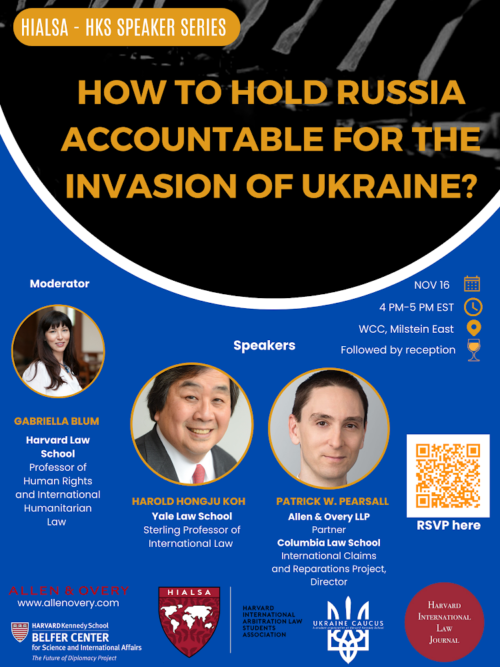
On November 16, 2022, the Harvard International Law Journal and Harvard International Arbitration Law Students Association hosted a speaker series discussing one of the most pressing international law questions confronting the world today: how to hold Russia accountable for the invasion of Ukraine?

Keynote speakers, Professor Harold Koh of Yale Law School and Mr. Patrick Pearsall, Director of Columbia Law School’s International Claims and Reparations Project, challenged the invisible college of international lawyers to help protect the global order.[1] Invoking the image on Achilles’ shield, one of history’s greatest warriors, as a metaphor for arbitration playing a significant role in post-conflict dispute resolution, Mr. Pearsall addressed how international arbitration in the context of the war between Russia and Ukraine can help international law rise to this challenge. Professor Koh, discussing his role as counsel to Ukraine before the International Court of Justice (ICJ), posed an existential challenge to the Court during his closing arguments in March 2022, asking if it was powerless to stop naked aggression and war crimes. He framed the current events not as Russia versus Ukraine, but rather Russia versus the post-World War II international legal order, and implored the ICJ to act.

The international community has answered the call twice now, first when the ICJ issued a 13-2 order on provisional measures that Russia “shall immediately suspend the military operations that it commenced on 24 February 2022 in the territory of Ukraine.”[2] On 7 November 2022, the international community responded again when ninety-four members of the United Nations General Assembly (UNGA) voted to hold Russia accountable for its violations of international law, recognized the need for an international mechanism for reparations for damage, loss, and injury arising from Russia’s internationally wrongful acts, and recommended the creation of an international register of damage to preserve evidence and claims.[3]

Mr. Pearsall indicated the UNGA Resolution of 7 November 2022 creates the necessary framework for the establishment of a claims commission to account for Russia’s wrongful acts.  Citing historical precedent for the establishment of post-conflict claims commissions, Mr. Pearsall asserted that a claims commission solely empowered with the authority to issue final and binding awards, is the most efficient and fair mechanism to ensure claims are lawfully adjudicated.  Estimating that Russia’s invasion of Ukraine has caused in excess of $1 trillion in damages, Mr. Pearsall warned that Russia remaining an international pariah and outcast from global financial markets will have more detrimental effects on conflict resolution; thus, a claims commission is a necessary step for Russia’s reintegration into the global order.

Now the task falls to the invisible college of international lawyers to turn this call into action. Both Professor Koh and Mr. Pearsall asserted that the way forward should include interested States creating a commission through multilateral agreement, identifying the details of a claims register of harm, and determining how a Russia-Ukraine conflict claims commission will be funded.  The Russia-Ukraine conflict will shape the next forty years of global relations; this is a unique opportunity for rising lawyers to become directly involved in the evolution of international law.  As the speakers highlighted, the “train is just getting into the station, so get onboard.”

[hr gap=”10″]

*Nicole Bredariol and Omer Duru are Harvard Law School LL.M Candidates, Class of 2023. They are focusing their studies on international humanitarian law and national security law.

1[1] Oscar Schachter, The Invisible College of International Lawyers, 72 Nw. U. L. Rev. 217 (1977).

2[2] Allegations of Genocide under the Convention on the Prevention and Punishment of the Crime of Genocide (Ukr. v. Russ.), Order, ¶ 86 (Mar. 16, 2022), https://www.icj-cij.org/public/files/case-related/182/182-20220316-ORD-01-00-EN.pdf.

3[3] G.A. Res. L.6/2022, U.N. Doc. A/ES-11/L/6 (Nov. 7, 2022).

Content, Essays, Online Scholarship

Taking Responsibility and Tying Hands: The Case for Limiting U.S. Relationships with Armed Groups Abroad

Kai M. Thaler*

[Click here for PDF]

The United States regularly criticizes and clashes with rivals over their relationships with armed groups, like Russia backing eastern Ukrainian rebels and Iran supporting militias in Iraq, but has its own long history of relationships with armed groups. There have recently been calls to increase U.S. reliance on armed group partners like rebel groups or militias to distribute the burden of great power competition with Russia and China. Relationships with armed groups are practically risky, however, and changes in international law around the crime of aggression and duty to ensure respect for humanitarian law have increased states’ liability for armed group partners. The United States should instead restrain itself from relying on armed groups and take greater responsibility for its armed group ties and wartime actions, a policy change that could help constrain violence against civilians, bolster the U.S.’s international reputation, and set an example for allies. Framing U.S. self-restraint as responding to international law could also provide a vital boost to the international justice system and ‘rules-based’ order if commitments are upheld.

Introduction

In February 2021, the Biden administration ordered its first known airstrikes since taking office, bombing targets in eastern Syria allegedly used for smuggling weapons into Iraq.[1] Department of Defense (DOD) spokesman John Kirby explicitly described the targets as being “used by a number of Iranian-backed militant groups.”[2] While less directly confrontational than the Trump administration’s assassination of Iranian Revolutionary Guard commander Qassem Soleimani in Iraq in 2020,[3] the strike in Syria was reportedly less about the targeted militias and more about signaling U.S. resolve to their Iranian backers.[4] In June 2021, the pattern continued, as U.S. drones attacked alleged weapons stores of “Iran-backed militia groups” along the Iraq-Syria border—attacks that the Iraqi government decried as violating their national sovereignty and international law.[5] The United States has designated Iran as a “state sponsor of terrorism” since 1984, and consistently criticizes Iran’s ties to prominent militant groups like Hezbollah, Hamas, the Taliban, the Houthis in Yemen, and al Qaeda, along with militias around the Middle East.[6] The United States used these relationships to justify the 2021 airstrikes.[7]

U.S. condemnation of Iranian armed group ties or Russian support for rebels in eastern Ukraine often rings hollow, however, given the its own history of outsourcing violence to rebels, militias, and other armed groups. Early colonial governments and post-independence U.S. expansions depended on relationships with informal settler militias and alliances with certain Indigenous nations.[8] This behavior continued, from the Bay of Pigs invasion and Cold War insurgencies in countries like Angola and Nicaragua to more recent U.S. relationships with rebel coalitions and militias in Afghanistan, Iraq, Libya, and Syria.[9] Following the withdrawal of U.S. ground forces from Afghanistan and the Taliban’s reassertion of control, there have been calls by newly-minted Afghan resistance leaders and by members of Congress to back anti-Taliban fighters, and Ahmad Massoud’s “National Resistance Front” set up a lobbying shop in Washington, D.C.[10] With Russia threatening to invade Ukraine in late 2021 and invading in early 2022, U.S. officials began planning for the possibility of supporting insurgents in the event that Russia toppled the Ukrainian government.[11]

Calls for renewing U.S. military, financial, and political aid to rebel groups clash with the Biden administration’s expressed goals of reestablishing U.S. leadership and global reputation, as well as strengthening a “rules-based international order” in the face of a rising China, resurgent Russia, and increasingly assertive Iran and Turkey.[12] To be an effective global leader, the United States must clean up its own act domestically with regard to issues of racism, political polarization, threats of violence, and voting restrictions.[13] Tackling human rights and democratic legitimacy issues at home and taking bold action to reinvent and revitalize the United States’ role in the world are mutually aligned goals, however, and can be pursued at the same time.[14]

Given the United States’ checkered history of covert interventions and other actions contravening international law,[15] one of the best ways for the United States to show actual fidelity to playing by the rules is by making a costly commitment and tying its hands when it comes to relationships with armed groups. Taking responsibility for the actions of U.S.-backed armed groups today can demonstrate the credibility of U.S. commitments to human rights and international law, and would show accountability to conflict-affected populations. The activation of the International Criminal Court’s (ICC) jurisdiction over the crime of aggression in 2018 and new International Committee of the Red Cross’s (ICRC) commentaries on the Geneva Conventions both provide a chance to increase state liability for armed group partners’ actions. Even if the United States remains wary of subjecting itself to international legal jurisdiction, active support for these legal shifts and proactive compliance with them would offer an opportunity for U.S. leadership among major powers and could help establish and enforce new norms of responsibility for armed group partners. Restricting relationships with armed groups could also constrain temptations to intervene in conflicts where there is little trust in local armed groups to protect civilians or de-escalate situations with rivals.

Taking options off the table is a tough sell when it comes to security policy, but reducing U.S. reliance on armed group intermediaries and accepting responsibility for relationships with armed groups are risks worth taking: for humanitarian reasons, to help restore the United States’ reputation abroad, and to set an example for allies. It is also a choice broadly embraced by the public and foreign policy elites, who prefer alliances with states, rather than armed groups.[16] Solidifying this strategic shift by embracing international law can provide stronger standing to pressure adversaries and allies alike about aggression and human rights abuses abroad, while also bolstering international law and international order when they are threatened or eroding.[17]

I. Understanding State-Armed Group Relationships

The United States and other countries engage with armed groups to pursue different goals, and with varying levels of cooperation and influence over armed group behavior. There is a long history of states outsourcing coercive actions to actors ranging from pirates and mercenaries before the 20th century, to rebel organizations, warlords, militias, and private military companies today.[18] States also sponsor armed groups for reasons not directly related to national security, such as ideological or identity affinity. In other instances, armed groups remain autonomous: independent of state influence or support, or equal to weak states in power and capabilities and engaging in relationships on their own terms. This Article focuses on the United States, but the arguments about the perils of state-armed group relations and their legal implications also apply to other major powers and U.S. allies. The United Kingdom and other North Atlantic Treaty Organization (NATO) allies, for instance, collaborated in Afghanistan with violent warlords and local militias who hastily rebranded themselves as security contractors; France backed Libyan rebels who committed atrocities during the war to overthrow Muammar Gaddafi, and has organized and allied with militias in Chad and Mali.[19]

Armed groups adopt forms, goals, and tactics intersecting categories used by analysts, and they shift over time. This makes it often unproductive to draw clean lines between, for instance, rebel groups, terrorist organizations, and criminal organizations, or—given the increasingly blurry lines between war and peace—to restrict typologies to wartime relationships.[20] State relationships with any sort of armed group, however, can be divided into three types: delegation, sponsorship, and autonomy.[21]

In a delegation relationship, a state either devolves coercive authority to an armed group or strengthens an armed group’s capabilities for it to advance the state’s core security goals, such as preserving territorial integrity, maintaining domestic political control, or countering threats from external rivals.[22] States may delegate to armed groups that project force in the domestic periphery, though this Article concentrates on delegation across national borders.[23] Delegation can be useful for states to reduce material and reputational costs, to take advantage of an armed group’s skills, or as a tool for domestic or interstate bargaining. Still, in delegation relationships, armed groups undertake tasks that states would pursue themselves absent the armed group’s collaboration.[24]

Delegation is a popular choice for invading or occupying forces without local knowledge or legitimacy. For example, the United States relied on local militias in the Sunni Awakening to retake Al-Anbar province from al Qaeda in Iraq.[25] States may also delegate across borders to attack rival states or foreign-based insurgents. For instance, the Reagan Administration helped organize and supported Contra forces to destabilize Nicaragua’s leftist Sandinista government in the 1980s, when there was not congressional or public will for direct intervention.[26] Another example is Algeria’s longstanding supplying and sheltering of Polisario Front rebels fighting against Morocco for Western Sahara’s autonomy.[27]

In sponsorship relationships, a state sees an armed group’s aims not as tied to its core security interests, but as compatible with broader national interests, usually due to ideological, ethnic, or other affinities.[28] For this reason, sponsorship tends to take place in countries beyond a state’s immediate neighborhood. Examples include North Korea’s support for leftist guerrilla movements around the globe during the Cold War, and Libya’s arming and training of Basque separatists Euskadi Ta Askatasuna (ETA) in Spain and the Irish Republican Army in Northern Ireland.[29] The United States sponsored right-wing rebels widely during the Cold War, from exiled Kuomintang fighters in Myanmar who continued the fight against China’s victorious communists in the 1950s,[30] to the formerly Chinese-sponsored National Union for the Total Independence of Angola (UNITA) in the 1980s and 1990s[31]—situations and tasks to which the United States was unwilling to commit its own forces.

An autonomy relationship involves an armed group that has independence in its decision-making and can survive without state support.[32] An autonomous armed group chooses whether to fight states, ignore them, or to engage in non-conflictual relationships with them. Autonomous groups have an approximate power symmetry or advantage relative to states in their areas of operations, such that they do not depend upon states for operational survival and could not be suppressed easily by the state in their base areas. This is, in part, why autonomous groups persist in areas of state weakness or collapse. The United States is most likely to work with autonomous groups through intelligence agencies and Special Operations Forces.[33] When there is a degree of U.S. cooperation with and material or intelligence support for an autonomous group, as with the Northern Alliance in Afghanistan up through 2001, legal obligations and liabilities can still apply to U.S. actors.[34]

An example of an autonomy relationship opposed by the United States would be the relationship between al Qaeda and the Taliban government in Afghanistan from 1996 to 2001. The Taliban used al Qaeda’s financial and military resources to help consolidate control throughout Afghanistan. Al Qaeda supported the Taliban in exchange for a territorial base, but maintained its strategic and operational autonomy.[35] Al Qaeda frequently acted against Taliban interests, but could not be held to account. Despite U.S. demands that the Taliban turn over al Qaeda’s leadership after the September 11 attacks, it is unclear the Taliban could have done so if they wanted to,[36] due to the power symmetry in the relationship and the Taliban’s incomplete control over Afghan territory. From the U.S. perspective, however, the Taliban government was liable for the actions of its armed group partner.

II. Who Is Liable for Armed Group Actions Under International Law?

Though armed groups control and affect areas populated by millions of people around the globe, international law was designed with states and interstate relations in mind. As a result, armed groups’ murky legal status has historically offered a loophole for their state backers to escape accountability for violating another state’s sovereignty or committing violence against civilians, even as legal enforcement has expanded to indict and try armed group leaders themselves.[37]

Delegating to armed groups to pressure external rivals is legally useful, since under the United Nations Charter sovereignty precludes states from invading each other’s territory except in self-defense,[38] and supporting an armed group offers potential plausible deniability if a state can keep the ties secret. Yet even when such ties are clear or “implausibly deniable,”[39] the international community has rarely legally punished state support for external armed groups. Powerful states have tended to escape accountability outside of diplomatic condemnations, while weaker states face financial or military consequences, but not legal action. For instance, Russia faced few consequences for its long support for South Ossetian rebels, which culminated in direct intervention and war against the Georgian government in 2008, and increased integration of South Ossetia into Russia.[40] African leaders and officials who have supported rebels and militias in the Democratic Republic of the Congo have faced some threats of sanctions, but little legal pressure.[41]

Recent advances in international legal standards and scholarship have created possibilities to close this gap, moving armed groups and their relations with states out firmly into the realm of international law, leading to some successful prosecutions. In 1977, the Geneva Conventions were expanded to cover armed groups fighting wars of national liberation against colonial powers as part of international conflicts,[42] while “other dissident armed groups” who control territory in non-international conflicts were also held to have obligations to abide by international humanitarian law.[43] Increasingly, international tribunals and national courts with universal jurisdictions have held armed group leaders subject to international criminal law on war crimes, crimes against humanity, genocide, piracy, and terrorism, which has restrained some armed group leaders in their decision making.[44] It is now generally accepted that armed groups have obligations to comply with international law, though only individuals, rather than entire organizations, can face legal claims.[45] Prosecuting individual armed group leaders or members may be useful for personal accountability, but it ignores armed groups’ collective nature and, crucially, does not address the problem of state support.[46]

In cases where a state delegates, using an armed group to pursue state aims, the armed group’s actions could be considered “adopted conduct” of the state if there is evidence that the state’s leaders considered the armed group to be acting on their behalf and approved of actions it took that violated international law.[47] Yet legal standards for attributing responsibility both to states and individual state officials have historically set high bars of state officials exercising direct operational control over armed groups, even for private military companies they contract with.[48]

The International Court of Justice (ICJ) in its 1986 Nicaragua ruling found clear evidence that the United States had financed, organized, and supplied the Contra rebel forces, which fought against Nicaragua’s revolutionary Sandinista government, by providing equipment, arms, training, and intelligence. U.S. intelligence agents even aided in operational planning and target selection.[49] Despite this, the court ultimately ruled that, to be liable, a state must have “effective control” over specific operations in which an armed group committed crimes.[50] The ICJ’s judges may have ruled narrowly in the Nicaragua case due to questions about the court’s legitimacy and U.S. non-cooperation.[51] The ICJ, however, upheld the effective control standard in its later Bosnian Genocide ruling.[52]

Customary law has since evolved, however, towards a standard of “overall control.” The International Criminal Tribunal for the Former Yugoslavia (ICTY) and then the Special Court for Sierra Leone (SCSL) have challenged the effective control standard and broadened the notion of state responsibility. In Tadić, the ICTY Appeals Chamber held that the standard for state liability need not be effective control over specific operations, but can be “overall control” resulting from “organising,  coordinating  or  planning  the  military  actions  of  the  military  group, in addition to financing, training and equipping or providing operational support to that group.”[53] The ICTY applied this standard to hold Federal Republic of Yugoslavia officials responsible for atrocities committed by their allied Serb armed groups in Bosnia-Herzegovina. It has since reaffirmed the overall control standard.[54]  This standard was then upheld by the SCSL in its case against former Liberian President Charles Taylor, who was convicted in 2012 of “aiding and abetting” atrocities committed by Revolutionary United Front rebels in Sierra Leone, with whom Taylor had a delegation relationship—though the SCSL also found Taylor liable for effective control of specific operations.[55]

Charles Taylor’s conviction established accountability for former heads of state (former Yugoslavian/Serbian leader Slobodan Milošević died during his ICTY trial before a verdict),[56] and a current proceeding will further test state leaders’ accountability for crimes committed by armed groups in delegation relationships. Sudan’s transitional government in 2020 pledged to turn over former President Omar al-Bashir and other officials to the ICC for prosecution of crimes against humanity in Darfur, including those committed by the Janjaweed militias that the ICC prosecutor’s office deemed “allied” with the government forces.[57] An October 2021 military coup that returned al-Bashir’s allies to power, however, may prevent his extradition any time soon.[58] The prosecutor’s office is also investigating the case of the anti-Rohingya ethnic cleansing campaign in Myanmar, in which the state security forces who are currently in power, with the support of the now-deposed civilian leaders, allegedly cooperated with communal and religious armed groups.[59]

Two changes in the making and interpretation of international law may further solidify state actors’ liability for conduct by armed groups with whom they are in delegation or sponsorship relationships—changes that would gain greater international legitimacy if the United States endorsed and abided by them. The first major shift was the 2010 Kampala Amendments to the Rome Statute, which now codify the crime of aggression,[60] an advance in international law long sought by jurists, scholars, and activists.[61] The crime of aggression not only includes direct state attacks undertaken aggressively, rather than in self-defense; it also prohibits “[t]he sending by or on behalf of a [s]tate of armed bands, groups, irregulars or mercenaries, which carry out acts of armed force against another [s]tate,” thereby holding state leaders liable for actions delegated to armed groups.[62] Since 2018, the ICC has been empowered to enforce these amendments. However, debates remain about the extent of jurisdiction over states parties to the Rome Statute that have not ratified the Kampala Amendments, and currently the ICC cannot try individuals from non-party states for the crime of aggression.[63]

This limitation, for instance, means that even though Ukraine has now recognized the ICC’s jurisdiction over crimes committed within its territory, because neither Russia nor Ukraine is signatory to the Rome Statute (and as such have not ratified the Kampala Amendments), the ICC cannot prosecute Russian leaders for the crime of aggression for Russia’s 2022 invasion of Ukraine, let alone for stoking an insurgency and intervening in Eastern Ukraine since 2014.[64] This is why some legal scholars and practitioners have argued for the government of Ukraine to work with the UN General Assembly to, through a treaty, create a special international tribunal for the crime of aggression in the Russian war on Ukraine.[65]

The crime of aggression amendments focus on violations of sovereignty, seeking to punish governments for breaching the borders and rights of other states, and for unjustified killings in that process.[66] Specific state obligations to protect people under international humanitarian law may also be expanding. The ICRC’s 2016 commentaries on the Geneva Conventions, specifically around Common Article 1, suggest that states have not only a duty not to encourage armed group partners to violate humanitarian laws, but also a duty to “ensure respect” for the Geneva Conventions by the armed groups.[67] This standard is not binding and has not yet been applied by international courts, but it offers a potential avenue for accountability in the future if judges accept the ICRC’s interpretation.[68]

Ensuring respect would mean actively seeking to restrain armed groups with which states are in delegation or sponsorship relationships—where states are providing support to armed groups and have some leverage and influence over their behavior.[69] This standard would hold states accountable even if an armed group-state relationship does not meet effective or overall control standards for attribution.[70] The positive obligation to ensure respect is “particularly strong in the case of a partner in a joint operation,” over whom a state is likely to have significant influence and leverage.[71]

For example, selling weapons to a sponsored armed group when a state knows that they will likely be used to commit violations of international humanitarian law would breach the state’s duty to ensure respect. Many activists and politicians argue that the United States bears such a responsibility for selling its state partners Saudi Arabia and the United Arab Emirates weapons used to bombard civilians in Yemen.[72] While states might object that they can never truly control other actors and that violations of the Geneva Conventions may take place regardless of how they have approached a relationship, there are obligations to ensure respect both from the beginning of a partnership and after violations have occurred. The ICRC outlines a range of actions states may take to try to ensure respect for international humanitarian law from state or armed group partners, including diplomatic pressure, placing IHL-related conditions of joint activities or arms transfers, and referring illegal actions to international and domestic investigative and judicial bodies.[73] All of these options require states to prioritize compliance with international humanitarian law at all times in a relationship.

III. Perilous Partnerships

In relationships between states and relatively powerful autonomous armed groups, there is limited scope for states to sanction or punish armed groups for behavior they disapprove of. Yet even in delegation and sponsorship relationships, armed groups always have agency and pursue their own interests, creating risks and potential pitfalls even for powerful states like the United States. Alliances with other states hold similar risks, but interstate relations also offer greater transparency than relationships with armed groups and contain more diplomatic and economic levers to persuade or compel desired behavior.[74]

Armed group partners might disobey targeting instructions or commit counterproductive, resentment-provoking violence, which can anger civilian populations or other states. U.S. reliance on militia groups to help control rural Afghanistan bred backlash when groups like the Khost Protection Force committed atrocities against local populations, increasing support for the Taliban’s return.[75] The execution of thirteen Turkish workers in northern Iraq in February 2021, allegedly by the Kurdistan Worker’s Party (PKK), increased U.S.-Turkish tensions, since Turkey saw the United States as tacitly supporting the PKK due to U.S. sponsorship of Kurdish rebels in Syria.[76] Where multiple armed groups are being trained or supported by different military branches or government agencies, there is a risk of confusion among the public and armed group partners themselves about who they are fighting alongside or competing against for territorial control and resources. An example of such risk is the U.S. military and Central Intelligence Agency (CIA)’s backing of different rebels and militias in Syria.[77] Armed groups might also take advantage of state resources to develop their own power bases and then strike out on their own or even switch sides—for instance, when Kashmiri militant groups flipped against Pakistan and worked with Indian security forces.[78]

When delegating to an armed group to achieve foreign policy goals, states generally want to be confident that they can exert significant control over the group. If a state relies on an armed group to target a rival and then loses influence over the group, the state has lost a bargaining chip: it can no longer credibly commit to reducing armed group attacks on the rival state.[79] For example, the Mozambican rebel group Renamo was initially formed by the Rhodesian intelligence agency and then entered into a delegation relationship with South Africa after Zimbabwe shifted to majority rule. Over time, however, Renamo developed its own domestic constituency and legitimacy in Mozambique by playing on popular grievances. By the late 1980s, Renamo was increasingly independent of South African influence and could no longer reliably be used as a negotiating tool by South Africa’s apartheid government.[80]

A worse scenario for states is when an armed group abandons a cooperative relationship and attacks its erstwhile patron.[81] Pakistan offers prime examples. Domestically in the Federally Administered Tribal Areas, Pakistan empowered radical Islamist leaders who developed militia groups that the government thought would help control remote areas, but which then threatened the stability of the country as a whole.[82] Relationships with rebel agents in Jammu and Kashmir have sometimes backfired,[83] and Pakistani attempts to destabilize and balance against Afghanistan have had similarly negative effects. The mujahideen whom Pakistan supported in the 1980s Afghan War evolved into the Taliban and al Qaeda—actors who have contributed to regional instability, increased violence within Pakistan, and threatened the Pakistani government. This issue afflicts powerful states, too: the United States likewise regretted its support for the Afghan mujahideen in the long run, as Osama bin Laden formed al Qaeda and turned against his former sponsor.[84]

Blowback from state-armed group relationships can also occur when delegation or sponsorship leads a rival to directly escalate conflict with the state. Where a state or armed group knows or suspects it was attacked by a group supported by a rival state, it may retaliate against the rival state, regardless of attempts to deflect or deny responsibility. States may respond through escalating economic sanctions and diplomatic conflicts, as the United States did over Libyan links to the 1985 Rome and Vienna airport attacks.[85]  Alternatively, states may take military action, like when the United States unleashed airstrikes on Libya after the 1986 Berlin bombing[86] or launched cruise missiles at Sudan and Afghanistan following al Qaeda’s 1998 embassy bombings in Kenya and Tanzania.[87] More recently, U.S.-Russian tensions escalated after Wagner Group mercenaries, with ties to the Russian government, were involved in a 2018 attack on U.S. forces in Syria.[88]

IV. Reversing U.S. Resistance to International Legal Accountability?

There are, therefore, strong practical reasons for restricting U.S. relationships with armed groups abroad. Alongside the potential security policy benefits, following international law and citing it as an additional justification for U.S. self-restraint would send a signal of U.S. willingness to hold itself to emerging international legal standards, despite past resistance. The crime of aggression entering into force and shifts in international humanitarian law move us closer to a world of accountability for states delegating to or sponsoring armed groups. Yet they also come at a time when the legitimacy of the laws of war is threatened and challenged by powerful actors’ open defiance, allegations of anti-African bias at the ICC, persistence of the ICJ’s state-centric nature, and bungled ICC prosecutions.[89] Increased U.S. support for international law and compliance with it would greatly shore up the international legal system.

Although keen to criticize China and Russia for violations of international laws and “rules-based order,” the United States has been reluctant to accept international courts’ jurisdiction over its own behavior—Nicaragua is still waiting for reparations payments ordered by the ICJ.[90] In particular, the United States has a complicated and often adversarial history with the ICC.[91] The United States refused to ratify the Rome Statute, rejected ICC authority to investigate U.S. officials and security personnel, and was skeptical of the Kampala Amendments;[92] nevertheless, it has also supported ICC investigations and cases against rebel leaders, former Libyan leader Muammar Gaddafi, and ex-Sudanese leader Omar al-Bashir.

The lowest point in U.S.-ICC relations came in 2020, when the Trump administration issued an executive order that effectively criminalized the ICC’s investigation of conduct by U.S. military forces and intelligence agents in Afghanistan, barred the ICC’s staff from U.S. territory, and threatened to seize their assets.[93] Later, the Trump administration sanctioned the ICC chief prosecutor Fatou Bensouda and top prosecutorial official Phakiso Mochochoko.[94]

President Biden revoked President Trump’s anti-ICC executive order and sanctions in April 2021,[95] yet the Biden administration remains wary of the ICC. President Biden’s Department of State (DOS) rejected the ICC’s initial February 2021 ruling that the court had jurisdiction to investigate potential crimes committed in the Israeli-occupied Palestinian Territories, since the United States refuses to recognize Palestinian sovereignty and Israel is not a state party to the Rome Statute.[96] The Biden administration likewise criticized the Palestine investigation when the ICC officially announced it in March 2021.[97] Even in his statement withdrawing sanctions on Bensouda and Mochochoko, Secretary of State Antony Blinken emphasized that the administration still “disagree[d] strongly” with the Afghanistan and Palestine investigations—before proclaiming how much the United States supported the rule of law and justice for victims of atrocities.[98]

The Biden administration faces continuing choices about how to respond to the ICC under the new chief prosecutor, Karim Khan, and as the Afghanistan and Palestine investigations continue. Given the potential liability of some Biden administration officials and U.S. military and intelligence personnel for war crimes or torture in Afghanistan and possibly Iraq, and with limited congressional interest in subjecting the United States to accountability in The Hague, it seems highly unlikely that the administration will seek to ratify the Rome Statute to have the United States finally join the ICC and accept the court’s authority to prosecute U.S. officials and security force members. After the Trump administration’s aggressive stance, however, even simply allowing ICC investigations to proceed without interference would improve relations with the court. Cooperating with the Afghanistan investigation, though, and explicitly acknowledging U.S. responsibilities under the Kampala Amendments could send a powerful global signal that the United States is willing to subject itself to international law, rather than only holding others accountable.

The United States need not be a member of the ICC or accept its jurisdiction to take seriously and act upon its investigatory findings. The ICC is a court of last resort, designed only to prosecute cases when domestic courts are unable or unwilling to do so. To illustrate, the prosecutor’s office in December 2020 closed its inquiry into abuses by British forces in Iraq because it deemed that the United Kingdom government had not blocked or abandoned investigations into the allegations.[99] The United States could take that as a cue and conduct its own new investigations of anyone flagged by ICC prosecutors as likely having committed crimes in Afghanistan, rather than treating international investigations as threats.

Accepting U.S. responsibility for the actions of armed groups it delegates to or sponsors abroad would mean doing more to constrain human rights violations, punishing abusers, and compensating victims. While U.S. forces have been uneven and inconsistent in self-monitoring and holding their own accountable (and the CIA often rejects oversight and accountability),[100]  U.S. military forces themselves are bound at all times by the Uniform Code of Military Justice[101] and are required to report known violations of it.[102] These obligations remain during counterinsurgency operations with foreign state or armed group forces.[103] The “Leahy Laws” also restrict the DOS and Department of Defense (DOD) from training or equipping units of foreign security forces that have been credibly implicated in “gross violations of human rights” including torture, extrajudicial killings, forced disappearances, and rape.[104] However, “the [DOS] and DOD do not generally consider civilian harm incurred during the conduct of hostilities in a conflict as a gross violation of human rights, even if and when credible third parties have determined that the laws of armed conflict may have been violated,”[105] and the CIA remains conspicuously not subject to the Leahy Laws.[106]

There should be consistent and thorough follow-through in ensuring that not only state allies, but also armed group partners are obeying international legal standards. To that end, the United States should cease or reduce assistance and cooperation when it is clear that an armed group partner is unable or unwilling to restrain its forces and hold them accountable for abuses, and should turn over evidence of human rights violations to international investigators. In addition, compensating victims of abuses by armed group partners could, alongside legal accountability, reduce enmity towards U.S. forces and the U.S. government,[107] and would reflect an acknowledgment of U.S. obligations towards those directly affected by its security policies abroad. Accepting responsibility would also mean being honest about the use of U.S. power and resources and the types of relationships the United States engages in with armed groups—rather than cloaking military relationships and strategic aims in ambiguity and jargon like hybrid warfare and grey zone conflicts,[108] while criticizing rivals for similar things the United States has done.[109]

Russia withdrew from the Rome Statute in 2016 over the ICC prosecutor’s preliminary findings on Russian aggression in Crimea and Eastern Ukraine.[110] China faces allegations from independent international law experts of genocide against Uyghurs in Xinjiang.[111] There is an opportunity available to demonstrate President Biden’s desired moral leadership in foreign policy,[112] and for the United States to make a significant reputational gain by embracing international law more broadly and working to respect it in practice, whether or not U.S. leaders ever accept ICC membership and jurisdiction.[113]

Conclusion

Opting for self-restraint goes against much current strategic thinking about U.S. relationships with armed groups and shifting the costs of war to state and non-state allies.[114] With Russia delegating its territorial aspirations and border anxieties to rebels in eastern Ukraine before a direct invasion[115]  and as concern grows about potential direct or proxy conflicts with China,[116] there have been some calls for the United States to increase its reliance on armed groups to distribute the burden of great power competition and counterterrorism.[117] Military officers and policy professionals have even discussed reviving U.S. support for maritime privateers to attack Chinese merchant vessels and port facilities.[118]

The United States has relied on delegation to militias in Afghanistan and Iraq and sponsorship of Syrian rebel groups in recent years, along with private military contractors. With U.S. forces stretched thin after two decades of “forever war” in Afghanistan and Iraq, increasing direct competition with Russia and China would likely entail higher degrees of support for armed groups, which may generate protracted conflicts, and, importantly, higher risks of escalation. For example, delegation and some sponsorship relationships involve a heavy presence of state forces in a training or supervisory role, thus increasing the chances of confrontations that could easily escalate to larger crises.

Following Russia’s full-scale invasion of Ukraine in February 2022, debates emerged within the Biden administration about arming Ukrainian insurgents in the event that Russia toppled the Ukrainian government or occupied major portions of the country, with worries that doing so could lead to direct conflict with Russia.[119] This is a case in which Russia has violated the United Nations Charter and Rome Statute (which has applied to violence in Ukraine since 2013) by invading Ukraine without just cause and committing the crime of aggression,[120] and has violated international humanitarian law by committing indiscriminate violence using weapons including cluster munitions, attacking protected civilian sites like hospitals, and massacring civilians.[121] Ukraine’s legitimate, democratically-elected and internationally-recognized government requested military and humanitarian aid before and since the beginning of the invasion, offering a strong basis for continued support to Ukrainian insurgents if the government fell.[122] In this case, there would be a strong justification for arming Ukrainian insurgents. Just as it must try to do in supplying the sitting Ukrainian government,[123] to ensure respect for international humanitarian law the United States would need to be careful about where its weapons and aid were going and how insurgents were treating captured Russian fighters or suspected local collaborators, especially given the presence in the Ukrainian National Guard and volunteer forces of right-wing extremists.[124]

Russian atrocities in Ukraine and a desire to seek accountability for them have even led some U.S. policymakers to reconsider the U.S. relationship with the ICC and objections to the court’s jurisdiction over citizens of states not party to the Rome Statute—while still trying to avoid ICC jurisdiction over U.S. officials and security personnel.[125] Regardless of its stance on the ICC, if the United States accepts liability for the behavior of armed group partners, it will need to become more selective, only engaging in delegation or sponsorship relationships with groups it feels certain it can trust or ensure compliance from, in situations where relying on or supporting the armed group is the last, best option.[126] It is difficult to end relationships with armed groups once they have begun, even when dealing with unreliable or abusive actors like certain Afghan militias who took U.S. arms, money, and grants of local authority and then undermined regional security and U.S. aims.[127] Setting a higher bar for which armed groups the United States is willing to cooperate with could make it easier to avoid such counterproductive relationships in the future.

If the United States feels legally compelled to effectively monitor and sanction armed group partners, this would require more on-the-ground forces to manage the relationship. This increased burden to U.S. personnel, and many U.S. soldiers’ and marines’ reluctance to focus on advisory relationships,[128] could make the government less willing to get involved in conflicts with limited clear connection to protecting American lives and the country itself. This is in line with a broader realist and conservative strategy of restraint in terms of limiting interventions abroad and focusing only on conflicts in which U.S. core interests are at stake.[129] Surveys among both the general public and foreign policy experts also reveal preferences for alliances with states over those with non-state actors and greater trust in state partners,[130] so pulling back from relationships with armed groups should be broadly popular. Anchoring the strategic shift in international law and accountability, not only self-interest, can inject more actual liberalism into the beleaguered “liberal international order,”[131] while also aligning with progressive priorities of limiting intervention abroad and respecting human rights globally,[132] whether or not actors are U.S. allies. U.S. financial and military power remain undeniable,[133] but as the Biden administration is well aware, credibility and global leadership must be earned.[134] To have a rules-based order, the powerful must follow the rules, too.

[hr gap=”30″]

[1] Alex Ward, Biden launched airstrikes against Iran-backed militias in Syria to “send a message” , Vox (Feb. 26, 2021), https://www.vox.com/2021/2/25/22302197/biden-syria-iran-airstrike-military.

[2] U.S. Conducts Defensive Precision Strike, U.S. Dep’t of Def. (Feb. 25, 2021), https://www.defense.gov/Newsroom/Releases/Release/Article/2516518/us-conducts-defensive-precision-strike/.

[3] Luca Ferro, Killing Qasem Soleimani: International Lawyers Divided and Conquered, 53 Case W. Reserve J. Int’l L. 163, 166–83 (2021).

[4] Ward, supra note 1.

[5] Louisa Loveluck et al., U.S. forces come under fire in Syria hours after airstrikes target Iran-backed militias, Washington Post (June 28, 2021), https://www.washingtonpost.com/world/middle_east/iraq-condemns-us-militia-airstrikes/2021/06/28/c5f44b58-d80e-11eb-8c87-ad6f27918c78_story.html.

[6] Ofira Seliktar, Iran’s Geopolitics and Revolutionary Export: The Promises and Limits of the Proxy Empire, Orbis, Winter 2021, at 152, 155–65; shley Lane, Iran’s Islamist Proxies in the Middle East, Wilson Ctr. (May 20, 2021), https://www.wilsoncenter.org/article/irans-islamist-proxies; Asfandyar Mir & Colin P. Clarke, Making Sense of Iran and al-Qaeda’s Relationship, Lawfare (Mar. 21, 2021), https://www.lawfareblog.com/making-sense-iran-and-al-qaedas-relationship; Fatemeh Aman, Iran-Taliban growing ties: What’s different this time?, Atlantic Council (Feb. 16, 2021), https://www.atlanticcouncil.org/blogs/iransource/iran-taliban-growing-ties-whats-different-this-time/.

[7] U.S. Conducts Defensive Precision Strike, supra note 2; Ward, supra note 1.

[8] See, e.g., John Grenier, The First Way of War: American War Making on the Frontier, 32–43, 170–72 (2005).

[9] Erica Gaston, Practical Challenges and Hybrid Hypocrisy: Legal and Policy Dilemmas with the Hybrid Moniker, War on Rocks (Jan. 25, 2021), https://warontherocks.com/2021/01/practical-challenges-and-hybrid-hypocrisy-legal-and-policy-dilemmas-with-the-hybrid-moniker/.

[10] Ahmad Massoud, The mujahideen resistance to the Taliban begins now. But we need help., Washington Post (Aug. 18, 2021), https://www.washingtonpost.com/opinions/2021/08/18/mujahideen-resistance-taliban-ahmad-massoud/; Jack Detsch et al., ‘Charlie Wilson’s Playbook’: Lawmaker Pushes Biden to Back Anti-Taliban Resistance, Foreign Pol’y (Aug. 25, 2021), https://foreignpolicy.com/2021/08/25/charlie-wilson-playbook-biden-anti-taliban-resistance/; Lachlan Markay, Afghan resistance ups its U.S. lobbying, Axios (Oct. 27, 2021), https://www.axios.com/afghan-resistance-lobbying-0af8ad09-e44a-4015-bed9-b8c97fbcd546.html

[11] David Ignatius, The Biden administration weighs backing Ukraine insurgents if Russia invades, Washington Post (Dec. 19, 2021), https://www.washingtonpost.com/opinions/2021/12/19/biden-ukraine-insurgents-russia/; Jack Detsch & Robbie Gramer, Biden Administration Debates Legality of Arming Ukrainian Resistance, Foreign Pol’y (Feb. 24, 2022), https://foreignpolicy.com/2022/02/24/biden-legal-ukraine-russia-resistance/.

[12] Kai Thaler, Afghan Insurgents Are a Dead End, Foreign Pol’y (Nov. 23, 2021), https://foreignpolicy.com/2021/11/23/afghanistan-taliban-national-resistance-front/.

[13] Kelebogile Zvobgo, Foreign Policy Begins at Home, Foreign Pol’y (Jan. 15, 2021), https://foreignpolicy.com/2021/01/15/human-rights-foreign-policy-domestic/; Emma Ashford, America Can’t Promote Democracy Abroad. It Can’t Even Protect It at Home., Foreign Pol’y (Jan. 7, 2021), https://foreignpolicy.com/2021/01/07/america-cant-promote-protect-democracy-abroad/.

[14] William J. Burns, The United States Needs a New Foreign Policy, Atlantic (July 14, 2020), https://www.theatlantic.com/ideas/archive/2020/07/united-states-needs-new-foreign-policy/614110/; Sarah H. Cleveland, A Human Rights Agenda for the Biden Administration, 115 AJIL Unbound, 2021, at 57.

[15] See generally Michael Poznansky, In the Shadow of International Law: Secrecy and Regime Change in the Postwar World (2020); Lindsey A. O’Rourke, Covert Regime Change: America’s Secret Cold War (2021).

[16] On public opinion, see Sara Plana, Proxies and the Public: Testing the Statist Bias in Public Support for Military Aid (MIT Political Sci. Dep’t Research, Paper No. 2020-9), https://dx.doi.org/10.2139/ssrn.3708305. On foreign policy elites’ view, see Sibel Oktay et al., Treaty Allies Matter for US Foreign Policy Experts — but They Are Not Indispensable, Chicago Council on Global Aff. (Aug. 3, 2021), https://www.thechicagocouncil.org/research/public-opinion-survey/treaty-allies-matter-us-foreign-policy-experts-they-are-not.

[17] On the struggles of the international legal regime, see, e.g., Ian Clark et al., Crisis in the laws of war? Beyond compliance and effectiveness, 24 Eur. J. Int’l Rel. 319 (2018); Eric A. Posner & Jack L. Goldsmith, The Limits of International Law Fifteen Years Later, 22 Chi. J. Int’l L. 110 (2021). On the state of international order, see, e.g., Rebecca Friedman Lissner & Mira Rapp-Hooper, The Day after Trump: American Strategy for a New International Order, 41 Wash. Q., no. 1, 2018, at 7; Michael Barnett, The End of a Liberal International Order That Never Existed, Global (Apr. 16, 2019), https://theglobal.blog/2019/04/16/the-end-of-a-liberal-international-order-that-never-existed/.

[18] See generally Irregular Armed Forces and their Role in Politics and State Formation (Diane E. Davis & Anthony W. Pereira eds., 2003); Alex Marshall, From civil war to proxy war: past history and current dilemmas, 27 Small Wars & Insurgencies 183 (2016); see also Waseem Ahmad Qureshi, The Ethics of Asymmetric Warfare, 4 Cardozo Int’l & Comp. L. Rev. 233, 234–36 (2020).

[19] Graham Cronogue, Rebels, Negligent Support, and State Accountability: Holding States Accountable for the Human Rights Violations of Non-State Actors, 23 Duke J. Comp. & Int’l L. 365, 376–83 (2013); Elke Krahmann, NATO contracting in Afghanistan: the problem of principal-agent networks, 92 Int’l Aff. 1401, 1404–12 (2016); Michael Shurkin, France’s War in the Sahel and the Evolution of Counterinsurgency Doctrine, Tex. Nat’l Sec. Rev., Winter 2020, at 35, 54–56.

[20] Revisiting the State Monopoly on the Legitimate Use of Force (Alyson Bailes et al. eds., 2007), https://www.dcaf.ch/revisiting-state-monopoly-legitimate-use-force; Sabine Otto et al., Capturing group alignments: Introducing the Government and Armed Actors Relations Dataset (GAARD), Res. & Pol., October 2020, at 1, 1–3; Paul Staniland, Ordering Violence: Explaining Armed Group-State Relations from Conflict to Cooperation (2021); Kai M. Thaler, Delegation, Sponsorship, and Autonomy: An Integrated Framework for Understanding Armed Group–State Relationships, 7 J. Global Sec. Stud. ogab026, 3–6 (2022).

[21] Thaler, supra note 20, at 5–13.

[22] Id. at 5–10; Daniel Byman et al., Trends in Outside Support for Insurgent Movements 9–40 (2001).

[23] In domestic settings, governments often rely on armed groups to control or defend remote and contested areas where they are unable or unwilling to project force, such as Uganda organizing militias in the country’s north or police collaborating with criminal organizations to keep neighborhoods out of gang control in Brazil. See, e.g., Enrique Desmond Arias, The Impacts of Differential Armed Dominance of Politics in Rio de Janeiro, Brazil, 48 Stud. Comp. Int’l Dev. 263 (2013) (discussing Uganda); Adam Branch, Neither Peace nor Justice: Political Violence and the Peasantry in Northern Uganda, 1986-1998, Afr. Stud. Q., Spring 2005, at 1 (discussing Brazil).

States also find domestic delegation relationships useful for technically illegal, but state-condoned, coercive actions. In some cases, state-armed group connections are opaque and there is a degree of plausible deniability, like the Assad regime’s use of local armed gangs to attack protesters in pre-civil war Syria. See Reinoud Leenders & Antonio Giustozzi, Outsourcing state violence: The National Defence Force, stateness and regime resilience in the Syrian war, 24 Mediterranean. Pol. 157, 163–65 (2019).

[24] See generally Daniel Byman & Sarah E. Kreps, Agents of Destruction? Applying Principal-Agent Analysis to State-Sponsored Terrorism, 11 Int’l Stud. Persp. 1 (2010); Navin A. Bapat, Understanding State Sponsorship of Militant Groups, 42 Brit. J. Pol. Sci. 1 (2012); Idean Salehyan, Rebels without Borders: Transnational Insurgencies in World Politics (2009).

[25] Govinda Clayton & Andrew Thomson, The Enemy of My Enemy is My Friend … The Dynamics of Self-Defense Forces in Irregular War: The Case of the Sons of Iraq, 37 Stud. Conflicts & Terrorism 920, 924–31 (2014); Henning Tamm, The Invader’s Dilemma: Enlisting Rebel Groups, in The Governor’s Dilemma: Indirect Governance Beyond Principals and Agents 119, 106–08 (Kenneth W. Abbott et al. eds., 2020).

[26] See generally Robert Pastor, Not Condemned to Repetition: The United States and Nicaragua (2d ed. 2002).

[27] Foreign manoeuvres in W.Sahara destabilising Algeria: PM, France 24 (Dec. 12, 2020), https://www.france24.com/en/live-news/20201212-foreign-manoeuvres-in-w-sahara-destabilising-algeria-pm.

[28] Thaler, supra note 20, at 10–11; see also Daniel Byman, Deadly Connections: States That Sponsor Terrorism (2005).

[29] On Libya, see Mark Devenport, Gaddafi death, the Eta ceasefire and Northern Ireland, BBC (Oct. 21, 2011), https://www.bbc.com/news/uk-northern-ireland-15403982. On North Korea, see generally Benjamin R. Young, Guns, Guerillas, and the Great Leader: North Korea and the Third World (2021).

[30] Patrick Winn, They were CIA-backed Chinese rebels. Now you’re invited to their once-secret hideaway., World (Aug. 28, 2019), https://www.pri.org/stories/2019-08-28/they-were-cia-backed-chinese-rebels-now-you-re-invited-their-once-secret-0.

[31] See, e.g., William Minter, The US and the War in Angola, 18 Rev. Afr. Pol. Econ. 135 (1991).

[32] Thaler, supra note 20, at 11–13.

[33] See Loch K. Johnson, Intelligence Analysis and Planning for Paramilitary Operations, 5 J. Nat’l Sec. L. & Pol’y 481 (2012); Richard M. Pious, White House Decisionmaking Involving Paramilitary Forces, 5 J. Nat’l Sec. L. & Pol’y 465, 467–74 (2012).

[34] Ahmed S. Younis, Imputing War Crimes in the War on Terrorism: The U.S., Northern Alliance, and Container Crimes, 9 Wash. & Lee Race & Ethnic Anc. L. J. 109, 117–23 (2003).

[35] Byman, supra note 28, at 200–10; see also Amin Saikal, The Role of sub-national actors in Afghanistan, in Violent Non-State Actors in Contemporary World Politics 239 (Klejda Mulaj ed., 2010).

[36] Byman, supra note 28, at 209–15; see also Alex Strick van Linschoten & Felix Kuehn, An Enemy We Created: The Myth of the Taliban-Al Qaeda Merger in Afghanistan (2012).

[37] See generally Noah Weisbord, The Crime of Aggression: The Quest for Justice in an Age of Drones, Cyberattacks, Insurgents, and Autocrats (2019); Oona A. Hathaway et al., Ensuring Responsibility: Common Article 1 and State Responsibility for Non-State Actors, 95 Tex. L. Rev. 539 (2017).

[38] U.N. Charter art. 2(4).

[39] Rory Cormac & Richard J. Aldrich, Grey is the new black: covert action and implausible deniability, 94 Int’l Aff. 477, 478 (2018).

[40] See generally Adam Sorenson, South Ossetia and Russia: The Treaty, the Takeover, the Future, 42 N.C.J. Int’l L. 223 (2016).

[41] Philippe Le Billon, Wars of Plunder: Conflicts, Profits and the Politics of Resources 163–70 (2012).

[42] Protocol Additional to the Geneva Conventions of 12 August 1949, and Relating to the Protection of Victims of International Armed Conflicts (Protocol I), art. 1, ¶ 4, June 8, 1977, 1125 U.N.T.S. 3.

[43] Protocol Additional to the Geneva Conventions of 12 August 1949, and Relating to the Protection of Victims of Non-International Armed Conflicts (Protocol II), art. 1, ¶ 1, June 8, 1977, 1125 U.N.T.S. 609. On the evolution of international humanitarian law norms, see generally M. Cherif Bassiouni, The New Wars and the Crisis of Compliance with the Law of Armed Conflict by Non-State Actors, 98 J. Crim. L. & Criminology 711 (2008).

[44] See, e.g., Hyeran Jo, Compliant Rebels: Rebel Groups and International Law in World Politics 41–50  (2015).

[45] Ezequiel Heffes & Brian E. Frenkel, The International Responsibility of Non-State Armed Groups: In Search of the Applicable Rules, 8 Goettingen J. Int’l L. 39, 46–55 (2017). In two notable examples, the ICC prosecutor brought cases against Congolese rebel leader Bosco Ntaganda and Lord’s Resistance Army leaders including Dominic Ongwen for war crimes and crimes against humanity. See Prosecutor v. Ntaganda, ICC-01/04-02/06-2359, Judgment (July 8, 2019); Prosecutor v. Ongwen, ICC-02/04-01/15-1762-Red, Trial Judgment (Feb. 4, 2021).

[46] Neal A. Pollard, Globalization’s Bastards: Illegitimate Non-State Actors in International Law, 11 Low Intensity Conflict & L. Enforcement 210, 227–29 (2002).

[47] Int’l Law Comm’n, Rep. on the Work on Its Fifty-Third Session, U.N. Doc. A/CN.4/SER.A/2001/Add.1 (Part 2), at 52–54 (2001). For an application of the standard of adopted conduct to human rights violations by non-state actors with ties to states, see Jan Arno Hessbruegge, Human Rights Violations Arising from Conduct of Non-State Actors, 11 Buff. Hum. Rts. L. Rev. 21, 50–53 (2005).

[48] See generally Derek Jinks, State Responsibility for the Acts of Private Armed Groups, 4 Chi. J. Int’l L. 83 (2003); Hannah Tonkin, State Control over Private Military and Security Companies in Armed Conflict (2011); see also Hessbruegge, supra note 47, at 50–55.

[49] Military and Paramilitary Activities in and Against Nicaragua (Nicar. v. U.S.), Judgment, 1986 I.C.J. 14, 50–55 (June 27).

[50] Id.

[51] The United States subsequently refused to pay reparations awarded for sabotage by U.S. operatives. Hathaway et al., supra note 37, at 548–50.

[52] Application of Convention on the Prevention and Punishment of Crime of Genocide (Bosn. & Herz. v. Serb. & Montenegro), Judgment, 2007 I.C.J. 43, ¶¶ 208–09, 400–01 (Feb. 26). For discussion of the effective control standard in this case, see Hathaway et al., supra note 37, at 550–52.

[53] Prosecutor v. Tadić, Case No. IT-94-1-A, Appeal Judgement, ¶ 137 (ICTY July 15, 1999).

[54] Prosecutor v. Delalic, Case No. IT-96-21-A, Appeals Judgment, ¶ 26 (ICTY Feb. 20, 2001); Prosecutor v. Aleksovski, Case No. IT-95-14/1-A, Appeals Judgment, ¶ 134 (ICTY Mar. 24, 2000).

[55] Prosecutor v. Taylor, SCSL-03-01-T, Judgment, ¶ 6994 (May 18, 2012). For a detailed discussion of the case, see Kai Ambos & Ousman Njikam, Charles Taylor’s Criminal Responsibility, 11 J. Int’l Crim. Just. 789 (2013).

[56] Prosecutor v. Milošević, Case No. IT-02-54 (ICTY). On the Milošević case and its implications, see, e.g., Scott Grosscup, The Trial of Slobodan Milosevic: The Demise of Head of State Immunity and the Specter of Victor’s Justice, 32 Denver J. Int’l L. & Pol’y 355 (2004); Hirad Abtahi & Grant Dawson, The anatomy of the Milošević trial (2001–2006), 1 J. Int’l Humanitarian Action, 2016, at 4.

[57] Case Information Sheet: The Prosecutor v. Omar Hassan Ahmad Al Bashir, ICC (July 2021), https://www.icc-cpi.int/CaseInformationSheets/AlBashirEng.pdf.

[58] Emma DiNapoli & Mohammed Hassan, Why the ICC’s First Trial on Darfur is About More Than Securing Justice, Just Sec. (Apr. 4, 2022), https://www.justsecurity.org/80920/why-the-iccs-first-trial-on-darfur-is-about-more-than-securing-justice/.

[59] Situation in the People’s Republic of Bangladesh/Republic of the Union of Myanmar, ICC-01/19-27, Decision Pursuant to Article 15 of the Rome Statute on the Authorisation of an Investigation (Nov. 14, 2019). In February 2021, military leaders seized power in Myanmar once again in a coup d’état, and they have resisted subsequent calls for accountability for violence against the Rohingya, now recognized by the United States as a case of genocide. See Lara Jakes, Myanmar’s Military Committed Genocide Against Rohingya, U.S. Says, N.Y. Times (Mar. 21, 2022), https://www.nytimes.com/2022/03/21/us/politics/myanmar-genocide-biden.html.

[60] International Criminal Court RC/Res. 6, The Crime of Aggression (June 11, 2010) [hereinafter Kampala Amendments].

[61] See generally M. Cherif Bassiouni, The History of Aggression in International Law, Its Culmination in the Kampala Amendments, and Its Future Legal Characterization, 58 Harv. Int’l L.J. Online 87 (2017); Claus Kreß, On the Activation of ICC Jurisdiction over the Crime of Aggression, 16 J. Int’l Crim. Just. 1 (2018); Weisbord, supra note 37.

[62] Kampala Amendments, supra note 60, Article 8 bis, ¶ 2.

[63] Dapo Akande & Antonios Tzanakopoulos, Treaty Law and ICC Jurisdiction over the Crime of Aggression, 29 Eur. J. Int’l L. 939, 940–43 (2018); Kreß, supra note 61, at 7–13. For a critical view of the Kampala Amendments’ practical limits, see, e.g., Andreas Zimmermann, A Victory for International Rule of Law? Or: All’s Well that Ends Well?: The 2017 ASP Decision to Amend the Kampala Amendment on the Crime of Aggression, 16 J. Int’l Crim. Just. 19 (2018).

[64] Ellen Ioanes, Here’s what the ICC can actually do about Putin’s war crimes, Vox (Apr. 9, 2022), https://www.vox.com/23017838/international-criminal-court-icc-putin-war-crimes.

[65] Alexander Komarov & Oona Hathaway, The Best Path for Accountability for the Crime of Aggression Under Ukrainian and International Law, Just Sec. (Apr. 11, 2022), https://www.justsecurity.org/81063/the-best-path-for-accountability-for-the-crime-of-aggression-under-ukrainian-and-international-law/; James A. Goldston, Model Indictment for the Crime of Aggression Committed against Ukraine, Just Sec. (May 9, 2022), https://www.justsecurity.org/81411/osji-model-indictment-for-the-crime-of-aggression-committed-against-ukraine/.

[66] See generally Tom Dannenbaum, Why Have We Criminalized Aggressive War?, 126 Yale L.J. 1242 (2017).

[67] Jean-Marie Henckaerts, Article 1: Respect for the Convention, in Commentary on the First Geneva Convention: Convention (I) for the Amelioration of the Condition of the Wounded and Sick in Armed Forces in the Field 35, ¶ 154 (2d ed. 2016)

[68] Hathaway et al., supra note 37, at 574–78.

[69] Thaler, supra note 20, at 5–11.

[70] Henckaerts, supra note 67, ¶¶ 125, 150–70.

[71] Id. ¶ 167.

[72] See, e.g., Robert Malley & Stephen Pomper, Accomplice to Carnage: How America Enables War in Yemen, Foreign Aff., March/April 2021, at 73; US: Suspend Saudi Arms Sales, Hum. Rts. Watch (Nov. 29, 2016), https://www.hrw.org/news/2016/11/29/us-suspend-saudi-arms-sales; Ben Hubbard & Shuaib Almosawa, Biden Ends Military Aid for Saudi War in Yemen. Ending the War Is Harder., N.Y. Times (Feb. 5, 2021), https://www.nytimes.com/2021/02/05/world/middleeast/yemen-saudi-biden.html. Such weapon sales violate the duty to ensure respect, as the ICRC’s 2016 commentaries state: “An illustration of a negative obligation can be made in the context of arms transfers. Common Article 1 requires High Contracting Parties to refrain from transferring weapons if there is an expectation, based on facts or knowledge of past patterns, that such weapons would be used to violate the Conventions.” See Henckaerts, supra note 67, ¶ 162.

[73] Henckaerts, supra note 67, ¶ 181.

[74] See, e.g., Marina E. Henke, Constructing Allied Cooperation: Diplomacy, Payments, and Power in Multilateral Military Coalitions 22–29 (2019); Barbara Elias & Alex Weisiger, Influence through Absence in U.S. Counterinsurgency Interventions? Coercing Local Allies through Threats to Withdraw, 22 Civ. Wars 512, 514 (2020).

[75] Toon Dirkx, The Unintended Consequences of US Support on Militia Governance in Kunduz Province, Afghanistan, 19 Civ. Wars 377, 388–93 (2017); Emran Feroz, Atrocities Pile Up for CIA-Backed Afghan Paramilitary Forces, Foreign Pol’y (Nov. 16, 2020), https://foreignpolicy.com/2020/11/16/afghanistan-khost-protection-forces-cia-us-pullout-taliban/; Anand Gopal, The Other Afghan Women, New Yorker (Sept. 6, 2021), https://www.newyorker.com/magazine/2021/09/13/the-other-afghan-women.

[76] Simon Lewis & Tuvan Gumrukcu, U.S. reassures Turkey over executions after Erdogan calls response ‘a joke’, Reuters (Feb. 15, 2021), https://www.reuters.com/article/uk-turkey-iraq-security-idUSKBN2AF0XV.

[77] Sam Heller, Are CIA-backed Syrian Rebels Really Fighting Pentagon-backed Syrian Rebels?, War on Rocks (Mar. 28, 2016), https://warontherocks.com/2016/03/are-cia-backed-syrian-rebels-really-fighting-pentagon-backed-syrian-rebels/.

[78] Milos Popovic, The Perils of Weak Organization: Explaining Loyalty and Defection of Militant Organizations Toward Pakistan, 38 Stud. Conflicts & Terrorism 919, 924–29 (2015).

[79] Bapat, supra note 24, at 16.

[80] See generally Carrie Manning, Constructing Opposition in Mozambique: Renamo as Political Party, 24 J.S. Afr. Stud. 161 (1998); Robert H. Davies, South African strategy towards Mozambique in the post-Nkomati period: A critical analysis of effects and implications (1985).

[81] See generally Milos Popovic, Fragile Proxies: Explaining Rebel Defection Against Their State Sponsors, 29 Terrorism & Pol. Violence 922 (2017).

[82] Yelena Biberman, Gambling with Violence: State Outsourcing of War in Pakistan and India 97–111 (2019); Kimberly Marten, Warlords: Strong-Arm Brokers in Weak States 31–63 (2012).

[83] Popovic, supra note 78; Byman & Kreps, supra note 24, at 9.

[84] See generally Saikal, supra note 35; Steve Coll, Ghost Wars: The Secret History of the CIA, Afghanistan, and Bin Laden, from the Soviet Invasion to September 10, 2001 (2005).

[85] Chronology of Libya’s Disarmament and Relations with the United States, Arms Control Ass’n (2018), https://www.armscontrol.org/factsheets/LibyaChronology (last reviewed Mar. 2021).

[86] Id.

[87] See generally Leah M. Campbell, Defending Against Terrorism:  A Legal Analysis of the Decision to Strike Sudan and Afghanistan, 74 Tul. L. Rev. 1067 (2000); Jules Lobel, The Use of Force to Respond to Terrorist Attacks: The Bombing of Sudan and Afghanistan, 24 Yale J. Int’l. L. 537 (1999).

[88] Neil Hauer, Russia’s Mercenary Debacle in Syria: Is the Kremlin Losing Control?, Foreign Aff. (Feb. 26, 2018), https://www.foreignaffairs.com/articles/syria/2018-02-26/russias-mercenary-debacle-syria; Thomas Gibbons-Neff, How a 4-Hour Battle Between Russian Mercenaries and U.S. Commandos Unfolded in Syria, N.Y. Times (May 24, 2018), https://www.nytimes.com/2018/05/24/world/middleeast/american-commandos-russian-mercenaries-syria.html.

[89] On interconnected crises of legitimacy, compliance, and effectiveness in the IHL regime, see generally Clark et al., supra note 17. On potential problems with current ICJ jurisprudence, see Hathaway et al., supra note 37, at 552–554. On the ICC cases and relations with African states, see generally Oumar Ba, States of Justice: The Politics of the International Criminal Court (2020).

[90] Diane Desierto, Reopening Proceedings for Reparations and Abuse of Process at the International Court of Justice, EJIL: Talk! (Aug. 16, 2017), https://www.ejiltalk.org/reopening-proceedings-for-reparations-and-abuse-of-process-at-the-international-court-of-justice/.

[91] See, e.g., Kyle Rapp & Kelebogile Zvobgo, Biden reversed Trump’s sanctions on International Criminal Court officials. What happens now?, Washington Post (Apr. 5, 2021), https://www.washingtonpost.com/politics/2021/04/05/biden-reversed-trumps-sanctions-international-criminal-court-officials-what-happens-now/; Q&A: The International Criminal Court and the United States, Hum. Rts. Watch (Sept. 2, 2020), https://www.hrw.org/news/2020/09/02/qa-international-criminal-court-and-united-states; Charlie Savage, U.S. Weighs Shift to Support Hague Court as It Investigates Russian Atrocities, N.Y. Times (Apr. 11, 2022), https://www.nytimes.com/2022/04/11/us/politics/us-russia-ukraine-war-crimes.html.

[92] See generally Harold Hongju Koh & Todd F. Buchwald, The Crime of Aggression: The United States Perspective, 109 Am. J. Int’l L. 257 (2015).

[93] US Sets Sanctions Against International Criminal Court, Hum. Rts. Watch (June 11, 2020), https://www.hrw.org/news/2020/06/11/us-sets-sanctions-against-international-criminal-court.

[94] International Criminal Court officials sanctioned by US, BBC (Sept. 2, 2020), https://www.bbc.com/news/world-us-canada-54003527.

[95] Pranshu Verma & Marlise Simons, Reversing Trump, Biden Repeals Sanctions on Human Rights Prosecutor, N.Y. Times (Apr. 2, 2021), https://www.nytimes.com/2021/04/02/us/politics/biden-international-criminal-court-sanctions.html.

[96] Ned Price, Opposing International Criminal Court Attempts to Affirm Territorial Jurisdiction Over the Palestinian Situation, U.S. Dep’t of St. (Feb. 5, 2021), https://www.state.gov/opposing-international-criminal-court-attempts-to-affirm-territorial-jurisdiction-over-the-palestinian-situation/.

[97] Antony J. Blinken, The United States Opposes the ICC Investigation into the Palestinian Situation, U.S. Dep’t of St. (Mar. 3, 2021), https://www.state.gov/the-united-states-opposes-the-icc-investigation-into-the-palestinian-situation/; see also Sari Bashi, Biden Can’t Claim ‘Moral Leadership’ While Sanctioning the ICC, Foreign Pol’y (Mar. 3, 2021), https://foreignpolicy.com/2021/03/03/biden-cant-claim-moral-leadership-while-sanctioning-the-icc/.

[98] Antony J. Blinken, Ending Sanctions and Visa Restrictions against Personnel of the International Criminal Court, U.S. Dep’t of St. (Apr. 2, 2021), https://www.state.gov/ending-sanctions-and-visa-restrictions-against-personnel-of-the-international-criminal-court/.

[99] Owen Bowcott, ICC abandons inquiry into alleged British war crimes in Iraq, Guardian (Dec. 9, 2020), http://www.theguardian.com/uk-news/2020/dec/09/icc-abandons-inquiry-into-alleged-british-war-crimes-in-iraq.

[100] See generally Michael J. McNerney et al., U.S. Department of Defense Civilian Casualty Policies and Procedures: An Independent Assessment (2021), available at https://www.rand.org/pubs/research_reports/RRA418-1.html; Exception(s) to the Rule(s): Civilian Harm, Oversight, and Accountability in the Shadow Wars, Ctr. for Civilians in Conflict (Nov. 19, 2020), https://civiliansinconflict.org/wp-content/uploads/2020/11/CIVIC_US_Report_Drones_Final.pdf; Katherine Hawkins, Torture and the CIA’s Unaccountability Boards, Just Sec. (Feb. 5, 2015), https://www.justsecurity.org/19724/torture-cias-unaccountability-boards/.

[101] Uniform Code of Military Justice (UCMJ), 10 U.S.C. §§ 801–946 (2020).

[102] 10 U.S.C. § 931c.

[103] U.S. service members are obligated to report any “possible, suspected, or alleged violation of the law of war, for which there is credible information, or conduct during any operation in the range of military operations that would constitute a violation of the law of war if it occurred during an armed conflict.” Dep’t of Army, FM 3-24/MCWP 3-33.5, Insurgencies and Countering Insurgencies, § 13, ¶ 45 (2014).

[104] Foreign Assistance Act of 1961 § 620M, 22 U.S.C. § 2378d (2020); 10 U.S.C. § 362 (2020).

[105] Daniel Mahanty, The “Leahy Law” Prohibiting US Assistance to Human Rights Abusers: Pulling Back the Curtain, Just Sec. (June 27, 2017), https://www.justsecurity.org/42578/leahy-law-prohibiting-assistance-human-rights-abusers-pulling-curtain/.

[106] Sarah Margon, The CIA’s grotesque secret: How it’s partnering with human rights abusers — and sparking blowback, Salon (Aug. 18, 2015), https://www.salon.com/2015/08/18/the_cias_grotesque_secret_how_its_partnering_with_human_rights_abusers_and_sparking_blowback/.

[107] Daniel Silverman, Too Late to Apologize? Collateral Damage, Post-Harm Compensation, and Insurgent Violence in Iraq, 74 Int’l Org. 853, 854–55 (2020).

[108] See generally Donald Stoker & Craig Whiteside, Blurred Lines: Gray-Zone Conflict and Hybrid War—Two Failures of American Strategic Thinking, 73 Naval War C. Rev. 12 (2020); Frank Hoffman, On Not-So-New Warfare: Political Warfare vs Hybrid Threats, War on Rocks (July 28, 2014), https://warontherocks.com/2014/07/on-not-so-new-warfare-political-warfare-vs-hybrid-threats/.

[109] Overt, rather than covert, support for armed groups can also help restrain armed group violence against civilians by increasing public scrutiny and the armed group’s awareness of it. See generally Arthur Stein, Committed sponsors: external support overtness and civilian targeting in civil wars, 28 Eur. J. Int’l Rel. 386 (2022).

[110] Robbie Gramer, Why Russia Just Withdrew from the ICC, Foreign Pol’y (Nov. 16, 2016), https://foreignpolicy.com/2016/11/16/why-russia-just-withdrew-from-icc-putin-treaty-ukraine-law/.

[111] The Uyghur Genocide: An Examination of China’s Breaches of the 1948 Genocide Convention, Newlines Inst. (Mar. 8, 2021), https://newlinesinstitute.org/uyghurs/the-uyghur-genocide-an-examination-of-chinas-breaches-of-the-1948-genocide-convention/.

[112] Remarks by President Biden on America’s Place in the World, White House (Feb. 4, 2021), https://www.whitehouse.gov/briefing-room/speeches-remarks/2021/02/04/remarks-by-president-biden-on-americas-place-in-the-world/.

[113] U.S. hypocrisy on matters of international law and human rights damages the country’s reputation and can undermine its credibility in criticizing abuses by other states and non-state actors. See generally Daryl Glaser, Does Hypocrisy Matter? The Case of US Foreign Policy, 32 Rev. Int’l Stud. 251, 261–67 (2006); Douglas A. Johnson et al., The Strategic Costs of Torture: How “Enhanced Interrogation” Hurt America, Foreign Aff., September/October 2016, at 121.

[114] See Andreas Krieg, Externalizing the burden of war: the Obama Doctrine and US foreign policy in the Middle East, 92 Int’l Aff. 97 (2016); Matthew Levitt, Rethinking U.S. Efforts on Counterterrorism: Toward a Sustainable Plan Two Decades After 9/11, 12 J. Nat’l Sec. L. & Pol’y 247, 257–65 (2022).

[115] Andrew S. Bowen, Coercive diplomacy and the Donbas: Explaining Russian strategy in Eastern Ukraine, 42 J. Strategic Stud. 312, 321–31 (2019).

[116] Dominic Tierney, The Future of Sino-U.S. Proxy War, Tex. Nat’l Sec. Rev., Spring 2021, at 49.

[117] Frank Hoffman & Andrew Orner, The Return of Great-Power Proxy Wars, War on Rocks (Sept. 2, 2021), https://warontherocks.com/2021/09/the-return-of-great-power-proxy-wars/; Remarks as Prepared for Delivery by Assistant to the President for Homeland Security, Dr. Liz Sherwood-Randall on the Future of the U.S. Counterterrorism Mission: Aligning Strategy, Policy, and Resources, White House (Sept. 9, 2021), https://www.whitehouse.gov/briefing-room/speeches-remarks/2021/09/09/remarks-by-assistant-to-the-president-for-homeland-security-dr-liz-sherwood-randall-on-the-future-of-the-u-s-counterterrorism-mission-aligning-strategy-policy-and-resources/.

[118] Brandon Schwartz, U.S. Privateering Is Legal, Proc., https://www.usni.org/magazines/proceedings/2020/april/us-privateering-legal (last visited July 5, 2020); Mark Cancian & Brandon Schwartz, Unleash the Privateers!, Proc., https://www.usni.org/magazines/proceedings/2020/april/unleash-privateers (last visited July 5, 2020); Christopher Booth & Walker Mills, Unfurl the Banner! Privateers and Commerce Raiding of China’s Merchant Fleet in Developing Markets, War on Rocks (Feb. 18, 2021), https://warontherocks.com/2021/02/unfurl-the-banner-privateers-and-commerce-raiding-of-chinas-merchant-fleet-in-developing-markets/.

[119] Detsch & Gramer, supra note 11.

[120] Hurst Hannum, International law says Putin’s war against Ukraine is illegal. Does that matter?, Conversation (Feb. 25, 2022), http://theconversation.com/international-law-says-putins-war-against-ukraine-is-illegal-does-that-matter-177438.

[121] See, e.g., Russia commits indiscriminate attacks during the invasion of Ukraine, Amnesty Int’l (Feb. 25, 2022), https://www.amnesty.org/en/latest/news/2022/02/russian-military-commits-indiscriminate-attacks-during-the-invasion-of-ukraine/; Ukraine: Russian Cluster Munition Hits Hospital, Hum. Rts. Watch (Feb. 25, 2022), https://www.hrw.org/news/2022/02/25/ukraine-russian-cluster-munition-hits-hospital; Amnesty International, Ukraine: “He’s not coming back”. War crimes in Northwest areas of Kyiv Oblast, Amnesty Int’l (May 6, 2022), https://www.amnesty.org/en/documents/eur50/5561/2022/en/.

[122] A similar argument could be made that supporting insurgents in Myanmar is justified and legal, given that the military toppled the elected government in a coup d’état and has since been engaging in widespread human rights violations, in addition to its prior genocide against the Rohingya Muslim minority. See generally Andrew Ong, Ethnic Armed Organisations in Post-Coup Myanmar: New Conversations Needed, ISEAS Yusof Ishak Inst. (June 11, 2021), https://www.iseas.edu.sg/wp-content/uploads/2021/05/ISEAS_Perspective_2021_79.pdf; Kaitlyn Robinson, To Support Democracy in Myanmar, Engage with Ethnic Armed Organizations, War on Rocks (Jan. 19, 2022), https://warontherocks.com/2022/01/to-support-democracy-in-myanmar-engage-with-ethnic-armed-organizations/.

[123] Katie Bo Lillis et al., What happens to weapons sent to Ukraine? The US doesn’t really know, CNN (Apr. 19, 2022), https://www.cnn.com/2022/04/19/politics/us-weapons-ukraine-intelligence/index.html.

[124] See generally Andreas Umland, Irregular Militias and Radical Nationalism in Post-Euromaydan Ukraine: The Prehistory and Emergence of the “Azov” Battalion in 2014, 31 Terrorism & Pol. Violence 105 (2019); Tim Hume, How a Far-Right Battalion Became a Part of Ukraine’s National Guard, Vice (Feb. 16, 2022), https://www.vice.com/en/article/3ab7dw/azov-battalion-ukraine-far-right.

[125] Christopher J. Dodd & John B. Bellinger III, How the U.S. can support a war crimes investigation into Russia, Washington Post (Apr. 5, 2022), https://www.washingtonpost.com/opinions/2022/04/05/us-international-criminal-court-russia-war-crimes-putin-ukraine/; see also Savage, supra note 91. Politicians presenting U.S. support for the ICC and assistance to it as an important step for protecting human rights could even help sway more Americans towards supporting joining the ICC. See Kelebogile Zvobgo, Human Rights versus National Interests: Shifting US Public Attitudes on the International Criminal Court, 63 Int’l Stud. Q. 1065, 1076–77 (2019).

[126] James Pattison, The Ethics of Arming Rebels, 29 Ethics & Int’l Aff. 455, 462–64 (2015).

[127] See generally Niklas Karlén, Turning off the Taps: The Termination of State Sponsorship, 31 Terrorism & Pol. Violence 733 (2019). On Afghanistan, see Dirkx, supra note 75, at 388–93.

[128] Kyle Atwell & Paul Bailey, Wanna Fight? Pushing Partners Aside in Afghanistan, War on Rocks (Oct. 11, 2021), https://warontherocks.com/2021/10/we-wanted-to-fight-incentivizing-advising-over-fighting-in-afghanistan-and-beyond/.

[129] See generally Barry R. Posen, Restraint: A New Foundation for U.S. Grand Strategy (2014).

[130] Plana, supra note 16; Oktay et al., supra note 16.

[131] See, e.g., Barnett, supra note 17; Friedman Lissner and Rapp-Hooper, supra note 17.

[132] See, e.g., Policy Roundtable: The Future of Progressive Foreign Policy, Tex. Nat’l Sec. Rev. (Dec. 4, 2018), https://tnsr.org/roundtable/policy-roundtable-the-future-of-progressive-foreign-policy/.

[133] See generally Michael Beckley, Rogue Superpower: Why This Could Be an Illiberal American Century, Foreign Aff., November/December 2020, at 73.

[134]  Remarks by President Biden on America’s Place in the World, supra note 112.

[hr gap=”30″]

*       Kai M. Thaler is Assistant Professor of Global Studies at the University of California, Santa Barbara, and affiliated faculty in Political Science. He conducts research on civil conflict, political violence, global security policy, and statebuilding, especially in Africa and Latin America. He is grateful to Jennifer Jacobs, Zachary Taylor, Jeffrey Thaler, and the HILJ Online editors for helpful comments.

Content, Online Scholarship, Perspectives

The Legal Significance of U.S. Recognition of the Armenian Genocide: Implications for Strategic Litigation

ANOUSH BAGHDASSARIAN*

I. Introduction

One year ago, on April 24th, 2021, President Biden did what no U.S. President had done before and recognized the atrocities committed against the Armenian population by the Ottoman Empire in 1915 as genocide. Descendants of Armenian Genocide survivors living in the United States, scholars, attorneys, and others close to the Armenian community, saw this acknowledgement as a step towards accountability.[1] Not only did this recognition place political pressure on Turkey[2] and offer a moral sense of redress through the recognition of the victims’ dignity, but it also opened doors for strategic litigation in U.S. courts that had been closed previously. Before Biden Administration’s recognition, many claims brought in U.S. courts seeking redress for harms suffered in connection to the Armenian Genocide were unsuccessful because the executive branch had not clearly designated the 1915 events as genocide. Without this designation, the judiciary often cited the “act of state doctrine”[3] or similar principles of deferring to the executive with regard to matters of foreign affairs, to dismiss Armenian Genocide cases before reaching their merits. Now that this obstacle to Armenian Genocide litigation has been removed with U.S. official recognition, litigants can try to bring Armenian Genocide claims again in U.S. courts with hope to reach the merits stage. Even without guarantee to win on the merits, the ability to reach this stage gives litigants both a greater chance of success as well as a sense of fairness in that their claims will be decided on the basis of their strength in law and will be less influenced by geopolitics.

Through an examination of the trajectory of Armenian Genocide litigation in the United States, this Article addresses the legal significance of U.S. genocide designations, a particularly timely analysis. In just the past year the United States has officially declared three atrocities genocide: the Ottoman Empire’s Genocide of the Armenians,[4] China’s Genocide of the Uyghurs,[5] and Myanmar’s Genocide of the Rohingya.[6] Not only is such recognition important for upholding human dignity and signaling the United States’ intolerance for impunity, but it also opens possible avenues for accountability and redress in the United States. Even if litigation for the Armenian Genocide may be limited given the fact that over a century has passed since its perpetration and evidence may be stale, lacking, or inadmissible, a review of the ways in which recognition for the Armenian Genocide could have propelled failed cases forward shed light on the importance of recognition for other potential genocide-related litigation in the United States for ongoing genocides today.

II. History of U.S. litigation involving the Armenian Genocide: “Impermissibly Intruding on Foreign Affairs”

For the past 100 years, creative lawyers have attempted to bring cases in the United States for descendants of Armenian Genocide survivors, mostly against banks or life insurance groups. Oftentimes those cases would fail: without the executive branch’s recognition (or even after the legislative branch’s recognition in 2019[7]), the judiciary hesitated to deem the killings of 1915 a genocide through its decisions. Courts would often decide that the nature of the 1915 events was not yet fully settled by the executive and fell outside the judicial powers, thereby hindering certain avenues for justice for descendants of those affected in the Genocide. This Section reviews some of those failed cases implicating lack of U.S. recognition of the Armenian Genocide as one of the reasons for dismissal, in order to better understand the legal implications of President Biden’s designation of the 1915 massacres of 1.5 million Armenians as genocide.

Courts have long recognized that foreign affairs are a matter to be left to the executive branch. The Constitution reserves exclusively to the federal government the power to make and resolve war, including the power to legislate restitution and reparations claims.[8] Within the ambit of the executive’s foreign affairs power is the legal designation of a mass killing as genocide. In Sarei v. Rio Tinto, PLC, the dissenting judge articulates the broad scope of this power:

“The political branches may choose to take no action against terrible evils to preserve essential alliances, as they did with respect to the Soviet Union during World War II; to avoid entanglements that would cost blood and money despite the justice of the cause, as with the Rwandan genocide; to avoid giving offense to regimes whose votes are useful to us in the United Nations or whose disinvestment in treasury securities would damage our economy; and to avoid ejection of our military bases from foreign territory if we characterized their history in an offensive manner, as with the Armenian genocide by Turkey. These political decisions are not pretty, but they are an integral part of the management of foreign affairs, and this task is for good reasons not assigned to the judiciary.”[9]

The court’s concern of impermissibly intruding into foreign affairs is what has stopped many U.S. cases related to the Armenian Genocide before they could reach an assessment on the merits. This Part will review four cases: Deirmenjian v. Deutsche Bank A.G.;[10] Bakalian v. Central Bank of Republic of Turkey;[11] Movsesian v. Victoria Verischerung A.G.;[12] and Davoyan v. Republic of Turkey.[13]

A. Deirmenjian v. Deutsche Bank A.G.

In Deirmenjian, California residents of Armenian descent filed a putative class action against German banks operating in Turkey, alleging that the banks withheld money from Armenian account holders following the Armenian Genocide.[14] The defendants claimed that “as a matter of Turkish … and international law the Republic of Turkey is the successor state of the Ottoman Empire,” and it “has not disavowed its acts.”[15] As a consequence, the defendants argued, adjudication of the action could interfere with the United States’ relations with Turkey. The court engaged in a choice of law analysis and decided that Turkish law would apply to the claims, rather than U.S. or, more specifically, California law.[16] The choice of law analysis is consequential. California Code of Civil Procedure poses no statute of limitation on actions brought to recover money or other property deposited with any bank.[17] Thus, under California law, the plaintiffs’ claims would likely not have been time-barred. Conversely, under Turkish law, the claims were time-barred after ten years, and thus the plaintiffs found no recourse.[18]

The choice of law analysis included a governmental interest test. First, the court examined each jurisdiction’s interest in applying its own law to the particular case to determine whether a true conflict existed.[19] Then, the court evaluated and compared the nature and strength of each jurisdiction’s interest to determine whose interest would be more impaired if its policy was subordinated.[20] In carrying out this analysis, the court worried whether its decision would disrupt U.S. relations with Turkey. To prove the possibility of disruption, the defendants cited the fact that in 2000, several former executive officials wrote to the Chairman of the House Committee on International Relations and urged the defeat of a bill that would have officially categorized the Armenian tragedy as genocide.[21] The appellate court ultimately decided that Turkey’s interests in applying its laws to conducts that occurred within its borders and in regulating companies doing business there predominated over California’s interests in applying its law.[22] This finding only served to reinforce judicial hesitation in ruling on cases regarding redress for the Armenian Genocide.

B. Movsesian v. Victoria Verischerung A.G.

Not only are federal courts presumed to relegate any foreign affairs matters to the executive, but states are too.[23] Under the Supremacy Clause, the Constitution and acts of Congress preempt state law.[24] State law therefore must yield to federal law where: (1) an express provision for preemption is included in federal law; (2) federal law was intended to occupy the relevant field; or (3) state law conflicts with federal law.[25] Under this formulation, a state law that interferes with foreign affairs may be unconstitutional if it “may disturb foreign relations.”[26] However, a state law with no more than an “incidental or indirect effect in foreign countries” would be valid.[27] This is known as the “incidental effects test,” whose application the Supreme Court[28] and several circuits have addressed, one example of which is Movsesian.

In Movsesian, the Ninth Circuit held that a California statute vesting state courts with jurisdiction over insurance actions by Armenian Genocide victims and extending the statute of limitations for victims’ claims was unconstitutional. It found that the statute at issue had “more than some incidental or indirect effect” on foreign affairs because it established “a particular foreign policy for California — one that decrie[d] the actions of the Ottoman Empire and [sought] to provide redress for ‘Armenian Genocide victims’ by subjecting foreign insurance companies to lawsuits in California.”[29] Ultimately, the Ninth Circuit held that the California Armenian Genocide insurance statute impermissibly intruded on foreign affairs by “impos[ing] the politically charged label of ‘genocide’ on the actions of the Ottoman Empire (and, consequently, present-day Turkey),” and by requiring courts to make a “highly politicized inquiry” into whether a policyholder “escaped” the Ottoman Empire “to avoid persecution”.[30] The court further said,

“The passage of nearly a century since the events in question has not extinguished the potential effect of section 354.4 [of the California Code of Civil Procedure: Armenian Genocide victims; insurance policy claims; waiver of statute of limitations] on foreign affairs. On the contrary, Turkey expresses great concern over the issue, which continues to be a hotly contested matter of foreign policy around the world.”[31]

Later cases have cited Movsesian as a representative case for the principle that a state could be deemed to have intruded impermissibly on foreign affairs by “express[ing] a distinct point of view on a specific matter of foreign policy” and “send[ing] a political message on an issue of foreign affairs by providing relief and a friendly forum to a perceived class of foreign victims.”[32] However, when the federal government designates an atrocity as genocide, such concerns of intruding impermissibly on foreign affairs cease to exist because the act of state defense does not extend to acts of genocide — which constitute  a “‘clear and unambiguous’ violation of the law of nations.”[33] Thus, the California statute in Movsesian might not have been preempted had the genocide designation been in place at the time.

C. Davoyan v. Republic of Turkey

Davoyan, a case brought around the same time as Movsesian, furthered this hesitancy to reach the merits of Armenian Genocide-related cases absent of U.S. designation of the atrocities as genocide. In Davoyan, grandchildren of Armenians and former Turkish citizens brought a putative class action against the Republic of Turkey and Central Bank of the Republic of Turkey, alleging that their grandfathers were deprived of citizenship, deported, and had their property seized and expropriated by Turkey or its predecessor government under the Ottoman Empire.[34] Similar to Movsesian, the Davoyan court declines to decide this case because they did not wish to answer the question of whether the events of 1915 were genocide. The court concluded,

“In either case, [referencing Movsesian], allowing the lawsuit to proceed would involve judicial interference in foreign relations—here because establishing that ‘genocide’ occurred is a jurisdictional prerequisite. In light of the political question doctrine and analogous Ninth Circuit precedent, this Court cannot resolve such an inherently political question that our Constitution reserves for the other two coordinate branches of government. Therefore, this lawsuit must be dismissed.”[35]

It is clear that a case like Davoyan would have been able to move further along had the genocide designation already been in place.

D. Bakalian v. Central Bank of Republic of Turkey

Most recently in Bakalian, grandchildren of Armenians and former Turkish citizens brought a putative class action against two Turkish national banks, similarly seeking compensation for property taken from their ancestors. They brought the case under the Foreign Sovereign Immunities Act (FSIA), which establishes the limitations on whether a foreign sovereign nation may be sued in U.S. courts.[36] While foreign sovereigns enjoy jurisdictional immunity by default, exceptions exist under the FSIA.[37] One of these exceptions is the expropriation exception, which grants U.S. courts jurisdiction over foreign states in cases where rights in property taken in violation of international law are at issue.[38]

Although the court in Bakalian did not reach the substantial legal questions concerning FSIA jurisdiction, it did raise an important question, of whether the judiciary could be the first branch to decide that a genocide has occurred. The court rested its decision “on a straightforward statute of limitations determination” and found that the plaintiffs’ claims were time-barred.[39] Otherwise, the court further elaborated, it would have had to decide “a complex issue of first impression: whether the FSIA necessarily authorizes the judiciary to decide in the first instance whether a genocide has occurred even if a foreign state denies that it has.”[40] The genocide determination was critical in this case because it was necessary to allow the cause of action to properly fall within the expropriation exception. For many years, including when Bakalian was decided, there was a judge-made exception to the FSIA in which courts had interpreted the expropriation exception to incorporate international human rights law. Thus, some courts held that a state’s systematic expropriation of its nationals’ property in conjunction with an alleged genocidal scheme could establish jurisdiction under the FSIA’s expropriation exception.[41]

While this legal path could have been available for descendants of Armenian Genocide survivors just a few months prior to President Biden’s official recognition, it is unfortunately cut off by a quiet ruling by the Supreme Court in February 2021.[42] In Germany v. Philipp, the Court held that the expropriation exception to the FSIA does not cover expropriations of property belonging to a country’s own nationals, on the reasoning that the expropriation exception is tied to the international law of expropriation specifically, and does not incorporate broader international law, including human rights law.[43] Under international human rights law, including laws prohibiting genocide, there might be a cause of action against a sovereign in a foreign court; by contrast, under the international law of expropriation, a foreign sovereign’s taking of its own nationals’ property — that is, a domestic taking — remains a domestic affair.[44] Thus, descendants of those Armenians who were citizens of the Ottoman Empire and whose property was taken by the Ottoman Empire would not be able to use this exception to hold the Turkish government or its instrumentalities accountable for their ancestors’ loss of property since the Supreme Court held that the expropriation exception excludes domestic takings.

III. Conclusion

While the expropriation exception of the FSIA may no longer be a viable litigation avenue, there are still available paths for genocide litigation in the United States through civil federal statutes like the Alien Tort Statute,[45] possible criminal prosecution under the Genocide Statute,[46] and both primary and secondary liability state law tort claims, including negligence per se, intentional infliction of emotional distress, unjust enrichment, conspiracy, aiding and abetting of wrongful death, assault, battery, and more. In each of the four cases discussed above, an official genocide designation by the United States would have likely helped the cases go further and preserved the plaintiffs’ day in court.

This can be seen in one comparative case currently being litigated in New York, Kashef v. BNP Paribas. The plaintiffs brought this case against a French corporation for aiding and abetting the Sudanese regime in its perpetration of genocide and raised twenty tort claims under New York law.[47] The atrocities that took place in Sudan are widely known and have been condemned by the United States as genocide.[48] The Second Circuit held that the act of state doctrine does not apply,[49] because “international law does not recognize an act that violates jus cogens as a sovereign act.”[50] In other words, acts of genocide and other atrocities allegedly committed by the Sudanese government violated jus cogens norms[51] and thus could not be considered “official acts” of Sudan.[52]

Kashef demonstrates how genocide recognition can help defeat the act of state doctrine defense. According to the district court, the act of state doctrine also bars claims against private entities if an inquiry into “the motives of [a] foreign government” is necessary to determine whether the defendant’s alleged conduct caused the plaintiff’s injury.[53] Thus, to impose secondary liability on BNP Paribas, the court held that it would need to conclude that the Sudanese government engaged in tortious conduct within its territorial boundaries against its own people, and having an official genocide determination is certainly one way to do that.[54]

The Kashef case demonstrates a way forward for accountability for jus cogens violations through state tort law against corporations or banks operating within and beside those sovereign states. In this scenario, foreign sovereign immunity might not pose a bar. To the extent that banks or corporations are not agents or instrumentalities of the state, they are not immune from jurisdiction in the United States. Even for national banks which are considered to be state agents or instrumentalities, the commercial activities exception under the FSIA might help absolve that immunity. The commercial activities exception applies when a cause of action is based on (1) a commercial activity carried on in the United States by the foreign state; (2) an act performed in the United States in connection with a commercial activity of the foreign state elsewhere; or (3) an act outside the territory of the United States in connection with a commercial activity of the foreign state elsewhere and that act causes a direct effect in the United States.[55] Numerous foreign banks and corporations have been held to lack immunity through this exception, and it is reasonable to expect the same exception to continue to apply in similar situations.[56] Thus, with ways around immunity and the act of state doctrine, genocide litigation has a foreseeable path forward in the United States.

While the same reasoning may well be true for litigation of Armenian Genocide claims, the United States perhaps does not intend the recognition to implicate any FSIA exceptions. Tellingly, the State Department said that “[t]he President’s recent statement was not intended to impact Turkey’s sovereign immunity from the civil jurisdiction of United States courts.”[57]

However, as Davoyan demonstrated, new statutes can be written to preclude the statute of limitations from another country, and state courts are bound by their state law unless the statute is unconstitutional. Now this specific California statute might be favored over foreign law because it may not raise as many red flags as before the recognition. Movsesian would have moved further without the determination of a “highly politicized inquiry” of the genocidal nature of the 1915 events. The same was true for Bakalian.

Just the idea that the official genocide recognition could open legal avenues that were closed due to the lack of genocide designation, is a striking testament to the importance of political will in order for certain legal avenues to be available. Official genocide designations have a value and significance that can be felt tangibly within the law, in addition to the intangible added political pressure along with the catharsis in feeling a sense that the victims and survivors’ dignity has been at least partially restored.

Official U.S. recognition/designation is particularly important for the ongoing human rights abuses and genocides in Myanmar and China today, as recourse to those countries’ legal systems are clearly unavailable and any complicity that can be litigated in U.S. courts can help provide some form of redress to those affected by the conflicts in real time. In recent history, such designations have been retroactive, leaving little recourse for those who suffered and only opening narrow avenues for litigation after the fact. However, designations as the crimes are happening are critical to stopping them and preventing more harm while we still can. In the field of U.S. human rights litigation, legal avenues are often blocked in the absence of political will. Hence, it is important to note the legal significance that comes from designations of ongoing genocides to identify how U.S. litigation can be a valuable avenue for efforts of redress and accountability today and in the future.


[1] See, e.g., Miriam Berger, What it means for the U.S. to recognize massacre of Armenians as genocide, Washington Post (Apr. 24, 2021), https://www.washingtonpost.com/world/2021/04/22/armenia-genocide-recognize-biden-turkey/.

[2] See, e.g., Natalie Longmire-Kulis, Recognizing the Armenian Genocide Marks a Historic Turning Point in American Foreign Policy, Just Sec. (Apr. 25, 2021), https://www.justsecurity.org/75881/recognizing-the-armenian-genocide-marks-an-historic-turning-point-in-american-foreign-policy/.

[3] The act of state doctrine prohibits courts from sitting in judgment of another government’s acts. See generally, John Harrison, The American Act of State Doctrine, 47 Geo. J. Int’l L. 507 (2016).

[4] Statement by President Joe Biden on Armenian Remembrance Day, The White House (Apr. 24, 2021), https://www.whitehouse.gov/briefing-room/statements-releases/2021/04/24/statement-by-president-joe-biden-on-armenian-remembrance-day/.

[5] Fadel Allassan, Biden signs historic bill punishing China for Uyghur genocide, Axios (Dec. 23, 2021), https://www.axios.com/biden-signs-uyghur-forced-labor-bill-f4280bcb-adc4-4a7e-87e9-36307e29f83a.html.

[6] Secretary Antony J. Blinken on the Genocide and Crimes Against Humanity in Burma, U.S. Dep’t of State (Mar. 21, 2022), https://www.state.gov/secretary-antony-j-blinken-at-the-united-states-holocaust-memorial-museum/.

[7] Anoush Baghdassarian, Congressional Recognition of the Armenian Genocide – 104 years of Denial, Harvard Hum. Rts. J. (Dec. 27, 2019), https://harvardhrj.com/2019/12/congressional-recognition-of-the-armenian-genocide-104-years-of-denial/.

[8] See, e.g., Von Saher v. Norton Simon Museum of Art at Pasadena, 592 F.3d 954, 965–66 (9th Cir. 2010).

[9] Sarei v. Rio Tinto, PLC, 671 F.3d 736, 815–16 (9th Cir. 2011).

[10] Deirmenjian v. Deutsche Bank A.G., No. CV 06-00774 MMM CWX, 2006 WL 4749756 (C.D. Cal. Sept. 25, 2006).

[11] Bakalian v. Cent. Bank of Republic of Turkey, 932 F.3d 1229 (9th Cir. 2019).

[12] Movsesian v. Victoria Verischerung A.G., 670 F.3d 1067 (9th Cir. 2012).

[13] Davoyan v. Republic of Turkey, 116 F. Supp. 3d 1084 (C.D. Cal. 2013).

[14] Deirmenjian, 2006 WL 4749756, at *1.

[15] Id. at *24.

[16] Deirmenjian v. Deutsche Bank A.G., 548 F. App’x 461, 463–66 (9th Cir. 2013).

[17] Cal. Civ. Proc. Code § 354.45 (West).

[18] Deutsche Bank A.G., 548 F. App’x at 466.

[19] McCann v. Foster Wheeler LLC, 225 P.3d 516, 524 (Cal. 2010).

[20] Id. at 527.

[21] Deirmenjian v. Deutsche Bank A.G., No. CV 06-00774 MMM CWX, 2006 WL 4749756, at *26 (C.D. Cal. Sept. 25, 2006).

[22] Deutsche Bank A.G., 548 F. App’x at 466. It is interesting to note, though, that the district court was not completely without favor towards California’s interests in adjudicating the case. For example, earlier in the litigation, when presented with a motion to dismiss the case from U.S. courts on grounds of forum non conveniens (that is, the U.S. being a comparatively inconvenient forum), the court held that California had a local interest in resolving the controversy as “California is home to the largest populations of Armenians in the world outside the Republic of Armenia…California has expressed strong localized interest in ensuring that Armenian residents obtain relief for claims arising out of or related to the Genocide.” Deirmenjian, 2006 WL 4749756, at *16–17. In response to the defendant’s arguments that Germany has a strong interest in monitoring the activities of its banks, the court agreed but held that “Germany’s interest is outweighed by the interest of the United States and California in ensuring that residents are able to obtain adequate redress for their grievances.” Id. at *16. Lastly, the court held that “in the absence of any similar public sentiment in the European forum under consideration in this case, or a more tangible present-day connection to this subject matter of plaintiffs’ claims, this forum has the stronger public interest in adjudication of plaintiffs’ claims.” Id. at *17. These quotes are important because they demonstrate that perhaps with enough public policy reasons to support the decision in one forum, a foreign country’s interests can be outweighed.

[23] Deutsch v. Turner Corp., 324 F.3d 692, 714 (9th Cir. 2003) (“In the absence of some specific action that constitutes authorization on the part of the federal government, states are prohibited from … modifying the federal government’s resolution of war-related disputes.”).

[24] Const. art. VI, cl. 2.

[25] See generally Crosby v. Nat’l Foreign Trade Council, 530 U.S. 363 (2000).

[26] US Awami League, Inc. v. City of Chicago, 110 F. Supp. 3d 887, 892 (N.D. Ill. 2015) (citing Zschernig v. Miller, 389 U.S. 429, 434–41 (1968)).

[27] Id.

[28] See generally Zschernig v. Miller, 389 U.S. 429 (1968). The Court struck down an Oregon law it deemed to be an “intrusion by the State into the field of foreign affairs” because it required judges to determine the overlap of rights protected by foreign law and Oregon law. The Court distinguished this from an earlier decision of its regarding a California law, reiterating the fact that state laws with only “some incidental or indirect effect in foreign countries” do not intrude on the federal domain. Id. at 432–33.

[29] Movsesian v. Victoria Verischerung A.G., 670 F.3d 1067, 1076 (9th Cir. 2012).

[30] Id.

[31] Id. at 1077. To demonstrate this political turmoil, the Court referred to New York Times and BBC articles that discussed Turkey’s retaliatory response to the French bill that criminalized Armenian Genocide denial, and President Obama’s circumvention of the use of the word so as not to anger Turkey. Id.

[32] Id.; Cassirer v. Thyssen-Bornemisza Collection Found., No. CV 05-3459-GAF (CTX), 2012 WL 12875771, at *17 (C.D. Cal. May 24, 2012), aff’d in part, rev’d in part, 737 F.3d 613 (9th Cir. 2013) (citing Movsesian).

[33] See, e.g., Filartiga v. Pena-Irala, 577 F.Supp. 860, 862 (E.D.N.Y. 1984).

[34] Davoyan v. Republic of Turkey, 116 F. Supp. 3d 1084, 1090–93 (C.D. Cal. 2013).

[35] Id. at 1104.

[36]  28 U.S.C. § 1604 (“Subject to existing international agreements to which the United States is a party at the time of enactment of this Act a foreign state shall be immune from the jurisdiction of the courts of the United States and of the States except as provided in sections 1605 to 1607 of this chapter.”).

[37] 28 U.S.C § 1605 (General exceptions to the jurisdictional immunity of a foreign state).

[38] 28 U.S.C. §1605(a)(3).

[39] Bakalian v. Cent. Bank of Republic of Turkey, 932 F.3d 1229, 1235–36 (9th Cir. 2019).

[40] Id.

[41] Cases in Seventh, Fifth, and Ninth Circuits demonstrated this exception. See, e.g., Abelesz v. Magyar Nemzeti Bank, 692 F.3d 661, 675 (7th Cir. 2012), aff’d sub nom. Fischer v. Magyar Allamvasutak Zrt., 777 F.3d 847 (7th Cir. 2015). Additionally, the 7th circuit observed that all U.S. courts to consider the issue recognize genocide as a violation of customary international law. Id. The Ninth Circuit stated that it is settled that genocide violates international law. See, e.g., Sarei v. Rio Tinto, PLC, F.3d 736, 759 (9th Cir. 2011).

[42] Federal Republic of Germany v. Philipp, 141 S. Ct. 703, 705 (2021).

[43] Id. at 714.

[44] Id. at 705.

[45] 28 U.S.C. § 1350.

[46] 18 U.S.C. § 1091.

[47] Kashef v. BNP Paribas S.A., 925 F.3d 53, 55 (2d Cir. 2019).

[48] Steven R. Weisman, Powell Declares Genocide in Sudan in Bid to Raise Pressure, N.Y. Times (Sept. 9, 2004), https://www.nytimes.com/2004/09/09/international/africa/powell-declares-genocide-in-sudan-in-bid-to-raise.html.

[49] Kashef, 925 F.3d at 61–62.

[50] Siderman de Blake v. Republic of Argentina, 965 F.2d 699, 718 (9th Cir. 1992).

[51] “A jus cogens norm, also known as a peremptory norm of international law, is a norm accepted and recognized by the international community of states as a whole as a norm from which no derogation is permitted and which can be modified only by a subsequent norm of general international law having the same character.” Id. at 61.

[52] Id. at 60.

[53] Kashef v. BNP Paribas S.A., 316 F. Supp. 3d 770, 774 (S.D.N.Y. 2018), vacated and remanded, 925 F.3d 53 (2d Cir. 2019) (quoting O.N.E. Shipping Ltd. v. Flota Mercante Grancolombiana, S.A., 830 F.2d 449, 453 (2d Cir. 1987)).

[54] Kashef, 925 F.3d 53. While the district court was concerned that it would be impermissibly intruding on the foreign affairs powers of the other branches in issuing this decision, the Second Circuit reversed and said that applying the act of state doctrine would actually contradict the legislative and executive branches since they have already made clear that they believe atrocities have been committed in Sudan. See Brief of Members of Congress as Amici Curiae at *1, Kashef, 925 F.3d 53 (No. 18-1304).

[55] 28 U.S.C. § 1605(a)(2).

[56] See, e.g., United States v. Turkiye Halk Bankasi A.S., 16 F.4th 336 (2d Cir. 2021), petition for cert. pending, No. 21-1450 (filed May 17, 2022).

[57] Michael Hernandez, Biden’s 1915 events move to not affect legal status, Anadolu Agency (Apr. 30, 2021), https://www.aa.com.tr/en/americas/bidens-1915-events-move-to-not-affect-legal-status/2225900.

[hr gap=”30″]

*       Anoush Baghdassarian is a JD Candidate at Harvard Law School. She has a Master’s in Human Rights Studies from Columbia University, and a Bachelor’s in Psychology and Genocide Studies from Claremont McKenna College. She is Co-founder of the Rerooted Archive, documenting over 200 testimonies from Syrian-Armenian refugees who have fled Syria in the last ten years. She has a career focus on transitional justice and international criminal law and some of her work experiences include interning as an advisor to the Armenian Permanent Mission to the UN, an intern at the UN Office of the High Commissioner for Human Rights, and serving as an upcoming visiting professional at the International Criminal Court.

Content, Online Scholarship, Perspectives

The Shapes and Shades of Global Legal Dissent: An International Human Right to Protest Online?

QERIM QERIMI*

Introduction

Protest is an inherent part of human history. The process of formation and transformation of democratic polities, old and new, is rooted in protest.  Every new human discovery or technology has exerted its impact and transformed protest, not so much its substance as much as its manifestation. From Gutenberg’s printing press and its impact on the Protestant Reformation; to the role of radio during the People Power Revolution in the Philippines, which ousted the Ferdinand Marcos regime and restored the country’s democracy; to the mobile phone-enabled “Text-Messaging Revolution”—the People Power II Revolution in the Philippines—which allowed information on former President Joseph Estrada’s corruption to be shared widely and, ultimately, deposed him from power; and to the role of “Facebook revolution” during the Arab Spring, human invention has been at the forefront of protest and its many faces, testifying to both the perpetual validity of protest and its indispensable power for change. In all these circumstances, however, technology has either complemented or enhanced, but never (completely) replaced or substituted physical protests.

What we have now, a trend most prominently exposed during the Covid-19 pandemic, is an all-virtual protest, standing in absolute autonomy from the classic physical gatherings. Advances in digital innovation have enabled the creation of a radically new and different space for critique, creativity, community, consensus, conflict, control and common civility. Faced with an unprecedented situation dictated by a lately unforeseen pandemic, many governments took measures encompassing restrictions on a number of internationally guaranteed human rights and fundamental freedoms, including the right to peaceful assembly—the common formal denomination of the notion of protest in international legal discourse.

In many countries, critical voices have emerged in relation to the broad scope of restrictions on people’s right to assemble or the implementation of such restrictions, or other public concerns. Where physical protests were suspended or cancelled, protests were then transferred to online spaces. Environmental activists assembled around Fridays for Future moved their assemblies online. In Hungary, civil society put in place the first online protest on social media to oppose the Hungarian “corona law” and attracted nearly 40,000 viewers. The protest was shut down after half an hour. In Poland, human rights advocates protested virtually against the new abortion bills during Covid-19 lockdown by posting selfies with the #ProtestAtHome hashtag. In the United States, a Pew Research Center analysis of tweets found that the #BlackLivesMatter hashtag on Twitter had been used roughly 47.8 million times between May 26 and June 7, 2020, a hitherto unprecedented figure. According to another survey conducted by Pew Research in June 2020, 54 percent of social media users of ages 18 to 29 responded that they had used social media platforms in the last month to look for information about protests or rallies happening in their area. This indicative list of online protests depicts an inescapable trend of the future. An essential by-product of real life problems, law comes as the next natural step. This Article seeks to contribute to this discussion by delimiting and defining the status and contents of a right to protest online on a global scale.

I. International Legal Foundations of the Right to Peaceful Assembly

In 1948, the Universal Declaration of Human Rights (UDHR) recognized everyone’s right to freedom of peaceful assembly and association (art. 20, § 1). Article 21 of the International Covenant on Civil and Political Rights (ICCPR) reaffirmed and elaborated on this right, as well as set out exceptions to it:

“The right of peaceful assembly shall be recognized. No restrictions may be placed on the exercise of this right other than those imposed in conformity with the law and which are necessary in a democratic society in the interests of national security or public safety, public order (ordre public), the protection of public health or morals or the protection of the rights and freedoms of others.”

A number of regional human rights instruments complement this broader international framework, enabling direct enforceability in national jurisdictions, notably the European Convention on Human Rights (ECHR) (art. 11), American Convention on Human Rights (art. 15), American Declaration of the Rights and Duties of Man (art. XXI), African Charter on Human and Peoples’ Rights (art. 11), and Arab Charter on Human Rights (art. 24).

Given the interdependent nature of rights generally and the contents of the right to peaceful assembly specifically, this right is inextricably intertwined with other rights, primarily freedom of association and freedom of expression. Indeed, some of the international instruments such as the ECHR treat assembly and association as part of a singular legal right, secured in article 11, whereas others, such as the ICCPR, provides for two separate rights, codified in articles 21 and 22, respectively. Moreover, the very notion of assembly or protest would be meaningless if stripped of the conditioning cause, dissent, or displeasure which it seeks to express. As stated by the European Court of Human Rights (ECtHR), one of the aims of freedom of assembly is to secure a forum for public debate and the open expression of personal opinions (Ezelin v. France, ¶ 37). The link between the two rights is most apparent where the national authorities’ intervention against an assembly or protest is at least in part related to the “views held or statements made by participants.” (Stankov v. Bulgaria, ¶ 85).

The rights of assembly, association, and expression share a common element of necessary and tolerable critique for democracy and human beings to continue to progress:

“Freedom of expression constitutes one of the essential foundations of a [democratic] society, one of the basic conditions for its progress and for the development of every man. … [I]t is applicable not only to “information” or “ideas” that are favourably received or regarded as inoffensive or as a matter of indifference, but also to those that offend, shock or disturb the [s]tate or any sector of the population. Such are the demands of that pluralism, tolerance and broadmindedness without which there is no ‘democratic society’. This means … that every “formality”, “condition”, “restriction” or “penalty” imposed … must be proportionate to the legitimate aim pursued.” (Handyside v. United Kingdom, ¶ 49).

Likewise, freedom of assembly protects a demonstration that may “annoy or give offence to persons opposed to the ideas or claims that it is seeking to promote.” (Platform Arzte fur das leben v. Austria, ¶ 32).

II. The Case for the Right to Protest Online

To begin with, there is no express articulation in the existing binding corpus of international instruments of a right to protest online. At the same time, there is no prohibition of it. Indeed, the very phrasing of the relevant provisions in the international instruments referenced above is neutral as to the form of manifesting protest. These provisions do not limit the freedom of assembly or the corresponding freedom of association or expression only to physical presence, encounter, or expression. To recall article 21 of the ICCPR: “[t]he right of peaceful assembly shall be recognized;” and article 11 of the ECHR: “[e]veryone has the right to freedom of peaceful assembly and to freedom of association with others…” Given the growing magnitude of digital interaction, one might observe a higher degree of association happening online than offline.

In any event, the relevant judicial praxis, as evidenced by judgments of international courts, has set no bar to applying these rights to events occurring in, or disputes emerging from, the online sphere. For instance, ECtHR jurisprudence has routinely applied the rights and freedoms guaranteed in the ECHR to the internet and new technologies. While no case has been brought to the ECtHR on the specific right to protest online, there are numerous judgments on the right for private and family life, including right to respect for correspondence. Indeed, it would be truly incomprehensible to think of the right to privacy and correspondence as limited to classic, physical context only, which is overshadowed by online interaction. The same is true with regard to the freedom of expression. As observed by the ECtHR, “the [i]nternet has now become one of the principal means by which individuals exercise their right to freedom of expression and information, providing as it does essential tools for participation in activities and discussions concerning political issues and issues of general interest.” (Yildirim v. Turkey, ¶ 54). Any interference from national authorities will constitute a breach of the protected right unless it is prescribed by law, pursues a legitimate aim, and is required to achieve the aim in a democracy (¶ 56). This jurisprudential approach represents a naturally evolved application of the ECHR rights to online contexts. The same standard would be equally applicable to the right to protest online, such as in the scenario when internet service providers and intermediaries can potentially restrict online assemblies or the privacy of participants.

III. Existing Practice and Trends in U.N. Bodies

At a global context, on 6 July 2018, the U.N. Human Rights Council, a 47-member body, adopted by consensus a resolution on “the promotion and protection of human rights in the context of peaceful protests.” The resolution makes clear that, unlike the way it has been understood by some, an assembly does not require a physical gathering of people. Rather, “human rights protections, including for the rights to freedom of peaceful assembly, of expression and of association, may apply to analogous interactions taking place online.” The Human Rights Council expresses concern about undue restrictions that hinder internet users from gathering or sharing information at important political moments, thereby impairing their ability to organize and participate in assemblies. It recognizes that the safe and private usage of communications technology under the protection of international human rights law is essential for the realization of the freedom of expression and the right to peaceful assembly. Hence, the resolution calls on all states to stop or refrain from measures aimed at blocking internet users from obtaining or distributing information online. Although a soft law instrument by formal characterization, the resolution is a significant normative development because it is adopted by consensus under the umbrella of a U.N. organ.

The U.N. General Assembly has subsequently endorsed the Human Rights Council’s position. In a resolution adopted on 17 December 2018, the General Assembly called upon all states to ensure that “the same rights that individuals have offline, including the rights to freedom of expression, of peaceful assembly and of association, are also fully protected online,” in particular by holding back from internet shutdowns and content regulation in a manner that violates international human rights law. The resolution was adopted by a significant 154 votes in favor, none against, and 35 abstentions, yet it failed to pass without a vote.

The U.N. Special Rapporteur on the Rights to Freedom of Peaceful Assembly and of Association has also recognized that digital technology forms an integral part to the exercise of the rights of peaceful assembly and association. The Human Rights Committee, the treaty body that monitors implementation of the ICCPR, has affirmed that the right to peaceful assembly extends to online sphere. In its General Comment No. 37 on article 21 of the ICCPR, the Committee clarifies that this provision “protects peaceful assemblies wherever they take place: outdoors, indoors and online; in public and private spaces; or a combination thereof.”

Although all the instruments discussed above fall under the notion of “soft law” rather than representing legally binding obligations, they are nonetheless authoritative and unanimous in conceiving the application of relevant “hard law” framework to the rights to freedom of peaceful assembly and association online. Therefore, international law ought to protect the right to protest online.

IV. Process, Prospects, and Problems of the Realization of a Right to Protest Online in Real-Life Settings

Despite the existence of a clear and strong international legal protection of the right to peaceful assembly, this right is not absolute. In law and reality, it means that the right is subject to limitations. Such limitations, although clearly expressed in legal terms, provide space for potential contention and abuse. The general international human rights standard requires any restriction be (1) prescribed by law; (2) necessary in a democratic society; and (3) in the interests of national security or public safety, for the prevention of disorder or crime, for the protection of health or morals, or for the protection of rights or freedoms of others. Similarly in the digital context, the freedom to access and use digital technologies for purpose of exercising the right to freedom of peaceful assembly constitutes the default, with limitations being the exception. Whenever such exceptions are invoked, it is incumbent upon states to demonstrate the necessity of the restrictions and implement them only to an extent proportionate to the pursuance of legitimate aims. In no case can a restriction be applied or invoked in a manner that would result in the impairment of the essence of the right (Human Rights Committee, General Comment No. 31).

Being “one of the foundations” of a democratic society, the right to freedom of peaceful assembly should not be interpreted restrictively, unless in gatherings where the organizers and participants have violent intentions, actually incite violence, or otherwise reject the foundations of a democratic society. In order to avert the risk of a restrictive interpretation, the ECtHR has “refrained from formulating the notion of an assembly, which it regards as an autonomous concept, or exhaustively listing the criteria which would define it.” (Navalnyy v. Russia, ¶ 98). However, in its relevant jurisprudence, the ECtHR has clarified that the right to freedom of assembly covers “both private meetings and meetings in public places,” and can be exercised by “individual participants and by the persons organising the gathering.” (Kudrevičius v. Lithuania, ¶ 91). It is of distinct significance that a violation of, or interference with, the right to freedom of peaceful assembly does not need to amount to an outright ban of assembly, be it legal or de facto, but can consist in various other measures imposed by public authorities. The existing case law of the ECtHR has provided several examples (Kudrevičius v. Lithuania, ¶ 100), which could apply and be equally valid to an online context. A prior ban can create a chilling effect on those who may plan to participate in a protest and thus arise to the level of interference, even if the protest subsequently proceeds without obstruction from the authorities. A prior ban of an online platform intended to serve as a venue of protest can likewise have a chilling effect on those planning to participate in that protest. A refusal to permit individuals to travel with the goal of attending a meeting—which in the digital context could translate into blocking an individual’s access to the internet—amounts to an interference with the right to freedom of peaceful assembly. So do the measures taken during the protest, such as dispersal of the meeting, apprehension of participants, or other punishments inflicted upon protesters—the same measures can be equally applicable to participants and organizers of an online protest.

It has been increasingly common for states to shut down access to the internet and communication services during public protests, alternatively known as “blackouts” or “kill switches.” According to data collected by Access Now and the #KeepItOn coalition, one of the most commonly observed causes of internet shutdowns in 2019 was protests. Consequently, “when a government says it is cutting access to restore ‘public safety,’ in reality it could mean the government anticipates protests and may be attempting to disrupt people’s ability to organize and speak out, online or off.” When “a government claim that a shutdown is necessary to fight ‘fake news,’ hate speech, or incendiary content,” it “could be an attempt to hide its efforts to control the flow of information during periods of political instability or elections.” Indeed, internet shutdowns—the most frequent tool employed by governments to suppress online dissent and protest—is impermissible under international human rights law, even in times of conflict or other emergencies. As stated by four Special Rapporteurs on the field of freedom of expression respectively appointed by the U.N., the Organization for Security and Co-operation in Europe, the Organization of American States, and the African Commission on Human and Peoples’ Rights in a Joint Declaration on Freedom of Expression and responses to conflict situations, web content filtering and complete shutdown of communication systems “can never be justified under human rights law.” (¶ 4.c.). To substantiate this statement, it must be noted that whereas the rights to freedom of expression and freedom of assembly and association are not qualified as normatively absolute rights in the sense that they are subject of legally prescribed limitations, such limitations must be necessary and proportionate, and “must be narrowly interpreted.” (Kudrevičius v. Lithuania, ¶ 142). However, a complete internet shutdown is more analogous to a complete denial of the rights than a narrowly qualified limitation.

As the U.N. Special Rapporteur on the Rights to Freedom of Peaceful Assembly and of Association has explained, the right to freedom of peaceful assembly not only imposes a negative obligation on the state to not interfere with the enjoyment of the right; it also creates a positive obligations on public authorities to secure and facilitate the effective enjoyment of this right. States must therefore act in consonance with their international obligation to protect the right to freedom of peaceful assembly online by permitting protesters to peacefully gather online. In other words, states should ensure that access to the internet is not blocked, censored, restricted, or shut down entirely; that the privacy of those peacefully participating in an online assembly is respected; and that they face no actual or subsequent consequences for participation or organization of an online protest, such as arrest, detention, or imposition of penalties. The primary responsibility of states for the realization of the right of peaceful assembly also entails the responsibility to prevent non-state actors, including businesses, from unduly interfering with individuals’ freedom of peaceful assembly. According to Human Rights Council, states should “ensure effective remedies for human rights violations, including those related to the internet.”

Conclusion

Those who undertake to imagine the future of online protests or digital dissent on earth or in space can do so not only on the basis of their power of imagination but also knowing that the byproduct of that imagination is protected by law. As many tragic events in human history that have given rise to new legal and institutional inventions (to name a few, the United Nations, the Universal Declaration of Human Rights, and the Genocide Convention after Second World War), the Covid-19 pandemic and the subsequent governmental limitations on peaceful assembly have brought the right to protest into a new light. However, while the analysis here reveals the existence of legal foundations and safeguards of a right to protest online, including its composite principles, it nonetheless points to a demand for the development of a universally agreed framework and its enforcement. One out of many possible courses of action—at least as an initial step—could be the adoption by heads of state and government at the next U.N. General Assembly plenary of a joint declaration that affirms the right to protest online. In operational practice, courts are the obvious natural candidates to recognize and implement the right to protest online.


*       Qerim Qerimi is a professor of international law, international law of human rights, and international organizations at the University of Prishtina. He is also a visiting professor and member of the Law and Development Research Group at the University of Antwerp Faculty of Law. Additionally, he is a member of Council of Europe’s European Commission for Democracy through Law (Venice Commission) and chair of its sub-commission on the protection of national minorities, and serves as Rapporteur for Oxford International Organizations (OXIO). He has pursued postdoctoral research at Harvard Law School on a Fulbright scholarship.

       See generally, Cass R. Sunstein, Why Societies Need Dissent (2005); Josiah Ober, Political Dissent in Democratic Athens: Intellectual Critics of Popular Rule (2001).

Content, Forum, Online Scholarship

Fireside Chat with Prof. Alette Smeulers and Dr. Thijs Bouwknegt

Editorial note: This exchange is part of the ILJ Forum series “International Criminal Law and the Criminal Mind”.

International criminal jurisprudence, principally that of the International Criminal Tribunal for the former Yugoslavia (ICTY), notes that “under customary law, ‘purely personal motives’ do not acquire any relevance for establishing whether or not a crime against humanity has been perpetrated.”[1] Similarly, at the International Criminal Court (ICC), “the [Rome] Statute does not envisage any requirement of motive or purpose to prove that a policy to commit an attack against the civilian population exists.”[2] Against this background, we ask …


Alette Smeulers is professor at the University of Groningen, the Netherlands and works at the Law Faculty and the University College of Groningen. She studied political science and did her PhD in international criminal law. Her main expertise and research focus is on the psychology of perpetrators of mass atrocities. Her most important publications include an article on how ordinary people transform into perpetrators and a book chapter in which she presented a typology of perpetrators. She can furthermore be considered one of the founders of Supranational Criminology, the criminology which focuses on international crimes. In her research she also looks at concepts of individual criminal responsibility from a criminological perspective. She is a passionate scholar and teacher and has published widely in this field. See here for more about her research. She can be contacted [email protected].

Dr. Thijs B. Bouwknegt is historian of mass atrocity violence and transitional justice. He is a researcher at the NIOD Institute for War, Holocaust and Genocide Studies in Amsterdam (part of the Royal Netherlands Academy of Arts and Sciences, KNAW). Bouwknegt also directs the Master’s programme “Holocaust and Genocide Studies” at the University of Amsterdam. He has previously worked as researcher at Amnesty International, the ICTR and the ICC, and as international justice Correspondent for Radio Netherlands Worldwide and Editor of the International Justice Tribune. Since 2003, Bouwknegt has attended and monitored over 150 atrocity crime trials at the ICC, international tribunals (ICTY; ICTR; SCSL; ECCC; STL; KSC) and jurisdictions in Europe and Africa. Bouwknegt is currently finishing his book “Transitional History”, which deals with mass violence and transitional justice in Africa between 1884 and 2022, and is working on a project on atrocity and the illiberal use of transitional justice in settler colonies. He can be contacted at [email protected] and @thijsbouwknegt.


The mental element required to convict a person of international crimes, under the Rome Statute, varies from knowledge to specific intent.[3] Should these provisions have a more nuanced reference to the mental processes that take place when a person participates in these types of crimes?

A.S. Yes, I think they should. From a purely legal perspective these provisions might make perfect sense. But when we consider the psychology of perpetrators, some of the provisions could indeed be perceived as odd.

Let me explain: for the elements of a crime against humanity to be fulfilled the suspect needs to have the knowledge that his or her conduct is part of a widespread or systematic attack.[4] The point is that social-psychological research has consistently shown that human beings are social beings who look at others to see what appropriate behavior is and then tend to follow suit. In the famous Asch experiment, participants were placed in groups of six and were asked to indicate which line (out of three) was equal in length to another line. Not known to the actual participants, all other people in the group were confederates of the experimenter and had been instructed to deliberately give the wrong answer at times. When being alone almost no one erred; but when confronted with a unanimous wrong answer from all others in the group, many actual participants also gave the wrong answer. This experiment and social-psychological research in general show that people are likely to go along with the group and conform.

Interestingly they do so for different reasons. Some believe that the group must have it right and that hence their own perception is wrong (informational conformity). Others simply do not want to go against the group (normative conformity).  The first reason is especially intriguing and seems to be at odds with the knowledge requirement in international criminal law. To put it differently: the normal and ordinary human reaction to knowing that his or her act constitutes part of a widespread attack and thus knowing that many others participate, in itself can make the person believe that it must therefore be the right thing to do. I would say that those perpetrators seem less guilty than the ones who do not know this but still decide to participate. International criminal law as it stands today would, however, conclude the exact opposite.[5]

In my opinion, the law would indeed have much to gain if it takes a better look at the mental processes of the low-ranking perpetrators. Research on perpetrators has shown that many of them (albeit not all of them) are ordinary people acting within extraordinary circumstances. In other words, they commit their crimes in a very specific political, ideological, institutional, and social context. Roxin’s idea of organisationsherrschaft” gives room to explaining the power of organizational environment which to a large extent can shape the behavior of people working within it. Roxin’s analysis was strongly based on the lessons learned from the Holocaust, but it is confirmed by Milgram’s obedience to authority experiments. Milgram’s findings have often been misinterpreted: he did not show that people blindly obey just any order no matter what it is. What Milgram’s experiments show is that people are inclined to trust a person in a position of authority and conform to his or her request. Human beings are social beings and are heavily influenced by their surroundings, but they are not automatons: they do have a choice, although the choice is often much more confined than we can see from the outside. Roxin’s ideas seem to acknowledge that.

In that sense, it is good that the ICC took up these ideas by using the control theory as a liability theory because there is indeed a certain level of control. However, I have argued that the current requirements of almost absolute control in ICC’s case law are too high because human behavior can rarely be controlled to such a degree.[6] We need to acknowledge that people high up in the chain of command can stir and direct human behavior and thus indirectly incite international crimes. They are the ones who create the atrocity-producing situations which make others commit horrendous crimes, and therefore should be held responsible for that. International criminal law, however, is often too much focused on direct forms of incitement and ordering and — as in the case of the ICC — on absolute control. This narrow focus makes those higher up in the chain of command get off the hook too easily. By putting the focus and blame much more on higher-ranking commanders, international criminal law would become more just and therefore more effective.

T.B. I am not sure. I have come to realize that social scientists, even historians, expect way too much from what courts (international or national) could realistically contribute to empirical, judicially unbiased knowledge and understanding about how the processes and dynamics of mass violence work in the first place, and the role of individual perpetrators in that context. Also, as an observer and professional historian of legal and quasi-legal reckonings with mass violence through courts and truth commissions, I would feel uncomfortable to comment on what courts “should do” or what states ought to consider to include, or change, in the mandates of the institutions they set up. That is not my mandate.

However, when I gauge the modern development of international justice, it is quite clear to me that the orientation of the political, legal, and activist agents who set up the ICC in the 1990s was primarily towards the victims. The ICC was supposed to be forward-looking, not reflective: founders of the ICC were envisaging lofty extra-legal effects such as deterrence and contribution to peace, rather than unraveling root causes and discerning macro-, meso-, and micro motives. More importantly, inspired by positivistic human rights ideologies, the founders desired the ICC to be victim-centred instead of being perpetrator-centred: give the victims a voice, have them participate (distantly, phantom-like, through counsel, though), and compensate their suffering through reparations. Such a desire trumped over the need to hear the suspects. The goal was no longer to fathom the undercurrents of mass violence, nor to get to the bottom of why it happens and why individuals might get caught up, or choose to participate, in it (a false expectation raised in light of Israel’s “didactic” trial of Adolf Eichmann in the 1960s). As a result, at the ICC the trial-encounters with alleged perpetrators — the traditional sole focus of individual criminal proceedings — are shallowed, rendered less important: the goal has become to simply adversarially investigate, prosecute, convict, and sentence them, and have them pay reparations if convicted. Defendants — with exceptions like Bosco Ntaganda — have also become increasingly reluctant to testify or to address the ICC judges. We saw in the case of former Congolese militiaman Germain Katanga that there are risks in doing so. Controversially, after Katanga gave a statement, the judges changed the charges accordingly and convicted him.

Having said so — and having observed all trials at the ICC since 2006 — I find that there is another dynamic at play, which might provide an explanation as to why the ICC produces hardly any usable resources on perpetrators’ motives and circumstances. There is a trial record, but it is a problematic historical source. First, the records hardly ever provide any perpetrator testimony. Second, even while international judges are not psychologists and are not professionally trained to deal with those very complex matters, they “could” have chosen a different style in proceedings, a style that is more inquisitorial and more oriented towards “understanding” the accused’s reasons for doing what they did. For example, the International Crimes Chambers at The Hague’s District and Appeals Courts do things very differently, and often engage extensively in “conversations” with accused persons at trial, even if they do not always opt to provide answers. Coming from a civil law tradition, I am always quite surprised by the lack of engagement of individual international judges (or chambers as a whole) with the defendants: they never choose to question, examine, or enter into a dialogue with accused persons, but rather take a distanced approach as “arbiter” over the competing narratives and theories offered by the Prosecution, Victims’ Representatives and the Defense. So, to me, it is not so much the Rome Statute that poses an obstruction or a problem; it is the way in which judges actually operate and position themselves — opting to settle with adversarial custom — towards suspects of mass violence.


To what extent does the disregard of motives in international criminal trials come at the expense of not entirely understanding, in the international legal profession, how the human mind works in connection with the commission of atrocity crimes?

A.S. By not taking the underlying psycho-sociological processes and the mind of the perpetrator into account, international criminal law risks not only putting most of the blame on the wrong people but also failing to identify the true causes and true nature of such crimes. The power of top leaders to create atrocity-producing situations has been underestimated and needs to be better understood and addressed. Whereas there are legal provisions that prevent low-ranking soldiers from relying on the defense of superior orders,[7] the true nature of the pressure that results from explicit and implicit orders is still not completely understood.

Kelman and Hamilton have developed the term “crimes of obedience.” They did not mean to say that each individual is a passive automaton and blindly follows orders. Rather, they were saying that we trust people who have legitimate authority, such as heads of states, government officials, and military leaders. It is a natural human tendency to follow their lead. Low-ranking soldiers have often not only stated that they merely obeyed orders, but I also found in my own research that they thought they were doing the right thing — at least within the duty they perform. Such statement has often been brushed aside as a petty excuse, but I think it is important to look more into who made the soldiers believe that committing horrendous crimes was the right thing and how such person did this. Not making this inquiry works to the advantage of the top leaders who play a crucial role in generating atrocities and helps them escape the blame too easily. More importantly, not sufficiently listening to the foot soldiers prevents us from fully understanding the causes of atrocities. This is a missed opportunity, because merely locking up the perpetrators is not going to make the world a safer place. To make it safer we need to address the underlying causes. In order to do so we need to understand them first.

T.B. I would not say that all international(-ized) criminal trials disregard motive and/or personal circumstances, particularly in some civil law courts with universal jurisdiction, or even at some hybrid tribunals. At the first trial before the Extraordinary Chambers in the Courts of Cambodia, for instance, Kaing Guek Eav (alias “Duch”) – who confessed his crimes – was invited to attend and responded at large to many questions relating to why he did what he had done in the 1970s, and how he reflected on it 40 years later. At the Special Court for Sierra Leone, former President Charles Taylor — in his own defense — was allowed to testify for hundreds of hours.[8] In the Netherlands, I have attended many atrocity crime trials in which the judges inquired in-depth about what motivated the defendants to participate in certain acts. This month (April 2022), for example, the Dutch war crimes chamber spent three days in interrogating and talking with a Dutch-Ethiopian suspect, Eshetu Alemu. The chamber asked how the suspect got caught up in mass murder and torture in the late 1970s, and how he thinks and feels about that now – including towards victims. There are, thus, opportunities to gauge at least post-fact explanations and rationalizations of the historical mind. The ICC is different. In April also started the trial over the alleged atrocities in Sudan’s west-Darfur region. But from the outset, the judges did not even bother to ask the accused, Ali Muhammad Ali Abd-Al-Rahman — who is a Muslim in his 70s and was practicing Ramadan during the trial — whether he was able to concentrate on the proceedings.

Whether one comes out of such judicial experience with useful, let alone truthful, information is another massive question. Calculating potential life consequences (i.e., a long prison sentence), the perpetrator rationalizes the past in a trial setting and comes up with what the late anthropologist Bert Ingelaere called “pragmatic truth” — which oftentimes is not “the” (entire) truth. Could cosmopolitan legal professionals without (social) psychology training really comprehend how “the mind” of divergent actors works in the context of mass violence, which took place in foreign countries? I do not think so. I do not think it is possible for judges to come to a consensus about any generalizable feature of the mentality of atrocity, for three simple reasons. First, a courtroom is something completely different from a professional psychological “laboratory.” Second, international judges deal with too wide a range of different individuals from myriad societies with completely different cultures, practices, and norm-and-value systems. It would be empirically odd to draw generalities from these culturally, socially, and economically incomparable individuals about “the mind”. Third, not a single case of mass violence is similar with one another, even while political scientists want us to see it that way: a Rwandan farmer probably killed for completely different reasons than a Syrian member of the Shabiha. The legal umbrella label of “atrocity crimes” — which includes dozens of violent acts against both humans as well as historic, cultural, or military objects — does little justice in capturing the unique local dynamics and multiple layers of actual mass violence. Apart from those aspects, what can retrospectively and anachronistically asking oftentimes aged defendants about the crimes they committed many years — sometimes decades — ago, really tell us about their actual mental state in the past?

Trying to understand both the “agency” and “structure” of mass violence (in addition to rendering a legal opinion about it and meting out punishment) is thus a complex, perhaps impossible, challenge — that requires deep and long-term engagement, such as in some proceedings at the ICTY and International Criminal Tribunal for Rwanda (ICTR). This challenge is even more prominent at the ICC, which is essentially a broad collection of mini-tribunals dealing with widely diverging “situations” and “perpetrators”. What can a single judge — let’s say an aged white man from a modern western country that has not experienced any war, violence, or repression for nearly a century — really learn and understand about the “criminal atrocity mind,” when they — rather artificially and intermittently — deal with incomparable suspects (a former child soldier, a former President, a former teacher, a former nurse) who have committed incomparable crimes (enlisting child soldiers, smashing a mosque’s door, ordering a massacre, killing drug dealers) in completely different social-historical contexts (Myanmar, Venezuela, Afghanistan, Democratic Republic of the Congo, etc.)?

A.S. Thijs, you questioned whether “an aged white man from a modern western country that has not experienced any war, violence, or repression” can “really learn and understand about the criminal atrocity mind.” That is true, but the judge does not need to fully understand as this might indeed be an impossible task. The point, however, is that it is the job of an ICC judge to decide on the extent of blameworthiness in the context of atrocity crimes. This job can only be done by trying to understand the actual social context and the psychological reality in which the suspects committed their alleged crimes. The judge needs to make an effort and get a good grasp of what has happened and the mental state of the suspect. Otherwise, they should merely judge on the basis of actus reus and not mens rea. In the Ongwen case, for instance, the horrendous past and its devastating effect on Ongwen were in my view not sufficiently considered. How can it be that in the Lubanga case it is acknowledged that the children who were recruited to become child soldiers suffer a long term trauma and that their development was strongly affected,[9] and yet a former child soldier who then stands trial was merely told that there was no duress and that he could and should have escaped?[10] I am not saying it is easy — quite the contrary — but we need to take the social context in which the perpetrators operate and their state of mind into account. If that cannot be done sufficiently then we should maybe reconsider whether to try these cases, because international criminal law can only be effective if it is fair.

T.B. Thank you, dear Alette, for bringing Ongwen into our conversation. I have observed this trial extensively, and have written together with criminologist Barbora Holá on the problems you raise, and I fully agree with you. The judges there heavily leaned towards understanding the victims’ trauma and needs, while they basically disregarded Ongwen’s presence in the courtroom — including his unsworn statement, in which he narrated how he was victimized when he was 9 years old, and how his parents were murdered by his abductors. More fundamentally, the Ongwen trial was marred by contradictions as to who the ICC considers victims or perpetrators. There was no space to explore the grey zones.


If we accept one of the objectives of international criminal justice is deterrence and prevention of atrocity crimes, should personal motives to participate in the commission of these crimes play a more central role in international trials, so we can understand the motives of the crimes we aim to prevent?

T.B. I understand the symbolic tropes of “deterrence” and “prevention” as philosophical or utopian phrases that legitimize the existence of international criminal justice institutions socio-politically. The empirics are against the hypothesis that atrocity crime trials — whether national, hybrid, or international — contribute to immediate or future peace, or processes of reconciliation that may then lead to peace. Nuremberg did not stop nations — including those involved in running the military tribunals — to inflict mass atrocity violence themselves soon thereafter; over 5,000 trials for politicide through a national judicial system (1992-2010) did not deter new wars in Ethiopia; Srebrenica happened two years after the ICTY’s establishment in 1993; the Democratic Republic of the Congo has been in permanent war since 1994, despite ICTR and ICC’s “interventions”. Last but not least, did international justice deter Russia from attacking Ukraine, or did Russia weaponise the language of international law to legitimize its acts? The question at hand thus triggers more questions than there are scholarly answers. Could trying to understand Thomas Lubanga Dyilo’s (a former psychology student himself) motives to use child soldiers as bodyguards, help prevent Ahmad al-Faqi Al Mahdi (a former primary education student) from destroying the door of an ancient mosque with a pickaxe?

Moreover, atrocities are always driven by some political motives. If prevention is a goal, then trying to comprehend the political processes more generally, rather than asking the defendants why in the distant past they did an “alleged” crime — which they often deny — might provide more guidance? In addition, oftentimes we already know that defendants would rationalize and explain what they did by attributing it to particular political or social circumstances, external pressure, or — and it is a reason often forgotten — fear or opportunity. So, we are back to “Arendtism”: human beings are just susceptible to violence-producing situations when circumstances either direct or allow them. If prevention of mass violence is a purpose — even while genocide scholars, particularly historians who study the longue durée of mass violence, agree that mass violence is, sadly but simply, a cyclic continuum in the history of homo sapiens, and thus unpreventable — of individual criminal trials, then — perhaps at maximum — trying to understand an individual’s motive could only assist in preventing that individual from atrocity-crime recidivism.

Not many (would-be) perpetrators fear international justice, for they (ironically including some leaders of large democracies like the United States of America and India) resist to subscribe to it. In plain evidence today are Vladimir Putin, Bashar Assad, and the Tatmadaw. Perhaps what judges could at least apprehend about “the mind” of many perpetrators, is that those people hardly ever see themselves as perpetrators at all — but rather as liberators, peacemakers, or even victims. Yes, they were involved in violence, but they believe it was the right thing to do and thus not criminal. The only time international judges took this self-perception into consideration was in the trial of the Civil Defence Forces’ leadership in Sierra Leone. What is regularly at play, however, is a collision between different world views and appraisals of realities, including mentality, on the ground.

A.S. Thijs, I fully agree with your last statements on Putin and others but I strongly disagree with one of your other points, namely that: “trying to understand an individual’s motive could only assist in preventing that individual from atrocity-crime recidivism”. I totally understand that judges are not psychologists, but they can make more use of the work of social scientists to better understand the social-psychological reality in which perpetrators operate. It would lead to a fairer international criminal justice system and a better understanding of atrocities. In this regard, using typologies of perpetrators as a general and theoretical framework can help. You are right that perpetrators differ: they have different roles, ranks, and motives, and they operate in different political and cultural contexts. However, there are also many similarities even across cultures and time periods. It is important to understand both these differences as well as the similarities and to understand how all these different individual “cogs” (small, bigger, and biggest) play a role in a destructive or genocidal machine. That understanding is important in order to prevent such crimes from happening in the future. It is also important in the prosecution and sentencing of the perpetrators.

Let’s take the example of Ukraine. It matters whether a Russian foot soldier participates in the attack (i) because he genuinely believes that Ukraine is committing a genocide against the Russian people there (which he might believe because he is told so) and that he comes to their rescue; or (ii)  because participation will give him the opportunity to outlive his violent urges; or (iii) because he is forced to participate; or (iv) because he is just doing as he is told in order to enhance his chances to build a career in the military. It matters if we look at the aims, functions, and purposes of the international criminal justice system; it also matters because we can then better see how the Russian top leaders managed to create an atrocity-producing situation. It shows how the foot soldier who believes that he needs to come to the rescue of his former fellow countrymen has been affected by the propaganda of the state authorities. Uncovering his motive shows where the main (not sole) guilt lies. We need to understand the dynamics between the perpetrators: understand how someone like Putin, a head of state, affects the beliefs and hence behavior of his foot soldiers. The international criminal justice system can much better fulfill its role and task if it uncovers, blames, and subsequently deters a powerful head of state like Putin than it could ever do by blaming and deterring the foot soldier. The foot soldier is not innocent (unless he is coerced), but he committed his crimes in a context that was created by political top leaders and his close associates, who made him believe that committing horrendous crimes is the right thing to do as an act of self-defense. Uncovering these motives would show much better how dangerous propaganda (and fake news) can be and make us get closer to understanding the actual cause of such crimes. We absolutely need to more efficiently criminalize and prosecute creating such atrocity-producing situations and for that we need to understand motive.

[1]       See, e.g., Prosecutor v. Tadić, Case No. IT-94-1-A, Appeal Judgement, ¶ 270 (ICTY July 15, 1999);  Prosecutor v. Kvočka, Case No. IT-98-30/1-A, Appeals Judgment, ¶ 463 (ICTY Feb. 28 2005); see also Prosecutor v. Jelisić, Case No. IT-95-10-A, Appeals Judgement, ¶ 49 (ICTY July 5, 2001); Prosecutor v. Krnojelac, Case No. IT-97-25-A, Appeals Judgement, ¶ 102 (ICTY Sept. 17, 2003); Prosecutor v. Martić, Case No. IT-95-11-A, Appeals Judgement, ¶ 154 (ICTY Oct. 8, 2008).

[2]      Prosecutor v. Ruto, ICC-01/09-01/11, Decision on the Confirmation of Charges Pursuant to Article 61(7)(a) and (b) of the Rome Statute, ¶ 213 (Jan. 23, 2012).

[3]      Rome Statute of the International Criminal Court arts. 6, 25(3), 30, July 1, 2002, 2187 U.N.T.S. 90 [hereinafter “Rome Statute”].

[4]      Rome Statute art. 7(1).

[5]      See id.

[6]      See also Prosecutor v. Lubanga, ICC-01/04–01/06, Separate Opninion of Judge Adrian Fulford, ¶ 18 (Mar. 14, 2012); Prosecutor v. Ngudjolo Chui, ICC-01/04–02/12, Concurring Opinion of Judge Christine Van den Wyngaert, ¶ 42 (Dec. 18, 2012).

[7]      See, e.g., Rome Statute art. 33.

[8]      See also Thijs B. Bouwknegt, Unravelling Atrocity: Between Transitional Justice and History in Rwanda and Sierra Leone, in Genocide: New Perspectives on its Causes, Courses and Consequences 217 (Uğur Ümit Üngör ed., 2016).

[9]      Prosecutor v. Lubanga, ICC-01/04-01/06, Decision on Sentence pursuant to Article 76 of the Statute, ¶ 39 (July 10, 2012) (citing testimony of expert witness Ms. Schauer).

[10]     Prosecutor v. Ongwen, ICC-02/04-01/15, Trial Judgment, ¶ 2668 (Feb. 4, 2021).

Scroll to Top