Content

Content, Online Scholarship, Perspectives, Ukraine

Uniting for Peace: The Emergency Special Session on Ukraine

MICHAEL RAMSDEN*

In the days following Russia’s invasion of Ukraine the United Nations (UN) General Assembly convened an Emergency Special Session under its Uniting for Peace mechanism. The initiation of this session was prompted by the exercise of the veto power by Russia, thereby impeding the Security Council from adopting a resolution on the situation. The Security Council took the unusual step (by majority vote) of deciding to call an Emergency Special Session given that Russia’s veto had “prevented it from exercising its primary responsibility for the maintenance of international peace and security.” For the first time since 1997, the General Assembly convened an Emergency Special Session on a new situation, broadcast live around the world, in which state diplomats joined together in large numbers to express their collective disapprobation of Russian aggression. It resulted in the adoption of Resolution ES-11/1 by a large majority (141 for, five against and 35 abstentions). This Article discusses the legal significance of this resolution and revisits the powers available to the General Assembly in supporting the maintenance and restoration of international peace and security. It shows that, moving forward, there are various legal solutions open to the General Assembly, some creative, to mitigate the Security Council’s failures to act on the Ukraine situation.

The nature of the Uniting for Peace mechanism has been extensively analyzed, such that only a brief outline of its key features is necessary here. In response to Security Council deadlock on continued UN military action in Korea, the General Assembly adopted Resolution 377A on 3 November 1950. The resolution stipulates that either the General Assembly or Security Council can initiate an Emergency Special Session where, due to a “lack of unanimity of the permanent members,” the Council “fails to exercise its primary responsibility for the maintenance of international peace and security.” In this case, the Assembly “shall consider the matter immediately with a view to making appropriate recommendations to Members for collective measures, including in the case of a breach of the peace or act of aggression the use of armed force when necessary, to maintain or restore international peace and security.” In the ten prior Emergency Special Sessions, the Assembly took and recommended a variety of measures. It has condemned violations of international law and called for cessation of these breaches. It has recommended the imposition of sanctions against offending states. It has established peacekeeping forces with host state consent. Perhaps most famously associated with the Uniting for Peace mechanism, in 1951 the Assembly called upon states to support continued UN military action in Korea, including to repel Chinese aggression, a feat that it has not repeated since.

The output of the first meeting of the Emergency Special Session on Ukraine, Resolution ES-11/1, did not go as far as some of these prior resolutions, but it did return to a legal characterization that it has long avoided: aggression. It deplored “in the strongest terms the aggression by the Russian Federation against Ukraine in violation of Article 2 (4) of the [UN] Charter” and condemned Russia’s declaration as to the necessity of this “‘special military operation.’” It demanded Russia to “cease its use of force against Ukraine” as well as to “immediately, completely and unconditionally withdraw all of its military forces from the territory of Ukraine within its internationally recognized borders.” It also condemned “all violations of international humanitarian law and violations and abuses of human rights,” demanding that parties to the conflict “fully comply with their obligations under international humanitarian law to spare the civilian population.” It recalled the obligations under Article 2(2) of the UN Charter, that all member states, “in order to ensure to all of them the rights and benefits of membership, shall fulfil in good faith the obligations assumed by them in accordance with the [UN] Charter.”

Resolution ES-11/1 is unlikely to be the General Assembly’s final word on the Ukraine situation. The Emergency Special Session is now adjourned, but can be resumed in the future upon requests from member states. Although it is impossible to predict how this unfolding crisis is resolved, it is worthwhile considering the legal options open to the Assembly in seeking to secure peace and, in time, justice for the victims of aggression and other international crimes. To what extent is the Assembly able to take action or otherwise recommend measures to the membership that would be legally analogous to that taken by the Security Council?

This question comes back to the debate on the scope of the General Assembly’s powers and the effect of its resolutions. A commonly held view is that the Assembly, being a deliberative body, is lacking in legal authority to impose its will on states; its powers in Articles 10 to 14 are merely recommendatory. Rather, it is the Security Council that is vested with the powers to bind and coerce the membership, including to justify the use of military force and the imposition of economic sanctions. Furthermore, it is clear from past Assembly practice that it is not necessary for them to act in an Emergency Special Session in order to condemn member states or the Security Council in failing to meet its responsibilities under the UN Charter; it has become routine practice in regular sessions to do so. An Emergency Special Session under Uniting for Peace, on this view, is symbolic, in creating the bracing optics of an urgently convened session to address shocking events, but does not give the Assembly any more power than it possesses under the UN Charter. Yet, even if one accepts that Uniting for Peace does not add to the Assembly’s legal powers, this view ignores the important role that the General Assembly’s solemnly worded resolutions in an emergency situation possess in crystallising a series of legal claims by the community of nations that can be used to support future actions. In this context, the use of the Uniting for Peace mechanism is a symptom of the UN’s institutional failure, with the many (i.e. the 193 members of the Assembly) attempting to do through a process of collective legal interpretation what the few have failed to do through Chapter VII decisions (i.e. the 15 members of the Security Council). The Assembly can legally support future actions against Russia in a variety of ways.

Its finding in Resolution ES-11/1 that Russia has committed aggression in Ukraine provides the first such internationally authoritative determination that this conduct occurred. Prior Assembly findings of this nature in other situations have been used to augment legal action taken by other bodies, including the International Criminal Court’s (ICC) exercise of jurisdiction and the ordering of provisional measures in the International Court of Justice (ICJ). Most relevantly, Resolution 68/262 (2014), which declared Russia’s annexation of Crimea to be of “no validity” was used by the ICC Prosecutor to support the opening of an investigation, on the basis that Crimea was Ukrainian territory. Indeed, in the recently initiated case, Ukraine v Russia, the ICJ drew upon Resolution ES-11/1 to support the ordering of provisional measures to protect the rights of Ukraine from being subject to the use of force by Russia based upon false allegations of genocide under the Genocide Convention.

The General Assembly can also take into account the Russian aggression as a factor in those internal operational matters in which it is empowered to make decisions. Its finding in Resolution ES-11/1 that the “rights and benefits” of membership entail good faith obligations provide a hook for future claims that the Russian government has not acted in accordance with the expectations incumbent on a UN member state. One route is via Article 5 of the UN Charter, which provides that “a member of the United Nations against which preventive or enforcement action has been taken by the Security Council may be suspended from the exercise of the rights and privileges of membership by the General Assembly upon the recommendation of the Security Council.” The obvious impediment here is that Russia would not support its own suspension from the UN when voting on the matter in the Security Council. However, this does not preclude the membership from forming a view as to whether a representative possesses the credentials to represent a state in the Assembly. Normally this is a formality in approving the governmental representatives of a state, but there is precedent for the General Assembly to factor in a regime’s fidelity to the UN Charter in assessing whether to accept or reject credentials. The credentials of the South African apartheid regime were thus rejected by the Assembly due to its “flagrant violation” of the UN Charter. Whether isolating Russia in this way is politically wise is another matter. Yet, it is open to member states to object to the Russian representative based on the South Africa precedent, thereby triggering a consideration of its credentials by the UN Credentials Committee.

Another way in which the General Assembly’s legal determinations might assist in the Ukraine situation is in supporting the legal justification for the imposition of sanctions against Russia. Sanctions raise complex questions of legality, particularly when taken unilaterally outside an international institutional framework. Within the text of the UN Charter, the power to sanction is textually the reserve of the Security Council, which, pursuant to Article 41, are able to take measures to restore or maintain international peace and security. Still, there is a body of Assembly practice in calling upon members to impose sanctions against offending states, including the breaking of diplomatic relations; closure of sea and air ports; trade boycotts; severance of cultural relations; targeted sanctions against individual perpetrators; and arms embargoes. The difference in the Ukraine situation is that states have been quick to impose sanctions without the need for encouragement or endorsement from the Assembly. Still, there is a role, moving forward, for the Assembly to evaluate the legality of sanctions against Russia by, for example, certifying that the conditions for the valid invocation of the law of countermeasures have been met. These conditions, according to Article 49 of the International Law Commission’s Draft Articles on State Responsibility, include proportionality, proper purpose (aimed at inducing Russia’s compliance), and temporal limitation to the period of the breach. While an Assembly resolution would not automatically release states from its various treaty obligations to Russia, the involvement of the Assembly in certifying that these conditions have been met can serve to alleviate concerns regarding abuse that might arise in a single state, or a small group of states, determining the legality of sanctions unilaterally. Furthermore, closer coordination of sanctions through the Assembly would give effect to the international obligation on states to cooperate through international institutions (such as the UN) to bring to an end breaches of peremptory norms (such as the prohibition on aggression).

The General Assembly can also empower judicial or quasi-judicial bodies to address the legal implications arising from Russia’s aggression and its conduct in Ukraine. Resolution 377A noted it to be one of the Assembly’s responsibilities under the Uniting for Peace mechanism to “ascertain the facts and expose aggressors.” The Assembly can advance this purpose most obviously by creating a commission of inquiry with a mandate to collect and evaluate evidence to ascertain violations of international law. The recent precedent set in the Syria situation takes the Assembly’s powers a step further to allow commissions to prepare individual case files of persons suspected of committing international crimes, thereby facilitating future investigations and prosecutions at a domestic or international level. In 2016, Russia sought to resist this innovation as ultra vires but failed. A quasi-prosecutorial mechanism of this nature in turn enhances the Assembly’s ability to meet its responsibility under the Uniting for Peace mechanism to “expose aggressors” in the Ukraine situation. In this respect, it is noteworthy that the Assembly’s subsidiary organ, the Human Rights Council, has established a commission of inquiry to investigate a broad range of violations arising from the Russian aggression. This will, in turn, serve to not only ensure that an international investigation is conducted into these violations, but also provide the Assembly with information to underpin its future findings and legal characterizations on the Ukraine situation.

Furthermore, the General Assembly, acting under Article 96 of the UN Charter, could request an advisory opinion from the ICJ. Ukraine has already initiated proceedings against Russia which, given the latter’s limited acceptance of the ICJ’s jurisdiction, is confined to arguments concerning the application of the Genocide Convention. This provides a hook for the judicial consideration of the reasons purporting to support the invasion, but the Assembly might also confer jurisdiction on the ICJ on a broader basis through a request for an advisory opinion. The ICJ has the power to consider “any legal question” which has been construed broadly to include the conduct of individual states. As the Emergency Special Session on Israel shows, the Assembly has used the Uniting for Peace mechanism to request an advisory opinion on the legal consequences of Israel’s construction of the wall in the Occupied Palestinian Territory. Similarly, the Assembly could ask the ICJ to address the legal consequences arising from Russian conduct on a broader basis, both in February 2022 as well as in relation to earlier incursions into Ukrainian territory, such as its 2014 annexation of Crimea.

Finally, a more radical suggestion is for the General Assembly to create an ad hoc criminal tribunal to try suspects accused of international crimes, including aggression, in relation to the Ukraine situation. A group of leading figures have called for a Special Tribunal for Aggression to be established to prosecute Russia’s aggressive acts. While it has been the Security Council who has established ad hoc tribunals in the past, their failure to act on the Ukraine situation would arguably support the creation of an analogous tribunal by the Assembly under the Uniting for Peace mechanism. This view has gained some traction in UN practice, with the commission of inquiry report on North Korea noting the possibility for states to pool their combined sovereign powers over criminal jurisdiction to empower an Assembly created ad hoc tribunal. Although the Prosecutor of the ICC has initiated an investigation into the Ukraine situation, there are limitations to this Court’s jurisdictional reach, particularly over the crime of aggression. As Russia is not an ICC state party, and the Security Council is unable to make a referral of the situation due to Russia’s veto, the crime of aggression cannot be prosecuted at the ICC in this situation. The establishment by the Assembly of an ad hoc tribunal over the crime of aggression represents one legal option to redress this impunity gap.

The overview of legal options open to the General Assembly says nothing about the sizeable challenges in operationalizing these various options, especially in trying the incumbent Russian leadership for the crime of aggression. Nor has it sought to predict the geopolitical winds of change that might make these options more or less viable as a matter of international politics. However, as states and other actors coordinate their activities and strategize in forging creative solutions to overcome misuses of the Security Council veto, it is the General Assembly, now as in 1950, that can step into the breach. Resolution ES-11/1 has made a start.

      Michael Ramsden, International Justice in the United Nations General Assembly 133–36 (2021).

      Id. at 114–45.

[hr gap=”30″]

*       Michael Ramsden is an associate professor at the Faculty of Law, The Chinese University of Hong Kong and a barrister door tenant at 25 Bedford Row, London. Michael also previously worked in the Appeals’ Division of the International Criminal Court and at United Nations Assistance to the Khmer Rouge Trials. He has published extensively in the areas of international criminal law, international human rights law and international institutional law, including a monograph, International Justice in the United Nations General Assembly, published by Edward Elgar Publishing in 2021.

Speaker Events

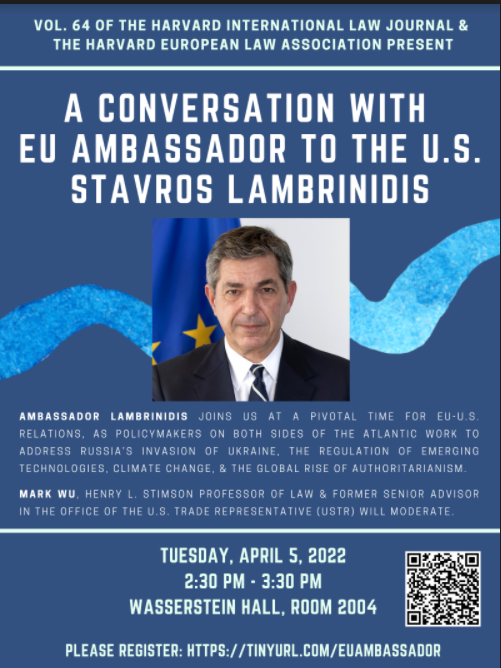
A Conversation with European Union Ambassador to the U.S. Stavros Lambrinidis at Harvard Law School

A Conversation with European Union Ambassador to the U.S. Stavros Lambrinidis

at Harvard Law School

Tuesday, April 5 2022, 2.30 – 3.30 pm EST

Location: Wasserstein Hall 2004

Register Here!

The Harvard International Law Journal and Harvard European Law Association are pleased to welcome Ambassador Stavros Lambrinidis to campus for an interactive discussion with students and faculty on the future of transatlantic relations!

Ambassador Lambrinidis began his tenure as Ambassador of the EU to the United States in March 2019. He joins us at a pivotal time for EU-U.S. relations, as policymakers on both sides of the Atlantic work to address Russia’s invasion of Ukraine, the regulation of emerging technologies, climate change, and the global rise of authoritarianism. Mark Wu, Henry L. Stimson Professor of Law and former Senior Advisor in the Office of the U.S. Trade Representative (USTR) will moderate the conversation.

Prior to his current role, Ambassador Lambrinidis served as the European Union Special Representative for Human Rights, Foreign Affairs Minister of Greece, and Member of the European Parliament. He received a B.A. in Economics and Political Science from Amherst College and a J.D. from Yale Law School.

This event is held in compliance with Harvard Law School’s updated health and safety protocols. Open to all members of the Harvard community.

Speaker Events

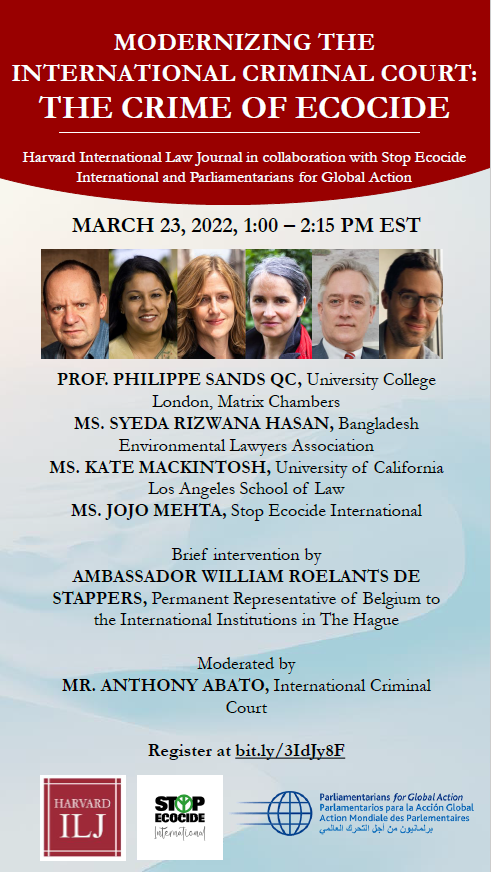
MODERNIZING THE INTERNATIONAL CRIMINAL COURT: THE CRIME OF ECOCIDE

MODERNIZING THE INTERNATIONAL CRIMINAL COURT: THE CRIME OF ECOCIDE

Organized by Harvard International Law Journal in collaboration with Stop Ecocide International and Parliamentarians for Global Action

Wednesday 23 March 2022, 1.00 – 2.15 pm EST

Register at bit.ly/3IdJy8F

A litany of environmental harms perpetrated by individuals, companies, and governments are escalating across the globe.  These harms are causing devastation in the communities they are affecting, and ultimately threaten the future for all. Though there is widespread agreement that the environment must be protected, international enforcement systems are lacking.  Accountability and deterrence for environmental harms constituting ecocide are desperately needed.

The International Criminal Court plays an important role in the promotion of global justice and peace. Currently, its jurisdiction is limited to war crimes, crimes against humanity, genocide and the crime of aggression.  To reflect the severity of environmental harms constituting ecocide, and to enhance accountability and deterrence on the international level, the Rome Statute could be amended to expand the Court’s jurisdiction to the crime of ecocide.  This event discusses the need to criminalize ecocide, and the advocacy currently underway to expand the jurisdiction of the International Criminal Court, including the definition of ecocide proposed by Stop Ecocide’s independent expert panel.

This discussion will cover:  an introduction to the necessity of criminalising ecocide under the Rome Statute; an overview of the work currently underway by Stop Ecocide, including the Expert Panel’s report; discussion of intersection with environmental law principles; next steps from here.

Content, Online Scholarship, Perspectives

A Hague Convention on Parallel Proceedings

PAUL HERRUP AND RONALD A. BRAND*

Introduction

Two of the most recent conventions produced by the Hague Conference on Private International Law create frameworks for transnational litigation in areas that clearly needed development at a global level. The 2005 Convention on Choice of Court Agreements regulates jurisdiction and the recognition and enforcement of judgments in civil and commercial matters in international cases in which an exclusive choice of court agreement has been concluded. The 2019 Convention on the Recognition and Enforcement of Foreign Judgments in Civil or Commercial Matters applies to the recognition and enforcement of foreign judgments in civil and commercial matters.

Both of the existing conventions resulted from a broader project begun in the early 1990s, considering issues of jurisdiction as well as the recognition and enforcement of judgments. A consensus determination in 2001 that a comprehensive treaty on jurisdiction and judgments recognition was not possible allowed the Hague Conference to focus on specific pieces of that broader project, and led to the two existing conventions.

The question now facing the Hague Conference is whether further international legal instruments can add to the package in a manner that will solve other significant problems raised by cross-border litigation — and solve them well. It is our view that a convention that would purport to require or prohibit national court jurisdiction in the first instance (i.e., regulate “direct jurisdiction”) is neither feasible nor desirable. There is a current and growing need, however, for rules that address questions of parallel proceedings by designating a “better forum” when courts in more than one state are seized with the same or related claims under their own jurisdictional rules.

Global Mobility and Global Dispute Settlement Needs

Any transnational litigation convention must be measured against the progress of global communication and transportation over the past quarter-century, and the near certainty that the global mobility these developments demonstrate will accelerate in the future. The resulting combination of enhanced knowledge of opportunities across borders and reduced transaction costs have brought an unprecedented ability of people, goods, ideas, electrons, and even microbes to move across borders, easily and cheaply. This, in turn, has created social, cultural, and economic connections, as well as the inevitable attendant disputes.

Not only is there a far greater number of persons engaged in global activities, but the breadth, flexibility, and plasticity of the relationships has proliferated. This includes new types of family relationships, as well as new variations in commercial relationships such as licensing and other arrangements in areas including intellectual property rights and data transmission.

This democratization of cross-border activities results in an increase in the number of states with a significant connection, legal or factual, to any given transaction or relationship. For example, in the sale of goods, any stage in the stream of commerce might well justify a jurisdictional connection, including the location of the advertisement for sale, the contract offer, the contract acceptance, the initial packaging of the goods, the loading of the first carrier for transit, the export customs territory, the import customs territory, the storage upon arrival in the import customs territory, the unloading from the final carrier for transit, the purchaser’s facility at destination, the bank through which payment is made or financing is arranged, the office where payment is received, or any other geographic activity conducted by one or more of the parties to the transaction. Each of these factors may be considered important to national rules determining judicial jurisdiction, resulting in there being courts in multiple states in which a legal action may be filed when a dispute arises.

A Convention Regulating Direct Jurisdiction

The fact that there may be multiple states in which jurisdiction for judicial settlement of a dispute exist for a single cross-border relationship does not mean that it is either necessary, or even possible, to prepare a convention purporting to require or prohibit the exercise of jurisdiction as a general matter by national courts. To the contrary, any effort to prepare such a convention will fail — and is not needed in order to improve the field of transnational litigation.

Judicial jurisdiction is an attribute of national sovereignty, and reflects differing appraisals of the proper scope and qualities of a particular kind of exercise of state power. Each state touched by an instance of global mobility may have reasonable grounds from its own perspective to vest its courts with jurisdiction over a resulting dispute, which leads to the possibility of multiple reasonable fora. The mere fact that one state’s jurisdictional nexus may differ from that in another state does not necessarily make litigation in one of those states better than in the other. Different states may legitimately value different interests in determining access to, and protection in, their courts. Neither access to justice nor due process is a finite, unchanging value, and efforts to create rules that definitively limit either of them for global purposes — regarding jurisdiction or any other concept — are presumptuous at best, and likely to be destructive of the very values they purport to champion in the long run.

Mechanical rules of jurisdiction, especially when based upon nineteenth century notions of physical presence, can result in a highly expensive and cumbersome fragmentation of related litigation, with no guarantee that each piece of the litigation will yield non-overlapping results, and with real risks of inconsistent judgments. The oft-stated claim that transactions require ex ante certainty as to jurisdiction is belied by experience. Levels of economic activity in the United States, whose jurisdictional rules allegedly are uncertain, compare favorably to those in Europe, which does attempt to provide rigid, ex ante jurisdictional rules.[1]

The European experience shows that, even on a regional basis with a single court in control of interpretation of jurisdictional rules, ex ante certainty cannot be achieved or can be achieved only after extensive litigation and by creating an artificial legal terrain disconnected from commercial and other realities of mobility. One need only survey case activity before the Court of Justice of the European Union (CJEU) in 2020 and 2021 to illustrate and understand this problem in a system of relatively homogenous states in a single region, with a single court to provide definitive interpretation. In April of 2020, Advocate General Campos Sánchez-Bordona issued his opinion in Verein für Konsumenteninformation v Volkswagen AG, wrestling with tort jurisdiction and the “place where the harmful event occurred” test of Article 7(2) of the Brussels I (Recast) Regulation, in the “Dieselgate” affair and the resulting products liability actions brought on behalf of automobile purchasers. His recommendation that the place of injury (which applies in addition to the place-of-act test under CJEU interpretation), be “the place . . . where the victim purchased the product from a third party,” was qualified by a requirement that “the other circumstances confirm the attribution of jurisdiction to the courts of that State.”[2] Moreover, “[t]hose circumstances must include, at all events, one or more factors which enabled the defendant reasonably to foresee that an action to establish civil liability as a result of his or her actions might be brought against him or her by future purchasers who acquire the product in that place.”[3] In July of 2020, the court ultimately chose a more limited test, providing that “where a manufacturer in a Member State has unlawfully equipped its vehicles with software that manipulates data relating to exhaust gas emissions before those vehicles are purchased from a third party in another Member State, the place where the damage occurs is in that latter Member State.”[4] Even with the rejection of Advocate General Campos Sánchez -Bordona’s more complex test, consider the multiple complex factual predicates to the court’s rule of interpretation:

-unlawfully

-equipped its vehicles

-with software

-that manipulates data

-relating to exhaust gas emissions

-before those vehicles are purchased

-from a third party

-in another Member State.

One need only think for a minute of how such decisions would be made regarding a convention that applied on a global basis, without the homogeneity of the European region, and where every national judicial system could enter conflicting interpretations. The claimed predictability would be non-existent as the world evolves and new types of claims arise from new problems and new technology.

Other CJEU cases of 2020 and 2021 provide additional examples of this problem. In LJ and Others v. Rina SpA, the court entered the sticky area of jurisdiction when companies assert sovereign immunity as a result of sovereign ownership of an otherwise private company. The court’s conclusion that “[t]he principle of customary international law concerning immunity from jurisdiction does not preclude the national court seised from exercising the jurisdiction provided for by that regulation in a dispute relating to such an action, where that court finds that such corporations have not had recourse to public powers within the meaning of international law,”[5] requires very little imagination to realize the problems when expanded to a global treaty context. Similar issues of sovereignty and jurisdiction were raised in Belgische Staat v. Movic BV, where the question involved whether Belgian authorities, which had brought interlocutory proceedings against a foreign corporation, were acting in a public or private (commercial) manner and thus governed by the jurisdictional rules of the Brussels I (Recast) Regulation.[6]

The case of Mittelbayerischer Verlag KG v. SM, decided on June 17, 2021, again raised interpretation problems with Article 7(2) of the Brussels I (Recast) Regulation, wrestling with where the location of a claim falls for jurisdictional purposes when the claim is that an individual’s personality rights have been infringed by content published online on a website. The court ruled that “the courts of the place in which the centre of interests” of that person bring the claim could claim jurisdiction under Article 7(2) “in respect of the entirety of the alleged damage, . . . only if that content contains objective and verifiable elements which make it possible to identify, directly or indirectly, that person as an individual.”[7] One need not be very skilled in constructing hypotheticals to understand how such issues and opinions could affect the uniformity of application normally required in a Hague Convention when multiple courts in contracting states have final interpretive authority.

The Mittelbayerischer Verlag case brings to the forefront the problems of the EU system, which breaks down mechanical direct jurisdiction connecting factors by separating contract jurisdiction from tort jurisdiction (a process long ago discarded in common law legal pleading and thus alien to common law practice), and prohibiting a court with jurisdiction from granting full compensation for the liability it is authorized to determine. Expanding that process to a global realm and saving any hope that words in a convention will lead to predictability and uniform interpretation is a fool’s errand at best.

Perhaps the most telling single case in only the past two years for a demonstration of the potential problems of a global system of direct jurisdiction connecting factors based on the EU model is the Obala case, decided on March 25, 2021. That decision provides a triple interpretation hit at potential global uniformity and complexity, determining that:

  • An action for recovery of a parking ticket fee is a “civil and commercial matter” within Article 1(1) of the Brussels I (Recast) Regulation;
  • A parking ticket is not a “tenancy of immovable property” within Article 24(1) of the Brussels I (Recast) Regulation; and
  • A parking ticket is a contract for the provision of services within Article 7(1)(b) of the Brussels I (Recast) Regulation.[8]

The myriad potential problems for predictability and uniformity of interpretation in a global convention with similar rules are more than can be contemplated in the brief length of this discussion.

The list above involves only some of the cases of the past two years, demonstrating problems of interpretation and technical evolution that would face a global convention built upon wooden application of tests requiring mechanical direct jurisdiction connecting factors. The critical factor for action in the world is not ex ante jurisdictional certainty but a reasonable basis of prediction of possible fora.

One of the principal goals of any Hague Convention should be to improve the world of transnational litigation by reducing the time and expense involved. The time and expense wasted by litigants demonstrated in a relatively small number of CJEU cases, from a relatively short period of time, provide clear demonstration of the cliff the world would be jumping off if similar rules of direct jurisdiction are included in any new Hague Convention.

More important in any process of drafting a new legal instrument, a convention purporting to regulate direct jurisdiction is an exercise in solving a problem that has not been identified. Not only can it be easily demonstrated that any convention including direct required bases of national jurisdiction in national courts would create innumerable litigation problems, but those championing such a convention have yet to identify any significant problems that have arisen in real-life litigation that they seem to be trying to solve. Indeed, the existence of multiple potential fora does not appear to be a significant deterrent to transnational mobility. The challenge generally is not to specify a single forum ex ante, but what to do in those cases in which litigation over the same or related claims materializes in multiple fora. This problem should be explored and investigated from the ground up, rather than starting from well-entrenched positions that are not necessary to the solution of the problem and tend to add time, expense, and confusion in international litigation.

The Need for a Convention Offering Assistance to Courts with Parallel Proceedings Do Occur

An increasing irritant in transnational civil litigation is posed by situations in which multiple states assert jurisdiction, each under its own law, over or related to the same claim or set of claims. The traditional solution in many common law countries is to let litigation proceed in multiple countries, with resolution of the matter (or not) coming at the stage of recognition and enforcement of the first judgment issued by the various courts considering the matter. This approach leads to a race to judgment, and may result in duplicative litigation, significant additional expense for litigants, and potential conflicting judgments. These problems may be modulated by application of the doctrine of forum non conveniens, which usually requires a court to balance a basket of factors and defer to proceedings in another forum only if the other forum is clearly more appropriate to resolve the dispute.[9]

The traditional solution in many civil law states is to rigidly prescribe and rank order jurisdictional bases and, if nonetheless jurisdiction might subsist in multiple fora, then apply a strict lis pendens rule, which bars consideration of a claim or set of claims if another court was “seized” first. This approach leads to a race to the courthouse and very artificial strategic litigation, such as an anecdotally reported proliferation of requests for negative declaratory judgments (e.g., a declaration in favor of a party who expects to be sued in another forum that the party bringing the request has no legal obligations to the other persons).

Both approaches create opportunities and incentives for strategic forum shopping, and neither approach necessarily directs litigation to the forum most suited to dispute resolution in a particular case. Both add to the advantages that a well-funded party has over a less affluent party.

Parallel proceedings in the courts of two or more states can and do result from jurisdictional rules that (appropriately) provide multiple judicial fora for the resolution of a single cross-border dispute. The differences in approaches across legal systems to such parallel litigation suggest the value of an international legal instrument that would move the same or related litigation to a “better forum.” But the determination of the “better forum” does not, and should not, require engaging in the complex and difficult enterprise of mandating or prohibiting preexisting national jurisdiction rules. At the same time, this determination under such an instrument should be accomplished in a manner that will provide far more direction and specificity than are found in existing common law forum non conveniens regimes.

No legal system currently resolves the problem of parallel proceedings with any great distinction, and certainly not in a way that is useful on a global scale. We desperately need fresh thought, unfettered by the shibboleths of past practice or decrepit dogma. The Hague Conference has a once-in-a-generation opportunity to engage in a critical examination of the area, without preconceptions, with due regard to empirical reality, and from the ground up. Whether it will meet that challenge remains to be seen.


[1]      See, e.g., C.I. Jones, The Facts of Economic Growth, in 2A Handbook of Macroeconomics 3, 35 figs. 24 & 25, 36 fig. 26 (John B. Taylor & Harald Uhlig eds., 2016).

[2]      Opinion of Advocate General Campos Sánchez-Bordona, Case C-343/19, Verein fur Konsumenteninformation v. Volkswagen AG, ECLI:EU:C:2020:253, ¶ 81 (Apr. 2, 2020).

[3]      Id.

[4]      Judgment, Case C-343/19, Verein fur Konsumenteninformation v. Volkswagen AG, ECLI:EU:C:2020:534, ¶ 41(July 9, 2020).

[5]      Judgment, Case C-641/18, LG v. Rina SpA, ECLI:EU:C:2020:349, ¶ 61 (May 7, 2020).

[6]      See Judgment, Case C-73/19, Belgische Staat v. Movic BV, ECLI:EU:C:2020:568, ¶¶ 23–24 (July 16, 2020).

[7]      Judgment, Case C-800/19, Mittelbayerischer Verlag KG v. SM, ECLI:EU:C:2021:489, ¶ 47 (June 17, 2021).

[8]      Judgment, Case C-307/19, Obala i lučice d.o.o. v. NLB Leasing d.o.o., ECLI:EU:C:2021:236, ¶ 99 (Mar. 25, 2021).

[9]      See generally, Ronald A. Brand & Scott Jablonski, Forum Non Conveniens: History, Global Practice and Future Under the Hague Convention on Choice of Court Agreements (2007).

[hr gap=”30″]

*       Paul Herrup is member of the Pennsylvania Bar. Ronald A. Brand is the Chancellor Mark A. Nordenberg University Professor and Academic Director of the Center for International Legal Education at the University of Pittsburgh School of Law. Both authors were members of the Experts Group and are current members of the Working Group considering a convention on parallel proceedings at the Hague Conference on Private International Law. This article is prepared entirely in their personal capacity and should not be taken to represent the position of any delegation, state, office, or institution.

Content, Essays, Online Scholarship

Falling Through the Cracks: Kashmir’s Resistance Against Settler Colonialism and the Limits of International Law

Shaiba Rather*

[Click here for PDF]

This Note centers Kashmir as a case study to illuminate the ways in which the law can and cannot offer respite for those in settler colonial regimes. In particular, it highlights how the international community has failed to accept Kashmir as under occupation and thus refused to extend the protections of jus in bello to its civilians.  While Kashmiris have been pushed out of the protections from international law in the past, this Note presents settler colonialism as an analytical lens that can potentially offer respite. It acknowledges that international law does not explicitly prohibit settler colonial conduct but highlights how advocates can couple their “legal work” with the rights that are established in international law to build their own opportunities for relief outside of the law. This piece provides two contributions to existing literature: it advances the very limited discussion of the international law of settler colonialism and strengthens the current understanding of the modes of oppression that exist in Kashmir.

Introduction

On December 14, 1960, the U.N. General Assembly issued a solemn proclamation in Resolution 1514: that the “speedy and unconditional end [to] colonialism in all its forms and manifestations” was a “necessity.”[1] For the “subjection of peoples to alien subjugation, domination and exploitation constitutes a denial of fundamental human rights, [was and is] contrary to the Charter of the United Nations and [was and is] an impediment to the promotion of world peace and co-operation.”[2] It was this proclamation that the global community fondly remembers as the start of the decolonization era. Despite the moment’s grandeur, the modern global political climate suggests that this declaration from 1960 was far too ambitious and perhaps altogether deceptive. Traditional colonial empires superficially collapsed. But their undercurrents—the need to dominate the “other”—lingered. The result was that colonialism of the past did not crumble but instead persisted, evolved, and re-clothed itself in nations both new and old.

Settler colonialism is the General Assembly Resolution 1514’s modern enemy. Settler colonialism is premised on the state’s recruitment of a class of settlers whose goal is to not only occupy the land of the Indigenous but also to eliminate the Indigenous who stand in their way.[3] Settler colonialism and colonialism are distinct, yet intertwined, modes of oppression. While colonizers say, “you, work for me,” settler colonizers say, “you, go away.”[4] Still, at the core of both projects are migration and a relationship of ascendency.[5]

Since 1960, settler colonialism has wreaked havoc on a number of global communities: from Indigenous people across the Americas, New Zealand, and Australia,[6] to the Palestinians.[7] And unfortunately, the global expanse of settler colonial forces has not slowed down. With the 2019 abrogation of Jammu and Kashmir’s semi-autonomous status in India, some scholars now fear that India’s relationship with the region has transitioned into a fully settler colonial one. Some, as I have previously argued,[8] contend that settler colonialism narratives in Kashmir have persisted since well before the abrogation.  Regardless of the starting point of India’s settler colonial project in Kashmir, the fears for the future are the same: that India will recruit a class of non-Kashmiri settlers to change the predominantly Muslim demographic of the region.

This Note centers Kashmir as a case study to illuminate the ways in which the law can and cannot offer respite for those in settler colonial regimes. Given a settler state’s interest in preserving itself, domestic law’s use as a shield appears unlikely.[9] This piece thus asks: What, if anything, can we make of international law?

After presenting context on the situation in Jammu and Kashmir in Part I, Part II discusses the ways international law has failed the region in the past. In particular, it highlights how the international community has failed to accept Kashmir as under occupation and has thus failed to extend the protections of jus in bello to its civilians. This Note then proceeds in Part III to present the settler colonialism framework as one that can potentially offer respite for Kashmiris outside of the traditional jus in bello framework.  Although literature on the subject remains limited, the approach offered by Professor Natsu Taylor Saito is a helpful starting point for understanding what tools currently exist in international law. In the final Part, this Note examines the strengths and weaknesses of the existing international legal framework on settler colonialism. While it acknowledges that international law does not explicitly prohibit settler colonial conduct, it recognizes that advocates can couple their “legal work” with the rights established in international law to build their own opportunities for relief outside of the law.

I. The Legacy of Partition

In August 1947, the Indian subcontinent comprised not only the familiar nations of India and Pakistan but also more than 500 “princely states” foreign to modern maps.[10] The princely system relied on nested sovereignty, where princes exercised near-autonomy while still heeding the title of the British monarchy.[11] Each chiefdom confronted a challenging question with the onset of 1947: How would, and should, their future manifest in a free Indian subcontinent?

For the majority of the princely states, the answer to this question was bifurcated: join Pakistan or India.[12] Although the Viceroy of India Lord Mountbatten successfully persuaded nearly all of the princely states to align based on geography or religious demography, three states remained unfettered. Of these three, the snow-capped, Himalayan-crested state of Kashmir stood tall.

At the time, the state of Jammu and Kashmir neared the physical size of the United Kingdom and had a population of just over four million people.[13] The region was culturally and topographically heterogenous, including what is now the predominantly Hindu low-hilled region of Jammu, the majority Muslim Valley of Kashmir, and the Buddhist dominated high-peaked Ladakh.[14] What could have been three distinct states in and of themselves were unified under the regime of Dogra Rajput, a clan who stretched the state’s borders from Afghanistan to Tibet.[15] Together, the heterogenous region was a notable powerhouse in the subcontinent. Prized for its naturally rich land and strategic geographic location,[16] Kashmir captured the interest of both the infantile India and Pakistan.

However, Kashmir did not fit neatly into the framework for alignment.[17] The state was not only predominantly Muslim yet ruled by a Hindu king, Maharaja Hari Singh, but also uniquely abutted both Indian and Pakistani frontiers.[18] The King’s own preference for an independent Kashmir only further muddled the region’s future.[19] Thus, when confronted with the question of accession, the Maharaja opted instead for a “standstill agreement,” leaving Kashmir with free movement and transport across both India and Pakistan without ceding any sovereignty.[20]

What comes next remains as disputed as Kashmir’s present-day story. What is clear however is that the so-called standstill did not last very long. The agreed upon facts are the following: in October 1947, a mass of armed men invaded the region from the north, made their way to the capital, and launched an invasion of an ill-defended Kashmir.[21] Unsettled still, and hotly debated, is why and how these raiders came to Kashmir.[22] Some accounts characterize the invasion as Pakistani-orchestrated to secure Kashmir; others present an independent group rushing to save subjugated Muslims suffering under an oppressive Hindu rule in Kashmir.[23] Regardless, the invasion forced Maharaja Singh’s hand—fearing for his ill-equipped state army, he turned to India for defensive support. India conditioned its support on Kashmir signing the Instrument of Accession, and the Maharaja agreed.[24] Critical to that signing, however, was an agreement between Lord Mountbatten and Maharaja Singh that although India would provide Kashmir with military aid given the invasion, “as soon as law and order have been restored in Kashmir and her soil cleared of the invader, the question of the State’s accession should be settled by a reference to the people.”[25]

Despite assurances for a plebiscite from the Viceroy and later, the United Nations,[26] such an inquiry never took place. Instead, select Kashmiri political leaders continued their negotiations with the Indian national government, eventually crafting Article 370 of the Indian Constitution in 1950.

Article 370 crystallized Kashmir’s uniquely semi-autonomous status. Notably, Article 370 curtailed the application of the Indian Constitution and the national government’s powers to the domains specified in the Instrument of Accession: defense, external affairs, and communication.[27] While it allowed for other constitutional provisions to discretionarily apply to Kashmir, it required not just the President’s notification but critically the approval from the “Constituent Assembly of the State.”[28] Similarly, Article 370 could only be deemed inoperative with the state assembly’s recommendation.[29] It was with the powers vested in Article 370 that Kashmir adopted Article 35A to the Indian Constitution,[30] which empowered the state legislature to both define the “permanent residents” of the state and attach specific privileges, like the ownership of land, to such residency.[31]

The region’s autonomy grew beyond Article 370, manifesting in the terms of its own state Constitution as well.[32] These terms included the creation of Kashmir’s own Prime Minister-ship and a unique state flag.[33] Ultimately, Kashmir’s legal regime empowered it to block the application of federal legislation in its own boundaries, limit the ownership of land to Kashmiri natives, and safeguard its Muslim majority demographic.[34]

However, Kashmir’s promised autonomy was whittled to a legal fiction. From the reduction of Kashmir’s Prime Minister to a Chief Minister to the extension of a majority of the articles of the Indian Constitution to the state,[35] Article 370 was more a symbol of Kashmir’s desired sovereignty than the sword championing it. This whittled autonomy, apexed by the Indian-rigged state elections in 1989,[36] amplified a Kashmiri freedom struggle that had existed even before Partition.[37] However, it also launched an intense counter-insurgency strategy from the Indian state, one which was facilitated by the deployment of hundreds of thousands of troops that secured Kashmir’s title as one of the most densely militarized zones in the world.[38]

Almost two years ago, the Indian government delivered its final blow to Kashmir’s autonomy. On August 5th, 2019, the Indian government—under the leadership of the Bharatiya Janata Party (BJP)—abrogated Articles 370 and 35A of the Indian Constitution.[39] This legal strike was not without an Indian-orchestrated brutal crackdown in Kashmir, including but not limited to: enforcing a curfew, blockading communications arbitrarily detaining civilians, limiting civilian access to basic necessities like medical care, disappearing civilians, and conducting torture and extrajudicial killings.[40] The move both eliminated the region’s status as a state and overturned provisions that shielded Kashmir from land purchases made by non-Kashmiris. Post August 5th, Jammu and Kashmir was officially “for sale . . . .”[41]

II. Kashimir’s History with International Law

The Third World Approaches to International Law (TWAIL) have highlighted international law’s impotence writ large. In particular, the school has critiqued the regime for its dubious origins: colonialism.[42] Core to states’ imperial project and thus the creation of international law was a “civilizing mission,” where states justified their casting aside of “the other.”[43] This dynamic has only been reproduced in a “supposedly non-imperial world” and its international order.[44] The result—as seen by TWAIL scholars—is that international law is strapped by the sovereignty doctrine, where “states are the principal actors . . . bound only by that to which they have consented.”[45]

The primacy of state sovereignty has been at the root of Kashmir’s tortured history with international law. Following the 1947 invasion, Kashmir was the first inter-state conflict discussed at the United Nations Security Council (UNSC).[46] Brought through Article 35 of the UN Charter, India sought the aid of the UNSC in enforcing the withdrawal of Pakistani troops from “a State which acceded to the Dominion of India.”[47] Pakistan responded with its own counter-claims, accusing India of waging a genocide against Muslims in parts of India and forcing Kashmir’s accession by fraud and violence.[48] Pakistan made a number of requests of the UNSC, but of note, it asked that the UNSC coordinate a cessation of fighting, ordering the withdrawal of outsiders in Kashmir, and hold a plebiscite in Kashmir “as to whether the State shall accede to Pakistan or to India.”[49] Thus, in the aftermath of decolonization, Kashmir was not its own sovereign but rather the home to a “dispute”[50] between warring India and Pakistan.

From 1948 to 1971, the UNSC issued a series of increasingly watered-down resolutions on Kashmir.[51] What began as a firm call for a “free and impartial plebiscite”[52] ended with a jockey game between India and Pakistan over who erred first.[53] Although the “India-Pakistan Question” remains on the UNSC agenda as a matter of which the “Security Council [is] currently seized,”[54] it functions as nothing more than a placeholder. The “Kashmir dispute” is at best a bilateral issue and at worst, an internal one.[55] To this day, no plebiscite has taken place.

Kashmir’s frayed relationship with international law does not stop with hollowed UNSC resolutions. Despite scholars robustly arguing for the application of the law of occupation to Kashmir,[56] the international community has resisted such a classification. As Critical Kashmir Studies scholar Haley Duschinski explains, the stopping block is typically Kashmir’s partition history.[57] Those unwilling to apply the occupation law reason that Kashmir, by way of signing the Instrument of Accession, is integral to the territory of the Indian state.[58]

The denial of the application of international humanitarian law to Kashmir has been a large blow to its freedom struggle generally. The benefits of this regime are clear: unlike other areas of international law, the rules are bright lined and concretized.[59] Without the recognition of the unlawful occupation of Kashmiri soil, India has been able to portray a different narrative on the ground. The intense military presence in Kashmir does not represent occupying powers but rather components of a necessary counter-insurgency strategy. Likewise, the use of force to suppress unrest is, once again, an internal matter rather than one of international import.  India, like other states, has resisted any classification as an occupying force and instead, has promoted what some scholars call a de facto occupational constitutionalism, where foreign dominance and control are legalized through domestic mechanisms.[60] As a result, international law has largely left Kashmiris to fend for themselves within the bounds of the Indian state.

III. International Law’s Existing Tools Against Settler Colonialism

The lens of settler colonialism can shift the focus from Kashmir’s debated accession history to the less disputed threat to their land and people. Thus, where occupation law falters, the lens of settler colonialism can supplant. The question then arises—where are such protections in international law?

Unfortunately, articles discussing the protective value of international law in settler colonial regimes are limited. However, Professor Natsu Taylor Saito has discussed the application of international law as it relates to the settler colonial projects waged against Indigenous persons and people of color in the United States.[61] This part builds on her analysis in the context of the Kashmiri struggle in India. Ultimately, international law, as it currently exists, does not prohibit “settler colonialism” by name. Yet, it does supply key legal principles that offer protections more expansive than those that typically exist within a nation. This part turns to a number of different areas of international law—first, key framing principles; then, the rights of the Indigenous; and finally, the right to self-determination—to present the existing tools available to those colonized in settler regimes today.

A. Framing principles

Human rights law operates with two key principles in the background: the preservation of human dignity and the prohibition on discrimination. Human dignity is often recognized as a precursor to the realization of other rights.[62] This principle strikes at the core of the settler regime: “the coercive rule of one or the few over the many is incompatible with a due respect for the dignity of the person.”[63]

International law explicitly creates a prohibition on discrimination and reaffirms that prohibition across conventions.[64] In particular, the two core human rights treaties, the International Covenant on Civil and Political Rights (ICCPR)[65] and the International Covenant on Economic, Social and Cultural Rights (ICESCR)[66] bind India on this front by way of ratification.[67] The anti-discrimination right extends to a broad category of persons.[68] The ICCPR even goes so far as to enshrine rights protecting against the forced assimilation of minorities,[69] reflecting concerns over erasure. More simply, the principle of anti-discrimination fights the creation of the Indigenous other.[70]

B. Rights of Indigenous Peoples

Following several decades of robust advocacy, the UN passed the Declaration on the Rights of Indigenous Peoples (UNDRIP),[71] which received India’s vote.[72] While there is no authoritative definition of Indigenous populations in international law, the Special Rapporteur of the Sub-Commission on Prevention of Discrimination and Protection of Minorities proposed the following indicators for indigeneity: historical continuity; distinctiveness; non-dominance; and a determination to pass their ancestral territories and culture to future generations.[73] But above all, “self-identification as Indigenous or tribal” is the fundamental criterion.[74] Kashmiris have not only consistently self-identified as a distinct political entity,[75] but they have also organized around Kashmiriyat, a culture which is comprised of a “love of the homeland (kashir) and common speech (koshur).”[76]

UNDRIP,[77] although a non-binding declaration,[78] rhetorically combats the logic of elimination driving settler colonial projects. It reinforces the right of Indigenous communities to maintain their cultures and prohibits forced assimilation and displacement,[79] both of which, as Saito notes, are powerful for ensuring the protection of Indigenous resources and lands.[80] However, the Declaration is most dilute as it relates to recognizing Indigenous sovereignty—recognizing the explicit right of self-determination for Indigenous people but failing to require the realization of such a right by states.[81]

Although the Indigenous rights framework may not be as comprehensive as the laws of war governing occupation, they are “arguably more comprehensive than international legal instruments associated with minorities”[82] and can therefore be an important resource for Kashmiri advocates. However, UNDRIP, notably, is a declaration and not a treaty, thus giving it no binding power under international law. While some persuasive arguments have been made to UNDRIP’s customary, and thus binding status, they are not widely accepted.[83]

C. Right to Self-Determination

The right to self-determination—that is the peoples’ right to its own sovereignty—is arguably the most crucial element for release from a settler colonial regime. In some ways, international law has glorified this right the most, with its cardinal articulation as one of the “purposes” of the UN Charter itself.[84] This purpose was given muster with the passage of the Declaration on the Granting of Independence to Colonial Countries and Peoples, which called for the “the speedy end [of] colonialism in all its forms and manifestations [to be a] necessity.”[85]

This unabashed right to self-determination has narrowed in its scope since the “Decolonization Era.” Today, the right to self-determination is divided into internal and external forms. The more widely applicable form is the internal one, which entails guaranteeing socio-political rights to ensure autonomy for peoples within a state.[86] External self-determination, where the result is the drawing of new international boundaries,[87] has been limited to the extreme cases of “alien subjugation” and traditional colonial regimes as they existed in the past.[88] Although some jurists suggest that the right may exist where self-determination is blocked internally,[89] there has been no authoritative interpretation on this matter.

As a threshold matter, both internal and external rights to self-determination are limited to “peoples.” Similar to the definition of Indigenous peoples, “peoples” in the context of self-determination is not defined by an international treaty. It is generally accepted that the “peoples” determination is both subjective and objective, often including a shared belief in being a unit as well as actually sharing things like race, culture, and ethnicity.[90] In defending themselves from claims to self-determination, settler states typically argue that the population is not a “people,” that only geographically distinct territories warrant decolonization, and that, regardless, these matters are internal affairs.[91]  However, Saito, by looking at self-determination from the bottom-up, debunks these defenses.[92]

Self-determination is arguably the most crucial element for release from a settler colonial regime. However, its dilution in the law is the product of the tension it straddles. The right to self-determination toes the line between respecting the rights of subjugated people and upsetting uti possidetis juris, the preference for the territorial status quo in the name of stability.[93] Notably, and despite this friction, international law still emphasizes that it is only “by virtue of that right [to self-determination]” that other widely accepted human rights can have meaning.[94]

IV. Working for Remedies

Given international law’s colonial origins,[95] how can we expect the principles laid out above to protect against settler colonial projects? The answer is not an easy one, and it might in fact be we cannot.

Kashmiris, like many in settler colonial states, are trapped in oppressive domestic regimes. Their oppressor states spin narratives of “internal affairs,” escaping the protections and limitations of the law of occupation and jus in bello more generally. International legal principles, like the ones above, may dismiss settler conduct as normatively wrong but fail to provide any remedial bite. The result? Kashmiris and those similarly colonized by settler states have fallen through the cracks of international legal regime.

However, dismissing international law entirely may not be the answer either. While it may be limited due to its origins, the current international legal regime at least evinces this: native peoples combatting settler colonial states are empowered with rights recognized by the international framework. It is a framework that calls for decolonization and recognizes the right to self-determination of peoples. It is one that lifts up the shared culture, identity, and collectively-owned land and calls for their preservation. It is the vesting of these rights that shifts our original question to a more appropriate one—how can Kashmiris use these rights to not just resist but launch their decolonization? And perhaps, how can they reimagine a new regime altogether?

Decolonization of settler colonial states requires, then, what Professor Duncan Kennedy initially coined[96] and Professor Noura Erakat later deploys in the context of Palestine,[97] engaging in “legal work.” “Legal work,” at its core, entails an effort on the part of the worker to mold a legal regime to their benefit.[98] At this stage, the existing international principles described above are embedded in a weak enforcement regime with little binding power.[99] But with “legal work,” as Kennedy explains, the worker can “transform an initial apprehension of what the system of norms requires . . . so that a new apprehension of the system . . . will correspond to the extra-juristic preferences of the interpretive worker.”[100]

While there is no “blueprint” for the decolonization of a settler regime, one thing is clear: it must be crafted from the hands of the oppressed.[101] Kashmiris, by engaging in “legal work” with the principles laid out above, can reinvigorate their struggle at the international stage. For example, by organizing around these rights—of indigeneity and more generally peoplehood— advocates can better illuminate the parallels between the Kashmiri pro-freedom movement and that of the Palestinians or the Indigenous communities in Australia and New Zealand.[102] Both of the movements have received more concretized legal support in the international order, like large recognition for their independent statehood[103] and the benefits of the passage of UNDRIP respectively. Working within the settler colonialism framework can also shift conversations away from the law of occupation, which the international community has resisted.[104] Principles of indigeneity can instead focus the discussion on the less disputed threat to Kashmiri land and people.

Activist can utilize these principles to imbue their work with a newfound sense of urgency. Taken to its end, the settler logic warns of a full, physical and violent elimination of the native. It is this elimination that UNDRIP itself explicitly warns and protects against.[105] As a result, the question of genocide—prohibited by international law[106]—lurks behind any discussion of settler colonialism.[107] Kashmir itself is no stranger to these concerns, particularly in the aftermath of the abrogation.[108]

By repositioning itself in the settler colonial narrative, the Kashmiri freedom movement can use the concerns articulated in UNDRIP to illuminate India’s seemingly normal actions as insidious. These principles provide the language for why emerging “neighborhoods” or changes in title may be problematic.[109] Having this language can also illuminate new acts of resistance that may be necessary, like discouraging Indians from buying land in the region[110] or larger Boycott, Divestment and Sanctions movements like in Palestine. Moreover, exposing this urgency—stopping the settler colonial project before it is too late—can itself “create[] the imperatives of decolonization.”[111]

Conclusion

The fight against settler colonialism has been no stranger to the benefits of the “legal work” of the colonized. Indigenous movements have made great strides in decolonizing domestic legal spaces like those in Canada,[112] and pushed international courts, like the Inter-American Court of Human Rights, to recognizing the principality of land to Indigenous communities as a “material and spiritual element.”[113] In fact, it was only from several decades of intense advocacy that UNDRIP was even born.

Thus, the fact that international law does not itself carry explicit legal remedies may be secondary to the fact that it does vest Kashmiris with rights relevant to settler colonial realities. Indigenous communities do in fact have rights recognized by the law. “[T]aking up the struggle for freedom,” particularly around the framework of settler colonialism, is a fundamental way for Kashmiris to “assert [their] international personality,” and more fundamentally, their identity as people protected by international law.[114] Whether India or other settler colonial states heed activism, their sovereignty, “inherent in every people,” will continue to exist regardless of whether India or the international order is willing to recognize them at this moment.[115] Thus, although creating an international legal order that penalizes settler colonial states may require radical reimagination, creating an international legal order that acknowledges the wrongs of a settler regime and vests rights within the wronged requires much less.

However, as the settler colonized engage in “legal work” to reimagine their own relief, we should ask whether this is how we want our international legal system to operate. Without explicit remedies for settler colonial conduct in existing international law, those suffering under oppressive regimes now have the additional labor of crafting their own relief. They must engage in the legal work while also protecting their culture, their land, and their people. Are these cracks in the international legal system by design? Or the mere reality of true decolonization?

[1]      G.A. Res. 1514 (XV) (Dec. 14, 1960).

[2]      Id.

[3]      See Patrick Wolfe, Settler Colonialism and the Elimination of the Native, 8 J. Genocide Rsch. 387, 388 (2006).

[4]      Lorenzo Veracini, Introducing: Settler Colonial Studies, 1 Settler Colonial Stud. 1, 1 (2011).

[5]      Id.

[6]      See generally A. Grenfell Price, White Settlers and Native Peoples (1950) (comparing the effects of white settler colonialism on Indigenous populations of North America, New Zealand, and Australia).

[7]      See generally, e.g., Maxime Rodinson, Israel: A Colonial-Settler State? (1973); Nadim N. Rouhana & Areej Sabbagh-Khoury, Settler-Colonial Citizenship: Conceptualizing the Relationship Between Israel and Its Palestinian Citizens, 5 Settler Colonial Stud. 205 (2015).

[8]      See Note, From Domicile to Dominion: India’s Settler Colonial Agenda in Kashmir, 134 Harv. L. Rev. 2530 (2021).

[9]      See Natsu Taylor Saito, Settler Colonialism, Race, and the Law 167 (Ediberto Roman ed., 2020) (“States, as political constructs, have little if any incentive to recognize the rights of minority groups or peoples who are colonized, internally or externally.”).

[10]    Ramachandra Guha, India After Gandhi: The History of the World’s Largest Democracy 36–37 (2008).

[11]     Id.

[12]     See Neera Chandhoke, Contested Secessions: Rights, Self-determination, Democracy, and Kashmir 19 (2012).

[13]     See Guha, supra note 10, at 59.

[14]    See id. at 37.

[15]     Id.

[16]    See Chandhoke, supra note 12.

[17]     See Matthew J. Webb, Escaping History or Merely Rewriting It? The Significance of Kashmir’s Accession to Its Political Future, 20 Contemp. S. Asia 471, 477 (2012).

[18]    Guha, supra note 10, at 60.

[19]    Id. at 64.

[20]    See Webb, supra note 17.

[21]     The Maharaja’s Letter to the Governor-General of India, Lord Mountbatten (Oct. 26, 1947), reprinted in A.G. Noorani, Article 370: A Constitutional History of Jammu and Kashmir 41–42 (2011).

[22]    Guha, supra note 10, at 64–65.

[23]    Id.

[24]    Note that the Maharaja’s signing of the Instrument of Accession is also contested, with scholars arguing that the accession was induced through false promises. See, e.g., Chandhoke, supra note 12, at 101.

[25]    Letters between Lord Mountbatten and Maharaja Singh suggest that although India would aid in Kashmir’s military aid given the invasion, “as soon as law and order have been restored in Kashmir and her soil cleared of the invader, the question of the State’s accession should be settled by a reference to the people.” Letter from Governor-General, India, Delhi, to Maharaja Sahib (Oct. 27, 1947), reprinted in Noorani, supra note 21, at 43 [hereinafter Letter from Governor-General].

[26]    Infra Part II.

[27]     Constitution of India art. 370, cl. 1(a)–(b).

[28]    Id. cl. 3.

[29]    Id.

[30]    Ministry of Law, Constitution (Application to Jammu and Kashmir) Order, 1954, C.O. 48 (Issued on May 14, 1954).

[31]     Id. pt. 4, cl. (j). Other states in India have similar restrictions on land ownership as described in Vakasha Sachdev, Despite J&K Changes, You Still Can’t Buy Land in These States, The Quint (Oct. 29, 2020), https://www.thequint.com/news/india/jammu-kashmir-land-laws-amended-other-states-where-outsiders-cant-purchase-property-himachal-sikkim-arunachal-tribal-areas [https://perma.cc/N3ES-U6N9].

[32]    Constitution of Jammu and Kashmir Nov. 17, 1956, arts. 3–5.

[33]    Id. arts. 36, 144.

[34]    Haseeb A. Drabu, Modi’s Majoritarian March to KashmirN.Y. Times (Aug. 8, 2019), https://www.nytimes.com/2019/08/08/opinion/modis-majoritarian-march-to-kashmir.html [https://perma.cc/U9W5-W3ZM].

[35]    See Angana P. Chatterji, Kashmir: A Place Without Rights, Just Sec. (Aug. 5, 2020), https://www.justsecurity.org/71840/kashmir-a-place-without-rights [https://perma.cc/G4EB-8695].

[36]    See generally Sten Widmalm, The Rise and Fall of Democracy in Jammu and Kashmir, 37 Asian Surv. 1005 (1997) (detailing notable and perceived-as-rigged elections in Kashmir).

[37]    See generally Mridu Rai, Hindu Rulers, Muslim Subjects 224–87 (2019) (discussing Kashmiri political mobilization against the “Hindu State” under the ruling dynasty).

[38]    See Jammu Kashmir Coal. of Civ. Soc’y, Structures of Violence: The Indian State in Jammu and Kashmir 36–37, 75 (2015).

[39]    India Revokes Kashmir’s Special Status, Al Jazeera (Sept. 4, 2019), https://www.aljazeera.com/news/2019/09/india-revokes-kashmir-special-status-190904143838166.html [https://perma.cc/DN2H-FELR].

[40]    See Kashmir: Curfew-Like Restrictions Imposed on Movement of People, India Today (Aug. 5, 2019), https://www.indiatoday.in/india/story/jammu-and-kashmir-curfew-section-144-imposed-1577218-2019-08-05 [https://perma.cc/8LMP-2KAB].

[41]     Omar Abdullah (@OmarAbdullah), Twitter (Oct. 27, 2020, 4:06 AM), https://twitter.com/OmarAbdullah/status/1321015482544054273 [https://perma.cc/TSN7-994N].

[42]    See Antony Anghie, Core Imperialism, Sovereignty and the Making of International Law 3 (2005).

[43]    Id. at 311–12.

[44]    Id. at 310–11.

[45]    Id. at 33.

[46]    Rakesh Ankit, Britain and Kashmir, 1948: “The Arena of the UN”, 24 Dipl. & Statecraft 273, 273 (2013).

[47]    Stephen P. Westcott, The Case of UN Involvement in Jammu and Kashmir, E-Int’l Rels. 1, 4 (2020), https://www.e-ir.info/pdf/81046 [https://perma.cc/F2SC-DS2S].

[48]    Brian R. Farrell, The Security Council and Kashmir, 22 Transnat’l L. & Contemp. Probs. 343, 346 (2014).

[49]    Minister of Foreign Affs. of Pakistan, Letter dated Jan. 15, 1948 from the Minister of Foreign Affairs of Pakistan to the Secretary-General, U.N. Doc. S/646 (Jan. 15, 1948).

[50]    S.C. Res. 39 (Jan. 20, 1948).

[51]     See generally Farrell, supra note 48 (for a detailed history of Security Council action on Kashmir).

[52]    S.C. Res. 47 (Apr. 21, 1948).

[53]    See Farrell, supra note 48, at 354–55.

[54]    Ghulam Nabi Fai, Kashmir and the UN Security Council, Anadolu Agency (Sept. 12, 2020), https://www.aa.com.tr/en/analysis/kashmir-and-the-un-security-council/1971039 [https://perma.cc/N4BJ-3L29].

[55]    Geeta Mohan, Kashmir a bilateral issue, India tells US after Trump offers help, India Today (Jan. 22, 2020), https://www.indiatoday.in/india/story/kashmir-a-bilateral-issue-india-tells-us-after-trump-offers-help-1639126-2020-01-22 [https://perma.cc/YC3P-6SXU].

[56]    See generally Nosheen Ali et al., Geographies of Occupation in South Asia, 45 Feminist Stud. 574 (2019); Mona Bhan et al., “Rebels of the Streets”: Violence, Protest, and Freedom in Kashmir, in Resisting Occupation in Kashmir 1, 5 (Haley Duschinski et al. eds., 2019); Haley Duschinski & Shrimoyee Nandini Ghosh, Constituting the Occupation: Preventive Detention and Permanent Emergency in Kashmir, 49 J. Legal Pluralism & Unofficial L. 314 (2017).

[57]    Duschinski & Ghosh, supra note 56, at 315–16.

[58]    Id.

[59]    See Breven C. Parsons, Moving the Law of Occupation into the Twenty-First Century, 57 Naval L. Rev. 1, 5–8 (2009) (discussing the law of occupation’s robust treaty framework but noting how it’s been practically undermined).

[60]    Duschinski & Ghosh, supra note 56, at 318.

[61]    See generally Saito, supra note 9.

[62]    See International Covenant on Civil and Political Rights, preamble, Dec. 16, 1966, 999 U.N.T.S. 171 [hereinafter ICCPR]; International Covenant on Economic, Social, and Cultural Rights, preamble, Dec. 16, 1966, 993 U.N.T.S. 3 [hereinafter ICESCR] (“[R]ecognition of the inherent dignity and of the equal and inalienable rights of all members of the human family is the foundation of freedom, justice and peace in the world.”).

[63]    Oscar Schachter, Human Dignity as A Normative Concept, 77 Am. J. Int’l L. 848, 850 (1983).

[64]    See U.N. Charter art. 1(3); ICCPR, arts. 2, 7; ICESCR, art. 2(2).

[65]    ICCPR, arts. 2(1), 26.

[66]    ICESCR, art. 2(2).

[67]    Ratification Status for India, https://tbinternet.ohchr.org/_layouts/15/TreatyBodyExternal/Treaty.aspx?CountryID=79&Lang=EN [https://perma.cc/9BZZ-M8VW] (last visited May 2, 2021).

[68]    ICCPR, art. 26 (protecting “discrimination on any ground such as race, colour, sex, language, religion, political or other opinion, national or social origin, property, birth or other status.”)

[69]    ICCPR, art. 27 (“In those States in which ethnic, religious or linguistic minorities exist, persons belonging to such minorities shall not be denied the right, in community with the other members of their group, to enjoy their own culture, to profess and practise their own religion, or to use their own language.”)

[70]    See Veracini, supra note 4, at 2.

[71]     G.A. Res. 61/295, United Nations Declaration on the Rights of Indigenous Peoples (Sep. 13, 2007) [hereinafter UNDRIP].

[72]    Ratification Status for India, supra note 67.

[73]    José R. Martinez Cobo (Special Rapporteur of the Sub-Commission on Prevention of Discrimination and Prot. of Minorities), Study of the Problem of Discrimination Against Indigenous Populations, U.N. Doc. E/CN.4/Sub.2/1986/7 and Adds. 1–4 (1987).

[74]    ILO Convention (No. 169) concerning Indigenous and Tribal Peoples Convention in Independent Countries, art. 1(2), June 27, 1989, 1650 U.N.T.S. 383.

[75]    Rattan Lal Hangloo, Kashmiriyat: The voice of the past misconstrued, in The Parchment of Kashmir 28 (N. Khan ed., 2012) (citing the use of revolutionary phrases — “choun desh meun desh, Koshur Desh! Koshur Desh! (Your country, my country, Kashmir! Our country, Kashmir!)” — well before 1975).

[76]    Id. at 38.

[77]    UNDRIP, arts. 5, 8–15.

[78]    While some persuasive arguments have been made to UNDRIP’s customary, and thus binding status, they are not yet widely accepted. See Office of the High Commissioner, Indigenous Peoples and the United Nations Human Rights System 8 (2013), https://www.ohchr.org/documents/publications/fs9rev.2.pdf [https://perma.cc/JLK8-3WGF].

[79]    UNDRIP, arts. 5, 8–15.

[80]    See Saito, supra note 9, at 173. The Inter-American Court of Human Rights has also stressed the importance of protecting Indigenous land in particular, noting that: “relations to the land are not merely a matter of possession and production but a material and spiritual element.” Mayagna (Sumo) Awas Tingni Community v. Nicaragua, Merits, Reparations, and Costs, Judgement, Inter-Am. Ct. H.R. (ser. C) No. 79, ¶ 149 (Aug. 31, 2001).

[81]    UNDRIP, arts. 3–4.

[82]    See Office of the High Commissioner, supra note 78, at 3.

[83]    Id. at 8.

[84]    U.N. Charter art. 1(2).

[85]    The UN Charter includes guaranteeing respect for the “self-determination of peoples” as one of the UN’s core “purposes.” G.A. Res. 1514 (XV), supra note 1, preamble (emphasis added).

[86]    Reference re Secession of Quebec, [1998] 2 S.C.R. 217, ¶¶ 130–135 (Can.).

[87]    G.A. Res. 2625 (XXV) (Oct. 24, 1970).

[88]    Reference re Secession of Quebec, [1998] 2 S.C.R. 217, ¶ 136.

[89]    Id. at ¶ 134; Accordance with International Law of the Unilateral Declaration of Independence in Respect of Kosovo, Advisory Opinion, 2010 I.C.J. 403, 618, ¶ 16 (July 22) (separate opinion of Yusuf, J.).

[90]    Michael P. Scharf, Earned Sovereignty: Judicial Underpinnings, 31 Denv. J. Int’l L. & Pol’y 373, 373–79 (2003).

[91]    See Saito, supra note 9, at 192–93.

[92]    See id. at 193 (highlighting five principles: “Territorial integrity is a legal fiction;” “Peoplehood is constructed and defined by the people, not the state;” “Self-determination cannot be constrained by a paradigm of “universal” rights;” “States are not the only viable forms of political organization;” “Self-determination is a process and a continuing right.”).

[93]    Frontier Dispute (Burk. Faso/Mali), 1986 I.C.J. 554, ¶ 20 (Dec. 22); see also id. ¶¶ 25–26 (“At first sight [uti possidetis juris] conflicts outright with another one, the right of peoples to self-determination.”).

[94]    ICCPR, art. 1; ICESCR, art. 1.

[95]    See Anghie, supra note 42, at 5–6.

[96]    Duncan Kennedy, A Left Phenomenological Alternative to the Hart/Kelsen Theory of Legal Interpretation, in Legal Reasoning, Collected Essays 158 (2008).

[97]    See Noura Erakat, Justice for Some 7 (2019).

[98]    See Kennedy, supra note 96.

[99]    See Daryl J. Levinson & Jack L. Goldsmith, Law for States: International Law, Constitutional Law, Public Law, 122 Harv. L. Rev. 1791, 1822–23 (2009).

[100]   Kennedy, supra note 96.

[101]   See Saito, supra note 9, at 202.

[102]   Stand with Kashmir, a prominent group of Kashmiri activists, protested with the First Nations peoples of Australia to “stand against the devastation and lasting impact of settler colonialism on Indigenous communities.” Stand with Kashmir, Facebook (Jan. 28, 2021, 11:27 AM), https://www.facebook.com/StandWithKashmir/posts/2183498138449673 [https://perma.cc/GJE9-EKSF]. While they mention settler colonialism, concretizing that framework through the law, as this Note attempts, can embolden their case and highlight the parallels for the international community.

[103]   139 UN members recognize Palestine as an independent state. See Permanent Observer Mission of The State of Palestine to the United Nations New York, https://palestineun.org/about-palestine/diplomatic-relations/ [https://perma.cc/R84M-MU9D] (last visited Jan. 15, 2021).

[104]   Those unwilling to apply the occupation law reason that Kashmir, by way of signing the Instrument of Accession, is integral to the territory of the Indian state. See Bhan et al., supra note 56 at 315–16.

[105]   UNDRIP, art. 7.

[106]   Convention on the Prevention and Punishment of the Crime of Genocide, art. 2, Dec. 9, 1948, 78 U.N.T.S. 277.

[107]   See Wolfe, supra note 3, at 387.

[108]   See Gregory Stanton, Genocide Alert for Kashmir, India, Genocide Watch (Aug. 15, 2019), https://www.genocidewatch.com/single-post/2019/08/15/genocide-alert-for-kashmir-india [https://perma.cc/9M89-JUGK].

[109]   See Veracini, supra note 4, at 31 (“This is why merely calling settlements ‘neighborhoods’ or ‘communities’ and ensuring that settlements look like neighborhoods can never be enough. The necessary normalization cannot proceed unless these ‘neighborhoods’ become fully integrated in their surroundings and the relationship of opposition between settler and Indigenous collectives is erased or superseded, which for the reasons noted above is not possible.”)

[110]   Kashmir for Kashmiris, Stand with Kashmir, https://www.standwithkashmir.org/kashmir-for-kashmiris [https://perma.cc/45AR-UHZR] (last visited Apr. 30, 2021).

[111]    See Saito, supra note 9, at 175.

[112]   Kristy Gover, The Potential Impact of Indigenous Rights on the International Law of Nationality, 115 AJIL Unbound 135, 135 (2021) (“Love-Thomas and Desautel extend this idea by establishing that the relevant connection can endure across state boundaries irrespective of state law and international law on nationality, as a constitutional right vested in Indigenous non-citizens.”).

[113]   Mayagna (Sumo) Awas Tingni Community v. Nicaragua, Merits, Reparations, and Costs, Judgement, Inter-Am. Ct. H.R. (ser. C) No. 79, ¶ 149 (Aug. 31, 2001).

[114]   Legal Consequences for States of the Continued Presence of South Africa in Namibia (South West Africa) notwithstanding Security Council Resolution 276 (1970), Advisory Opinion ,1971 I.C.J. 16, ¶ 2 (June 21) (separate opinion of Ammoun, J.).

[115]   See id. (“Sovereignty, which is inherent in every people, just as liberty is inherent in every human being, therefore did not cease to belong to the people subject to mandate. It had simply, for a time, been rendered inarticulate and deprived of freedom of expression.”)

[hr gap=”30″]

*       Shaiba graduated from Harvard Law School in 2021 and is now clerking in the Central District of California. She has precious experience working in India and Myanmar and hopes to continue her work in international law going forward.
Content, Essays, Online Scholarship

Afro Communities’ Struggle for Land Rights in Latin America: A New Approach to Protect their Lands in the Inter-American Human Rights System

Silja Aebersold*

[Click here for PDF]

The Inter-American human rights system, which has been the region’s driving force for extensive land rights protection of indigenous peoples, has failed to effectively protect Afro communities’ collective land claims. While it has identified Afro-descendants as tribal peoples and vulnerable groups to afford them the same land rights as indigenous peoples, these two qualifications have numerous limitations. To overcome these weaknesses and strengthen Afro communities’ land rights protection, this essay proposes a community-based approach.

Introduction

Latin America is characterized by the world’s most unequal distribution of land ownership. The land distribution inequality is particularly extreme in Colombia where two-thirds of the agricultural land is in the hands of only 0.4 percent of the farms.[1] Data from Brazil, Chile, Paraguay, and Venezuela show similar patterns.[2] This inequality exacerbates poverty and contributes to the displacement of rural communities that lack land security, as these communities cannot provide for themselves and are forced to migrate to impoverished urban centers for employment. In the 1950s and 60s, many Latin American states undertook agrarian reforms to grant ownership to those who physically work the land. However, the reforms did not substantively alter land distribution, and subsequent military dictatorships and armed conflicts reversed much of the progress made.[3] After the fall of the authoritarian regimes in the 1990s, Latin America witnessed the rise of indigenous rights movements, reviving the public debate on land distribution. Across the region, indigenous peoples demanded, inter alia, recognition of their existence and access to the lands where they traditionally inhabited. Afro communities, made up of descendants of enslaved Africans brought to the region during colonial times, joined the indigenous rights movements, raising similar land-related demands in many countries. In response, most Latin American states took steps towards titling lands of indigenous peoples and, to a lesser extent, Afro communities, partially remedying these communities’ restricted access to property. At the international level, the Inter-American human rights system, including the Inter-American Commission on Human Rights (Inter-American Commission) and Inter-American Court of Human Rights (Inter-American Court), supported and accelerated the states’ efforts by developing an extensive human rights framework on collective land rights and corresponding state obligations in favor of indigenous peoples. According to a 2015 survey, indigenous and Afro communities now own or control 1.7 percent of the total territory in Costa Rica, Guatemala, and Honduras, and 20 percent of the total territory in Argentina, Bolivia, Brazil, Chile, Colombia, Guyana, Peru, Suriname, and Venezuela.[4]

Land rights remain one of the most contentious issues in Latin America. Many communities, particularly those of African descent, still lack access to and control over their lands. In Colombia, only 2 percent of the Caribbean coastal lands occupied by Afro communities are formally titled in the communities’ names,[5] and the government refuses to grant collective land ownership to Afro communities residing on lands designated for mining and other extractive industries.[6] Afro-Brazilians have experienced similar delays in the land titling process after the government cut the budget of the competent authority, the National Institute for Agrarian Reform and Colonization, by over 90 percent between 2012 and 2018.[7]

In addition, several states have rolled back the legal land protection once granted to Afro communities to attract investors and large-scale development projects. Peru implemented a series of legislative changes to facilitate expropriation of collective land titles belonging to non-indigenous communities, including Afro and other peasant communities, to promote private and public investment.[8] Colombia recently withdrew a collective land title from an Afro community under a flimsy legal pretext. Local authorities and lawyers assume that the real motivation behind the withdrawal is to pressure the community into clearing the way for a tourism project on its land.[9]

Activists and lawyers have risked their lives in an effort to reverse or mitigate these developments and advance land rights protection for their communities. In 2020, 264 human rights defenders were reportedly killed in Latin America, over 100 of whom pursued causes related to land, indigenous peoples, and environmental protection.[10] Most of these killings occurred in a climate of impunity.

An adequate legal framework to protect Afro communities’ land rights claims is important from a legal and practical perspective. Cases involving collective land rights protection of Afro communities are pending before the Inter-American Court and require a sustainable solution that is consistent with recognized international and national legal principles. For instance, the Afro-Honduran community of San Juan has filed a petition against Honduras for failing to issue a collective ownership title over the community’s entire ancestral land, among other allegations.[11] Honduras has allegedly awarded part of the ancestral land to third parties, including hotel businesses, without previously consulting the community. If the allegations are true, the Court could use this case to set a precedent for stronger land rights protection for Afro communities across the region than under the limited concepts of tribal peoples and vulnerable groups. Practically, enhanced land rights protection would help ameliorate the immense land inequalities in Latin America by allowing more Afro communities to access land. Additionally, studies have shown that communities thrive economically after obtaining collective land titles.[12] Legally secured land ownership affords communities the stability to invest in their land and community life by removing fear of displacement. Thus, land rights protection also contributes to the economic integration of a historically marginalized population group.

The current international human rights framework is, however, limited in its ability to strengthen the land rights protection of Afro communities. Binding international human rights instruments do not explicitly address Afro-descendants’ legal protections, let alone recognize them as a separate category of rightsholders. Human rights bodies and legal scholarship have debated whether Afro-descendants can be qualified as indigenous or tribal peoples, vulnerable groups, racial and ethnic minorities, or individual rightsholders.[13] Two dominant approaches have emerged. The Inter-American human rights system has qualified several Afro communities as “tribal peoples,” affording them collective land rights if they are able to demonstrate certain cultural characteristics considered “tribal.” The Inter-American and United Nations (UN) human rights bodies as well as human rights practitioners have qualified Afro communities as vulnerable groups to grant them enhanced land rights protection.

This essay argues that the tribal peoples and vulnerable group approaches offer insufficient land rights protection for Afro communities. It proposes an alternative approach that requires Afro communities to fulfill three criteria in order to benefit from collective land rights in the Inter-American human rights system: (1) adherence to a community-based organizational structure; (2) self-identification as being of African descent; and (3) ancestral occupancy of the land they claim ownership over. These criteria are already being applied by several Latin American states, including Brazil, Colombia, Nicaragua, and Honduras, and are consistent with other domestic and international legal principles and supported by practical considerations.

This essay first outlines the current understandings of Afro-descendants’ land rights protection, including the tribal peoples and vulnerable group approaches. Next, the essay presents the weaknesses of these approaches and proposes an alternative solution to Afro communities’ land rights based on domestic and international law principles as well as practical considerations.

I. Current International Human Rights Protection of Afro-Descendants’ Land Claims

The dominant approaches to Afro communities’ land rights protection in international human rights law are the qualification of Afro-descendants as tribal peoples and vulnerable groups.

A. The Tribal Peoples Approach

The Inter-American human rights system primarily bases the land rights protection of Afro communities on the concept of tribal peoples as stipulated in the International Labor Organization Convention No. 169 (ILO Convention No. 169). This convention defines tribal peoples as population groups who (1) exhibit social, cultural, and economic characteristics different from other population groups; (2) regulate their status wholly or partially by their own customs, traditions, or special rules; and (3) self-identify as tribal members.[14] Applying this concept to Afro-descendants is appealing because it contains elements of collectivity and self-regulation that resonate with Afro communities.[15] Moreover, unlike the definition of indigenous peoples, it does not require a community to live on a given territory prior to colonization or the establishment of state boundaries.[16] The former is crucial given that Afro-descendants arrived as enslaved people during the European colonization of Latin America and therefore have not lived on their lands since before the colonization. Rather, they were present on the territory of Latin American states at the same times as these states were established.

All Inter-American human rights cases dealing with Afro communities apply the terminology of tribal peoples.[17] For instance, in Saramaka People v. Suriname, the Inter-American Court addressed the land rights of the Afro-descendant Saramaka people and their battle against mining and logging companies, which had received concessions from the Surinamese state to carry out activities on the Saramaka’s land without prior consultation.[18] When discussing the legal scheme applicable to the Saramaka, the Court held that the Saramaka is a tribal people “because of their special relationship with their ancestral territories, and because they regulate themselves, at least partially, by their own norms, customs, and/or traditions.”[19] In more recent jurisprudence, the Inter-American Court has abandoned the distinction between indigenous and tribal peoples altogether. In the 2015 case, Garifuna Community of Triunfo de la Cruz and its Members v. Honduras, the Court dealt with the question of whether the Honduran state’s urban development projects that extended into the ancestral land of the Afro community of Triunfo de la Cruz violated the community’s land rights under the American Convention on Human Rights.[20] To determine the nature and scope of these land rights, the Court discussed whether the community qualifies as an indigenous people, tribal people, or neither. It first analyzed the community’s history, relationship to the traditional land, economic activities, language, and internal organization.[21] The Court then simply stated that it would consider “the indigenous or tribal nature”[22] of the community, as both indigenous and tribal peoples enjoy the same land-related rights.

In Saramaka and Garifuna Community of Triunfo de la Cruz, the Court looked for cultural characteristics similar to those attributed to indigenous peoples to determine whether a specific community qualified as tribal. For example, it analyzed whether the community has a unique language, observes folkloric elements of culture, such as traditional dances and music, relies on the ancestral land for its cultural, spiritual, and material survival, and engages in traditional economic activities, including fishing, hunting, and agriculture.[23] In evaluating the folkloric elements criteria, the Court relied on testimonies of anthropologists, historians, and other experts on cultural features of these communities. This approach requires Afro-descendants to show cultural elements to gain the right to collective land ownership, natural resources, prior consultation, and a healthy environment.[24] Legal scholars have coined this understanding “the cultural approach” because it obliges communities seeking protection under the concept of tribal peoples to prove certain cultural characteristics.[25]

The Inter-American human rights system’s rationale for its tribal peoples approach is that Afro-descendant communities adhere to a traditional lifestyle akin to that of indigenous peoples and thus should be able to prove the same cultural features to benefit from the collective land rights protection.[26] Unlike the majority population, Afro communities rely on their ancestral land to survive as a community and maintain their ancestors’ way of life. The Inter-American human rights system also argues that granting legal protection of their lands supports the communities’ cultures, an integral part of a democratic and pluralist society.[27] Based on these considerations, the Inter-American human rights system has granted far-reaching land rights to Afro communities that qualify as tribal.

B. The Vulnerable Groups Approach

The reference to Afro-descendants as a vulnerable population group is based on the understanding that they have historically been discriminated against and have not enjoyed the same opportunities as the rest of the population. Their vulnerability is a result of “poverty, underdevelopment, social exclusion and economic inequalities that are closely linked to racism, racial discrimination, xenophobia and related intolerance.”[28] By identifying Afro communities as vulnerable groups, the international human rights bodies and scholars seek to push for enhanced State protection and expand the scope and content of state obligations. States should take measures to overcome the communities’ exclusion and discrimination and ensure their cultural survival.[29]

Several UN and Inter-American human rights bodies and practitioners have referred to Afro-descendants as a vulnerable group. While the legal protection derived from this concept is less specific than that derived from the categorization of Afro-descendants as tribal peoples, it provides the benefit of commanding states to remedy the vulnerability that prevents communities from claiming their rights.

The concept of vulnerable groups emerged from the practice of UN and regional human rights treaty bodies. It is not explicitly mentioned in binding international human rights instruments. The UN Committee on Economic, Social, and Cultural Rights, the UN Committee on the Elimination of Racial Discrimination, the Inter-American human rights system, and the European Court of Human Rights, among others, have employed the term “vulnerable” or “disadvantaged” to refer to a group of persons that are more susceptible to human rights abuses than others due to their social or economic conditions, exposure to structural discrimination, or inability to seek judicial protection.[30] Yet they have frequently used the terms “vulnerable” and “disadvantaged” interchangeably without providing a consistent or clear definition of either term.[31] And the human rights treaty bodies apply the concept of a vulnerable group on an ad hoc basis to a variety of population groups. These groups have included women, children, persons with disabilities, persons deprived of liberty by the state, asylum seekers, persons of low economic status, indigenous peoples, and Afro-descendants.[32] The lack of definition and broad application of the terms raise the question of who qualifies as vulnerable or disadvantaged and whether this is a permanent classification.

With regards to Afro-descendants, scholars and human rights treaty bodies have referred to the population’s vulnerability to advocate for enhanced legal protection.[33] For instance, the UN Working Group of Experts on People of African Descent has repeatedly stated that Afro-Latin Americans are a vulnerable group and States should take special measures to combat the poverty, discrimination, and inequalities they suffer.[34] Similarly, the Inter-American human rights system has ordered states to implement measures for Afro (and indigenous) communities that go beyond the content of ordinary state obligations for individuals.[35] Such special measures are temporary in nature and seek to achieve substantive equality vis-à-vis the rest of the population, leveling the playing field for all members of society.

The Inter-American human rights system has also employed the vulnerability terminology to shed light on specific circumstances that might prevent Afro communities from enjoying their fundamental rights. This use of the vulnerability concept becomes evident in Punta Piedra Garifuna Community and its Members v. Honduras, in which the Inter-American Court addressed Honduras’ failure to prevent third parties from interfering with the Afro community’s traditional land despite knowing of the interferences.[36] The Court ruled that Honduras did not provide the community an effective domestic recourse to address these interferences.[37] It held that the decisions of the Honduran courts “should be executed without obstacles or undue delays in order to achieve their objective in a quick, easy, and integral manner. This is particularly important in cases on indigenous matters given the special situation of vulnerability that these peoples could be in, which by itself could impose obstacles not only to access justice but also to achieve implementation of the adopted decisions.”[38] Without defining the term “vulnerability,” the Inter-American Court concluded that the state should design its judicial avenues to provide easier access for indigenous and tribal peoples.[39] Thus, the Court used the vulnerability concept to inform the scope and content of specific State obligations, highlighting that Afro-descendants are particularly susceptible to human rights abuses.

II. Weaknesses in the Tribal Peoples and Vulnerable Group Approches to Afro Communities’ Land Rights Protection

While the Inter-American human rights system’s tribal peoples and vulnerable group approaches have helped some Afro communities gain collective land rights and contributed to enhanced legal protection of these communities, both approaches have several weaknesses. The tribal peoples approach overemphasizes folkloric cultural aspects and reinforces socio-economic inequalities and negative stereotypes. The vulnerable group approach fails to resolve ambiguities in the legal understanding of vulnerability. Both approaches neglect the land’s economic dimension, raise challenges with third party rights, and risk paternalizing Afro communities.

A. Overemphasis of Folkloric Cultural Aspects to the Exclusion of Most Afro Communities

The tribal peoples approach strongly emphasizes folkloric elements of culture, including a unique language, religious practices, and traditional economic activities. These elements are present in only a very small number of Afro communities, such as the Garifuna people in Central America or the community of San Basilio de Palenque in Colombia.[40] Slavery and the century-long assimilationist policies of Latin American States have caused the vast majority of Afro-descendants to lose touch with their ancestral languages or religions.[41] Most Afro communities speak the language of their territorial states, adhere to Christian beliefs, and do not exclusively engage in agriculture, fishing, or hunting. While these communities may still raise collective land claims, they do not possess the required cultural characteristics to qualify as tribal peoples. As a result, they lack any protection of their land claims under the tribal peoples framework of the Inter-American human rights system.[42]

The communities that still follow some unique rituals and customs are forced to essentialize their cultures if they seek qualification as tribal peoples and enjoyment collective land-related rights. This prevents them from developing or adjusting their way of life.[43] For instance, to enjoy continuous legal protection under the tribal peoples’ framework, Afro communities are required to maintain traditional economic activities. If they carry out different economic activities, they risk losing the ability to claim collective land title.[44] In Saramaka, for example, the Inter-American Court ruled that the community’s right to use and enjoy natural resources is only protected if the natural resources are “found on and within the […] territory” and “essential for the survival of [the community’s] way of life.”[45] The Court concluded that the Saramaka people have traditionally used timber but not the gold resources on their land and consequently have a right to use and enjoy only timber.[46] This leads to the paradoxical situation that multinational companies may obtain a license to extract natural resources from ancestral community lands, but the Afro communities living on the land may not engage in such activities if they want to maintain their collective land rights.

B. Reinforcement of Socio-Economic Inequalities and Negative Stereotypes About Afro Communities

The tribal peoples approach fails to acknowledge that land claims of Afro-descendant communities are the result of social and economic inequalities that have persisted since colonial times.[47] Across Latin America, many Afro-descendants live in poverty and have only limited access to quality education, health care, and sanitary installations.[48] The tribal peoples approach further entrenches these undesirable socio-economic structures by encouraging the communities to focus on their cultural characteristics. Afro-descendants enjoy land ownership only to preserve their traditional cultural identity while the dominant, racially mixed population has unlimited access to land. As a result, the Inter-American human rights system prevents Afro communities from pursuing economic development, which perpetuates the image that they are poor and underdeveloped.[49] This approach reduces the communities to their cultural features.

C. Ambiguous Concept of Vulnerability in the Law

The fact that U.N. and Inter-American human rights bodies have not adopted a working definition of the term “vulnerability,” renders the concept vague and leads to many ambiguities. While the Inter-American Court has referred to the vulnerability of Afro communities in its cases, it is unclear whether all Afro communities would be included in this concept. Would a community lose its enhanced legal protection if its living conditions improve such that it no longer qualifies as “vulnerable”? The precise scope and content of the enhanced legal protection a “vulnerable” community would enjoy is equally unclear. The concept of vulnerability by itself does not impose a specific framework of legal protection similar to the indigenous or tribal peoples schemes. This makes the land rights-related protection granted to Afro communities under the concept of vulnerability ambiguous. While this concept might be suitable to highlight the difficult socio-economic living conditions of many Afro communities, it is an insufficient basis for the legal protection of their land rights.

D. Neglect of the Land’s Economic Dimension

Both the tribal peoples and vulnerable group approaches disregard the economic value of the Afro communities’ ancestral lands. In Garífuna Community of Triunfo de la Cruz, the Inter-American Court held that indigenous and tribal communities enjoy collective property rights under Article 21 of the American Convention on Human Rights (ACHR) to “continue living their traditional way of life” and respect and protect “their cultural identity, social structure, economic system, customs, believes, and distinctive traditions.”[50] The Inter-American Court clarified that such conditions were necessary to ensure the communities’ physical and cultural survival.[51] This reasoning reveals that the Inter-American human rights system views land as a mere cultural commodity, ignoring the economic dimension of lands.[52] This reduction prevents Afro communities from freely deciding their own way of life and economic development.

The failure to recognize the economic value of communal lands further contradicts the Charter of the Organization of American States (OAS Charter), the cornerstone of the Inter-American human rights system.[53] While the OAS Charter does not explicitly mention human rights norms,[54] it states that land rights and control over natural resources are essential tools to overcome poverty and achieve a just society.[55] It also recognizes the importance of securing land rights to ensure economic survival.[56] States should, inter alia, modernize rural life and implement an equitable and efficient land tenure system.[57] These references demonstrate the importance of ownership, use, and control over land to ensure the economic existence of all people, including Afro communities.

E. Challenges with Third-Party Land Rights

The Inter-American human rights system’s existing case law on indigenous and tribal peoples indicates challenges with the rights of third parties over community lands. The Afro communities’ land rights (based on cultural features and vulnerability considerations) do not necessarily override the rights of third parties to the community land.[58] Instead, if non-community members have an interest in the communal lands, the Inter-American human rights system conducts a proportionality test according to which restrictions must be established by law, necessary, proportional, and have a legitimate goal in a democratic society.[59] This puts Afro communities in a disadvantageous position in land disputes with non-community members because the communities can only claim a cultural relationship with their land while third parties’ claims are not subject to any limitation. If the communities’ interest in their land becomes primarily economic because assimilationist policies have cause them to lose their unique cultural features, they risk losing legal protection of their traditional lands.

F. Risk of Paternalizing Afro Communities

With the current approaches to Afro communities’ land rights claims, the Inter-American human rights system risks determining the communities’ way of life on their behalf. In all cases involving Afro communities, the Inter-American Court places strong emphasis on the expert testimonies of anthropologists and other experts,[60] who are mostly not citizens of the territorial State in question. For instance, in Saramaka, the Inter-American Court heard seven expert witnesses testifying on the different aspects of the Saramaka people’s culture; the six community member witnesses primarily testified on human rights abuses and their efforts to remedy these abuses.[61] While the experts undoubtedly have knowledge in their respective fields, they might not be familiar with the cultural nuances of specific communities. By relying heavily on their testimonies, the Court risks adopting a top-down determination that cultural characteristics are not present in a case where the experts misinterpret the Afro communities’ way of life. Such result would challenge the legitimacy and influence of the Inter-American human rights system at the local level.

III. The Way Forward: A Community-Based Approach to Land Rights Protection

To counter the weaknesses in the tribal peoples and vulnerable group approaches and strengthen the land rights protection of Afro communities in Latin America, this essay proposes a community-based approach based on three criteria. If a community fulfills these criteria, it is entitled to collective land rights under the Inter-American human rights system. This community-based approach is based on domestic and international legal principles and practical considerations.

A. Three Criteria for Collective Land Rights Protection Under the Community-Based Approach

First, to benefit from collective land rights protection under international human rights law, the Afro community should possess a certain internal organization. This can include a community council, assembly, board, or other self-governance entity that is competent to decide and act on the community’s land issues. This criterion ensures that the group of people seeking collective land rights protection actually constitutes a community with a shared interest in accessing and using their traditional lands.

Second, the community in question should self-identify as being of African descent. This criterion helps limit the collective land claims to those groups who have historically been marginalized and prohibited from owning property. It also mitigates the risk that the relevant human rights bodies assessing the community’s land claims take a top-down approach, imposing their own views of who is and what it means to be of African descent.

Lastly, the Afro community should have ancestral occupancy of the land to which they claim to be entitled. Information indicating the existence of early settlements, such as church or other official records, testimonial accounts, maps, or the presence of historical sites, can serve as proof. This criterion ensures that the community has existed over a prolonged period without forcing it to adopt folkloric cultural features or limiting its economic, social, or cultural development. It also mitigates the risk that a community falsely self-identifies as Afro-descendant for the sake of improved land rights protection, as the community still needs to prove its prolonged existence in a specific location.

B. Legal and Practical Foundations of the Community-Based Approach

From a domestic law perspective, the community-based approach – or at least some elements of it – is already being applied by several Latin American States. In Brazil, Afro communities are entitled to collective land rights under federal law if they self-identify as “quilombolas,” who are broadly defined as employing “practices of resistance for the maintenance and reproduction of their characteristic way of life,”[62] and present a technical report that draws the boundaries of their land.[63] Brazil’s definition of quilombolas allows Afro communities to obtain land rights protection while freely determining their preferred lifestyle. Some state laws, such as those of the state of Para, only rely on the criterion of self-identification for Afro-Brazilians’ collective land rights.[64] In Colombia, Law No. 70 of 1993 states that only Afro communities with certain folkloric cultural features enjoy collective land rights,[65] but authorities have broadened the law’s scope. They grant collective land ownership to Afro communities if the communities have a community council, self-identify as Afro-descendants, and can prove ancestral occupancy of their land.[66] Similarly, the Honduran and Nicaraguan laws focus on the communities’ ancestral occupancy of their lands.[67] In Nicaragua, Afro communities are additionally required to form a community council prior to initiating the land titling process.[68]

The concept of the social function of property, which is reflected in the constitutions of many Latin American States,[69] further supports collective land rights of Afro communities. This concept states that private property ownership should not be exercised in a way that causes harm to others but should benefit the collective.[70] Private property may also invoke an obligation to use productive land to cultivate food and other goods for society. For example, arable land should not be left unused or for speculation. Restricting collective property rights to the few Afro communities with specific cultural features contradicts the social function principle because it leaves most communities without access to land that they could use for the benefit of their members and the society at large.

From an international human rights perspective, the community-based approach comports with the principle of self-identification. This principle establishes that communities and their individual members can freely choose to identify as indigenous or tribal.[71] Third parties, including State actors, international human rights bodies, anthropologists, legal scholars, and other experts, may not determine the identity and way of life of communities or their members. Outside the context of indigenous and tribal peoples, the principle of self-identification is implied in the right to participate in one’s cultural life enshrined in Article 15(1)(a) of the International Covenant on Economic, Social, and Cultural Rights.[72] According to the current interpretation of this provision, “[t]he decision by a person whether or not to exercise the right to take part in cultural life individually, or in association with others, is a cultural choice and, as such, should be recognized, respected and protected on the basis of equality.”[73] Thus, the self-identification principle is consistent with the community-based approach because both approaches refrain from imposing a particular culture on communities. Instead, they emphasize the preferred lifestyle and views of the communities and their members, irrespective of whether the communities identify as indigenous, tribal, or neither.

The community-based approach resolves existing challenges in the Inter-American human rights system’s jurisprudence on the rights of third parties to community land. Currently, the cultural relationship of indigenous and tribal peoples to their land does not necessarily trump third parties’ claims over the same land. While third parties can base their claims on any given justification, indigenous and tribal peoples are limited to claiming a cultural relationship to their land. The community-based approach removes this limitation as Afro communities can claim an economic link to their ancestral lands, just like third parties. This places Afro communities on an equal footing with third parties in land rights disputes. Lastly, the community-based approach grants land rights protection to a greater number of Afro communities than the tribal peoples or vulnerable group approaches, as more communities are likely to fulfill the three above-mentioned criteria. It therefore contributes to a more equal land distribution in Latin America and helps overcome existing inequalities as more Afro communities gain access to land that allows for economic, social, and cultural flourishing.

Conclusion

Land rights of Afro communities are one of the most disputed issues in Latin America. The Inter-American human rights system, the region’s driving force for extensive land rights protection of indigenous peoples, has failed to effectively protect Afro communities’ land claims. It has granted Afro-descendants collective land rights under the concepts of tribal peoples and vulnerable groups, but these concepts have numerous weaknesses. While the tribal peoples approach excludes most Afro communities based on an inability to demonstrate the cultural features of tribal peoples, and reinforces socio-economic inequalities, the vulnerable group approach is vague, neglecting to specify a set of rights for Afro communities. Further, both approaches fail to consider the economic value of Afro communities’ lands, which paternalizes such communities and places them in a disadvantageous position in property disputes with third parties. To overcome these weaknesses, this essay proposes a community-based approach. Afro communities who (1) have some sort of internal organization, (2) self-identify as being of African descent, and (3) have ancestral occupancy over the land, should be entitled to collective land rights protection in the Inter-American human rights system. This approach is based on existing domestic and international legal principles and practical considerations.

While this change in the framing of Afro communities’ land rights is necessary to strengthen land rights protection under international human rights law, it needs to be combined with efforts to enhance enforcement of international human rights norms at the domestic level. This can be achieved by, inter alia, improving the implementation of the Inter-American human rights system’s decisions on the ground, providing effective remedies for violations of the communities’ land rights, and holding those who threaten or even kill land rights defenders accountable before the law. The design of these measures is a topic that is ripe for future research.


[1]      Oxfam, Unearthed: Land, Power and Inequality in Latin America 23 (2016), https://www-cdn.oxfam.org/s3fs-public/file_attachments/bp-land-power-inequality-latin-america-301116-en.pdf.

[2]      Id.

[3]      Solon L. Barraclough, The Legacy of Latin American Land Reform, NACLA Magazine (Sept. 25, 2007), https://nacla.org/article/legacy-latin-american-land-reform; Thomas Griffiths, Indigenous Peoples, Land Tenure and Land Policy in Latin America, Land Reform: Land Settlement and Cooperatives, Jan. 2004, at 46.

[4]      Rights and Resources Initiative, Who Owns the Land in Latin America?: Formal Recognition of Community-Based Land Rights in Latin America 3 (2005), https://rightsandresources.org/wp-content/uploads/FactSheet_English_WhoOwnstheLandinLatinAmerica_web.pdf.

[5]      Id. at 4.

[6]      Maria Monica Monsalve, Las 401 solicitudes de títulos colectivos afros que están sin resolver [The 401 Afro Petitions for Collective Land Titling That Have Not Been Resolved], El Espectador (June 29, 2021), https://www.elespectador.com/ambiente/las-401-solicitudes-de-titulos-colectivos-afros-estan-sin-resolver/.

[7]      Oswaldo Braga de Souza, What Changes (or What’s Left) for the Quilombos with President Bolsonaro’s Reforms?, Instituto Socioambiental (Feb. 1, 2019), https://www.socioambiental.org/en/noticias-socioambientais/what-changes-or-whats-left-for-the-quilombos-with-president-bolsonaros-reforms.

[8]      Luis A. Hallazi Mendez, Situación de las tierras y territories indígenas en Perú [Situation of the Indigenous Lands and Territories in Peru], Servindi (Feb. 20, 2019), https://www.servindi.org/19/02/2019/situacion-de-las-tierras-y-territorios-de-los-pueblos-indigenas-en-el-peru.

[9]      Cartagena impugnerá fallo que anula título colectivo de La Boquilla [Cartagena will appeal the decision annulling the collective land title of La Boquilla], El Tiempo (Sept. 9, 2020), https://www.eltiempo.com/colombia/otras-ciudades/cartagena-impugnara-fallo-que-anula-titulo-colectivo-de-la-boquilla-536799.

[10]    Front Line Defenders, Global Analysis 2020, at 20 (2021), https://www.frontlinedefenders.org/sites/default/files/fld_global_analysis_2020.pdf.

[11]     Caso comunidad garífuna de San Juan y sus miembros vs. Honduras [Case of the Garifuna Community of San Juan and its Members vs. Honduras], Inter-American Court of Human Rights, https://www.corteidh.or.cr/docs/tramite/garifuna_de_san_juan_y_sus_miembros.pdf (last visited Aug. 26, 2021).

[12]     Ximena Peña et al., Collective Property Leads to Household Investments: Lessons from Land Titling in Afro-Colombian Communities, 73 World Dev. 27, 27 (2017).

[13]     E.g., Leonardo Reales, Ethnic Minorities and Human Rights Violations: The Afro-Colombian Case, 22 Rev. Latinoamericana de Derechos Humanos 153, 157–58 (2011).

[14]    ILO Convention Concerning Indigenous and Tribal Peoples in Independent Countries (I.L.O. No. 169), art. 1(a),  June 27, 1989, 1650 U.N.T.S. 383 [hereinafter ILO Convention No. 169].

[15]     See Saramaka People v. Suriname, Preliminary Objections, Merits, Reparations, and Costs, Judgment, Inter-Am. Ct. H.R. (ser. C) No. 172, ¶ 86 (Nov. 28, 2007).

[16]    See ILO Convention No. 169, art. 1(b).

[17]     See Inter-Am. Comm’n on Human Rights, Indigenous and Tribal People’s Rights over Their Ancestral Lands and Natural Resources: Norms and Jurisprudence of the InterAmerican Human Rights System, ¶ 34, OEA/Ser.L/V/II. Doc. 56/09 (Dec. 30, 2009).

[18]    Saramaka, supra note 15.

[19]    Id. ¶ 84.

[20]    Garifuna Community Triunfo de la Cruz and its Members v. Honduras, Merits, Reparations, and Costs, Judgment, Inter-Am. Ct. H.R. (ser. C) No. 305 (Oct. 8, 2015); American Convention on Human Rights, Nov. 22, 1969, O.A.S.T.S. No. 36, 1144 U.N.T.S. 143 [hereinafter ACHR].

[21]     Garifuna Community of Triunfo de la Cruz, id., ¶¶ 46–56.

[22]    Id. ¶ 57. The Inter-American Court reached the same conclusion in Punta Piedra Garifuna Community and its Members v. Honduras. Preliminary Objections, Merits, Reparations, and Costs, Judgment, Inter-Am. Ct. H.R. (ser. C) No. 304, ¶ 91 (Oct. 8, 2015). This case deals, inter alia, with the question of whether the Honduran State incurred an obligation to clear the Garifuna community’s traditional lands from interferences by third parties. The Court held that the community was indigenous or tribal in nature and therefore enjoyed collective land rights under Article 21 ACHR. Id. ¶¶ 83–90, 168.

[23]    Punta Piedra Garifuna Community, id., ¶¶ 85–91; Garifuna Community of Triunfo de la Cruz, supra note 20, ¶¶ 49–57; Saramaka, supra note 15, ¶¶ 80–84.

[24]    Inter-Am. Comm’n on Human Rights, supra note 17, ¶¶ 3, 194. For example, the Inter-American Court granted the Saramaka people the rights to natural resources and prior consultation because of its tribal characteristics. Saramaka, supra note 15, ¶¶ 121, 129.

[25]    Ariel E. Dulitzky, When Afro-descendants Became “Tribal Peoples”: The Inter-American Human Rights System and Rural Black Communities, 15 UCLA J. Int’l L. & Foreign Aff. 29, 32 (2010).

[26]    Saramaka, supra note 15, ¶ 79.

[27]    Kaliña and Lokono Peoples v. Suriname, Merits, Reparations, and Costs, Judgment, Inter-Am. Ct. H.R. (ser. C) No. 309 (Nov. 25, 2015).

[28]    Robert Rojas Davila, Afro-Descendants as Subjects of Rights in International Human Rights Law, SUR Int’l J. on Hum. Rts., Dec. 2018, at 151, 159.

[29]    Saramaka, supra note 15, ¶ 103; Maya Indigenous Communities of the Toledo District v. Belize, Case 12.053, Inter-Am. Comm’n H.R., Report No. 40/04, OEA/Ser.L/V/II.122 Doc. 5 rev. 1 at 727 ¶ 95 (2004); Int’l Labour Org., Indigenous and Tribal Peoples’ Rights in Practice: A Guide to ILO Convention No. 169, at 35 (2009).

[30]    Jo M. Pasqualucci, The Right to a Dignified Life (Vida Digna): The Integration of Economic and Social Rights with Civil and Political Rights in the Inter-American Human Rights System, 31 Hastings Int’l & Comp. L. Rev. 1, 17–22 (2008).

[31]     Audrey R. Chapman & Benjamin Carbonetti, Human Rights Protections for Vulnerable and Disadvantaged Groups: The Contributions of the UN Committee on Economic, Social and Cultural Rights, 33 Hum. Rts. Q. 682, 683 (2011).

[32]    Id. at 683–84.

[33]    Claudia Martin, The Moiwana Village Case: A New Trend in Approaching the Rights of Ethnic Groups in the Inter-American System, 19 Leiden J. Int’l L. 491, 498 (2006).

[34]    Human Rights Council, Rep. of the Working Group of Experts on People of African Descent: Visit to Peru, ¶¶ 99–141, U.N. Doc. A/HRC/45/44/Add.2 (Aug. 21, 2020); Human Rights Council, Rep. of the Working Group of Experts on People of African Descent: Visit to Ecuador, ¶¶ 69, 71, U.N. Doc. A/HRC/45/44/Add.1 (Aug. 21, 2020); Human Rights Council, Rep. of the Working Group of Experts on People of African Descent: Visit to Peru, ¶¶ 28, 42, U.N. Doc. A/HRC/42/59/Add.2 (Aug. 14, 2019).

[35]    Yakye Axa Indigenous Community v. Paraguay, Merits, Reparations, and Costs, Judgment, Inter-Am. Ct. H.R. (ser. C) No. 125, ¶¶ 63, 163 (June 17, 2005); Inter-Am. Comm’n on Human Rights, supra note 17, ¶¶ 48–54.

[36]    Punta Piedra Garifuna Community and its Members v. Honduras, Preliminary Objections, Merits, Reparations, and Costs, Judgment, Inter-Am. Ct. H.R. (ser. C) No. 304, ¶¶ 189, 372 (Oct. 8, 2015).

[37]    Id. ¶ 251.

[38]    Id. ¶ 249 (emphasis added).

[39]    Id.

[40]    The community of San Basilio de Palenque is an Afro-descendant community in Colombia’s Caribbean coast that was established by escaped slaves about four centuries ago. Its inhabitants have preserved unique cultural characteristics rooted in African traditions, such as the Palenque language, music expressions, medical practices, and distinct social practices. In 2005, the UNESCO listed the community as intangible cultural heritage of humanity. Cultural Space of Palenque de San Basilio, UNESCO Intangible Cultural Heritage, https://ich.unesco.org/en/RL/cultural-space-of-palenque-de-san-basilio-00102 (last visited Aug. 26, 2021).

[41]    Tanya Kateri Hernandez, Racial Subordination in Latin America 34–38 (2013).

[42]    Dulitzky, supra note 25, at 45.

[43]    Id. at 42–43, 46–48.

[44]    Id. at 42.

[45]    Saramaka People v. Suriname, Preliminary Objections, Merits, Reparations, and Costs, Judgment, Inter-Am. Ct. H.R. (ser. C) No. 172, ¶ 123 (Nov. 28, 2007).

[46]    Id. ¶ 155; Dulitzky, supra note 25, at 48.

[47]    Dulitzky, supra note 25, at 63.

[48]    World Bank, Afro-descendants in Latin America: Toward a Framework of Inclusion 65 (2018), https://openknowledge.worldbank.org/handle/10986/30201.

[49]    See, id. at 100.

[50]    Garifuna Community Triunfo de la Cruz and its Members v. Honduras, Merits, Reparations, and Costs, Judgment, Inter-Am. Ct. H.R. (ser. C) No. 305, ¶ 102 (Oct. 8, 2015).

[51]     Id.

[52]    Cf. Dulitzky, supra note 25, at 61, postscript.

[53]    Charter of the Organization of American States, Apr. 30, 1948, O.A.S.T.S. No. 61, 119 U.N.T.S. 47 [hereinafter OAS Charter]. The OAS Charter created the Organization of American States (OAS), which has adopted numerous human rights treaties, and established the Inter-American Commission of Human Rights. OAS Charter, art. 106.

[54]    The OAS Charter also does not impose obligations that member States have towards their individual citizens.

[55]    OAS Charter, art. 34.

[56]    OAS Charter, art. 30.

[57]    OAS Charter, art. 34(d).

[58]    Inter-Am. Comm’n on Human Rights, supra note 17, ¶ 116; Dulitzky, supra note 25, at 52.

[59]    Inter-Am. Comm’n on Human Rights, supra note 17, ¶ 117.

[60]    See also Dulitzky, supra note 25, at 43.

[61]    Saramaka People v. Suriname, Preliminary Objections, Merits, Reparations, and Costs, Judgment, Inter-Am. Ct. H.R. (ser. C) No. 172, ¶¶ 64–65 (Nov. 28, 2007).

[62]    Sue Branford & Mauricio Torres, Brazilian Supreme Court Ruling Protects Quilombola Land Rights for Now, Mongabay (Feb. 13, 2018), https://news.mongabay.com/2018/02/brazilian-supreme-court-ruling-protects-quilombola-land-rights-for-now/.

[63]    Article 2 of the Decreto No. 4.887, de 20 de Novembro de 2003, Diário Oficial da União [D.O.U.] de 21.11.2003 (Braz.).

[64]    Rapoport Delegation on Afro-Brazilian Land Rights, Between the Law and Their Land: Afro-Brazilian Quilombo Communities’ Struggle for Land Rights 27 (2008), https://law.utexas.edu/wp-content/uploads/sites/31/2016/02/brazil-eng.pdf.

[65]    Articles 2(5), 4 of the L. 70/93, agosto 31, 1993, D.O. (Colom.).

[66]    Juan Carlos Betancur & Sergio Coronado Delgado, Observatorio de Territorios Etnicos [Observatory of Ethnic Territories], Derechos territoriales de las comunidades negras: una mirada desde la Diferencia [Territorial Rights of Black Communities: A Differential Perspective] 14 (2012).

[67]    Article 93 of Decreto No. 82-2004, 15 June 2004, Ley de Propiedad [Property Law], D.O., 29 June 2004 (Hond.); Articles 39-40 of Ley No. 445, 13 Dec. 2002, Ley de Régimen de Propiedad Comunal de los Pueblos Indígenas y Comunidades Étnicas de las Regiones Autónomas de la Costa Atlántica de Nicaragua y de los Ríos Bocay, Coco, Indio y Maíz [Ley de Propiedad Comunal] [Law of the Communal Property Regime of the Indigenous Peoples and Ethnic Communities of the Autonomous Regions of the Atlantic Coast of Nicaragua and the Rivers Bocay, Coco, Indio, and Maíz], L.G., 23 Jan. 2003 (Nic.) [hereinafter Law of Communal Property].

[68]    Article 40 of the Law of Communal Property.

[69]    Danilo Bonilla & Sheila Foster, The Social Function of Property: A Comparative Law Perspective, 80 Fordham L. Rev. 1003, 1008 (2011).

[70]    Id. at 1004–05.

[71]     Inter-Am. Comm’n on Human Rights, supra note 17, ¶ 31.

[72]    International Covenant on Economic, Social, and Cultural Rights, art. 15(1)(a), Dec. 16, 1966, 993 U.N.T.S. 3.

[73]    Comm. on Econ., Soc. & Cultural Rights, General Comment No. 21: Right of Everyone to Take Part in Cultural Life (Art. 15, para. 1(a), of the International Covenant on Economic, Social and Cultural Rights), ¶ 7, U.N. Doc. E/C.12/GC/21 (Dec. 21, 2009).

[hr gap=”30″]

*       Silja Aebersold is a Swiss lawyer with a doctorate in law from American University Washington College of Law. Her doctoral thesis focused on human rights claims of Afro-descendant and indigenous communities in Latin America and their protection at the intersection of legal orders, identifying a model framework for improved rights implementation on the ground. For the past seven years, Ms. Aebersold has worked in civil society in Europe, Latin America, the Middle East, and the US. She currently serves as legal advisor to the Syrian Initiative at American University Washington College of Law. In this capacity, she leads research projects on legal issues in conflict and post-conflict situations and delivers trainings and lectures on international human rights, humanitarian, and criminal law.

Scroll to Top