Content

HALO x ILJ Collaboration, Online Scholarship

The Many Lives of “Guernica”: Art, War, and the International Order from the Crisis of the League of Nations to the Challenges facing the United Nations

Editor’s Note: This article is part of a collaboration between the Harvard Art Law Organization and the Harvard International Law Journal.

Daniel Ricardo Quiroga-Villamarín*

In the collective imagination of international lawyers and scholars of international affairs alike, perhaps the most vivid image we have of Pablo Picasso’s “Guernica” might be of its absence. While a tapestry reproduction of this famous artwork has adorned the entrance to the Chamber of the United Nations Security Council since September 13 1985, it was briefly “covered up” in February 2003. The reason was that Colin L. Powell, then Secretary of State of the U.S., delivered an infamous speech before the United Nations Security Council on Iraq’s failure to disarm —leading, eventually, to the so-called Second Gulf War later the same year. Instead, a blue curtain with the emblem of the United Nations was conspicuously hung. And, from a specific angle, TV cameras were able to capture a dismembered “horse’s hindquarters […] just above the face of the speaker.” While there is no public record of the decision-making behind this aesthetical choice, journalists have long speculated that it “would be too harrowing, too politically pointed if Colin Powell were to be shown defending war in front of this great denunciation of war” (see also here). Be that as it may, this minor incident bears witness to the entanglements of art, war, and law in our unending quest to create a just international order. 

This quest, of course, began long before the establishment of the United Nations in 1945 —and even perhaps of its immediate predecessor institution, the League of Nations (thereafter, the League), in the wake of the Paris Peace Conference of 1919-20. With this in mind, in this short intervention, I trace the connections between the Spanish Civil War of 1936 (the conflict which originally inspired Picasso’s work) and the League, all the way to the current challenges our liberal rules-based international order (with the United Nations as its cornerstone) is facing, using the many lives of the “Guernica” as a running thread. For the horrors that once inspired Picasso’s century continue to haunt our times —in fact, they seem to be returning with a vengeance on the world stage.

The entrance to the Chamber of the League’s Council (which, in many ways, worked as the inspiration of our contemporary Security Council) also has a connection with the Spanish polity. As I’ve explained with more detail elsewhere, all its interior décor had been donated by the Second Spanish Republic in the mid-1930s. This included the Latin-inscribed heavy bronze doors that guarded the entrance to the League. But the centerpiece of the Spanish donation had been the mural “The Lesson of Salamanca,” painted by the Spanish —or Catalan, depending on who you ask!— artist José María Sert y Badia between 1934 and 1936. This image was affixed to the Chamber’s abode, and it towered over the delegates who sat in its semicircular table. To accompany it, Sert also created a series of smaller murals for the walls entitled “Hope and Justice,” “Social Progress and the Law,” “The Vanquished and the Victors,” and “Peace Revived and Peace Dead.” The result was what in German is known as a Gesamtkunstwerk: a “total work of art”: an overarching aesthetical structure that gave the Council’s Chamber a coherent identity. It was Sert’s, and Spain’s, homage to world peace. And yet, by the time it was actually installed in the League’s Palais des Nations (“Palace of Nations”) building in Geneva, Switzerland, it had become a symbol of war —and, eventually, of the League’s own demise.

In July 1936, a military uprising brought the crisis-ridden Second Republic to the brink of catastrophe —taking, along with it, the “Great Experiment” that was the early League of Nations. To the embarrassment of League Officials, after a period of indecision, Sert decided to pledge his allegiance to the Nationalist camp in the civil war. This meant that, by the time the Council met for the first time in its new Chamber on 2 October 1936, the painter of their most hallowed hall had open Fascist sympathies. It was in this very Chamber where the Republican Government made its case, unsuccessfully, for international assistance. That same month, the Italian Fascists invaded Ethiopia, a fellow member of the League and nominally equal state. By 1937, winds of war were once sweeping the European continent —eventually leading to the collapse of the international order centered on the League and the eruption of what we now call World War II. The League’s embarrassment over having Fascist artwork in the middle of a great war against it was shared also by the Rockefeller family. The lobby of their “flagship 30 Rockefeller” Plaza building also harbored Sert’s massive mural “American Progress.” The fact that this occurred only after they had sacked the original artist, the Mexican muralist Diego Rivera, because he had included a prominent image of Lenin in his mural “Man at the Crossroads” is almost a joke that tells itself.

The aesthetical anti-Fascist war effort found an unlikely ally in Sert’s nephew: the Catalan (or Spanish, once again) architect, Josep Lluís Sert I López (see, generally, here). While the younger Sert had long admired the work of his uncle, he had thrown his weight behind the Republican cause. If the Spanish Civil War was a feud between brothers, as all civil wars are, then now the time had come for the two Serts to face their own family quarrel in the battle for the soul of modern Spanish art. They did so in the context of the Paris World Exposition of 1937, which had as its motto “Art and Technology in Modern Life.” Despite the ravages of the civil war, the legitimate government of Spain considered that it was “indispensable” to participate to garner international support in favor of the Republican cause. Their pavilion was designed by the younger Sert (along with Joan Miró and Alexander Calder) and it was crowned by Picasso’s “Guernica.” It was here where the painting first gathered international attention not only as an abstract condemnation of war but as a cri du cœur related to a very concrete ongoing conflagration. The exhibition-goers first saw it perhaps “did not understand that democracy on the whole continent was at stake.” It was not only a condemnation of an ongoing conflict, but a warning of a global war that already loomed on the horizon.

Given that the Fascist uprising had not —yet— won the civil war, they could not claim a place in the Expo’s Pavilions of Nations. But they found a willing sponsor in the Vatican City, a state that allowed its pavilion to act as a proxy for “Nationalist Spain.” The older Sert adorned this hall with a new painting called “the Intercession of Saint Teresa of Jesus in the Spanish Civil War” —as if there were any lingering doubts as to whether his true loyalties lied. While he collaborated with the Republican authorities to evacuate the “cultural treasures of Spain” and protect them from the ravages of the war, he did so because he was more concerned about left-wing iconoclasm than Fascist purges (see further here). His newest paintings deployed the characteristically style (use of massive figures and different shadows of gold) that he once used in the Rockefeller Center in New York City and in the League’s Council in Geneva, but now to wage the Spanish Civil War by other means. By 1939, the Republic was on the verge of military defeat as this conflict escalated into a wider global war. And Picasso’s “Guernica,” like many of Spain’s other human and more-than-human cultural treasures, found itself in exile. In particular, this painting was loaned by the artist by the Museum of Modern Art in New York City until “democratic freedoms” were reestablished in Spain. After the death of the former dictator in 1975, the original “Guernica” finally returned to Madrid in 1981.

This allowed, perhaps, the younger Sert to have the last word in this unfinished argument with his uncle. In 1955, Nelson A. Rockefeller commissioned a tapestry replica of Picasso’s work which he and his family would loan to the United Nations in 1985. Ever since (ignoring minor cover-ups like the one that occurred during Powell’s speech and a period of cleaning and preservation in 2021-2022), this central part of the younger’s Sert homage to the Republic has guarded the entrance to the United Nations Security Council —the most important organ of a new international order created in 1945 in a decisively “American way.” This is only fitting, considering that the younger Sert followed the “Guernica” into exile and had a prolific career in the U.S. —serving as Dean of Harvard Graduate School of Design between 1953-69 and becoming one of the most important figures in modernist architecture and urban planning. In exile, he and many other former Spanish Republican luminaries found a way to carry on with their lives despite all that was lost on the battlefield.

For that reason, it is not surprising that “Guernica” itself went onwards to live many other lives beyond those lost when a coalition of Fascists planes bombed the Basque country in April 1937. It has become a symbol of peace —and an indictment of the horrors of war— with echoes that go far beyond its Spanish (or Basque) origins. Indeed, in the painfully contemporary wars raging in Eastern Europe and Western Asia, the motif of the “Guernica” has been purposefully mobilized by victims to once again garner the world’s attention (see, for instance, here in relation to Ukraine, here with regard to Israel, and here in respect of Gaza). Its gaze still haunts international lawyers and foreign affairs experts when they pour into the United Nations Security Council Chamber to debate and deliberate about international law’s role in times of war and peace. In this intervention, I have tried to hold the painting’s gaze, looking deep in the abyss of its history. For its original meaning, and its many subsequent lives, offers a cautionary lesson about the entanglement of art, law, and war. We can only hope that those within the United Nations today do not forget that —in fact— the events that inspired the “Guernica” proved to be the straw that broke the camel’s back for the League of Nations. Let us work together so that its contemporary resonances do not prove to be the death knell of our liberal international order.

[hr gap=”1″]

*Daniel Ricardo Quiroga-Villamarín, Scholar in Residence, Decolonial Futures Research Priority Area — University of Amsterdam.

Contact emails: [email protected] & [email protected]

ORCID: 0000-0003-4294-4379

Cover image credit 


HALO x ILJ Collaboration, Online Scholarship

Why the Obsession with Human Creativity? A Comparative Analysis on Copyright Registration of AI-Generated Works

Editor’s Note: This article is part of a collaboration between the Harvard Art Law Organization and the Harvard International Law Journal.

Yelena Ambartsumian* and Maria T. Cannon**

The Terms of Service of many generative artificial intelligence (“generative AI”) tools, particularly those that produce illustrations and images, require that the user grant the AI tool an “irrevocable copyright license” to both the inputs and the outputs. While the content that the user provides to the generative AI tool (the input), and the data sets on which the generative AI tool was trained (training data) may consist of copyrighted material, the same is not true for the output—for example, the image that the generative AI tool generates in response to a user’s prompt. For such content to be copyrightable, most jurisdictions, including the United States, require some level of human creativity or originality in the selection and/or modification of the AI-generated content. That means AI-generated work, alone—in response to a human user’s prompt—is not afforded copyright protection. 

In its 2023 Rule on Works Containing Material Generated by Artificial Intelligence, the U.S. Copyright Office stated copyright protects “only material that is the product of human creativity.” In late January 2025, the U.S. Copyright Office published its highly anticipated report on the copyrightability of works created using generative AI. Far from signaling a departure, however, the Copyright Office maintains that there is no need for changes to legislation and that existing law can resolve questions of copyrightability and AI. While determinations are made on a casebycase basis, the Copyright Office clarified that most prompt-engineering will not suffice: this is because, for copyrightability, a human must determine the elements of creative expression, and, currently, “AI systems are unpredictable” given that the same prompt can create various outputs.

The U.S. approach is similar to that of many but not all other jurisdictions. We provide below a comparative analysis on the copyright laws of the United States, EU, UK, China, and Japan. In short, while all jurisdictions require some level of human involvement, one seeking to copyright AI-generated work would have the highest chances of success in China or Japan. When comparing different approaches to copyright protection, it is important to remember that the rights and ownership of copyright matter most when there is an alleged infringement. This practical concern—coupled with the United States’ policy interest in maintaining a monopoly on producing and exporting creative and entertainment goods—means it soon may be time to reevaluate U.S. copyright law’s human authorship requirement, particularly as AI technologies rapidly develop. 

United States

While the Copyright Office has granted registration to hundreds of works that incorporated AI outputs, where the applicant properly disclaimed the AI-generated content, it is not possible to copyright a work generated solely by AI today. Copyright does not protect ideas but rather the creative expression of those ideas. Accordingly, as the Copyright Office reasoned, “prompts alone do not provide sufficient human control to make users of an AI system the authors of the output.” For copyrightability, some level of originality is a prerequisite, though the “level of creativity is extremely low,” and not to be confused with “sweat of the brow” or industrious collection. See Feist Publications, Inc. v. Rural Telephone Service Co., 499 U.S. 340 (1991).

The hurdle to copyrightability stems from the “authorship” requirement in U.S. copyright law, found in the Constitution and the Copyright Act, and as interpreted by the courts. The Constitution gives Congress the power to promote the useful arts, by giving “authors” the exclusive right to their “writings” (Article I, Section 8, Clause 8). The Copyright Act, first enacted in 1790, thus protects “original works of authorship” (17 U.S.C. § 102(a)). The Copyright Office views this authorship requirement as “[m]ost fundamentally . . . exclud[ing] non-humans.” 

But AI is not the first technology that has required us to re-think authorship and human involvement. While lower court cases over a century ago often sought to limit that which was protected, two early and important Supreme Court cases evidenced an expansive approach. See Burrow-Giles Lithographic Co. v. Sarony, 111 U.S. 53 (1884) (Miller, J.) (holding photograph of Oscar Wilde a “writing” and photographer an “author”); Bleistein v. Donaldson Lithographing Co., 188 U.S. 239 (1903) (Holmes, J.; Harlan, McKenna, J., dissenting) (holding posters advertising a circus are copyrightable). 

In Burrow-Giles Lithographic Co., the Supreme Court reasoned that while some photographs result from purely mechanical actions and thus lack authorship, other photographs are the product of an author’s “intellectual conceptions” and design. The Copyright Office has since relied on Burrow-Giles and subsequent case law to imbue humanity into the authorship requirement for copyright registration. In its 1965 Annual Report, the Copyright Office explained “[t]he crucial question appears to be whether the ‘work’ is basically one of human authorship, with the computer merely being an assisting instrument, or whether the traditional elements of authorship in the work (literary, artistic, or musical expression or elements of selection, arrangement, etc.) were actually conceived and executed not by man but by a machine.”

Accordingly, an artist that inserts a prompt into a generative AI model and receives a written, visual, or musical output in response is unlikely to have created a work capable of copyright protection. The Copyright Office would view this work as lacking “any creative contribution from a human actor.” (Although, in the United States, copyright is automatically secured upon creation of the work, registration is a prerequisite to filing suit.) But an artist that produces a work containing AI-generated material, which also required human involvement (by editing or modifying the output, combining the AI-generated elements with other elements, etc.) may have created an original work of authorship. Importantly, while the overall work may be protected (for example, a comic book, with its text and arrangement of elements), the individual AI-generated images within that work likely would not be, for now.

European Union 

While no EU-wide unitary copyright exists, works receive protection according to the laws of the respective EU Member State. Currently, there is no prohibition on registering  works made using AI as a tool (AI-assisted works). In fact, the recent EU AI Act does not directly address the question of registration of AI-assisted works. 

On the subject of copyrightability of AI-generated works, there is little case law, apart from Infopaq International A/S v. Danske Dagblades Forening (Case C-5/08), in which the Court of Justice of the European Union (“CJEU”) held that copyright protection will only be available for works that are “the expression of the intellectual creation of their author.” What does this mean for the outputs of generative AI? In Infopaq, the CJEU suggests EU Member States should figure it out themselves (“[I]t is for the national court to make this determination”). Because the CJEU did not provide an exact formula, the States have some flexibility in interpreting and applying the law within their respective national frameworks. In a December 2024 policy questionnaire, the general view of the Member States was that AI-generated content could be eligible for copyright protection “only if the human input in their creative process was significant” (emphasis in original).

United Kingdom
The UK’s copyright laws have been shaped by EU harmonization, due to the UK’s nearly fifty-year membership in the EU, until 2020. Therefore, although early U.S. copyright law is rooted in the Statute of Anne (8 Anne c. 19, 1710), we see several departures between the American and UK systems today. 

Per Section 1(1)(a) of the UK’s Copyright, Designs and Patents Act (1988) (CDPA), a literary, dramatic, musical, or artistic work must be an “original” authorial work. This originality requirement is interpreted in accordance with the relevant EU case law, including Infopaq and subsequent decisions, which hold originality is the “author’s own intellectual creation” and requires the author to make choices that “stamp the work created with their personal touch.” CDPA Sec. 9(1) also recognizes a separate category of works called “entrepreneurial works,” which include films, sound recordings and broadcasts; these works do not require originality to qualify for copyright protection but the term for their protection is shorter.

All of this said, the CDPA explicitly speaks to computer-generated works. Section 9(3) provides that for “literary, dramatic, musical or artistic work which is computer-generated, the author shall be taken to be the person by whom the arrangements necessary for the creation of the work are undertaken.” In 2021, after seeking public comment on whether computer-generated works should continue to be protected, the UK Intellectual Property Office elected to keep the law in place. Section 9(3) does not specify the originality required for computer-generated works. Future case law will hopefully resolve whether Section 9(3) simply designates the authoror ownerfor such works that are entirely AI-generated and thus lack a traditional human author. (In that case, the person prompting the general-purpose AI tool simply would be the author.) Or, the courts may require the same originality as for other authorial works“the author’s own intellectual creation”which would be difficult to evaluate, particularly in the case of an entirely AI-generated work.

China

The Copyright Law of the People’s Republic of China approaches authorship through the lens of ownership, not originality. Historically, China’s Copyright Law lacked an “originality” requirement, to avoid confusion with the patent law requirement of “novelty” and “inventive step.” In 2002, the Regulations for the Implementation of the Copyright Law of the People’s Republic of China (amended 2013) introduced the concept of “originality” in Article 2 but with little guidance. Originality is interpreted through case law, with divergent interpretations by the courts but generally requiring that works be original, reflect intellectual achievement, and embody a concept of originality, among other factors—sometimes characterized as a “‘sweat of the brow’ plus” standard (effort and some creativity). 

In Li v. Liu, (2023) Jing 0491 Min Chu No. 11279 (2023), the Beijing Internet Court unlocked the path for artists in China to obtain copyright protections for outputs of generative AI models. Critically, the Court relied on Article 3 of the Copyright Law to categorize an AI-generated image as a “wor[k] of fine art” and thus capable of copyright protection.

Li v. Liu involved a plaintiff who created a picture of a woman in springtime using an open source program called Stable Diffusiona diffusion model which is trained on noising and denoising images, much like a human artist. The plaintiff exercised numerous choices in wording and phrasing when writing the prompt (including negative phrases, such as no “bad hands, text, error, missing fingers, extra digits”). He also adjusted the parameters to fine-tune the output. After the plaintiff posted the final image on social media, the defendant removed the watermark and published the same image in an article, on an alternate online platform, without obtaining permission or a license. The plaintiff sued for copyright infringement. 

After determining that AI-generated images are fine art, the Beijing Internet Court focused on examining the work’s originality. It analyzed factors such as the specificity of the prompts, the actual descriptions of elements of the finished image that could be generated, and the unique formula and method the plaintiff applied to obtain the final result. Here, the plaintiff demonstrated a trial–and–error creative process well known to all artists. The Court found that the cumulative impact of the plaintiff’s choices caused the contributions to meet the threshold of “original,” as applied to creative works.

In the end, the Beijing Internet Court ruled in favor of the plaintiff and his AI-generated work, but with the following caveat: AI-generated works will only meet the qualifications for copyright registration in “appropriate” (read: not all) cases, and whether or not a work meets this threshold will be determined case–by–case. Despite the guardrails, this decision gives artists greater freedom to use generative AI to create copyrightable works in China than in the United States (and perhaps even in the EU and UK). 

Japan

Japan amended its Copyright Act in 2018 in response to the development of new technologies. Notably, Article 30-4 of the Act gives broad rights to use copyrighted material for information analysis, including to train AI models for commercial useso long as the use of the copyrighted works does not unreasonably prejudice the interests of the copyright owner. In May 2024, the Copyright Subdivision of the Cultural Council published guidelines on AI and copyright. The Copyright Subdivision noted that copyrightability of AI-generated material rests on whether the human author has provided “creative contributions that surpass mere effort.” Examples include the amount and specificity of the instructions or inputs, the number of generation attempts, and the selection from multiple output materials.

Conclusion

Regardless of the jurisdiction, most courts seem to grapple with the human’s role in the AI-generated output, rejecting that a simple prompt is enough to constitute authorship or originality. We may need to rethink human authorship, as the AI Revolution changes the paradigm of how humans can express their creativity. By encoding neural network patterns and decision-making processes in such a way that closely mimics human thought, AI-powered technology can create new categories of creative goodswhich, as we saw in Li v. Liu, also require protection against theft, copying, and unfair competition (just as the photograph in Burrow-Giles and the circus poster in Bleistein). 

Apart from numerous examples of technology assisting artists in creating new possibilities of creative expression and copyrightable works (e.g., the camera, Photoshop, or Adobe Illustrator), there is another precedent for expanding our notion of authorship: conceptual art. As in the dispute between Maurizio Cattelan and Daniel Druet—the wax sculptor and artist who painstakingly executed some of Cattelan’s most famous works—we accept that Cattelan is the author, based on his instructions (the prompt) to Druet. Similarly, putting aside the U.S. doctrine of “works made for hire,” we also accept that Jeff Koons is the artist, and not his dozens of studio assistants—many of whom are sophisticated designers and engineers (and some of which are robots). Today’s copyright law is able to ignore that the studio assistant inevitably leaves her touch, even when following the artist’s instructions (or prompt). Why is AI treated differently? 

Ultimately, the copyrightability of AI-generated outputs will rest not on the law catching up to current events but on the technologies’ further development necessitating change. Advances in prompt engineering (i.e., adaptive prompting, human-in-the-loop) will inevitably allow humans to have more control over the creative expression produced by the AI tool. Soon enough, we will be prompted to rethink the human’s participation in creative expression and whether (and how) we want to incentivize and protect such creation.

[hr gap=”1″]

*Yelena Ambartsumian is the Founder of AMBART LAW, a New York City law firm offering outside general counsel services to startups, with a focus on data privacy, AI counseling, and intellectual property. Prior to founding AMBART LAW, Yelena founded the art-tech startup Origen, a collection management and analytics platform for emerging contemporary art. Yelena is a certified Information Privacy Professional (CIPP/US) by the International Association of Privacy Professionals (IAAP), and a co-chair of IAPP’s New York KnowledgeNet chapter. She has also worked as General Counsel at an engineering consulting firm, a Senior Associate at a premier global law firm handling complex commercial litigation and regulatory investigations, and Of Counsel at an art and cultural heritage law boutique. Yelena is a frequent contributor to the leading arts magazine Hyperallergic, on topics including copyright and cultural heritage destruction.

**Maria T. Cannon is an Associate at AMBART LAW and is a certified Artificial Intelligence Governance Professional (AIGP) by the International Association of Privacy Professionals. Maria frequently writes on the intersection of art, law, and technology and has been published by the American Bar Association, and the New York State Bar Entertainment, Arts and Sports Law Section (EASL), among others. She is an attorney admitted in New York State, and prior to her work as an associate in AI counseling and data privacy, she worked as a student extern in the Legislative Drafting Division of the North Carolina General Assembly.


Cover image credit 


Online Scholarship, Parella Symposium, Perspectives

Extraterrestrial Accountability and the Parella Stakeholder Management Approach

Editor’s Note: This article is part of a four-piece symposium that examines Kishanthi Parella’s work, “Enforcing International Law Against Corporations: A Stakeholder Management Approach,” featured in Volume 65(2) of the HILJ Print Journal.

*Monika U. Ehrman


I. Introduction

Corporate secrecy is not a new phenomenon. Companies routinely take steps to ensure that prized information is secured and kept from competitors. Securing intellectual property as trade secrets keeps the information confidential for as long as the owner employs reasonable measures to guard the information—unlike patents, which offer term protection of certain types of intellectual property in exchange for public registry. Geographical and geological location data are especially lucrative for mining and petroleum companies, which target mineral resources for extraction and production. So, it is not unexpected that space mining companies would want to do the same. But should they be able to do the same is another question.

In December 2023, AstroForge, a private company, announced a proposed launch to surveil an asteroid for commercial mining. Formed from the remains of planetary and other debris following the creation of the solar system over 4.5 billion years ago, asteroids are small outer space objects that orbit the Sun. Not only do they contain insightful information about the birth of our planet and the possible origins of life, but they may also be financially valuable. Some asteroids contain high ore content of minerals that are rare or critical to modern technologies. So, it is not surprising that AstroForge wants to mine an asteroid. Which one? We do not know—the company does not want its competitors to find out.

Why should it matter that AstroForge will not disclose its intended extractive target? Because its target is in outer space—the province of all humankind. As such, does everyone on Earth own what AstroForge and extraction companies like it mine? That part is not clear to everyone. However, what is more clear is that any disputes over these asteroids or other outer space bodies are governed by international law, including such landmark treaties as the Outer Space Treaty and the Moon Agreement. And international law governance prevails where state actors carry out various duties in the international forum. In the case of space, almost all major actions are performed by governmental entities. But that is about to change.

Private entities, such as AstroForge, represent a new brand of space explorer—they are private sovereigns. They hold loyalty not to the nation, but to the investors. And therein lies the challenge with international law as the primary mechanism to govern private sovereign behaviors. Professor Kishanthi Parella explains, “Many corporate actors do not abide by international law because the international legal order lacks adequate mechanisms to ensure their compliance.” So how can one control the behavior of extraction companies in outer space? In her innovative Harvard ILJ article, Enforcing International Law Against Corporations: A Stakeholder Management Approach, Parella proposes we apply principles of corporate stakeholder governance to international law, by using non-state actors as a mechanism to force good corporate behaviors. This innovative approach offers success in challenging hybrid environments such as outer space.

II. Current Authority to Govern Potential Space Mining Activities

Scholars generally analyze outer space governance under the existing rubric of international law, which mainly consists of the: (i) 1967 Treaty on Principles Governing the Activities of States in the Exploration and Use of Outer Space, including the Moon and Other Celestial Bodies (the “Outer Space Treaty”), (ii) 1968 Agreement on the Rescue of Astronauts, the Return of Astronauts and the Return of Objects Launched into Outer Space (the “Rescue Agreement”), (iii) 1972 Convention on International Liability for Damage Caused by Space Objects (the “Liability Convention”), (iv) 1976 Convention on Registration of Objects Launched into Outer Space (the “Registration Convention”), (v) 1979 Agreement Governing the Activities of States on the Moon and Other Celestial Bodies (the “Moon Agreement”), and (vi) 2020 Artemis Accords.

While multilateral approaches were once favored as a traditional mechanism to govern outer space, individual state action is on the rise, largely in part because of increased identification of resource potential—namely, the availability of precious minerals. Creation of an international agency or granting the United Nations authority over outer space resources is highly unlikely; and the creation of individual state agencies, while more tenable, does not address the international, cooperative governance required for the global commons. The third option thus prevails as the most likely scenario—states assert that each has the unilateral authority to extract resources. As state actors continue to embrace this strategy, other state actors have little choice but to follow the same approach, decreasing the likelihood of multilateral agreements. Thus, Parella’s framework offers a realistic governance overlay, allowing for oversight and changemaking without the niceties of formal international law.

III. The Necessity for Layered Approaches to Governance

International lawyers often express confidence in the rigor of international law to govern activities in space, but there are high tensions over the acceptance of multilateralism in an era of trending isolationism, exceptionalism, and non-interventionist stances. The political fluctuations of these policies may provide reassurance that multilateralism and international cooperation survive and endure. However, in those multilateral lulls and lows, there is an increased risk of private companies or isolationist States establishing extraction customs in outer space. Once established and ensconced, it becomes difficult to reject those practices and law often evolves around them.

The other major challenge is the physical and temporal distance of outer space regions to the Earth. Outer space resources—hidden resources—are far beyond the sight of Earth-bound observers, a physical manifestation of the saying, “out of sight, out of mind.” Control of outer space resources may still be manageable due to the restricted number of available commercial launch facilities; however, States make independent decisions with respect to launches and the number of space launch sites will only increase. Although commercial launch capabilities are now restricted to a few global centers, the privatization of commercial space transport will no doubt continue as entry costs decrease.

While international law remains an important foundation to govern space mining activities, it should not be the sole mechanism and, indeed, cannot. During a meeting of the SMU Subsurface Resources Research Cluster on April 29, 2024, Dr. Guillermo Garcia Sanchez described the energy legal process as a system of interconnected phases which only partly consist of the laws and contracts that govern exploration, discovery, development, production, and reclamation. These legal processes also include public and private law, in addition to industry customs and practices and other norms. The substantive laws and contracts operate in conjunction with the law of the resource situs—the law of the jurisdiction in which the resource is located. For example, offshore petroleum deposits are generally located in State waters (either in the Continental shelf or Exclusive Economic Zone), where the law of the State applies. In much of the rest of the world, the State, as sovereign, owns all mineral resources. However, States may invite or open resource development to firms outside the State, which then introduces international law to the transaction via the relationship between State and non-State firm(s). But where the resource is located beyond State boundaries, such as the high seas or outer space, international law also applies where recognized by consenting States—like those who are parties to the United Nations Convention on the Law of the Sea and the Outer Space Treaty.

What happens then when space mining actors disregard the law, whether out of principle or for convenience? Yet, that firm belief in the absolute resolve of international law fails to consider the lessons of historical import. Space mining is just an old story in a new realm. During the Gold Rush of the late 1800s, immigrant miners from diverse lands, including England, Germany, Mexico, and South American nations, ventured to the American West to make their fortunes. Most all those ancestral miners came from countries where the sovereign owned all mineral resources and, critically, paid a royalty—the regalian right—to the State. The miners were not fond of such sovereign ownership and payment and had no intention of deliberately instituting the same in these new American mines. So, they borrowed those helpful traditions and customs of their native mining districts, such as free access and the extralateral right, while denying others, such as reporting production and provisioning a royalty. Subsequently, though the Western mineral deposits were primarily located on federal lands, the miners implemented their own desired customs, later codified by Congress into the General Mining Law of 1872—which still applies today.

Why then were these miners able to keep ownership of mines and the produced minerals? Arguably because of a governance vacuum. Though there were applicable laws on ownership of the land—“there was no law governing the transfer of rights to these minerals from public ownership to miners.” The miners took advantage of such regulatory absence.

IV. Governance Vacuums and the Parella Stakeholder Governance Model

Many believe the question of asteroid space mining to be settled—that States may not claim ownership of asteroids, but they can own what they extract. From a property perspective, I contest this distinction. I believe that the action of extraction of the part is by its nature an assertion of ownership of the whole. But while legal uncertainty increases the corporate firm’s transactional risk, it also increases the availability of first mover advantage and, arguably, the opportunity for innovation. High risk-high reward companies, like venture-capital backed space mining companies, may prefer operating in governance vacuums, where property right legal uncertainty abounds. Enter Parella’s stakeholder governance model. Parella’s model provides greater stability where a weak system of ownership exists and some stability where no framework exists.

The main benefit of applying Parella’s model to space mining ventures is that it applies to both public and private companies. A central challenge in space extraction companies is a lack of transparency due to their often-private nature. Five of the largest companies—AstroForge (U.S.), Karman+ (U.S.), TransAstra (U.S.), Origin Space (China), and Asteroid Mining Company (U.K.) are all privately-held companies backed by venture capital. Before it was acquired by blockchain company, ConsenSys, Planetary Resources was a U.S. privately-held company, whose backers included billionaires Ross Perot Jr., then Google Chief Executive Officer Larry Page and Chairman Eric Schmidt, and former Goldman Sachs Group Inc. Co-Chairman John Whitehead. Neither corporation nor unincorporated publicly-traded company, these private companies have lesser built-in corporate accountability measures, like traditional shareholder governance. Further, there is not systematic financial reporting and mandatory disclosure of metrics like those on environmental, social, and governance goals; there may not be rigorous oversight for investors by federal agencies, such as the U.S. Securities and Exchange Commission. Here is where Parella’s framework shines. Instead of relying on formal mechanisms to govern or shape company behavior, Parella looks to stakeholder management to pressure corporate actors to:  “frequently align their behavior to conform to the values and expectations of a range of non-state actors—corporate stakeholders—such as consumers, employees, insurers, financial institutions, investors, industry organizations, and NGOs, among others.” She theorizes that “[t]hese stakeholders can address important gaps in the international legal order by offering incentives that nudge corporate actors toward compliance with international law.”

Moreover, Parella’s model is also practical, relying on enforcement by a variety of norm entrepreneurs and not just on a single State actor. Of particular interest to me is her meticulous, tabular identification of various stakeholder enforcement mechanisms, one of which is “monitoring.” Monitoring that is akin to an audit function will be crucial to space mining governance due the physical distance of potential mining sites from Earth observation—the main asteroid belt (between Mars and Jupiter) lies between 111.5 and 204.43 million miles from Earth. Because of the lack of physical visual site and a (cost-effective) method to visit the operation, the distant extraction community of miners, subcontractors, and other support tools/machines, can conduct operations without actual, observable oversight. Even the transmission of data to and from the mining site requires time, as a function of the distance. Although many missions and operations are conducted at great physical distances—for example, China’s recent unmanned mission to the far side of the Moon, the opportunity to disregard international law and custom or for malfeasance or misconduct increases without monitoring and the ability to audit.

Mining on planetary or lunar bodies is more complicated. As opposed to the Outer Space Treaty, there are fewer signatories to the Moon Agreement, and even fewer to the Artemis Accords. Notably, the major space exploring States, Russia and China, have signed neither. But whereas the potential for asteroid mining is great due to the millions of bodies surveyed, Martian and lunar mining sites are arguably more difficult—the property rights are more complicated. The difficulty arises with respect to the resource location. Minerals are not scattered among planetary crust in even fashion. They accumulate due to varying geologic and geomorphologic conditions and events over great periods of time. If one company establishes a mining location on Mars or the Moon, that location may preclude others from economically accessing the resource without disturbing the original company’s operations. Establishing, protecting, and defending mining operations could easily accelerate into risky, geopolitical situations. Parella’s model can diffuse future tensions by establishing cooperative frameworks, best practices in supply chain and operational management, and provide labeling of sourced minerals to help purchasers and end-users identify those minerals that are “conflict-free” or ESG compliant. The possibilities to apply Parella’s model are endless; and the potential to reduce threats is significant.

V. Conclusion

Natural resources are beset with antiquated legal doctrine. The lumbering laws governing mining arose from customs that primarily benefited the mining communities who formed them. Current congressional tensions hinder the passage of new natural resource legislation, though the Biden Administration has made good efforts to identify possible reforms to the 1872 General Mining Law. The incoming Trump Administration is likely to advance mining and space resource extraction, as it previously did during its first term. As always, science and technology has advanced far faster than the law and policy to govern them. And therein lies the power of Parella’s stakeholder management approach—it relies on an existing discipline that has had great success influencing corporate behaviors. International law is still the foundation of outer space activities. Applying stakeholder management principles, in addition to private contract and insurance, adds security to the business and mitigates the risk of failure.


[hr gap=”1″]

Cover image credit 

Online Scholarship, Parella Symposium, Perspectives

Enforcing International Law in an Era of Decentralized Entities

Editor’s Note: This article is part of a four-piece symposium that examines Kishanthi Parella’s work, “Enforcing International Law Against Corporations: A Stakeholder Management Approach,” featured in Volume 65(2) of the HILJ Print Journal.

*Carla L. Reyes


Introduction

Recent attempts to enforce law in an era of decentralized digital activity have supplied some surprising results. For example, a regulator places open-source software on the list of sanctioned nationals. A settlement agreement requires the “destruction” of immutable digital assets. Digital art is targeted as unlawful offerings of investment contracts. Centralized entities that create front-end websites for decentralized exchange technology become targets of enforcement for activity they did not actually undertake. These represent just some of the many announcements of regulatory activity that permeate the news cycle, documenting attempts by governments around the world to enforce domestic and international law against actors operating through decentralized technology. Meanwhile, developers and other actors in the decentralized software community file lawsuits claiming government overreach and challenging the applicability of traditional enforcement mechanisms.

In particular, an ongoing debate exists as to the extent to which certain software constitutes an entity, and whether and to what extent existing law binds such entities. This debate offers a fertile arena in which to consider the applicability of Professor Kish Parella’s stakeholder management approach to enforcing international law against corporations in the context of alternative business governance models—namely, governance models adopted by decentralized business entities. Governments have entered an era in which many voice concerns about how to detect, prevent, and punish legal violations committed by entities operating entirely through decentralized computer code. Further, governments find themselves lacking credible tools—both in terms of the law and in terms of enforcement—to address these rising concerns systematically. If Professor Parella’s framework can be adapted to the era of decentralized entities, it might offer public law—both domestic and international—a clearer path toward legal and enforcement clarity. This short Essay considers this possibility in the context of decentralized business entities. In doing so, the Essay uncovers a surprising opportunity: stakeholder enforcement of international law in the decentralized era is more about questioning whether state legal enforcement itself upholds international law—seeking to claw back fundamental rights quietly lost to digital architecture as it developed over the last half-century.

I. Decentralized Business Entities: Disrupting Your Average Corporation

Decentralized entities operate through decentralized computer code, commonly implemented via a blockchain protocol. Many people refer to such entities as “decentralized autonomous organizations” or “DAOs.” However, not all DAOs are entities, and even when they are, only some are decentralized business entities. A full review of the varied and extensive landscape of decentralized, blockchain-based entities is beyond the scope of this short Essay. Instead, this Section discusses the subset of DAOs that best fit the object of Professor Parella’s international law enforcement framework—namely, decentralized business entities (“DBEs”). This Section first summarizes the technical aspects of DBEs and then examines their social context.

What make a business a DBE? Answering that question first requires (an extremely) brief discussion of the technology that powers DBEs—blockchain protocols and smart contracts. Initially, blockchain protocols were designed to track transactions in specific units of digital value without relying upon a single third-party intermediary to maintain account balances. Later, other blockchain protocols enabled additional software to operate in a layered technology stack. One type of software frequently layered on top of blockchain protocols are smart contracts—computer code that says “if data is received that X has occurred, execute Y.” Smart contracts, or a group of smart contracts, can be designed to functionally approximate the operations of an entity by allowing widely disperse, highly fluid, and pseudonymous individuals to coordinate productive activity. When such widely disperse, highly fluid, and pseudonymous individuals use interlocking smart contracts to coordinate a profit-seeking business, they operate a DBE—the subject of this Essay.

When do businesses choose to become DBEs? Businesses may opt to become a DBE for any number of reasons, sometimes business-related and sometimes value-related. For example, some entrepreneurs seek the benefits of extremely disperse ownership made possible by a corporation, without sacrificing  the flatter governance structure of a partnership or member-managed LLC. Others want to experiment with new ways to economically incentivize production. Still others hope to democratize access to participation in major capital investments, or to democratize industries with traditionally high barriers to entry. Whatever the goal, businesses choose to become DBEs over traditional entity forms when they hope to eliminate one or more layers of management and engage in productive activity that can be highly automated. In light of the choice DBEs make to operate differently—through decentralized technology—in contrast to using more centralized and hierarchical operating mechanisms, exploring the impact of Professor Parella’s stakeholder management approach to international law enforcement in the DBE context requires considering the stakeholders that impact DBEs and how they functionally compare to corporate stakeholders.

II. Stakeholders Look Different in an Era of Decentralized Business Entities

Many DBEs functionally approximate—or, better stated, attempt to functionally improve upon—traditional corporate governance mechanisms. That said, many corporate governance functions are performed by different stakeholders than those found in traditional corporations. Professor Parella’s typology of non-state stakeholders with the power to enforce international law against corporations includes: states, consumers, employees, shareholders, insurers, financial institutions, benchmarking organizations, industry organizations, and multi-stakeholder institutions (Parella, pp. 289). In DBEs, the users represent the functional equivalent of consumers. In particular, users have the power to influence DBE approaches to social issues important to DBE communities by migrating from the services of one DBE to another, calling for what amounts to a blacklist of certain DBEs and their code, or initiating lawsuits. Smart contract developers may approximate the function of founders or employees depending upon the structure of the DBE, while protocol developers often functionally approximate employees by implementing policy choices made by the consensus of the broader stakeholder community.[1] Layer 1 consensus contributors (often referred to as nodes or miners, depending upon the blockchain protocol in question) may also fill the role of employees for DBEs operating at Layer 2 of the blockchain technology stack by simply providing core data processing services for the venture.[2]

Other corporate stakeholders have functional equivalents in certain DBEs as well. For example, some DBEs are managed through a community of individuals who hold “governance tokens.” When such governance token holders receive remuneration in proportion to their governance tokens holdings—and, importantly, not all governance tokens entitle their holders to a stream of profits—they may functionally approximate investors. Furthermore, many Layer 1 open-source protocols are related, even if only indirectly, to a foundation that funds community research and development. Such foundations loosely approximate the work that Professor Parella describes as the role of industry organizations in the realm of traditional corporations (Parella, pp. 315-17). Finally, standards organizations such as IEEE and W3C provide the same opportunities for monitoring and reputational benefits and sanctions that benchmarking organizations provide for traditional corporations (Parella, pp. 313-15).

Lastly, without needing to find a functional equivalent, three corporate stakeholders in Professor Parella’s typology directly play important stakeholder roles in the DBE context: financial institutions, multi-stakeholder initiatives, and NGOs. In addition to naming the conditions of obtaining financing more broadly, in the DBE context, financial institutions play a more basic and perhaps more significant role of gatekeeping the bridge between decentralized finance readily available to DBEs and traditional finance. It can be difficult to operate a business at scale without access to a traditional bank account, no matter how fancy the smart contracts powering the decentralized business are. In the DBE context, NGOs serve an education and advocacy role both similar and dissimilar to the corporate context. Blockchain-related NGOs, such as Coin Center, the DeFi Education Fund, and the Satoshi Action Fund, seek to educate the public about the technical mechanics of and important rights-preserving features embedded in blockchain protocols and the decentralized entities, including DBEs, operating via blockchain protocols. This represents somewhat of a departure from the role of NGOs that act largely as a mechanism of legal sanctions through litigation against corporations as discussed in Professor Parella’s framework for traditional corporations (Parella, pp. 319-21). Although blockchain-related NGOs do participate in litigation, they usually do so in defense of fundamental rights belonging to other stakeholders in the DBE context, as a mechanism for standing against government overreach that violates domestic and international legal norms. Finally, multi-stakeholder initiatives exist in the DBE context, but can be fraught with complexity and competing interests because they frequently attempt to unite an often unwieldy number and variety of stakeholders (Parella, pp. 317-19).


Table 1: Decentralized Stakeholder Enforcement Strategies [3]

Actor Mechanism Incentive Examples
Users Blacklists

Migration/Exit

Litigation

Market pressure

Legal sanction

Blacklist: LCX Hacker
Migration: Hardforks
Litigation: TerraForm; Sarcussi
Developers Improvement Proposals

Leave project

Start new, competing project

Social media activism

Reputational sanction

Community pressure

Community consensus

Core Developer Protest Exit
Hardforks such as Litecoin
Explain proposals via X, Reddit, Discord, Medium
Nodes Voting

Social media activism

Technical implementation
Reputational Sanction
Softfork Implementation
Hardfork Implementation
Governance Token Holders Voting

Social media activism

Market exit

Market pressure

Reputational sanction

Financial incentive

DASH Conversion to Business Trust
Cardano Constitution Process
Financial Institutions Access to TradFi

Conditions of Financing

Financial incentive Operation Chokepoint
Operation Chokepoint 2.0
Standards Organizations Develop and standardize technical norms Reputational benefit/sanction IEE
W3C
Foundations Monitoring
Protocol Development

Standard Setting

Recruitment Costs
Retention Costs
Reputational Benefit/Sanction
Ethereum Foundation
Cardano Foundation

Solana Foundation

Multi-stakeholder Initiatives Monitoring
Censorship
Reputational Benefit Digital Chamber of Commerce
NGOs Activism

Litigation

Education

Reputational Benefit
Legal Enforcement
Congressional Testimony
Amicus Brief
Public-Private Partnerships: Lionsgate Network


Ultimately, then, Professor Parella’s typology of non-state stakeholders that may impact a corporation’s compliance with international law is helpful for identifying similar stakeholders in the DBE context. Importantly, the function performed by each stakeholder in the typology is more important in the DBE context than the label of the stakeholder. Indeed, further consideration of the basic challenges of enforcing international law against DBEs and the tools available to DBE stakeholders reveals that while functionally equivalent to corporate stakeholders and applying functionally similar incentive mechanisms as those used by corporate stakeholders, stakeholders of decentralized entities pursue different reputational, strategic, and organizational goals than their traditional corporate counterparts.

Notably, the obvious missing stakeholder in the decentralized entity context is the one that Professor Parella contends could be the most effective if it only chooses to act: the state (Parella, pp. 302-04). The state does not feature prominently in the decentralized entity context as a stakeholder with enforcement power. Instead, it serves as an object of enforcement focus for the stakeholders in DBEs. Although stakeholders have enforced sanctions against bad actors in the decentralized entity context, the same stakeholders just as frequently seek to protect DBE stakeholders from the loss of fundamental rights like privacy and free speech at the hands of state actors.

III. Decentralized Business Entity Stakeholders Engage in Similar Enforcement Activity for Different Ends

Traditional critiques regarding the effectiveness of international law focus on the enforcement challenge (Parella, pp. 283). As Professor Parella puts it, “how do we convince corporate leaders to comply with international law when they may not be bound to do so?” (Parella, pp. 287) Decentralized entities compound these traditional problems by further insulating the object of regulation from the reach of the state. Indeed, both states and decentralized entities are actively engaged, in the first instance, in simply determining the appropriate relationship between domestic law and computer code.      Resolving those basic issues seems like a pre-requisite to determining how to apply and enforce international legal norms in a fully decentralized context. Law, policy, and DBE stakeholders simply are not yet concerned with questions of enforcing international legal norms in the decentralized era. Instead, for the moment at least, the era of decentralized entities more regularly creates space to question whether commonly accepted state action complies with core fundamental rights guaranteed by international law.

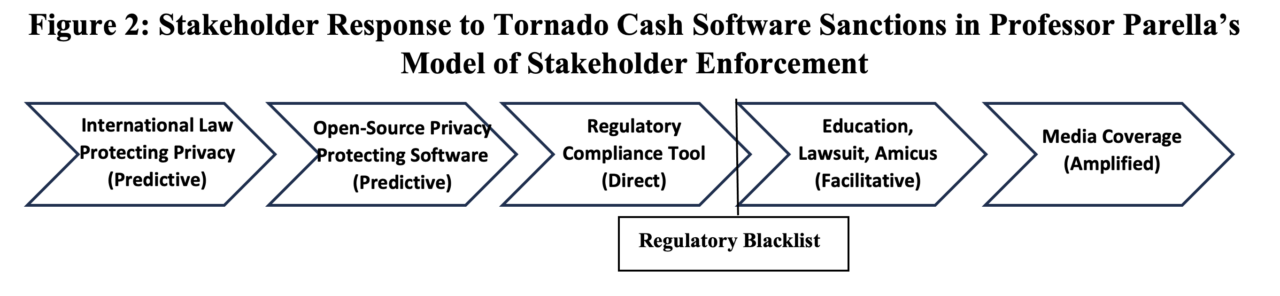
Ultimately, even though the specific actors and the mechanisms of action at their disposal differ significantly from those of traditional corporate stakeholders, they exert pressure through functionally equivalent enforcement activity. Professor Parella explains that corporate stakeholders undertake four forms of enforcement activity: direct, predicative, facilitative, and amplification (Parella, pp. 323-32), and that they do so in order “to change the: (i) preference of corporate actors to comply with international law, (ii) preferences of other corporate stakeholders to enforce international law, or both.” (Parella, pp. 323) Decentralized entity stakeholders also engage in these four forms of enforcement activity, but they do so to effect entirely different reputational, strategic and operational goals. Two very different examples of how this plays out in the era of decentralized entities can be found in DBE stakeholders’ private enforcement against the LCX exchange hacker and DBE stakeholders’ efforts to call the U.S. government to account for violation of privacy and free speech rights in the context of the Tornado Cash software.

In January 2022, the cryptocurrency exchange LCX suffered a loss of around $8 million from what is commonly referred to as a “hot” wallet. The term “wallet” refers to software that holds private keys that allow a user to transact in cryptocurrency, and a “hot wallet” refers to an Internet-connected wallet in which keys are readily accessible. Using algorithmic forensic analysis, LCX traced the stollen funds to various wallets belonging to the hacker. Once identified, monitoring entities such as Etherscan and Elliptic marked and flagged the wallets to enable further monitoring of transactions initiated from those wallets—effectively blacklisting the wallets. Further, some of the stollen funds ended up in wallets connected to technology operated by Circle Financial Services, a financial technology provider that froze the stolen funds until LCX could further recover them through additional legal process. Finally, LCX pursued legal action against the hackers in a New York District Court, serving them on-chain with the first ever NFT legal process airdrop. The media later amplified the actions of these many cryptocurrency stakeholders to recover the stolen cryptocurrency via on-chain means. The recovery of the LCX funds not only reflects an innovative combination of law and technology, but also serves as an example of Professor Parella’s stakeholder framework for enforcement of legal norms at work in a blockchain context.

Notably, the LCX exchange is a centralized entity, and not a DBE, but the example shows how such an entity used technology—both decentralized and centralized—and engaged with the stakeholders in the technology community to privately enforce laws prohibiting theft against a hacker that sought to hide legal violations behind a veil of decentralized technology.

In a separate context all together, a DBE offered individuals protection against perceived government overreach. The Tornado Cash open-source software offered a technology-enhanced path for protecting financial privacy in the digital era. The existence of the software acted as a form of predictive enforcement of international legal norms that declare privacy as a fundamental right. The software even provided a regulatory compliance tool to incentivize direct private enforcement of competing regulatory regimes. When a regulator blacklisted the software and effectively quashed the privacy-enhancing tool, NGOs produced educational reports and offered congressional testimony, users filed lawsuits, and industry organizations filed amicus briefs—all serving a facilitative function even as media amplified the issue. Although the blacklist remains in place for now, the collective effort of the DBE stakeholders led to a national debate about the extent to which the current trajectory of law upholds international legal norms that preserve the right to privacy, and invited a reevaluation of what privacy means in the decentralized digital era.

In considering why corporations obey international law, Professor Parella frames the question as “why do corporate managers comply with international law?” (Parella, pp. 332) DBEs, however, typically do not feature a board of directors or managers per se—not having them is a big part of the point of using the DBE form to coordinate productive activity. So, the question becomes: what will motivate the various DBE stakeholders to build sufficient consensus to enforce international legal norms via the enforcement mechanisms available to them? In other words, DBE stakeholders enjoy more direct input into compliance questions than their corporate stakeholder counterparts. To date, DBE stakeholders, including actors at each layer of the blockchain technology stack, are motivated to protect the fundamental rights that form the very fabric of the community and the technology the community built—sometimes to enforce law against individual bad actors, and sometimes to combat illegal enforcement of law by the state itself.

Conclusion

One of the key contributions that may emerge from applying Professor Parella’s typology of stakeholders and enforcement mechanisms to decentralized entities lies in the pervasively disruptive nature of the ethos that permeates the underlying technology. One of the core motivators for decentralized, encrypted, and open-source technology use derives from a desire to claw-back core rights from perceived government overreach. If the Tornado Cash fight is about anything, it is not money laundering. At its core, the fight over the Tornado Cash software is a fight to claw-back privacy rights that have been eroded in an era of infinite digital intermediation. Decentralized blockchain technology itself stands as a call to reclaim personal autonomy and individual freedom—key norms in international law.

In the era of decentralized entities, stakeholder mechanisms convert a decentralized entity’s alleged violation of certain domestic and international legal norms (such as the theft in the LCX hack or individual privacy in the case of the Tornado Cash software) into reputational, strategic and operational goals that incentivize stakeholders to examine whether the state complies with international law and, indeed, questions whether the legal rules themselves actually uphold international norms. The decentralized era is not about enforcing international law in a boardroom; it is about empowering users—individuals—to claw-back rights on their own terms. Ultimately, then, even as private actors work to govern decentralized entities in ways that align with international and domestic laws, decentralized entities seek to hold states themselves accountable to international legal norms. In other words, decentralized entities are intuitively flipping the script of international law enforcement through stakeholders from “provid[ing] important incentives for corporate actors to comply with international law” (Parella, pp. 340) to “empowering entities and individuals to internalize norms that states must respect.”


[1] Arvind Narayanan Et Al., Bitcoin and Cryptocurrency Technologies: A Comprehensive Introduction 171 (2016) (discussing that protocol developers “can urge the community on, but they don’t have the formal power to force people to follow them if they take the system in a technical direction that the community doesn’t like.”).

[2] Id. at 68-71 (explaining the role of Simplified Payment Verification (SPV) and fully validating nodes (including miners) in blockchain protocols for validating transactions and providing data processing services).

[3] Table 1 is an adaptation of Table 1: Stakeholder Enforcement Strategies in Parella, p. 322. It has been adapted to show the functional equivalence of stakeholders in the decentralized entity context to corporate stakeholders.


[hr gap=”1″]

*Carla L. Reyes. Associate Professor of Law, Southern Methodist University Dedman School of Law; Faculty, Institute for Cryptocurrency and Contracts (IC3); Research Associate, University College London Blockchain Research Centre; Affiliated Faculty, Indiana University Bloomington Ostrom Workshop on Internet Governance and Cybersecurity.

I would like to thank Professor Kishanthi Parella for her brilliant work and the invitation to respond to it in the context of my area of expertise. I also want to thank the Harvard Journal of International Law editors for making this symposium possible.

Cover image credit 

Online Scholarship, Parella Symposium, Perspectives

Pushing the Boulder: Engaging Social Media Companies in Atrocity Prevention

Editor’s Note: This article is part of a four-piece symposium that examines Kishanthi Parella’s work, “Enforcing International Law Against Corporations: A Stakeholder Management Approach,” featured in Volume 65(2) of the HILJ Print Journal.

Shannon Raj Singh

Any credible discussion on the future of the social media industry must reckon with its history of spectacular failures. Chief among those are the instances where social media has fueled or contributed to the commission of mass atrocities around the world. A wealth of examples is on the tip of our tongues: Leaked Facebook documents betray internal warnings that the company was not doing enough to prevent spiraling ethnic violence in Ethiopia, inaction that is now the subject of litigation in Kenyan courts. The Taliban deftly navigated Twitter’s content moderation rules to spread propaganda amidst its takeover of Afghanistan in 2021, in an effort to add a veneer of legitimacy to a brutal and oppressive regime. And in the sprawling refugee camps of Cox’s Bazar, Bangladesh, close to one million Rohingya remain displaced after unrestrained hate speech on social media played a significant role in inciting ethnic violence in neighboring Myanmar.

But amidst the rubble, we can find evidence of surprising successes, too—moments when social media companies have acted in broad alignment with international legal frameworks and standards on the prevention and punishment of mass atrocities. In select cases, platforms have agreed to share data that could be used to investigate and prosecute mass atrocities, or have acted rapidly to modify their products or policies to prevent them from contributing to atrocity crimes. In the context of Afghanistan, for example, Facebook released an innovative feature aimed at civilian protection: its “locked profile” feature allowed Afghan civilians to rapidly lock down their privacy settings to prevent information on their profiles from being used to target them in a rapidly devolving security situation. Amidst the Russian invasion of Ukraine, Twitter released a content moderation policy prohibiting depictions of prisoners of war, specifically referencing alignment with the Geneva Conventions. In several instances, platforms have developed war rooms and operations centers to respond to emerging dangers posed by their products in conflict and crisis settings. And at various points over the past few years, platforms have released human rights policies, hired human rights teams, and invested in human rights impact assessments to address risks related to their products, policies, and operations. Certainly, these initiatives can help buttress platforms’ reputations as they are being otherwise battered for their failures in conflict settings. But calling them mere PR stunts may obscure the investment, time, and effort of those working to steer platforms toward international law in moments of atrocity risk. What accounts for these bright spots, and how can we replicate them?

Kishanthi Parella’s article, Enforcing International Law Against Corporations: A Stakeholder Management Approach, illuminates how international law is at work in the private sector in “non-obvious ways” (Parella, p. 338). Nowhere is this more true than in the realm of social media, where platforms developed and operated by the private sector play a central role in modern political dialogue, breaking news, armed conflicts, demonstrations, revolutions, and social movements the world over.

Parella’s article offers a thorough landscape assessment of how various stakeholders interact with one another to inform and influence corporate conduct. In her conception, corporate stakeholders—ranging from states to consumers, shareholders, employees, benchmarking organizations, civil society organizations, and others—use an array of strategies to serve as modern enforcers of international law in the private sector. Its core contribution lies in both recognizing the aggregate effect of stakeholder actions as a form of international law enforcement, and mapping their enforcement strategies onto a typology so this work can be done more intentionally going forward.

Although it would seem to apply to a range of issue areas governed by international law, a stakeholder management framework may offer particular promise in pushing social media companies to better align with international legal frameworks relating to atrocity crimes: namely, genocide, crimes against humanity, and war crimes. While these legal frameworks face widespread enforcement challenges in courts of law, they may derive particular power in the corporate context specifically because they relate to the gravest crimes on earth. Indeed, the ability of mass atrocities to shock our collective conscience may well serve stakeholders’ ability to convert corporate violations of international law into reputational, strategic, and operational risks that can incentivize action and change.

There are legal frameworks regarding the role of corporate actors in mass atrocities, but they are notoriously difficult to enforce. While individuals (including corporate executives) can be prosecuted in either domestic or international legal systems for the commission of genocide, war crimes, and crimes against humanity, the Rome Statute does not provide for the prosecution of legal persons before the International Criminal Court. And despite a series of legal efforts that have sought to hold corporations to account for their role in atrocity crimes, enforcement is plainly the exception, not the rule. Indeed, asserting that social media companies should be held responsible for the dissemination of content, posted by an array of actors that can in the aggregate contribute to mass atrocities, can make for a challenging legal argument. Although the law certainly imposes responsibilities in this space, neither violations nor causations are easy to prove.

We must also distinguish obligations to prevent mass atrocities from obligations restraining actors from contributing to their commission. States, for example, are not only prohibited from committing mass atrocities, but also are obligated to help prevent them. These state obligations to prevent derive from distinct legal sources: the 1948 Convention on the Prevention and Punishment of the Crime of Genocide, for example, holds states to a due diligence standard that requires them to act according to their capacity to influence a situation at risk of genocide, wherever it occurs. Common Article 1 of the Geneva Conventions imposes a similar obligation for war crimes, obligating High Contracting Parties to both “respect and ensure respect” for the Conventions — meaning states must not only refrain from committing war crimes themselves, but are also obligated to take measures within their power to prevent war crimes by other states.

But there is no question that these treaties bind states, and not social media companies. And while the UN Guiding Principles on Business and Human Rights—widely recognized as the authoritative global framework on corporate obligations relating to human rights—requires companies to “[a]void causing or contributing to adverse human rights impacts through their own activities, and . . . [s]eek to prevent or mitigate adverse human rights impacts that are directly linked to their operations, products or services,” their nonbinding nature presents significant roadblocks to consistent enforcement.

Amidst these legal obstacles, and in an age where social media companies wield as much influence—if not more—over the risk of mass atrocities as many states, how can we encourage platforms to act more responsibly in atrocity risk settings? And what promise does a stakeholder engagement model hold for encouraging social media companies to reflect and uphold norms relating to mass atrocities?

Although Parella’s model of stakeholder management anticipates many of the core players in the social media context (such as shareholders, employees, civil society organizations, and states), it perhaps fails to adequately capture the unique nature of the social media user. As powerfully stated by technology ethicist Tristan Harris, social media users are simultaneously the “consumers” and the “products.” User data is packaged and sold to drive profit through a business model premised on targeted advertisement, rendering individuals both consumers of social media platforms and part of what is being sold. In addition, unlike most industries within the private sector, social media stands apart because the range of relevant “consumer” stakeholders encompasses literally billions of people. Meta has acknowledged this challenge explicitly, noting that its “stakeholder base includes every person or organization that may be impacted by [its] policies,” while being clear that it “can’t meaningfully engage with billions of people.”

So while stakeholder engagement in other sectors brings to mind outreach to a set of fairly clear-cut communities, social media tests the boundaries of what the category of “stakeholder” even means. In the mining industry, for example, stakeholder management may be premised on engagement with local communities directly affected by the sourcing of minerals, vendors throughout the supply chain, and a set of downstream consumers. But in the realm of social media, both every individual who has a social media account and every individual who may be affected by developments on social media platforms are veritable stakeholders of this industry. Social media has become so central to democratic processes, to peace, stability, and the risk of armed conflict, that it is difficult to envision who would not want to have the ability to shape its development and governance. Who, among us, is not a stakeholder in the way that our modern “public squares” organize, amplify, censor, and present purported information?

But as Parella recognizes, not all stakeholders have equal power. The sheer volume of social media stakeholders dilutes individual power, a fact which implicitly suggests the potential for stakeholder alliances to shift corporate conduct. Should those billions of stakeholders organize into meaningful blocs or groups that can articulate risks related to atrocity prevention, imagine the aggregate power they could wield to influence platform resourcing and decision-making. The fact that a stakeholder management model makes this so evident is valuable in itself—but it does not necessarily provide a ready answer to the modalities of “managing” such an extraordinary volume of stakeholders. In the social media industry in particular, this warrants further consideration.

At the same time, a stakeholder management model can be illuminating in demonstrating the array of enforcement opportunities open to actors in the social media space. One such actor—and a unique stakeholder with little direct precedent—is the Oversight Board. Established by Meta in 2020, the Oversight Board is mandated to make principled, independent decisions on selected cases about how digital content is handled by Facebook and Instagram, and now Threads as well. While created by Meta, the Board is funded by an independent trust (funded by Meta), and, pursuant to its Charter, Board members exercise independent judgment on Meta’s decisions and operations.

While skepticism about its ability to drive long-term change has been plentiful, the good news is that, from the outset, the Oversight Board seems to have accepted the relevance of international law as a core part of its mandate. Its decisions on cases selected for review regularly reference international law, including the Geneva Conventions, the International Covenant on Civil and Political Rights, Human Rights Committee jurisprudence, and the UN Guiding Principles on Business and Human Rights. In a world where the international legal community has largely failed to effectively wield the law as a sanction for social media companies’ conduct in conflict zones, the Oversight Board is “augment[ing] the architecture of international institutions that detect and punish violations of international law” (Parella, p. 341).

To date, the Oversight Board has (consciously or unconsciously) engaged in a range of strategies to enforce international law. Some of its work can be considered predicative enforcement: conduct that does not directly engage a corporation but creates the conditions for another stakeholder to do so. In 2021, for example, the Board issued a decision recommending that Facebook “[m]ake clear in its corporate human rights policy how it collects, preserves and, where appropriate, shares information to assist in investigation and potential prosecution of grave violations of international criminal, human rights and humanitarian law.” Serving a somewhat similar (if more toothless) function to mandated disclosure laws, its calls for transparency can push Meta to share information that it might not otherwise disclose, providing a foundation for other stakeholders to directly engage the platform on policies and practices that impact the prevention and punishment of mass atrocities.

The Oversight Board can also engage in action that “magnifies the impact of action taken by other stakeholders” (Parella, p. 329). This “amplified enforcement” (Parella, p. 329) strategy can play an important role in raising the magnitude of a risk for Meta, drawing attention to its actions in atrocity risk settings. Among other avenues, this can occur through the use of the Oversight Board’s “agenda-setting” function (Parella, p. 330) to influence the risks that a platform faces because of its conduct in atrocity risk settings. In December 2023, for example, the Oversight Board announced that it would be reviewing a case related to content depicting the apparent aftermath of a strike on a yard outside Al-Shifa Hospital in Gaza City. The content—which was removed by Meta—depicted “people, including children, injured or dead, lying on the ground and/or crying,” while a caption in Arabic and English suggested the hospital was targeted by Israeli forces. Strikingly, Meta reversed its decision—restoring the post to the platform—not because the Board asked it to, but simply upon learning the Board had taken up the case. In this case, through its agenda alone, the Oversight Board influenced Meta’s actions, causing it to reassess its decision to remove content documenting purported atrocities. This is particularly powerful where the removed content at issue is intended to raise public awareness of the risk of mass violence. To the extent that the media also then picks up on the Oversight Board’s decisions, its enforcement function can be amplified further.

But perhaps most impactfully, the Oversight Board’s decisions on cases—akin to court decisions in some ways—can be regarded as direct enforcement of international law. In a decision on digital content threatening violence in Ethiopia, for example, the Board found that “Meta has a human rights responsibility to establish a principled, transparent system for moderating content in conflict zones to reduce the risk of its platforms being used to incite violence or violations of international law. It must do more to meet that responsibility.” Although other stakeholders may build upon the Oversight Board’s decisions, these decisions are themselves a form of direct engagement with Meta. They often contain recommendations that go well beyond addressing how the platform should respond to an individual piece of content, calling for systemic change in how the platform responds to human rights risks in similar settings. In the Ethiopia decision, for example, the Oversight Board called on Facebook to both “publish information on its Crisis Policy Protocol,” and to “assess the feasibility of establishing a sustained internal mechanism that provides it with the expertise, capacity and coordination required to review and respond to content effectively for the duration of a conflict.”

It is not only significant that stakeholders such as the Oversight Board are calling for changed policies and practices from social media companies in atrocity risk settings—they are also invoking platforms’ international legal responsibilities in the process. Make no mistake: the Oversight Board warrants recognition as an emerging mechanism for the enforcement of international law, drawing on an array of enforcement strategies outlined in Parella’s model. Where the law does not itself represent a persuasive sanction, stakeholders of social media companies may be able to drive more immediate alignment with international law.

At the same time, it is worth bearing in mind Evelyn Douek’s prescient warning that “[t]he indeterminacy of [international human rights law] creates room for its co-optation by platforms, rather than their being constrained by it.” Certainly, the same could be said for legal frameworks relating to mass atrocities. Preventive obligations remain largely undefined even for state actors, and accountability for complicity in the commission of mass atrocities is pursued for only the smallest subset of responsible actors. We do not want social media platforms adopting the “language” of atrocity prevention unless it is accompanied by meaningful conduct to prevent and mitigate atrocity risks. Stakeholder engagement can help here too, but will need to ensure that advocacy is tied to the tracking and monitoring of data-driven indicators of progress by platforms operating in atrocity risk settings.

Perhaps the greatest benefit of a stakeholder engagement model is that it nods to our collective agency and responsibility in shaping a sector that is notoriously opaque. There is much to be said for the noble efforts of trust and safety professionals working to change social media companies from within—the wins referenced above could surely not have occurred without their work and expertise. But we must not forget that we find ourselves today in the midst of a “human rights recession,” a trend that extends to the tech industry. Amidst mass layoffs of teams focused on human rights, trust and safety, and election integrity, Parella’s framework offers us a necessary roadmap for the way forward. There will always be power in identifying opportunities to prosecute and punish those who contribute to atrocity crimes—natural persons and legal persons alike. But in the meantime, a stakeholder engagement model helps us conceptualize how those both inside and outside social media companies can steer platforms toward more responsible conduct in atrocity risk settings, in the moments it matters most.


[hr gap=”1″]

Cover image credit 

Online Scholarship, Parella Symposium, Perspectives

Climate Change and Stakeholder Enforcement of International Law Against Corporations

Editor’s Note: This article is part of a four-piece symposium that examines Kishanthi Parella’s work, “Enforcing International Law Against Corporations: A Stakeholder Management Approach,” featured in Volume 65(2) of the HILJ Print Journal.

*Carol Liao

Introduction

Climate change is an intractable, “wicked” problem, in that it resists definition and conventional solutions. Its global effects are systemic and interconnected, acting as a risk multiplier with political, economic, and social ramifications that have the ability to destabilize civilizations. Interwoven in the wicked problem of climate change is the difficulty of curtailing unsustainable and irresponsible corporate behavior, which is hastening the warming of our world. Concern over the drastically changing climate is nothing new, but pressure on corporate actors to proactively address climate change has never been more vital in holding the increase in global average temperatures to “well below 2 °C above pre-industrial levels and pursuing efforts to limit the temperature increase to 1.5 °C” as set out by the Paris Agreement. Given the transnational harms and importance of international collaboration across jurisdictions and industries, meaningful corporate accountability is needed to reduce greenhouse gas (GHG) emissions in the transition away from fossil fuels toward renewable energy systems, and help resolve the seemingly unresolvable question of climate change.

Kishanthi Parella’s formidable work, Enforcing International Law Against Corporations: A Stakeholder Management Approach, points out that international law can guide corporate managers on how to meet demands for more responsible business practices and address the complex reality of climate change, yet many crises occur because corporations fail to follow international law. As Parella notes, the problem lies in enforcement—the international legal order lacks adequate mechanisms to ensure compliance. It is in that vein, and in the application of Parella’s stakeholder management approach to international law, where one can consider how to incentivize corporations to align their behavior to conform to stakeholder expectations and address gaps in their international legal obligations.

This Article explores Parella’s stakeholder management framework specifically in the context of climate change. First, I provide a very brief history of major developments in climate change–related international legal instruments. Then, I apply Parella’s framework to shifting legalities in corporate climate accountability, reflecting upon how international legal obligations are channeled into mechanisms with localized teeth via various stakeholders. Specifically, I consider the “tidal wave” of climate-related litigation against the backdrop of international legal obligations. Using Parella’s typology of enforcement, I highlight how direct enforcement by stakeholder litigants against states and corporate actors, driven by international law and norms, incentivizes further predicative enforcement (creating conditions for another stakeholder to enforce), facilitative enforcement (limiting actions that could disrupt another stakeholder’s ability to enforce), direct enforcement, and amplified enforcement by other stakeholders. These behaviors induce an interactive process that aims to institutionalize climate governance norms while also pulling jurisdictions toward globalized standards of corporate regulation. I conclude with a comment on the urgency of further advancing corporate accountability across jurisdictions.

I. International Legal Frameworks to Address Climate Change

A web of international legal frameworks to tackle climate change has emerged over time—with progress and integration developing in fits and spurts. The Intergovernmental Panel on Climate Change (IPCC) was first established in 1988 by the United Nations (UN) General Assembly, tasked with researching the science of climate change and creating assessment reports detailing its effects and risks. In 1992, the United Nations Conference on Environment and Development built upon the two-decades-old Declaration of the United Nations Conference on the Human Environment to draft the Rio Declaration and 27 Principles (known as the Rio Principles) meant to guide the behavior of nations toward more environmentally sustainable patterns of development. Notable in these principles were Principle 1—stating that “[h]uman beings are . . . entitled to a healthy and productive life in harmony with nature”—and Principle 15, a precautionary principle which held that “[w]here there are threats of serious or irreversible damage, lack of full scientific certainty shall not be used as a reason for postponing cost-effective measures to prevent environmental degradation.” A key achievement stemming from the conference was the establishment of the UN Framework Convention on Climate Change (UNFCCC) and later, the Kyoto Protocol.

The implementation of the UNFCCC as a treaty is monitored by the Conference of the Parties (COP), providing a general framework with the main priority being the “stabilization of greenhouse gas concentrations in the atmosphere at a level that would prevent dangerous anthropogenic interference with the climate system.” The UNFCCC is guided by principles of equity in demanding “differentiated responsibilities” based on each country’s respective capabilities. The Kyoto Protocol, adopted at COP3 in 1997, set specific emissions reduction targets for developed countries, subject to an aggregate target flowing from this principle of equity. The Kyoto Protocol was then followed by the 2010 Cancun Agreements at COP16, and the 2012 Doha Amendment at COP18, which set the goal of reducing GHG emissions by 18% compared to 1990 levels for participating countries during the Kyoto Protocol’s second commitment period of 2013-2020.

These international treaties and agreements focused on states, but in 2008, the UN endorsed the “Protect, Respect and Remedy Framework” for business and human rights, which culminated in the UN Guiding Principles on Business and Human Rights (UNGP) adopted in 2011. The UNGP outlines state responsibilities in promoting and protecting human rights, including the duty of states to enact effective laws and regulations to prevent and address business-related human rights abuses, and to ensure access to effective remedies for those whose rights have been abused. The UNGP also specifically addresses the human rights responsibilities of businesses, establishing an overarching framework under which corporations have the responsibility to respect human rights wherever they operate and regardless of their size or industry. This responsibility includes requiring companies to know their actual or potential impacts, prevent and mitigate abuses, and address adverse impacts with which they are involved.

Four years after the UNGP, the UN Sustainable Development Goals (UNSDGs) were established, providing a “shared blueprint for peace and prosperity for people and the planet” with 17 goals emphasizing the interconnected environmental, social, and economic aspects of sustainable development. Goal 13 specifically addresses climate action, mandating that countries “[t]ake urgent action to combat climate change and its impacts.”

In 2016, the Paris Agreement—a binding international treaty established under the UNFCCC framework focused on limiting global temperature increases—came into force. Under the Paris Agreement, accountability is monitored through various structures including a transparency system, a global stocktake process, and recurring five-year assessments. As the intertwining of climate change and human rights grew ever more apparent, the UN Working Group on the issue of human rights and transnational corporations and other business enterprises issued its Information Note on Climate Change and the Guiding Principles on Business and Human Rights in June 2023. Its aim was to assist states and corporate actors in integrating climate change impacts with human rights–related impacts caused by, contributed to, or linked with business activities.

II. Direct Stakeholder Enforcement Through the Lens of Climate Change Litigation

As Parella notes, international law compliance is best guaranteed by the “institutionalization of international law norms”—in other words, internalization socially, politically, and legally. But since international tools do not bind corporations directly, Parella stresses that internalization is the product of interactive processes that occur between both states and nonstate actors, at both the domestic and institutional levels in a variety of fora. Thus, to answer the question of “How do we convince corporate leaders to comply with international law when they may not be bound to do so?”—one answer is that we must convince a particular group of intermediaries (stakeholders) with influence over corporate actors.

Part and parcel of the wicked problem of climate change is that it involves many different stakeholders who have different conceptions of the problem and its ideal solutions. Parella notes that judicial processes may or may not play a central role in the interactive processes that lead to internalization by a state. In climate change, the role of the judiciary in certain jurisdictions has become a fulcrum in establishing international norms as legally binding precedent. In this sense, “[c]limate change profoundly modifies these ancient premises and rattles judges’ comfort zones,” as Justice Antonio Herman Benjamin of the National High Court of Brazil noted in 2020.

International private climate litigation in the past few decades has played a role in shaping corporate behavior with regard to climate change and international law. The relative pace at which climate and human rights litigation has arisen throughout the world is rather remarkable. Across sixty-five jurisdictions around the world including the Netherlands, the United States, the Philippines, Canada, and Switzerland, municipalities, nongovernmental organizations (NGOs), private citizens, and other stakeholders have sued—or threatened to sue—corporations, industries and governments for the environmental and social harms they have inflicted on communities. Advancements in climate attribution science have strengthened tort-based claims, and new corporate legal claims are appearing regarding misleading disclosure of climate change risks and breaches of directors’ duties to identify and manage these risks. These latter claims differ from tort-based claims aimed at redressing past harms in that corporate statutory legal obligations are forward-looking predicative enforcements, tilting the pressure on corporations to change their ongoing governance behavior in relation to climate change, human rights, and potentially other areas related to the UNSDGs.

The landmark 2019 case of Urgenda Foundation v. The State of the Netherlands [Urgenda] involved a claim brought against a state, yet it laid much of the groundwork for climate litigation against private corporate entities. Urgenda is the first case in the world where a court has held that its government has a legal duty to accelerate its response to climate change in order to protect human rights. In the case brought by the plaintiff NGO, Urgenda Foundation, the Dutch Supreme Court recognized that global warming is caused by increased GHGs emitted into the atmosphere, which can be prevented, and that events associated with climate change are foreseeable. In making this decision, the court relied on the climate scientific reports of the IPCC, UNFCCC, and targets set by the Paris Agreement, as well as principles of international environmental law and other forms of soft law. The court found that the Dutch government owed a duty of care to protect its citizens from climate change under Dutch civil law and that it is required to take action to reduce its GHG emissions by at least 25% by the end of 2020 as compared to 1990 levels.

The reasoning in Urgenda has been instructive for corporate climate litigation claims. The case provided evidentiary weight and authority to climate attribution science and to methodologies that use this climate attribution science to calculate the emissions of a particular entity and the reductions required for it to meet its obligations. The court rejected the defense put forth by the Dutch government that its GHG emissions were relatively low on a global scale, even noting that such an argument would mean many could easily evade responsibility by simply pointing to worse actors. Regardless of how small a state’s share of emissions are on a global scale, the court found that the government still has an obligation to do its part to reduce its output of GHG emissions.

Additionally, the Urgenda court employed the “reflex effect” as its interpretative standard to determine the scope of the state’s duty of care and its discretionary power—meaning a standard that considers international obligations and principles when interpreting open standards in national laws. While the international obligations imposed by the UNFCCC and the Kyoto Protocol are binding on the state, these obligations only extend to situations where other states may bring claims against the Netherlands for cross-border harm due to emissions trading. Private citizens such as the Urgenda Foundation cannot find a right of action based on such international obligations. Nevertheless, under Dutch law, international obligations contribute to standards of national law, and the state can be presumed to be following international obligations. In this way, international obligation is said to have a “reflex effect” on national law, and the court applied this analysis to provisions not directly applicable to citizens.

The reflex effect in Urgenda echoes the modes of internalization that Parella outlines in her approach, involving interactive processes between states and nonstate actors that integrate international law domestically. Courts involved in climate change litigation may and likely will employ more generous interpretations of their domestic law doctrines of duty of care. The recently decided 2024 case of Verein KlimaSeniorinnen Schweiz and Others v. Switzerland [KlimaSeniorinnen] serves as evidence of this. In KlimaSeniorinnen, an appeal from the Federal Supreme Court of Switzerland (FSC), the European Court of Human Rights (ECtHR) reversed the FSC’s decision and found that the Swiss government violated the human rights of its citizens by taking insufficient action to combat climate change. This was so because the ECtHR found that Article 8 of the European Convention of Human Rights imposed a positive obligation to put in place relevant legislative and administrative frameworks to provide effective protection of human health and life; this obligation manifested primarily as a “duty . . . to adopt, and to effectively apply in practice, regulations and measures capable of mitigating the existing and potentially irreversible, future effects of climate change.” In the case, the ECtHR repeatedly cited Urgenda, and relied on many of the same international documents, to the same effect, as the Dutch Supreme Court did in Urgenda; importantly, the duty of care reasoning in KlimaSeniorinnen is largely consonant with that of Urgenda.

Thus, Urgenda has direct and amplified enforcement effects on subsequent litigation, as well as predicative and facilitative enforcement of future corporate behavior aimed at mitigating the risk of litigation. Parella’s observations on stakeholder enforcement are significant here. Between 1986 and 2014, 834 climate-related cases were recorded, but since Urgenda and as of June 2024, there are now 2,666 climate change cases filed around the world. In 2023, 40% of cases filed outside of the US named a corporation as a defendant. Landmark cases are increasingly altering the global legal landscape, and perhaps in a continual iterative and/or responsive process between the courts and governments, to date more than 170 countries have introduced national policies and laws on climate change mitigation and adaptation.

Indeed, the case of Milieudefensie et al. v. Royal Dutch Shell plc. [Shell], initiated in 2019, extended the principles from Urgenda to corporations. The NGO Milieudefensie, along with 17,379 co-claimants and six other NGOs, brought proceedings against Shell plc along the same lines as Urgenda, alleging that Shell plc’s contributions to climate change violated its duty of care under Dutch civil law informed by climate conventions and the European Convention for Human Rights. The Paris Agreement played a relevant role in the case, even though the defendant Shell plc, as a nonstate actor, was not a signatory to the agreement. These claimants sought an order from the District Court in The Hague, obligating Shell plc to reduce its GHG emissions associated with its business activities and energy products by at least 45% by 2030, 72% by 2040, and 100% by 2050, as compared to its 2010 emissions, in accordance with the Paris Agreement. The case also specifically referenced the UNGPs and OECD Guidelines for Multinational Enterprises—arguably crystallizing those international soft laws into hard law.

In May 2021, the court ordered Shell plc to reduce carbon dioxide emissions resulting from its operations by a net 45% in 2030, relative to 2019 levels. Shell demonstrates the tort liability that corporations may face not only for emitting GHGs that cause climate change, but also for failing to proactively mitigate climate change in their business activities.

Decisions such as Urgenda and Shell demonstrate that international treaties such as the Kyoto Protocol and Paris Agreement can serve—and have served—as a basis for plaintiffs to argue that states and corporations are violating international obligations.

Similarly, customary international law may influence domestic law. For example, in the landmark ruling of Nevsun Resources Ltd. v Araya [Nevsun], the Supreme Court of Canada affirmed that customary international law forms a part of Canadian common law via the doctrine of adoption, absent conflicting legislation, and that claims alleging breaches of jus cogens (a type of customary international law) can be brought under Canadian common law. Nevsun also determined that customary international law relating to human rights breaches can be applicable to private actors such as corporations, because human rights law has a unique, human-centric nature, primarily concerns individuals, and exists beyond state-to-state relationships. As climate litigation continues to focus on its connection with human rights, and as international legal obligations begin to reflect on these integrated issues, customary international law may increasingly play a role across jurisdictions. These cases also motivate director and officer insurers to improve their monitoring of insured companies’ climate governance.

These international climate cases demonstrate the wide potential range of stakeholders that could bring claims against corporations. Governments, for instance—who are typically defendants in public climate litigation—have an interest in bringing claims against corporations for causing climate-related harms. In the United States, for example, there has been a recent wave of litigation by state and local governments against companies and corporations for climate-related harms. Recently, in City and County of Honolulu, Hawaii v. Sunoco LP [Sunoco], the Supreme Court of Hawaii decided that tort claims brought by the City and County of Honolulu against several oil and gas producers, for allegedly misleading the public about climate-related risks and environmental impact associated with using fossil fuels, could proceed to trial. The defendants are now seeking review at the Supreme Court of the United States.

Municipalities and local governments are most likely to bear the cost of infrastructure to respond to rising sea levels, increased cross-border migration, and other climate-related events and social harms. Enforcement power is dynamic, notes Parella, and “its attributes may be gained or lost.” Thus, “stakeholders can compensate for their own lack of critical attributes by allying with other stakeholders who possess the missing attributes.” Ultimately, it may cost corporations more in the long run if they are unprepared for regulatory, reputational, and litigation risks coming at them from multiple fronts.

Furthermore, the failure or withdrawal of a claim does not necessarily indicate that the claim will not impact the corporations’ operations; rather, even unsuccessful litigation can serve several functions including maintaining pressure on fossil fuel companies and other large emitters, keeping sustainability issues alive in the public mind, and sending strong messages to governments that comprehensive legislation is needed because current statutes are inadequate to address climate change, planetary boundaries, and unsustainable business.

Corporations complicit in climate change must weigh the risks of stakeholders taking future action, along with the likelihood of increased legislation in reaction to constituent upheaval in climate inaction. International private climate litigation against corporations has been much more impactful in recent years given the developing body of legal precedent, advancements in climate attribution science, and the wide range of litigation avenues available for different stakeholders to hold corporations accountable. Not only are claimants using litigation to influence the behavior of target corporations, but they are also using this opportunity to call on government regulators to set clear expectations for corporations in relation to corporate disclosure.

Parella’s astute stakeholder management approach helps reveal the processes in which international law finds itself and reverberates within corporate accountability mechanisms. As theorized by Parella, we are witnessing numerous “interactive” processes including new standards being developed in terms of carbon emissions, materiality measures, and climate-related disclosures. The convergence of sustainability standards around the world and development of the Task Force on Climate-Related Financial Disclosures (TCFD) recommendations as a global benchmark for climate-related reporting signal the strong desire to tie corporate climate-disclosure standards to international norms. The formation of a new International Sustainability Standards Board (ISSB), which has been a years-long culmination of the work of the TCFD seeks to develop—in the public interest—a comprehensive global baseline of high-quality sustainability disclosure standards to meet investors’ information needs. The G7’s endorsement of the ISSB and a wide range of powerful stakeholders calling for greater corporate accountability have mainstreamed the international dialogue on climate governance, reflecting changing expectations and demands for new and sustaining relationships to bind our global community.

Conclusion

As Parella notes, legal risk is only part of the story. Stakeholder mechanisms convert a corporation’s violation of international law into reputational, strategic, and operational risks that incentivize corporate actors to comply with international law. Reputational risk is key, and stakeholders help create these risks. Litigation requires corporations to take responsibility for past harms, but to also proactively manage or mitigate sustainability-related risks because corporations occupy a special position of power in society and have the opportunity and capacity to improve the world’s response to this sustainability crisis. As mentioned previously, tort-based climate litigation is largely backward-looking in that claimants are primarily seeking compensation for injuries caused in the past, while corporate law–based litigation is both backward and forward-looking. Claimants using corporate legal mechanisms will not only seek to hold corporations responsible for omitting information or disclosing false or inaccurate information, but will also seek to require corporations to change their future conduct in relation to international norms on climate change.

The IPCC has provided different emissions scenarios based on the planet crossing various temperature thresholds in the future. An optimistic scenario of limiting temperature increases to the guardrails of well below 2°C and preferably 1.5°C as set out in the Paris Agreement, could contain the most catastrophic impacts of climate change. Attaining that goal will require a rapid and substantial reduction in global GHG emissions: net-zero emissions by 2050 or sooner and negative emissions thereafter. Failing that, a 2°C scenario of global warming would mean a profoundly disrupted climate, and a 4.4°C scenario would mean a vastly different world than we know now. It would be catastrophic. In the face of this wicked problem, states and nonstate actors must urgently respond to obligations under international laws to reduce their GHG emissions. Parella’s “norm entrepreneurs”—the stakeholders in this climate crisis—are all of us, with disproportionate harm facing those emitting the least. Stakeholder enforcement of international law in the context of climate change is reaching a critical juncture in history, and these next years will be especially telling.


[hr gap=”1″]

*Dr. Carol Liao is an Associate Professor at the Peter A. Allard School of Law, and the UBC Sauder Distinguished Fellow of the Peter P. Dhillon Centre for Business Ethics, University of British Columbia. She is the Chair of the Canada Climate Law Initiative, a national research center advancing director knowledge on climate governance and fiduciary obligations, and the Co-Director of the UBC Centre for Climate Justice. An internationally respected expert in corporate law and sustainability, Carol has been recognized with the Influential Women in Business Award, BCBusiness Women of the Year Award, TELUS Community Service Award, Canada’s Clean50 Award, and was named as one of Canada’s Top 100 Most Powerful Women and Canada’s Top 25 Most Influential Lawyers. She is a lawyer qualified to practice in New York, and prior to academia was a senior associate at a leading global law firm.

Cover image credit 
Scroll to Top